




Abstract
Background:
Listeriosis, a bacterial disease in humans and animals, is mostly caused by ingestion of Listeria monocytogenes via contaminated food and/or water, or by a zoonotic infection. Globally, listeriosis has in general a low incidence but a high case fatality rate.
Objective:
The objective of this study was to investigate the occurrence, antimicrobial profiles, and genetic relatedness of L. monocytogenes from raw meat and dairy products (raw milk, cottage cheese, cream cake), collected from the capital and five neighboring towns in Ethiopia.
Methods:
Two hundred forty food samples were purchased from July to December 2006 from food vendors, shops, and supermarkets, using a cross-sectional study design. L. monocytogenes were isolated and subjected to molecular serotyping. The genetic relatedness and antimicrobial susceptibility patterns were investigated using pulsed-field gel electrophoresis (PFGE) and minimum inhibitory concentration determinations.
Results:
Of 240 food samples tested, 66 (27.5%) were positive for Listeria species. Of 59 viable isolates, 10 (4.1%) were L. monocytogenes. Nine were serotype 4b and one was 2b. Minimum inhibitory concentration determination and PFGE of the 10 L. monocytogenes isolates showed low occurrence of antimicrobial resistance among eight different PFGE types.
Discussion and Conclusions:
The findings in this study correspond to similar research undertaken in Ethiopia by detecting L. monocytogenes with similar prevalence rates. Public education is crucial as regards the nature of this organism and relevant prevention measures. Moreover, further research in clinical samples should be carried out to estimate the prevalence and carrier rate in humans, and future investigations on foodborne outbreaks must include L. monocytogenes.
Introduction
L
In Ethiopia, few findings of L. monocytogenes have been reported, possibly due to lack of attention or resources (Molla et al., 2004).
The objective was to investigate the occurrence and prevalence of Listeria spp., the antimicrobial resistance, and clonal relatedness among L. monocytogenes in samples of raw meat and dairy products from Addis Ababa and neighboring towns in Ethiopia.
Methods
A cross-sectional study was conducted in 2006 at the Public Health Food Microbiology Laboratory of Ethiopian Health and Nutrition Research Institute (EHNRI), Addis Ababa, Ethiopia.
A total of 240 food samples—all different samples of raw meat, unpasteurized milk, cottage cheese, and cream cake—were purchased randomly from different retail markets, shops, supermarkets, and food vendors in suburbs of Addis Ababa and neighboring towns from July to December 2006.
Samples of 500 g or 500 mL of each food category were purchased and examined according to the standard International Dairy Federation method (IDF, 1990).
Based on biochemical testing, 66 isolates were Listeria spp., of which 59 remained viable after prolonged storage at−20°C in trypticase soy broth (TSB) supplemented with 10% glycerol. The isolates were then subjected to speciation by polymerase chain reaction assay (PCR) (Huang et al., 2007), genotyped by pulsed-field gel electrophoresis (PFGE) (Graves and Swaminathan, 2001), and antimicrobial susceptibility testing for minimum inhibitory concentration (MIC) determination (Aarestrup et al., 2007).
The isolates were identified at the species level utilizing a multiplex PCR previously described (Huang et al., 2007). Modifications to the method included one pair of oligonucleotide primers: 5′-CTCCCACATTGGTGCTACTCA-3′ and 5′-GTTGCTGCGAACTTAACTCA-3′. Amplicon sizes of 453, 373, 609, 420, 465, and 289 bp, respectively, identified each of the species L. monocytogenes, L. seeligeri, L. welshimeri, L. grayi, L. ivanovii, and L. innocua.
The 10 L. monocytogenes isolates were subjected to L. monocytogenes–specific serotyping utilizing a multiplex PCR assay according to Kérouanton et al. (2010). These isolates were genotyped by PFGE using ApaI and AscI with optimization set of 1% (Graves and Swaminathan, 2001). Comparative analysis based on unweighted pair group method using arithmetic averages was performed using Bionumerics software version 4.6 (Applied Maths, Sint-Martens-Latem, Belgium).
MIC determination was performed on the 10 L. monocytogenes isolates using Mueller-Hinton broth supplemented with 5% lysed bovine blood and a dehydrated panel from TREK Diagnostic Systems Ltd. (East Grinstead, England) with an incubation period of 24 h. Antimicrobials and epidemiological cut-off values used were based on guidelines for L. monocytogenes from the European Committee on Antimicrobial Susceptibility Testing (EUCAST) when available (i.e., for erythromycin, penicillin, tetracycline and sulfamethoxazole+trimethoprim). For the remaining antimicrobials—cefoxitin, chloramphenicol, ciprofloxacin, florfenicol, gentamicin, spectinomycin, streptomycin, sulfamethoxazole, tiamulin, and trimethoprim—they were utilized as described (Aarestrup et al., 2007).
Results
Sixty-six (27.5%) of the 240 food samples were positive by conventional culture technique for Listeria spp., and 59 isolates viable after prolonged storage positives were raw meat 62.7%, raw milk 8.5%, cottage cheese 6.8%, and cream-cake samples 22.0%, respectively.
The species-specific PCR revealed that 10 (17%) of the 59 isolates were L. monocytogenes and 49 (83%) isolates belonged to the species innocua. L. monocytogenes was isolated from four (6.8%), two (3.4%), one (1.7%), and three (5.1%) samples of raw meat, raw milk, cottage cheese, and cream cake, respectively. Nine of those belonged to serotype 4b and one (isolated from cream cake) to serotype 2b.
MIC determination of the 10 L. monocytogenes isolates showed low frequency of antimicrobial resistance. Intrinsic resistance to cefoxitin was not considered relevant; only resistance to the following five antimicrobials was observed: ciprofloxacin (n=3), gentamicin (n=1), penicillin (n=1), tiamulin (n=10), and sulfamethoxazole (n=1).
The 10 L. monocytogenes isolates rendered eight different PFGE types. One cluster was identified that contained three indistinguishable isolates, of which two originated from cream cheese sampled at different towns and dates, and one was isolated from raw meat on the same day and town as one of the cream-cake isolates (Fig. 1).
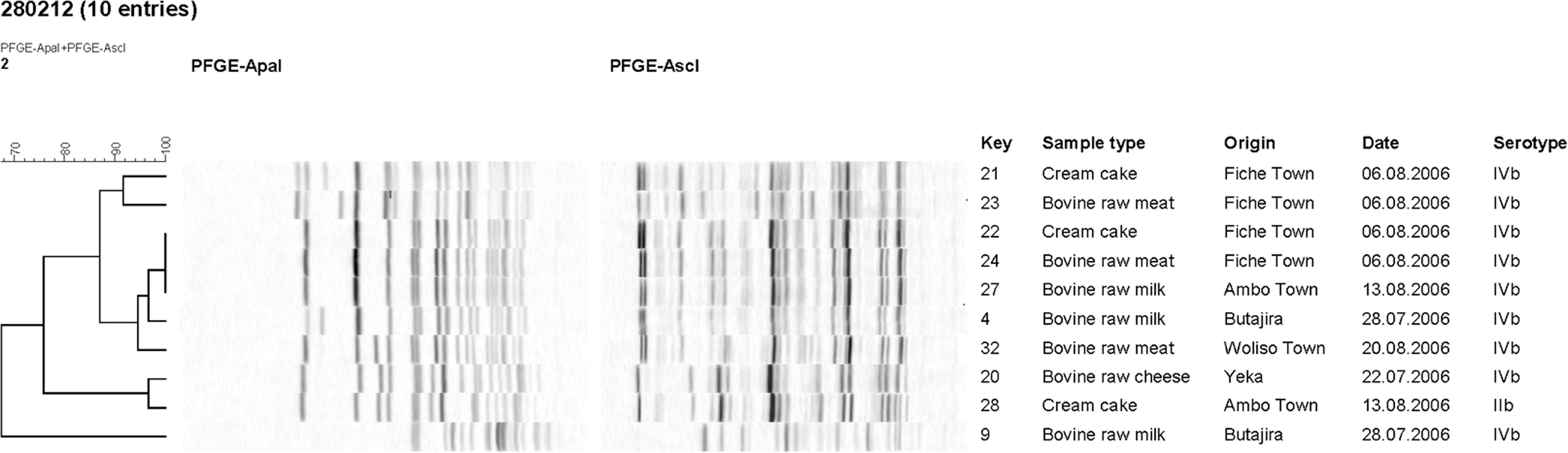
Dendrogram showing the genotypic relatedness among Listeria monocytogenes isolates based on ApaI/AscI pulsed-field gel electrophoresis (PFGE) fingerprints. Similarity value was calculated using the Dice coefficient, and tolerance and optimization were set at 1%. Profiles are grouped together according to the unweighted pair group method using arithmetic averages.
Discussion
This study as well as the previous Ethiopian study by Molla et al. (2004) showed that Listeria species exist in the Ethiopian food production system. Molla et al. (2004) detected all species of Listeria, whereas in this study only L. monocytogenes and L. innocua were found. The reason might relate to the limited number of collected samples. We found L. innocua to be the most predominant species (83%), which is in contrast to what has previously been reported in the United States by Zhang et al. (2007), who observed a prevalence rate of 65% in the same food categories as investigated here. The distribution of L. monocytogenes in indicated food types was compared with other studies, and similar findings were observed (Zhang et al., 2007).
All 10 isolates in this study were resistant to tiamulin, a veterinary-approved antimicrobial usually described as effective against L. monocytogenes for the last few decades. A previous study has already shown high levels of MICs to tiamulin in L. monocytogenes originating from animals (Aarestrup et al., 2007), which contributes to doubting the efficacy of tiamulin against L. monocytogenes. More worrisome is the resistance to gentamicin, which is recommended, in combination with penicillins, as first-line treatment of listeriosis in humans. A similar finding was reported in Botswana by Morobe et al. (2009).
The diversity and cluster observed for the strains 22, 24, and 27 (Fig. 1) suggests a low clonal relatedness among the isolates in contrast to a normally high clonality of the species. Serotypes 4b and 2b isolated here have previously been associated with human foodborne illness (Kathariou, 2002). Unfortunately, it has not been possible to compare the PFGE patterns of serotype 4 in this study with isolates belonging to epidemic clones (Kathariou, 2002).
This study highlights the presence of L. monocytogenes and L. innocua in raw food items from Ethiopia. Considering the risk of contracting listeriosis due to the practice of consuming raw food such as raw meat and unpasteurized and fermented flavored milk, especially in association with poor knowledge of good manufacturing practice and of handling the products, we suggest that the Ethiopian authorities liaise with the World Health Organization to assist the implementation of the technology for an integrated production-to-consumption approach to food safety. Such an approach relies mainly on the hazard analysis and critical control point system and good manufacturing practice (
Footnotes
Acknowledgment
This work was supported by the Ethiopian Health and Nutrition Research Institute, Addis Ababa University, UNIDO, and WHO Global Foodborne Infections Network (
Disclosure Statement
No competing financial interests exist.