




Abstract
Salmonella enterica is a zoonotic pathogen that is often associated with dairy farms. The organism can cause disease in cows but is also frequently shed in large numbers by dairy cows that are asymptomatic. Long-term asymptomatic infections with serotypes Cerro and Kentucky were previously identified in cows on a 100-head dairy farm in Pennsylvania, United States (focal dairy). Milk filters were collected from farms within 30 miles of the focal dairy to determine whether the infections by Cerro and Kentucky were limited to the focal dairy or whether the infection might be more regional in nature. Analysis of milk filters showed that Cerro and Kentucky were widespread in the surrounding region with 16 of 39 farms (41%) positive for one or both serotypes. Pulsed-field gel electrophoresis showed that the milk filter Kentucky strains shared >90% similarity with strains from the focal dairy and from local streams. Although there was more variation between Cerro strains (>80% similarity), most milk filter Cerro isolates from most milk filters were highly similar (>90%) to strains isolated from the focal dairy and local streams. In this intensely dairy-farmed region, Salmonella infection of dairy cows appears to be regional in nature, a fact that will impact efforts to control these pathogens.
Introduction
S
Milk and dairy products have often been implicated as vehicles of transmission of Salmonella from animals to consumers (Oliver et al., 2009; Van Kessel et al., 2011b). Most foodborne outbreaks are due to consumption of nonpasteurized products; however, pasteurized dairy products have also been implicated (Langer et al., 2012). Dairy cows are frequently found to harbor Salmonella enterica, and the organism can cause mild to severe illness in calves and cows; however, asymptomatic shedding of Salmonella by dairy cows is common and may be quite extensive (Callaway et al., 2005; Van Kessel et al., 2007).
We previously described a long-term outbreak of Salmonella enterica on a ∼100-cow dairy farm in Pennsylvania (Van Kessel et al., 2007; Van Kessel et al., 2012). The outbreak serotypes fluctuated between Cerro and Kentucky, which have been continuously isolated from animals on this farm for over 8 years. Shedding prevalence has varied between 8 and 97% of the herd, but there has never been a period when there were no animals shedding Salmonella. The herd is well managed and attempts to reduce the levels of Salmonella on the farm through diet manipulation, sick cow segregation, selective culling, immunization of young stock prior to entering lactating herd, and regular cleaning of water troughs and high-prevalence areas were unsuccessful.
Additionally, no clear external sources of salmonellae could be identified. During this period we also demonstrated that in-line milk filters, used to remove coarse contaminants from the milk before it enters the bulk tank, could be used to monitor shedding of Salmonella enterica within the focal dairy herd (Van Kessel et al., 2008).
The objective of this study was to determine whether other herds in the intense dairy farming area that surrounds this infected farm are also asymptomatically shedding these two Salmonella serotypes.
Materials and Methods
Sample collection
The participating farms (39) were located in one of the top 10 dairy-producing counties in Pennsylvania and were within 28 miles of the focal farm. The assistance of a local veterinary practice was solicited to facilitate communication with producers, and the veterinarians discussed the project with the producers during regular farm visits. Sampling instructions and supplies were left with producers who agreed to participate. The producers were instructed to aseptically collect a filter on each of the 3 consecutive days prior to the next scheduled veterinarian visit. Each filter was placed in a separate, prelabeled bag and refrigerated. The veterinarians collected the filters and shipped them overnight to the laboratory in a cooler with ice packs. Each group of filters received from a farm was considered a set and is hence referred to as such.
Water and sediments were collected from streams surrounding the focal dairy (both upstream and downstream) by submerging stoppered 500-mL Nalgene bottles into the flowing portion of the stream and pulling the stopper. Sediments were stirred up by scraping the bottle on the stream bottom before pulling the stopper. Samples were stored on ice for transport to the laboratory and processed within 24 h of collection.
Salmonella isolation and identification
The filters were processed on the day of arrival, and filters from each set were processed individually. Filters were cut into small (30–50 cm2) pieces and placed in a filtered stomacher bag, diluted (1 to 1 wt/wt) with 1% buffered peptone water and pummeled in an automatic bag mixer (BagMixer® 400W, Interscience, Rockland, MA) for 2 min. The bag was removed from the mixer and, if the filter pieces migrated to the top of the bag during the pummeling, they were repositioned to the bottom of the bag; the bag was pummeled for 2 additional min. For enrichment of Salmonella, 25 mL of filtrate was added to 25 mL of double strength tetrathionate broth (BD Diagnostics, Sparks, MD). Enrichment bottles were incubated at 37°C for 18–24 h after which 10 μL of the broth was streaked onto XLT4 agar (XLT4 agar base with XLT4 supplement, BD Diagnostics, Sparks, MD). Plates were incubated at 37°C and examined at 24 and 48 h for presumptive Salmonella (black colonies). Isolated, presumptive Salmonella colonies (at least five randomly chosen isolates per sample) were transferred from XLT4 plates onto XLT4, Brilliant Green, and L-agar (Lennox Broth base with 1.5% agar; Gibco Laboratories, Long Island, NY) and incubated at 37°C for 24 h. Colonies that exhibited the Salmonella phenotype (black on XLT4 and pink on Brilliant Green) were preserved from the L-agar and stored at −80°C for future analysis as previously described (Van Kessel et al., 2011a).
DNA was extracted from each isolate by suspending a small amount of cell mass from L-agar plates in 50 μL of a commercial extraction preparation (InstaGene Matrix, Bio-Rad Laboratories, Hercules, CA) following the manufacturer's directions. Presumptive Salmonella isolates were confirmed as such with a polymerase chain reaction (PCR) targeting the invA gene following the methods of Rahn et al. (1992) and Malorney et al. (2003) as described previously (Van Kessel et al., 2012).
To isolate Salmonella from water samples, 100 mL of water was filtered through 47 mm nitrocellulose filters (pore size 0.45 μm), which were placed into 10 mL of tetrathionate enrichment broth. The enrichments were incubated and processed as described above.
Salmonella isolates were placed into serogroups B, C1, C2, D1, or E1 using the PCR method described by Herrea-Leon, et al. (2007). This is an economical means for doing an initial assignment of isolates into serogroups. Based upon previous experience with Salmonella isolates from this region, an isolate that was positive for the invA gene but gave no band in this assay was considered to be Group K (Cerro). At least one isolate from each unique serogroup within each sample set was sent to the National Veterinary Services Laboratories in Ames, IA for serotype confirmation.
PFGE analysis
At least one isolate of each serotype from each positive filter set was typed by pulsed-field gel electrophoresis (PFGE) using the standardized PulseNet Salmonella protocol (Ribot et al., 2006) with a few modifications as described previously (Van Kessel et al., 2012). Two enzymes, Xba I and Bln I, were used to digest the genomic DNA. Relatedness of the Salmonella isolates from milk filters, focal dairy samples, and stream samples was determined by comparing the PFGE restriction digest patterns. Dendrograms were generated with BioNumerics software (Applied Maths, Austin, TX) using an average of individual Xba I and Bln I experiments and unweighted pair group method with arithmetic average cluster analysis. Bands were assigned manually.
Results
A total of 116 in-line milk filters were collected from 39 farms in the region surrounding the focal dairy. Although most of the filter sets (36) had three filters, one set had four filters, and two sets contained only two filters. Salmonella was recovered from 36 (31%) filters (Table 1) with at least one filter positive in 16 of the 39 filter sets (41%). All of the sets that had at least one positive filter contained three filters per set. Salmonella was recovered from one of three filters in three sets, from two of three filters in nine sets, and three of three filters in five sets.
One filter set had four filters, 36 filter sets had three filters, and two filter sets had two filters.
Based on PCR analysis, all of the Salmonella isolates (n=140) belonged to either serogroup K or serogroup C2, which were subsequently identified as serotypes Cerro and Kentucky, respectively. Salmonella Cerro was isolated from 18 filters representing nine filter sets. Salmonella Kentucky was isolated from 20 filters representing 13 filter sets. Only two of the 36 positive filters yielded both S. Cerro and S. Kentucky; these two filters were from different farms. A second filter in each of these sets yielded only S. Cerro. Four additional filter sets yielded both serotypes, but in these cases the isolates were from different filters within the set.
The two-enzyme PFGE restriction digest patterns from the S. Cerro and S. Kentucky milk filter and stream isolates were compared with the isolates from the focal farm study (Figs. 1 and 2). Based on the S. Cerro dendrogram (Fig. 1), five of the filter isolates were indistinguishable (≥96% similarity, cluster A1) from each other and from previous isolates that were collected from the focal farm and nearby streams between 2004 and 2011. Three additional filter isolates from two different farms also clustered together with previous S. Cerro isolates (between 92 and 95% similarity, cluster A), while two S. Cerro isolates were less related to the previous S. Cerro isolates with only ∼85% similarity observed (cluster B).

Dendrogram of two-enzyme pulsed-field gel electrophoresis of Salmonella enterica Cerro isolates from milk filters and from various samples collected at and around the focal dairy. FD, focal dairy; FS, filter set; Trough, water from drinking troughs at focal dairy; Stream, water or sediment from streams in the region.
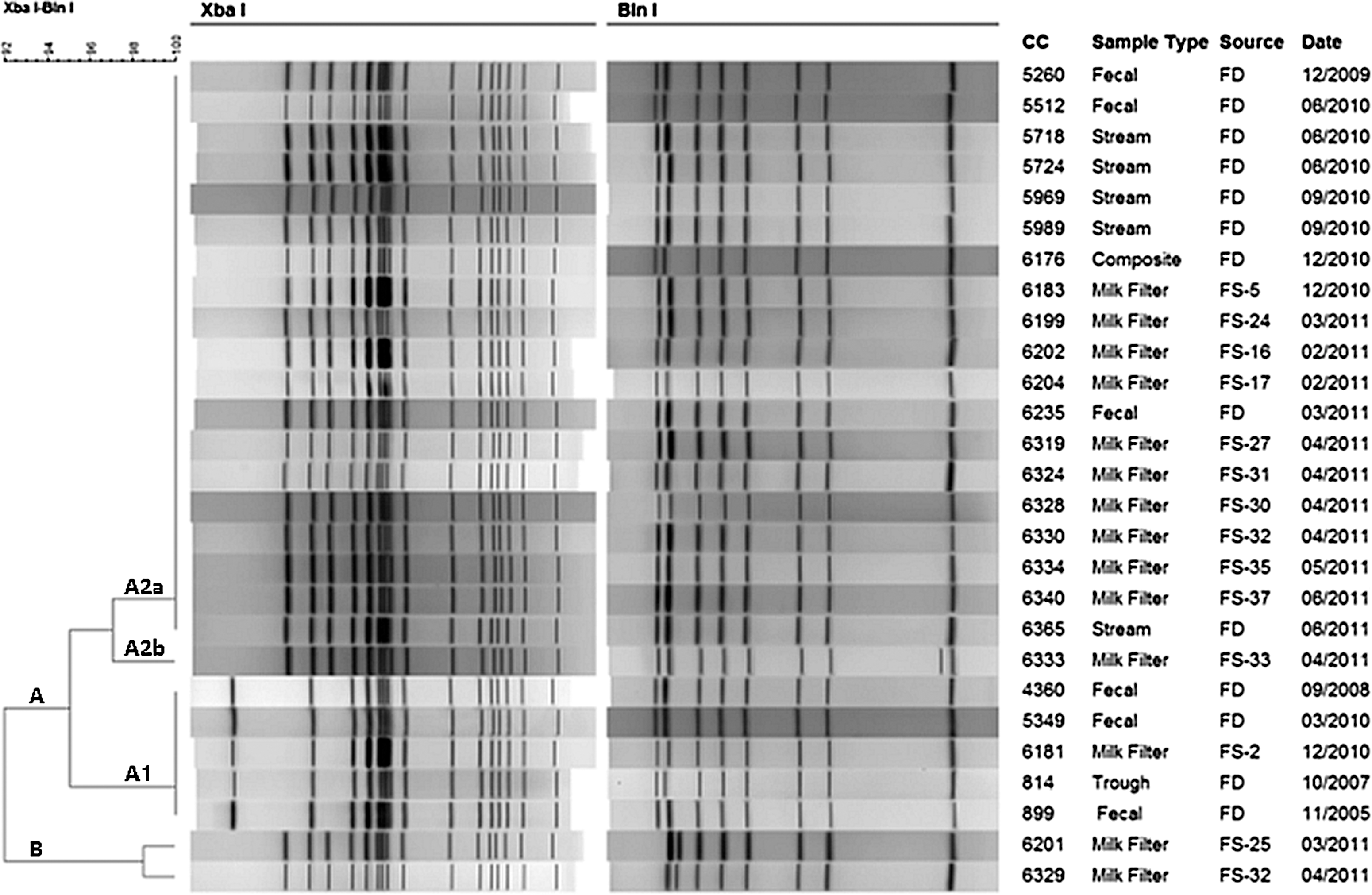
Dendrogram of two-enzyme pulsed-field gel electrophoresis of Salmonella enterica Kentucky isolates from milk filters and from various samples collected at and around the focal dairy. FD, focal dairy; FS, filter set; Trough, water from drinking troughs at focal dairy; Stream, water or sediment from streams in the region.
When the S. Kentucky milk filter isolates were compared with the S. Kentucky isolates that had been obtained from the focal dairy between 2007 and 2011, the restriction digest patterns of 10 filter isolates representing 10 different farms were 100% similar to each other and to S. Kentucky strains previously isolated from the focal dairy and surrounding environment between 2009 and 2011 (cluster A2a). Additionally, one of the new filter isolates was ∼97% similar to previous isolates (cluster A2b). A Kentucky isolate obtained early in the study clustered together with strains isolated from the focal dairy between 2005 and 2010 (cluster A1). The remaining two new S. Kentucky isolates clustered separately (cluster B) and were ∼92% similar to the other isolates collected from the filters and those from the previous focal dairy study.
In cases where both S. Cerro and S. Kentucky were both isolated from a single farm, both serotypes fell within the A clusters (93% similarity Cerro; 97% similarity Kentucky). In three cases (FS-5, FS-24, and FS-17) both Cerro and Kentucky isolates were identical (≥98% similarity). The Kentucky strain from FS-37 was indistinguishable from focal dairy and surrounding environment isolates, while the Cerro strain was somewhat more dissimilar at 93% similarity. Neither of the serotype isolates from FS-33 were an exact match for other milk filter isolates.
Discussion
Asymptomatic fecal shedding of many Salmonella serotypes has been frequently documented in dairy animals (Anderson et al., 2001; Van Kessel et al., 2007; Edrington et al., 2008). Such Salmonella infections of dairy herds can linger undetected indefinitely if herd health or production is not compromised. Even when Salmonella has been detected in a herd, if there is minimal or no impact on production there is little incentive to control the infection unless the farm markets raw milk for human consumption. Bulk milk can become contaminated by fecal-borne salmonellae, but standard pasteurization methods remove the risk of infection to the consumer. However, control of these pathogens is still necessary because of the raw milk market and because cull dairy cows contribute significantly to the supply of ground beef in the United States (Troutt and Osburn, 1997; Troutt et al., 2001). Once established on a farm, asymptomatic infections can be difficult to control solely through management techniques. If such infections were to exist on a wider scale, management might be considerably more challenging because of the possibility of constant re-introduction of the pathogen to the farms. A national surveillance of dairy farms was implemented in Denmark to minimize the spread of S. Dublin between herds (Nielsen and Dohoo, 2012). With careful monitoring of herd status, based on bulk-tank milk antibody screening, and animal movements, the prevalence of test-positive herds was reduced from 26% to 10% between 2002 and 2009. Despite the mandatory control program and the reduction in test-positive herds, S. Dublin continued to spread and infect new herds. Based on a survival analysis of the surveillance program data, Nielsen and Dohoo (2012) suggested that very high levels of biosecurity are needed at the individual farm level to ensure protection of the herd.
This milk-filter survey clearly demonstrates that infection with Salmonella enterica serotypes Cerro and Kentucky is widespread in this intensely dairy-farmed region of Pennsylvania. Like the focal dairy herd, infections in the surrounding herds were apparently asymptomatic based on the absence of observed salmonellosis in these herds (unpublished communication with the participating veterinarians). Milk filters from 12 of 39 operations were found to contain one or both of these serotypes that were identical or nearly identical based on analysis of two-enzyme PFGE patterns (∼92% similarity between Cerro strains and ∼94% between Kentucky strains). In addition, these patterns were very similar to those from a well-studied farm in the region (focal dairy) and to strains obtained from stream waters and sediments, upstream and downstream from the focal dairy. Filters from two operations harbored Cerro strains that, while similar to each other, were distinct (<80% similarity) from the isolates from the other operations or environmental samples in the region. Two other operations harbored Kentucky strains that were somewhat distinct (∼92% similarity) from those from other operations or environmental samples. Thus, although single variants of serotypes Cerro and Kentucky seem to have established infections on several dairy farms within the region, other variants seem to exist in the region as well. It is not known whether these variants were introduced separately or whether they evolved from the more abundant strain. From the limited amount of data from operations that yielded both Cerro and Kentucky, it is difficult to conclude whether both Cerro and Kentucky arrived on the operations simultaneously or whether each infection was independently introduced.
Efforts to understand and control widespread asymptomatic infections in dairy cows appear to require regional surveillance approaches. We previously demonstrated the increased efficiency of recovering Salmonella and Listeria monocytogenes from milk filters versus bulk milk (Van Kessel et al., 2011a) and the effectiveness of using milk filters to detect Salmonella shedding in a dairy herd (Van Kessel et al., 2008). Although not as sensitive as manure composite sampling, analysis of multiple filters over time was a reasonable means of detecting Salmonella shedding and was even somewhat predictive of the prevalence of Salmonella shedding within a herd. Salmonella shedding is often intermittent, and regular filter testing may be useful for monitoring herd-level shedding status. In this study, the collection of milk filters from 3 successive days was an effective means of detecting a regional presence of asymptomatic Salmonella. Based on the results obtained here, single-filter sampling would have had a 100% chance of detecting Salmonella on five operations but only a 33% chance of detecting Salmonella on two of the operations, and a 66% chance of detecting Salmonella on nine of the operations. With producer cooperation, milk filters are easy to collect and ship and they provide a convenient means for surveillance over large geographic regions or for temporal studies.
Larger studies of this nature will be required to fully understand the dynamics of Salmonella movement within a region and to develop techniques to limit or prevent the regional spread of pathogens. Rather than a single-farm issue, mitigation and control of endemic Salmonella serotypes will require a regional approach that addresses movements of animals (domestic and wildlife), people, feed, vehicles, birds, insects, and water. The impact of farm management practices designed at the farm level to minimize zoonotic pathogen contamination may be compromised when the regional pressure of the pathogen is high. Novel points of control that reduce the burden and movement of Salmonella need to be identified at the regional level to supplement on-farm biocontrol strategies.
Footnotes
Acknowledgments
The authors gratefully acknowledge the veterinarians and producers for their participation in this study. We also appreciate the technical support provided by Carolyn Burns, Hannah Lysczek, Thomas Jacobs, Jr., Crystal Rice-Trujillo, Jakeitha Sonnier, and Jamal Jeter.
Disclosure Statement
No competing financial interests exist.