




Abstract
Enterohemorrhagic Escherichia coli (EHEC) causes diarrhea, often with severe complications. Rapid and discriminatory typing of EHEC using advanced molecular methods is needed for determination of the genetic relatedness of clones responsible for foodborne outbreaks and for finding out the transmission sources of the outbreaks. This study evaluated the potential of DiversiLab, a semiautomated repetitive sequence-based polymerase chain reaction method for the genotyping of EHEC strains. A set of 52 EHEC strains belonging to 15 O:H serotypes was clustered into 10 DiversiLab groups. All of the O157 strains and one O55 strain were classified into the same group based on a 90% similarity threshold. The other serotypes were classified to their own DiversiLab group, with the exception of one R:H- strain that was grouped with O5:H- strains. In addition, O26 and O111 strains were grouped together but ultimately subdivided according to their O-serotypes based on a 95% similarity threshold. The O104 strain, which was associated with a major outbreak of hemolytic uremic syndrome in Germany in May 2011, was also classified independently. The DiversiLab performed well in identifying isolates, but the discriminatory power of the repetitive sequence-based polymerase chain reaction method was lower than that of pulsed-field gel electrophoresis. Analysis of 15 enteropathogenic E. coli (EPEC) strains revealed that some EPEC strains clustered together with EHEC strains. Therefore, the DiversiLab system cannot be used to discriminate between these pathogroups. In conclusion, DiversiLab is a rapid and easy system for the primary exclusion of unrelated EHEC strains based on their serotypes, but more discriminatory methods, such as pulsed-field gel electrophoresis, are needed for accurate typing of the EHEC strains.
Introduction
The major virulence factor of EHEC strains is Shigatoxin (Stx), which mediates both local and systemic disease by blocking protein synthesis and causing apoptosis (Welinder-Olsson and Kaijser, 2005). Some EHEC strains also possess a pathogenicity island denoted as the locus of enterocyte effacement. This island contains genes including eae, which mediates intimate adherence to intestinal epithelial cells (Spears et al., 2006). Enteropathogenic Escherichia coli (EPEC) causes diarrhea including persistent diarrhea, especially in children (Ochoa et al., 2008; Hernandes et al., 2009). The EPEC strains possess the eae gene but lack the stx genes for Shiga toxin production, thus differentiating them from the EHEC strains (Spears et al., 2006).
For epidemiological surveillance and the control of outbreaks, it is important to obtain data regarding the similarity and clonality of the strains. The serotyping of EHEC strains provides preliminary classification based on phenotypes and forms the basis for epidemiological analyses. Of the genotyping methods currently in use, pulsed-field gel electrophoresis (PFGE) is extensively used for subtyping EHEC strains. PFGE provides a highly discriminating analysis that is independent of the serotype. The PFGE protocol has been standardized by PulseNet at the Centers for Disease Control and Prevention to enable the comparison of the fingerprint patterns and facilitate the early detection of outbreaks (Ribot et al., 2006). In addition, phage typing for O157, multilocus sequence typing (MLST), multilocus variable-number tandem repeat analysis, and recently microarray assays have been exploited in epidemiological studies of EHEC (Noller et al., 2003a; Noller et al., 2003b; Hyytiä-Trees et al., 2010; Karama and Gyles, 2010).
In addition, repetitive palindromic extragenomic polymerase chain reaction (rep-PCR) has been used to type bacterial strains (Healy et al., 2005). In this method, the noncoding repetitive consensus sequences that are interspersed throughout the genome are amplified and separated by electrophoresis, and the resulting “fingerprint” patterns are compared. Recently, a commercial system for fingerprinting strains by the rep-PCR method (DiversiLab, Bacterial Barcodes, Athens, GA) has become available, offering both standardization and automated data analysis. This approach has been successfully used with several bacterial genera/species, such as Salmonella, Serratia, Pseudomonas aeruginosa, methicillin-resistant Staphylococcus aureus, Enterococcus, and Clostridium difficile (Ross et al., 2005; Doléans-Jordheim et al., 2009; Ben-Darif et al., 2010; Chuang et al., 2010; Fluit et al., 2010; Grisold et al., 2010; Ligozzi et al., 2010; Pasanen et al., 2011). In addition, several E. coli strains such as uropathogenic E. coli, extended-spectrum β-lactamase, and AmpC-producing E. coli and strains isolated from neonatal meningitis cases have been analyzed with the DiversiLab method (Bonacorsi et al., 2009; Pitout et al., 2009; Bogaerts et al., 2010; Brolund et al., 2010; Lau et al., 2010).
In this report, we describe the potential and applicability of the automated DiversiLab system in the typing of EHEC strains with known serotypes in comparison to PFGE analysis. In addition, for determination of the potential of DiversiLab to differentiate between the pathogroups, 15 EPEC strains were analyzed in DiversiLab and compared to the profiles of the EHEC strains.
Materials and Methods
Bacterial strains
In total, 52 EHEC strains representing 15 O:H serotypes were selected for the analysis (Fig. 1) including an O104:H4 strain (strain ID 111648) isolated from a Finnish patient who had visited Germany during the O104:H4 outbreak. The strains were isolated in the HUSLAB clinical microbiology laboratory from 2000 to 2011 and were subsequently submitted to the THL Bacteriology Unit for verification and further typing (serotyping, virulence genes stx 1 and stx 2 investigation, and PFGE analysis).
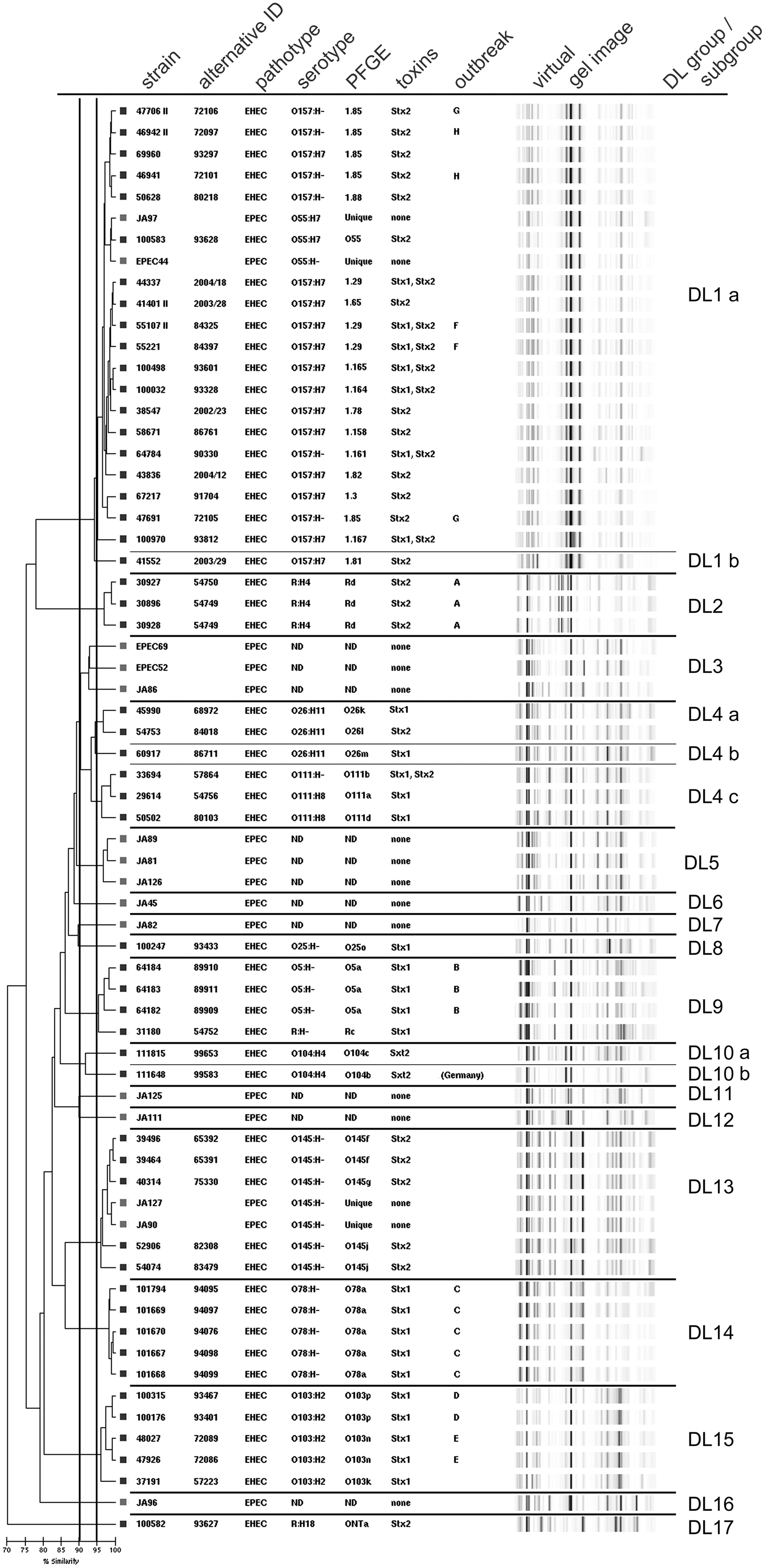
DiversiLab fingerprint profiles of the 52 enterohemorrhagic Escherichia coli (EHEC) strains and 15 enteropathogenic E. coli (EPEC) strains. Dendrogram and virtual gel images obtained by DiversiLab and pathotypes, O:H serotypes, pulsed-field gel electrophoresis (PFGE) types, Stxs (Stx1 and Stx2) produced, and outbreaks (A–H) are presented. In addition, 17 different DiversiLab groups (DL1–17) using a 90% similarity threshold and subgroups (DL1a–b; DL4a–c; DL10a–b) using a 95% similarity threshold are shown. The PFGE types of serotype O157 were coded by numbers and non-O157 serotypes referring to the O group. ND, not done.
In addition, 15 EPEC strains collected during a previous study (Antikainen et al., 2009) were analyzed. The absence (EPEC) or presence (EHEC) of Stx was confirmed by enzyme immunoassay (Premier EHEC assay, Meridian Biosciences, Inc., Cincinnati, OH) and PCR (Antikainen et al., 2009). The serotypes of EPEC strains (strain IDs: JA90, JA127, JA97, and EPEC44) were determined at THL.
Rep-PCR
DNA from each strain was extracted using the UltraClean microbial DNA isolation kit (Mo Bio Laboratories, Solona Beach, CA), and the DNA was diluted to 30 ng/μL. The DNA samples were amplified using the DiversiLab Escherichia kit (bioMérieux, Marcy-l'Etoile, France) for DNA fingerprinting following the manufacturer's instructions. In brief, 2 μL of genomic DNA (60 ng), 18 μL rep-PCR master mix (MM1) and 2 μL primer mix (provided in the kit), 2.5 U AmpliTaq polymerase, and 2.5 μL 10 X PCR buffer (Applied Biosystems, Roche, NJ) were added for a total of 25 μL per reaction.
The rep-PCR reactions were performed using the BioRad DNA Engine Tetrad 2 under the following conditions: initial denaturation at 94°C for 2 min, followed by 35 cycles of denaturation at 94°C for 30 s, annealing at 50°C for 30 s and extension at 70°C for 1.5 min, and a final extension at 70°C for 3 min. The kit-specific positive and negative controls were included to validate the amplification.
The rep-PCR products were detected and analyzed using lab-on-a-chip microfluidics technology (DiversiLab system, bioMérieux, Marcy-l'Etoile, France; Agilent 2100 Bioanalyzer, Santa Clara, CA). Further analysis was performed with the web-based DiversiLab software (version 3.4) using the Pearson correlation coefficient to calculate pairwise similarities among all samples. The automatically generated dendrograms using unweighted-pair group method with arithmetic mean, similarity matrices, electropherograms, virtual gel images, scatter plot, and selectable demographic fields were also used to interpret the results.
The manufacturer provides guidelines for strain-level discrimination: A similarity of more than 97% is considered indistinguishable (no differences in the fingerprints); a similarity of more than 95% is considered similar (one-to-two-band difference in the fingerprints); and a similarity of less than 95% is considered different. In this report, we used both 95% and 90% similarity thresholds for the data analysis.
PFGE
The PFGE was performed following the standard PulseNet protocol for E. coli O157:H7 using the XbaI restriction enzyme (Ribot et al., 2006). The tiff images of the gels were analyzed, and similarity values were calculated using the DICE coefficient with 1.5% band position tolerance and clustering was performed according to the unweighted-pair group method with arithmetic mean available in BioNumerics software (Applied Maths, Sint-Martens-Latem, Belgium). Any difference between the two PFGE profiles was considered sufficient to distinguish the profiles in the library. The PFGE types of the serotype O157 strains were coded by number, and the non-O157 serotype strains were coded according to the O group.
Results
In total, 52 EHEC strains and 15 EPEC strains were analyzed by DiversiLab. With the use of a similarity threshold of 90% to define clusters, DiversiLab analysis identified 17 different clusters (Fig. 1).
Characterization of EHEC isolates by rep-PCR fingerprinting
EHEC strains (n=52) representing 15 serotypes and belonging to eight infection clusters were analyzed by DiversiLab to obtain fingerprint patterns (Fig. 1). A similarity threshold of 90% was used to define clusters. The rep-PCR analysis allowed the identification of 10 different DiversiLab groups (DL1-2, DL4, DL8-10, DL13-15, DL17) among the EHEC strains. Subgroups (95% similarity threshold) were found in DL groups 1, 4, and 10. DL1 contained all O157 strains (19 isolates) and one O55 strain. DL4 was further divided into three DL subgroups (a–c) containing both the strains of O26 (DL3a and 3b) and O111 (DL3c) serotypes. The O104:H4 strain (strain ID: 111648) associating with the German epidemic also formed its own group (DL10b), with 91.7% similarity to an O104 strain of different origin (DL10a) and 86.8% similarity to the closest strain of another serotype (O111). All of the other O-serotypes were classified into individual DL groups, with the exception of one R:H- strain that was grouped with the O5:H- strains in the DL9 group. Strains belonging to the same outbreak grouped to the same DL group, and the lowest similarity between strains from the same outbreak was 96.1% (Fig. 1).
The 52 EHEC strains exhibited 34 different PFGE profiles. A comparison of the PFGE and DiversiLab types indicated that the profiles correlated adequately (Fig. 1). The types classified together by PFGE had at least 96.1% similarity in DiversiLab. However, in the PFGE analysis, the serotypes were further divided into subgroups, whereas the differences among the serotypes by the DiversiLab analysis were small (Fig. 1). For instance, the PFGE profiles of the serotype O111 strains showed differences of more than three bands (Fig. 2A), but these strains were not clearly differentiated in the DiversiLab profiles (Fig. 2B). The three strains exhibited more than 96% similarity. In addition, the O157 strains were all classified into the same DiversiLab group (DL1) but were divided into 13 different PFGE types.
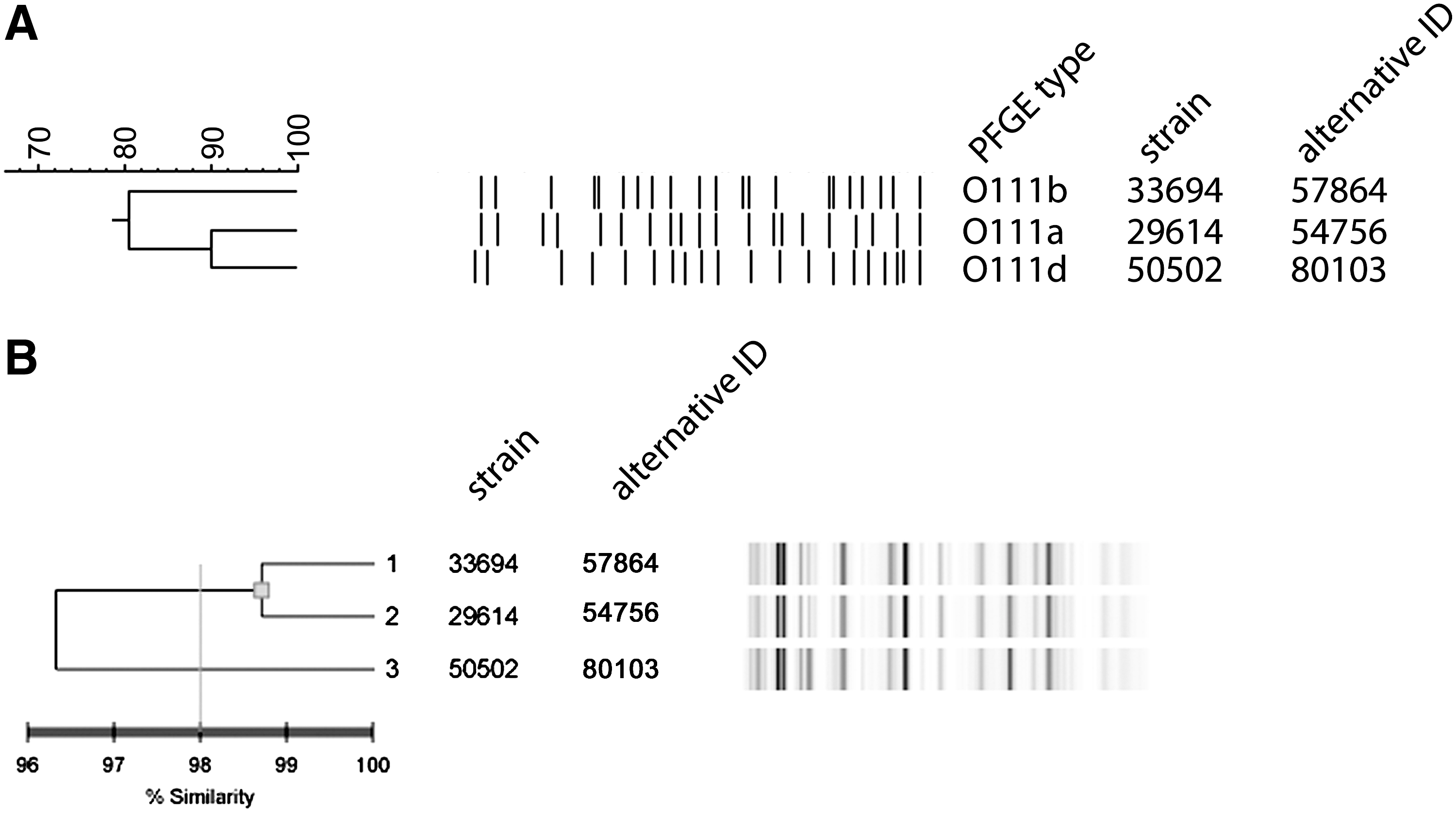
An example of the correlation of pulsed-field gel electrophoresis (PFGE) and DiversiLab profiles.
Characterization of EPEC isolates by DiversiLab
In addition to the EHEC strains, 15 EPEC strains were analyzed. Eleven strains grouped separately using DiversiLab, with less than 90% similarity to the EHEC strains (Fig. 1). Two of the EPEC strains grouped together with the EHEC O55 strains (DL1a), and two EPEC strains grouped together with the EHEC O145 strains (DL13) at more than 95% similarity (Figs. 1 and 3). The serotypes of these four EPEC strains were determined and were shown to belong to O55 and O145, respectively. No significant similarity was found between the EPEC and EHEC strains using PFGE (Fig. 3).
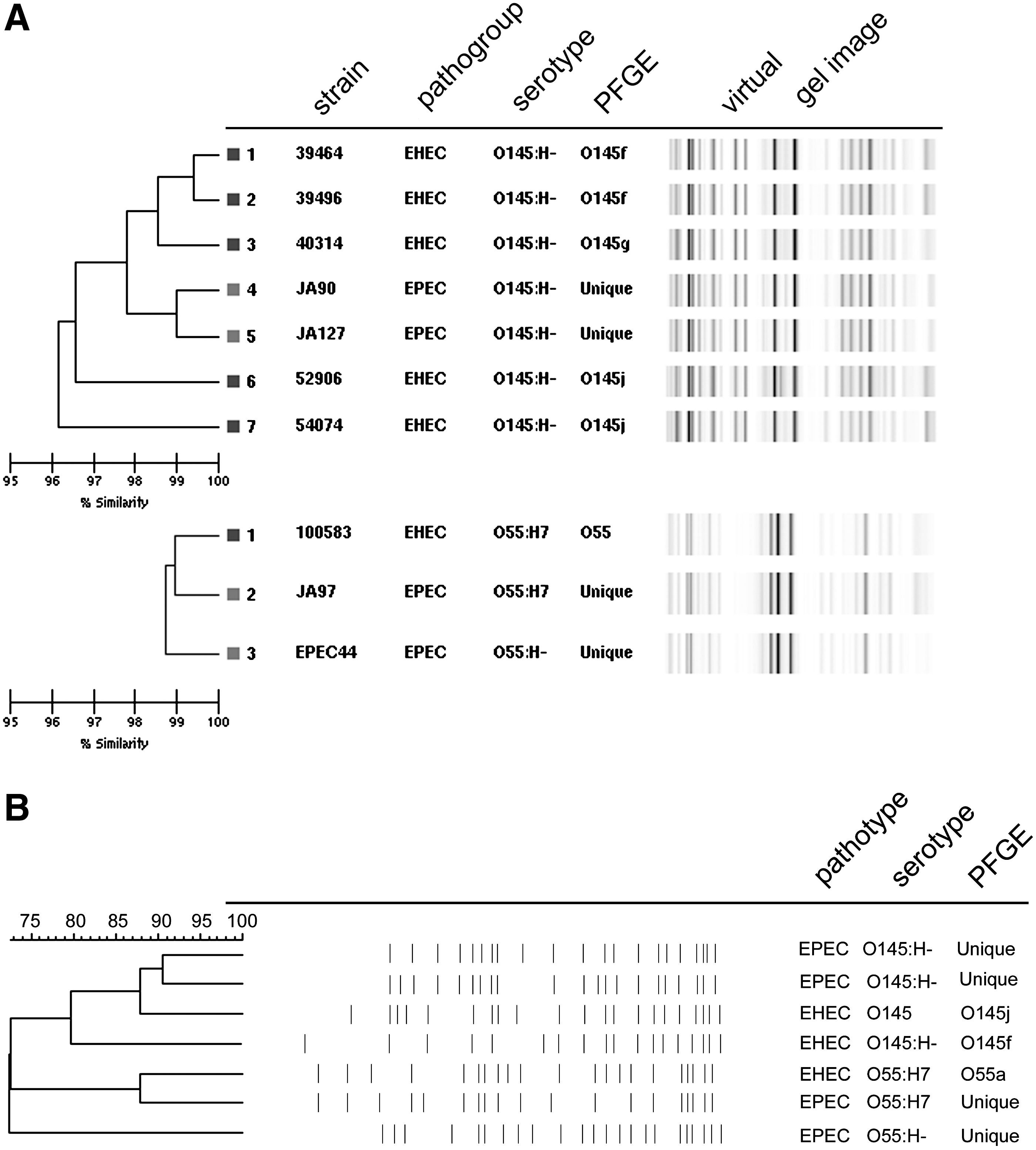
Clustering of specific enteropathogenic Escherichia coli (EPEC) strains next to enterohemorrhagic E. coli (EHEC) serotype O145 and serotype O55.
Discussion
The subtyping of EHEC strains provides important information for epidemiological surveillance and controlling outbreaks. In this work, we showed that the DiversiLab system classified the strains in subgroups and thus can be used for the preliminary fingerprinting of EHEC strains. The discriminatory power of the rep-PCR method was lower than that of PFGE. However, PFGE is more laborious and time consuming, requires specialized technical experience and is usually, as also O:H serotyping, only used by reference laboratories. In contrast, the DiversiLab system is easy to use in clinical routine laboratories with little expertise and produces results rapidly; the DNA purification, PCR amplification, and analysis of the results can be performed within 6–8 h (compared to 24–28 h of PFGE).
The DiversiLab system also has an advantage in the analysis of the results because the profiles are analyzed automatically by the provided software, avoiding the need for interpretation and visual analyses. The profiles are stored in a web-based library and therefore can easily be analyzed and compared whenever needed. In addition, the manufacturer offers a library of 20 EHEC strains (belonging to serotypes O26:H-, O26:H11, O111:H-, O113:H21, and O157:H7), which can be utilized as a starting point for assembling a library for specific epidemiological situations. Our strains were adequately linked to these strains (>90% similarity with the same serotypes). A high level of reproducibility for the DiversiLab system has been reported by several authors (Healy et al., 2005; Ligozzi et al., 2010; Pasanen et al., 2011). In addition, it has been shown that the DiversiLab profiles are reproducible between two independent laboratories (Higgins et al., 2012), thus enabling the potential utilization of DiversiLab in related outbreaks also in several countries.
Our results are consistent with previous studies. Lau et al., 2010 have shown that rep-PCR can be useful in typing of uropathogenic E. coli. DiversiLab showed a slightly higher level of discrimination than MLST, but was less discriminatory than PFGE. In addition, the DiversiLab system has been utilized in the discrimination of the clonal groups of meningococcal E. coli (Bonacorsi et al., 2009). Similarly, studies with extended-spectrum β-lactamase E. coli strains have shown that DiversiLab performed well relative to PFGE but is less discriminatory (Brolund et al., 2010). Our results showed a direct correlation between clusters constituted by DiversiLab types and O-serogroups. The only exceptions were strains lacking the O antigen as well as the O55 strain, which clustered together with the O157 strains. This result is consistent with the fact that the EHEC strains O55 and O157 are closely related (Wick et al., 2005). In this work, we used 90% and 95% as the similarity thresholds to define clusters. Because strains from the same outbreak shared a minimum of 96.1% similarity, a more stringent similarity threshold would be inappropriate.
Analysis of the strain originating in the German epidemic showed that DiversiLab can be used in outbreak situations as a front-line tool. The German epidemic strain (strain ID: 111648) was clustered independently as having the closest similarity (91.7%) to a strain with the same serotype but a different PFGE type (strain ID: 111815). However, the discriminatory power of DiversiLab might be insufficient for reliable outbreak typing in other cases. In particular, DiversiLab typing was inadequate for the O157 strains, which all grouped together in the same DiversiLab type, regardless of the outbreak or PFGE type. Similarly, Fluit et al., 2010 have reported that DiversiLab could be a useful tool for the analysis of hospital outbreaks of E. coli but that the discriminatory power of DiversiLab might not be sufficient in all cases. In addition, they showed that DiversiLab performed well relative to the level of MLST, but only partially to the more discriminatory multilocus variable-number tandem repeat analysis method.
In addition to the EHEC strains, 15 EPEC strains were analyzed to determine whether the DiversiLab system can be used to differentiate between E. coli pathogroups. Of these strains, four were clustered together with the EHEC strains. These EHEC and EPEC strains belonged to the same O-group, suggesting that they may have a shared ancestor. EHEC strains can lose the Stx-encoding genes during the isolation process in the laboratory (Karch et al., 1992). However, this was unlikely to have occurred in this case because the original identification of the EPEC strains was performed by direct PCR of stool samples. The patterns of these EHEC and EPEC strains clearly differed in the PFGE analysis. Thus, due to the similar fingerprint patterns generated for these EHEC and EPEC strains using DiversiLab, rep-PCR alone cannot be used to differentiate these pathogroups.
In conclusion, for laboratories with no expertise in serotyping or PFGE analysis, DiversiLab offers a rapid and easy method for the exclusion of the relatedness of EHEC strains during an outbreak and preliminary identification of their possible serotypes. However, the more discriminatory PFGE analysis should be used to confirm the DiversiLab typing and to accurately type the EHEC strains.
Footnotes
Acknowledgments
We gratefully acknowledge the skillful assistance of the personnel of the Enteric Bacteria Group in the Bacteriology Unit, National Institute for Health and Welfare (THL).
Disclosure Statement
No competing financial interests exist.