




Abstract
The objective of this study was to determine the prevalence and molecular typing of methicillin-susceptible Staphylococcus aureus (MSSA) and methicillin-resistant S. aureus (MRSA) in food-producing animals and retail meat in Fargo, North Dakota. A two-step enrichment followed by culture methods were used to isolate S. aureus from 167 nasal swabs from animals, 145 samples of retail raw meat, and 46 samples of deli meat. Positive isolates were subjected to multiplex polymerase chain reaction in order to identify the genes 16S rRNA, mecA, and Panton-Valentine Leukocidin. Pulsed-field gel electrophoresis and multilocus sequence typing were used for molecular typing of S. aureus strains. Antimicrobial susceptibility testing was carried out using the broth microdilution method. The overall prevalence of S. aureus was 37.2% (n=133), with 34.7% (n=58) of the animals positive for the organism, and the highest prevalence observed in pigs (50.0%) and sheep (40.6%) (p<0.05); 47.6% (n=69) of raw meat samples were positive, with the highest prevalence in chicken (67.6%) and pork (49.3%) (p<0.05); and 13.0% (n=6) of deli meat was positive. Five pork samples (7.0%) were positive for MRSA, of which three were ST398 and two were ST5. All exhibited penicillin resistance and four were multidrug resistant (MDR). The Panton-Valentine Leukocidin gene was not detected in any sample by multiplex polymerase chain reaction. The most common clones in sheep were ST398 and ST133, in pigs and pork both ST398 and ST9, and in chicken ST5. Most susceptible S. aureus strains were ST5 isolated from chicken. The MDR isolates were found in pigs, pork, and sheep. The presence of MRSA, MDR, and the subtype ST398 in the meat production chain and the genetic similarity between strains of porcine origin (meat and animals) suggest the possible contamination of meat during slaughtering and its potential transmission to humans.
Introduction
Most animals can become colonized with S. aureus (de Neeling et al., 2007; Moon et al., 2007; Lewis et al., 2008; van Belkum et al., 2008; Guardabassi et al., 2009; Persoons et al., 2009), and contamination of carcasses may occur during slaughtering (de Boer et al., 2009). Recently, MRSA strains have been isolated from several food-producing animals (de Neeling et al., 2007; Moon et al., 2007; Lewis et al., 2008; van Belkum et al., 2008; Guardabassi et al., 2009; Persoons et al., 2009); and from retail meat worldwide (de Boer et al., 2009; Pu et al., 2009; Lim et al., 2010; Weese et al., 2010; Bhargava et al., 2011; Hanson et al., 2011), representing a potential risk for its transmission to humans.
Methicillin resistance is attributed to the altered penicillin-binding protein (PBP2a), encoded in the mecA gene, which has a reduced affinity for β-lactam antibiotics (Hartman and Tomasz, 1981; Van De Griend et al., 2009). CA-MRSA strains are more likely to encode a virulence factor called Panton–Valentine leukocidin (PVL) toxin (Baba et al., 2002; Dufour et al., 2002), associated with skin infections and tissue necrosis (Ebert et al., 2009). Therefore, the PVL toxin has been identified as a genetic marker for CA-MRSA strains (Vandenesch et al., 2003).
Different molecular techniques have been used for typing MRSA strains, such as pulsed-field gel electrophoresis (PFGE) based on macrorestriction patterns of genomic DNA; multilocus sequence typing (MLST) that determines the allelic profile of seven housekeeping genes; and spa typing based on the sequencing of the polymorphic X region of the protein A gene. It has been demonstrated that the discriminatory power of PFGE is greater than MLST and spa typing (McDougal et al., 2003; Malachowa et al., 2005). Tenover et al. suggest that a combination of two methods may provide more precision in epidemiological studies (Tenover et al., 1994).
It has been demonstrated that MRSA strains causing CA-MRSA infections (USA300 and USA400) are different from those causing health care–associated MRSA infections (USA100 and USA200) (McDougal et al., 2003). The sequence type ST398 has been associated with livestock-associated MRSA (Lewis et al., 2008; van Belkum et al., 2008; Welinder-Olsson et al., 2008; Krziwanek et al., 2009), however, the presence of ST398 and the emergence of infections in humans with livestock exposure, mostly pig farmers, has increased the public health concern (van Belkum et al., 2008; Krziwanek et al., 2009; Pan et al., 2009; Golding et al., 2010).
The aim of this study was to determine the prevalence, molecular typing, and genetic similarity of S. aureus and MRSA isolated from animals and retail meat in Fargo, ND.
Materials and Methods
Samples
A total of 167 nasal swabs (sheep, n=64; pigs, n=60; cows, n=43) were collected from food-producing animals immediately after stunning at the Meat Lab (Department of Animal Sciences). An additional 57 samples (sheep, n=14; pigs, n=18; cows, n=25) were obtained from sick animals at the ND Veterinary Diagnostic Lab (North Dakota State University, Fargo, ND).
Moreover, 145 raw meat (pork, n=71; chicken, n=37; beef, n=37) and 46 deli meat (ham, n=21; turkey, n=16; chicken, n=9) samples were randomly purchased from four supermarket chains in Fargo, ND.
Samples were collected between May 2010 and April 2011, immediately stored at 4°C, and processed within 6 h of collection.
Isolation of S. aureus and MRSA
The isolation was carried out by enrichment (de Boer et al., 2009) followed by plating steps on selective agar. Briefly, for the primary enrichment, 25 g of meat and 225 mL of Mueller-Hinton broth (Becton, Dickinson and Company [BD], Sparks, MD) with 6.5% sodium chloride (VWR International, West Chester, PA) (MHB+6.5% NaCl) were placed in a sterile stomacher bag and homogenized using a stomacher®400 circulator (Seaward, England) at 230 rpm for 90 s. The suspension was incubated for 18–20 h at 37°C. One milliliter of primary enrichment was inoculated into 9 mL of phenol red mannitol broth (BD) containing ceftizoxime (5 μg/mL, US Pharmacopeia, Rockville, MD) and aztreonam (75 μg/mL, Sigma Chemical Co., St. Louis, MO) (PHMB+) (Wertheim et al., 2001), followed by incubation for 18–20 h at 37°C.
Nasal swabs were placed directly in 9 mL MHB+6.5% NaCl and incubated for 18–20 h at 37°C. Then, the procedure described above was carried out.
A loopful of secondary enrichment was struck directly to Baird-Parker medium with egg yolk tellurite supplement (BP) (according to manufacturer's recommendations) (BD) and incubated for 48 h at 37°C. Two presumptive S. aureus colonies on BP (black colonies surrounded by 2- to 5-mm clear zones) were transferred to Trypticase soy agar with 5% sheep blood (TSAII 5% SB) (BD) and incubated for 18–20 h at 37°C. Presumptive S. aureus on TSAII 5% SB (presence of β-hemolysis) was confirmed using Sensititre Gram Positive ID (GPID) plates (Sensititre,® TREK Diagnostic Systems Ltd., Cleveland, OH). Confirmed colonies were stored frozen at −80°C in brain–heart infusion broth (BD) containing 20% glycerol until use.
Multiplex polymerase chain reaction (PCR)
All S. aureus strains were recovered from frozen stock to TSA plates and incubated at 37°C for 18–24 h. DNA extraction was carried out by suspending one colony in 50 μL of DNase/RNase-free distilled water, heating the suspension (99°C, 10 min) and then centrifugation (30,000×g, 1 min) to remove cellular debris. The remaining DNA was transferred to a new tube and stored frozen at −20°C.
Multiplex PCR assay for detection of 16S rRNA, mecA and PVL genes included 2 μL of the DNA template (described above) added to a 50 μL final reaction mixture: 1X Go Taq® Reaction Buffer (Promega, Madison, WI), 0.025 U/μL of Go Taq® DNA polymerase (Promega), 200 μM dNTP (Promega), and 1 μM of primers (16S rRNA, mecA, LukS/F-PV, Table 1) (Integrated DNA Technologies, Inc., Coralville, IA) (McClure et al., 2006).
Multiplex PCR settings were carried out according to Makgotlho et al. (2009), using a thermocycler (Eppendorf, Hamburg, Germany).
Ten microliters of the PCR amplicons were loaded into a 1.5% (wt/vol) agarose gel (Agarose I™, Amresco, Solon, OH) in 1X TAE buffer using EzVision One loading dye (Amresco), and run at 100 V in 1X TAE buffer for 1 h. A molecular weight marker 100-bp ladder (Promega) and a positive control (ATCC 35591) were included on each gel. Bands were visualized using an Alpha Innotech UV imager (FluorChem™).
PFGE
The PulseNet protocol with slight modifications was used (McDougal et al., 2003). Briefly, frozen isolates were struck to TSA plates and incubated at 37°C for 18–24 h. A single colony was inoculated onto a second TSA plate and incubated at 37°C for 18–24 h. Colonies were transferred to 5-mL polystyrene round-bottom tubes containing 2 mL of cell suspension buffer (100 mM Tris HCl [pH 8.0], Invitrogen; and 100 mM EDTA [pH 8.0], Gibco), adjusting the concentrations to an absorbance of 0.9–1.1 in a spectrophotometer (Smart Spec™ plus, Bio-Rad Laboratories, USA) at 610 nm. After that, the preparation, lysis, and washes of plugs, and then the SmaI enzyme restriction digestion were performed according to the PulseNet protocol. Salmonella Branderup H9812 was used as a DNA marker (Ribot et al., 2006).
The electrophoresis was carried out in a Chef Mapper (Bio-Rad Laboratories) PFGE rig, with an initial switch time of 5 s, a final switch time of 40 s, and a total running time of 17 h 45 min.
After staining the gels with ethidium bromide (1.5 μg/mL), they were visualized using a UVP imager (UVP, Upland, CA). Macrorestriction patterns were compared using the BioNumerics Fingerprinting software (Ver 6.5 Applied Math, Austin, TX). The similarity index was calculated using the Dice coefficient, a band position tolerance of 1%, and an optimization of 0.5%. The unweighted-pair group method with arithmetic averages was used to construct a dendrogram, and clusters were selected using a cutoff at 80%.
Multilocus sequence typing (MLST)
Briefly, S. aureus isolates were struck to TSA plates and incubated at 37°C for 18–24 h. Colonies were picked to 40 μL of single cell lysing buffer (50 μg/mL of Proteinase K, Amresco; in TE buffer [pH=8]), and then lysed by heating to 80°C for 10 min followed by 55°C for 10 min in a thermocycler. The final suspension was diluted 1:2 in sterile water, centrifuged to remove cellular debris, and transferred to a sterile tube (Marmur, 1961).
The housekeeping genes: arcC, aroE, glpF, gmk, pta, tpi, and yqiL, were amplified (Table 1) (Enright et al., 2000). All PCR reactions were carried out in 50-μL volumes: 1 μL of DNA template, Taq DNA polymerase (Promega) (1.25 U), 1X PCR buffer (Promega), primers (0.1 μM) (Integrated DNA Technologies, Inc.), and dNTPs (200 μM) (Promega). PCR settings were adjusted according to Enright et al. (2000) using a thermocycler (Eppendorf). Ten microliters of the PCR products were loaded into 1% agarose gels in 1X TAE with EzVision One loading dye, and run at 100 V in 1X TAE for 1 h. Images were captured using an Alpha Innotech imager.
After PCR, each amplicon was purified of amplification primer using the QIAquick® PCR Purification Kit (Qiagen, Valencia, CA) as per manufacturer's instructions. Purified DNA was sequenced at Iowa State University's DNA Facility (Ames, IA) using an Applied Biosystems 3730xl DNA Analyzer (Applied Biosystems, Foster City, CA). Sequence data were imported into DNAStar (Lasergene, Madison, WI), trimmed, and aligned to the control sequences (from the MLST site) and interrogated against the MLST database (
Antimicrobial susceptibility testing
Minimum inhibitory concentrations (MICs) and the AR profiles of S. aureus isolates were determined using the broth microdilution method (CMV3AGPF, Sensititre®, Trek Diagnostics), according to the manufacturer's and the Clinical Laboratory Standards Institute guidelines (CLSI, 2009).
A total of 16 antimicrobials belonging to 13 classes were tested. Resistance to at least three classes of antibiotics was considered as multidrug resistance (MDR) (Aydin et al., 2011).
Statistical analysis
Fisher's exact test was used to assess significance in prevalence of S. aureus and MRSA between animal and meat types. A significance level of p<0.05 and two-sided p-values were assessed using SAS software 9.2 (SAS Institute Inc., Cary, NC).
Results
Table 2 shows the prevalence of S. aureus in animals (34.7%, n=58), with a higher rate in swine and sheep (p<0.05); in raw meat (47.6%, n=69), with a higher rate in chicken and pork (p<0.05); and in deli meats (13.0%, n=6). MRSA was detected solely in meat (five pork samples), representing a low prevalence (<5%). The PVL gene was not detected in any sample.
Most of the S. aureus isolates from animals were resistant to penicillin, tetracycline, and lincomycin; and from raw meat to those antibiotics and erythromycin. All MRSA strains were resistant to penicillin, and most of them showed resistance to erythromycin, tetracycline, and lincomycin (Table 3).
The following antimicrobials were tested using the National Antimicrobial Resistance Monitoring System (NARMS) panel: tigecycline (range 0.015–0.5 μg/mL); tetracycline (1–32); chloramphenicol (2–32); daptomycin (0.25–16); streptomycin (512–2048); tylosin tartrate (0.25–32); quinupristin/dalfopristin (0.5–32); linezoid (0.5–8); nitrofutantoin (2–64); penicillin (0.25–16); kanamycın (128–1024); erythromycin (0.25–8); ciprofloxacin (0.12–4); vancomycin (0.25–32); lincomycin (1–8); gentamicin (128–1024). All isolates were susceptible to vancomycin, tigecycline, daptomycin, tylosin, tartrate, nitrofurantoin, and linezolid.
A total of 47.7% (n=41) of the penicillin-resistant S. aureus strains exhibited MICs between 0.5 and 1 μg/mL. However, MRSA strains had higher MICs for penicillin (1–>16 μg/mL) (Table 4).
Levels of MIC values against tested antibiotics (CLSI, 2009).
Levels of MIC values against tested antibiotics (Jarløv et al., 1997).
Levels of MIC values against tested antibiotics (Nemati et al., 2008).
The rate of MDR strains was 41.4% (n=55); in animals was 51.7% (n=30), and in meat was 36.2% (n=25). Among MRSA strains, only one was not MDR, and the rest showed MDR to four classes of antimicrobials (Table 5).
CIP, ciprofloxacin; CHL, chloramphenicol; ERY, erythromycin; GEN, gentamicin; KAN, kanamycin; LINC, lincomycin; QUI/DAL, quinupristin/dalfopristin; PEN, penicillin; STR, streptomycin, TET, tetracycline.
Figure 1 shows a dendrogram displaying the macrorestriction patterns of S. aureus strains and the sequence type (ST). The largest cluster (cluster 4) contained S. aureus of porcine origin (animals and meat), all of which were ST9. S. aureus isolates included in the second largest cluster (cluster 3) were obtained from poultry meat, and all but one was ST5. Two MRSA isolates were clustered in cluster 5, all from pork and ST5. The rest of the MRSA isolates were ST398 (not included in the dendrogram). A total of 34 S. aureus isolates (25.6%) were not included in the dendrogram because they could not be restricted with SmaI or XmaI during PFGE analysis and were ST398, isolated from animals (sheep and pigs) and from pork meat (data not shown).
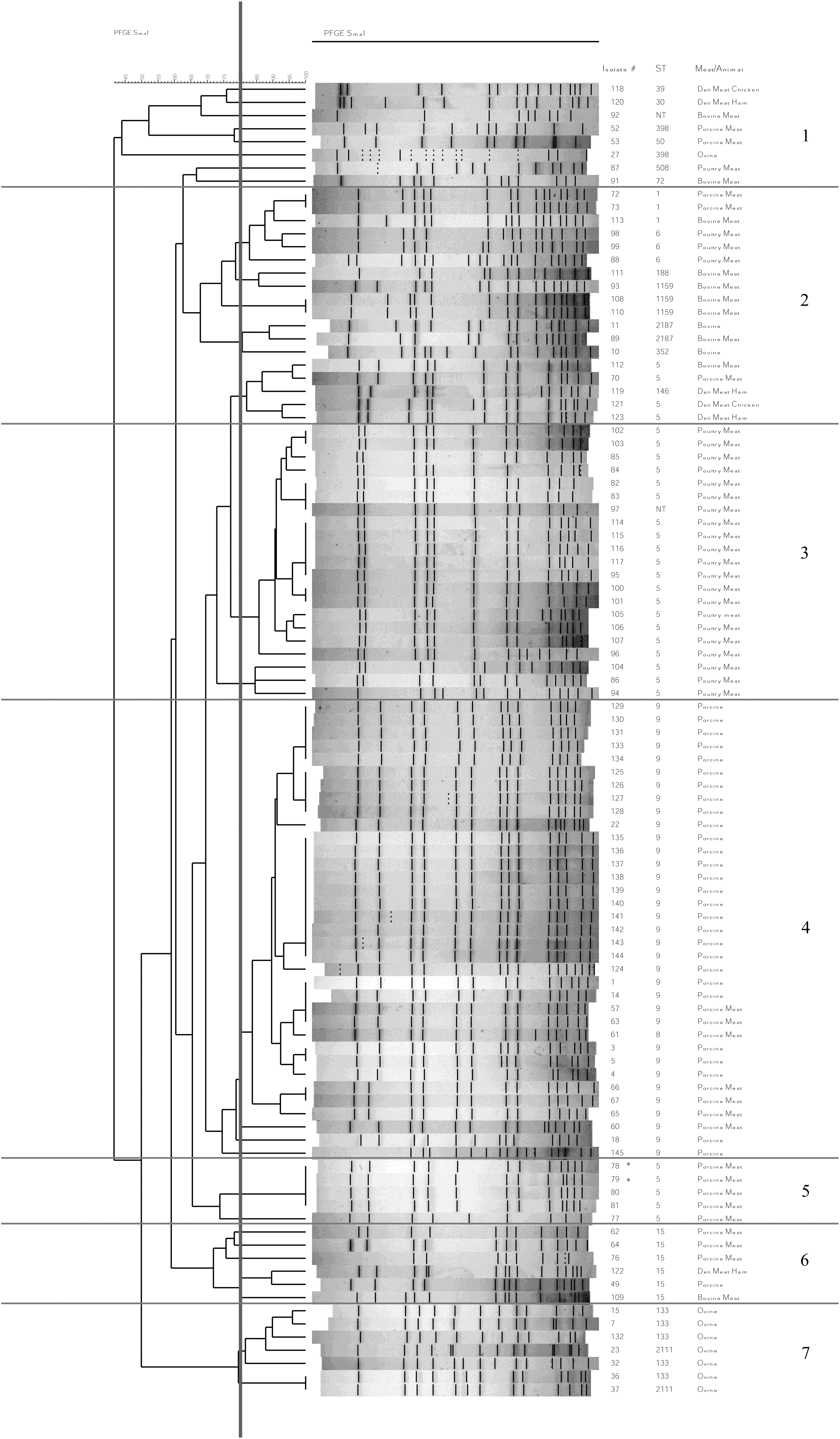
Dendrogram showing the genetic relatedness of 100 Staphylococcus aureus isolates as determined by the analysis of pulsed-field gel electrophoresis (PFGE) profiles by the unweighted-pair group method with arithmetic averages with the sequence type (ST). The scale indicates levels of similarity within this set of isolates. Numbers represent the samples codes, followed on the right by the STs and the type of the sample. Clusters are separated by horizontal lines and labeled with correlative numbers. Asterisks indicate methicillin-resistant Staphylococcus aureus isolates determined by multiplex polymerase chain reaction targeting the mecA gene.
Discussion
Both methods used for the confirmation of S. aureus—Sensititre identification plates and detection of the 16S rRNA gene by multiplex PCR—agreed with the results (Table 2). These results confirmed that the isolation method of two enrichment steps preceding plating is an appropriate method for recovering both S. aureus and MRSA from meat and animals. de Boer et al. (2009) used the same two-step enrichment, reporting a higher detection rate of MRSA.
It is well known that animals are natural reservoirs of S. aureus; in this study, positive nasal swabs were obtained from sheep, pigs, and cows. Other studies have detected a higher prevalence of S. aureus in sheep (57%) and cattle (14%) (Mørk et al., 2012); however, the prevalence in pigs has been reported to vary widely (6–57%) (Khalid et al., 2009; Lowe et al., 2011). The recovery of S. aureus in meat in our study was higher than previous studies (39.2% and 14.4%) (Pu et al., 2009; Aydin et al., 2011). The prevalence of S. aureus in ham was 19%, which was considerably lower than the prevalence reported by Atanassova et al. (2001). There is limited information about the prevalence of S. aureus and MRSA in processed retail meat products, and this study provides some information as to the potential exposure of consumers through consumption of deli meats that typically do not need heating prior to consumption.
In this study, MRSA was not detected in animals; however, a prevalence of MRSA in swine ranging from 10% to 71% has been detected previously (Köck et al., 2009; Smith et al., 2009; Tenhagen et al., 2009). The low rate of MRSA in pork raw meat (3.4%) determined in this study agreed with the low prevalence reported by other authors (de Boer et al., 2009; Pu et al., 2009).
Most of the S. aureus strains isolated from animals exhibited resistance to the same antimicrobials reported by other authors (Nemati et al., 2008; Huber et al., 2010) (Table 3). The AR bacteria in animals have increased over time due to the frequent use of antimicrobial agents at the farm level (de Neeling et al., 2007; Nemati et al., 2008). Therefore, controlling the use of antibiotics in farming could limit the risk of transmission of AR pathogens among animals and potentially to humans (Huber et al., 2010).
Other authors have also determined a higher occurrence of resistance to penicillin, tetracycline, and erythromycin in S. aureus strains isolated from retail meats and different food samples (Aydin et al., 2011; Pu et al., 2011). Penicillin resistance has been reported to spread rapidly among S. aureus strains being facilitated by plasmids and is the most frequently reported resistance detected in foodborne S. aureus (Aydin et al., 2011).
AR S. aureus exhibited a MIC for erythromycin and lincomycin (>8 μg/mL) lower than the MIC determined by Nemati et al. (2008). The MIC of tetracycline (>32 μg/mL) and penicillin (0.5–1 μg/mL) concurred with the results reported by Nemati et al. (2008). Previously, other authors have reported MDR in S. aureus from food samples at a lower rate compared with this study (Aydin et al., 2011; Nam et al., 2011) (Table 4).
All S. aureus isolates examined in this study were susceptible to dapromycin, linezolid, nitrofurantoin and vancomycin, concurring with the results reported by Pu et al. (2011).
The clustering of isolates obtained by PFGE agreed well with the MLST types (i.e., the identical restriction patterns or patterns that differed at two to six bands had an identical ST) (Fig. 1). Restriction patterns with the same numbers of bands represent the same strain; patterns that differ up to three fragments represent strains that are closely related; and isolates that differs at four to six bands may have the same genetic lineage (Tenover et al., 1995).
The major clones identified corresponded to ST9 and ST5. The emergence of ST9 in pigs was first reported in 2008 by Guardabassi et al. (2009) in Hong Kong, disseminating later as demonstrated in this study. The genetic relatedness between S. aureus strains ST9 from pigs and pork meat may suggest the possible contamination of meat during slaughtering. Previously, ST5 was associated with poultry (Hasman et al., 2010) and poultry meat (Waters et al., 2011). In this study, the majority of strains isolated from chicken were ST5, which can also suggest the contamination of meat during slaughtering. A high prevalence of ST398 was found, which may indicate the potential risk for humans to acquire this emerging sequence type that has potential for causing infection.
MRSA isolates had the same MLST allelic profile and indistinguishable PFGE patterns than two methicillin-susceptible S. aureus (MSSA) strains, all obtained from pork. The close genetic similarity of the MRSA and MSSA isolates may be due to the acquisition of the mecA gene by horizontal transfer of SCCmec from MRSA strains to MSSA lineages (Enright et al., 2000; Wielders et al., 2001; de Neeling et al., 2007; Guardabassi et al., 2009;).
Most of the S. aureus isolates susceptible to all antimicrobial agents were obtained from chicken, of which 76% were ST5. MDR isolates from pork were mainly ST398 (60%) (not included in the dendrogram), and ST9 (30%). All MDR strains from sheep were ST398 (not included in the dendrogram). The MDR can be due to the presence of other antibiotic resistance genes, such as dfrK (resistance to trimethoprim) (Kadlec and Schwarz, 2009) and cfr (MDR gene) (Kehrenberg et al., 2009).
Conclusions
The presence of MDR S. aureus, and subtype ST398 in animals and meat, and MRSA in retail meat, and the genetic relationship between strains isolated from animals and meat, suggests the likely contamination of meat during slaughtering.
Although the MRSA prevalence in raw meat is low, the prevalence of MDR S. aureus and ST398 is higher; therefore, the risk of transmission through the meat production chain cannot be ignored.
Footnotes
Acknowledgments
This study was supported by the Dean's Office, College of Agriculture, Food Systems and Natural Resources College, North Dakota State University (Valeria Velasco), the Dean's Office, College of Veterinary Medicine, Iowa State University, Ames, Iowa; and the Commission of Scientific Research Projects, Uludag University (Project YDP (V)-2009/4).
Disclosure Statement
No competing financial interests exist.