




Abstract
Most bacterial pathogens associated with human enteric illness have zoonotic origins and can be transmitted directly from animals to people or indirectly through food and water. This multitude of potential exposure routes and sources makes the epidemiology of these infectious agents complex. To better understand these illnesses and identify solutions to reduce human disease, an integrative approach like One Health is needed. This article considers the issue of Salmonella in Canada and interprets data collected by several Canadian surveillance and research programs. We describe recovery of Salmonella from various samples collected along the exposure pathway and compare the serovars detected in the different components under surveillance (animal, food, environment, and human). We then present three examples to illustrate how an approach that interprets multiple sources of surveillance data together is able to address issues that transcend multiple departments and jurisdictions. First, differences observed in recovery of Salmonella from different cuts of fresh chicken collected by different programs emphasize the importance of considering the surveillance objectives and how they may influence the information that is generated. Second, the high number of Salmonella Enteritidis cases in Canada is used to illustrate the importance of ongoing, concurrent surveillance of human cases and exposure sources to information domestic control and prevention strategies. Finally, changing patterns in the occurrence of ceftiofur-resistant Salmonella Heidelberg in retail meats and humans demonstrates how integrated surveillance can identify an issue in an exposure source and link it to a trend in human disease. Taken together, surveillance models that encompass different scales can leverage infrastructure, costs, and benefits and generate a multidimensional picture that can better inform disease prevention and control programs.
Introduction
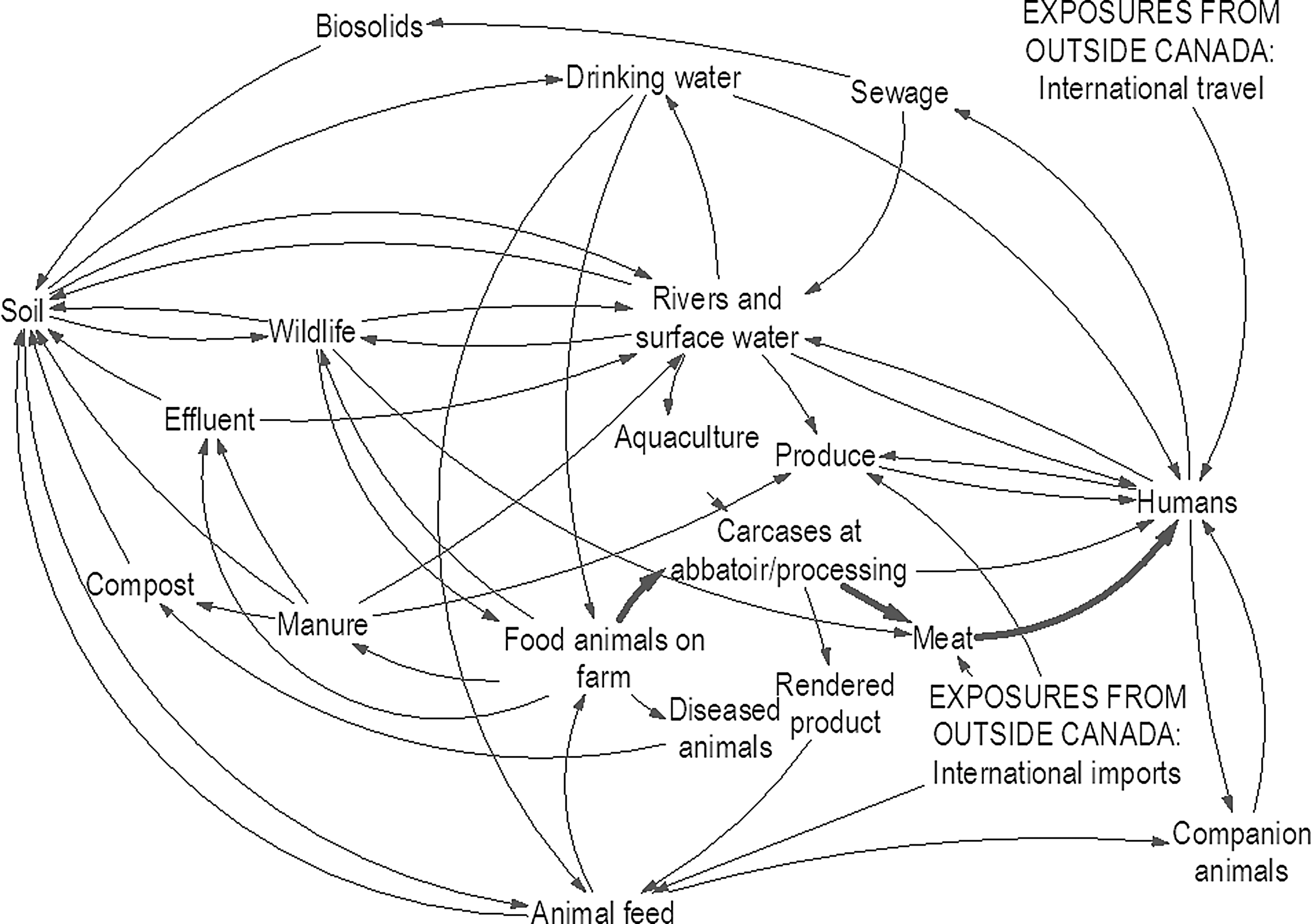
Sources and pathways of transmission of Salmonella in Canada.
Identification of sources and routes of infection is the cornerstone of disease prevention and requires an integrated, multiprogram approach, as no single program or jurisdiction is able to inform all aspects of the problem. One Health is an internationally accepted model that recognizes the inter-relationship between human, animal, economic, and environmental health, and proposes a multidisciplinary, cross-sectoral approach to surveillance and mitigation of complex public health problems (Waltner-Toews, 2009; Powdrill et al., 2010). This makes it a suitable approach to address the epidemiology of enteric illness.
In Canada, there are several national enteric pathogen surveillance programs that measure disease incidence and target some of the possible exposure sources. The Public Health Agency of Canada (PHAC) has a suite of national enteric disease surveillance programs, each designed to support different public health actions. The Canadian Notifiable Disease Surveillance System (PHAC, 2012a), the National Enteric Surveillance Program (NESP) (PHAC, 2012b), and PulseNet Canada (PHAC, 2012c) focus solely on human cases and provide data for early outbreak detection and response and national disease trend monitoring.
Infectious, enteric illness is not exclusively a human problem. To reduce the burden of disease, information is needed about the presence of pathogens in the full array of exposure sources (e.g., foods, animals, drinking water, and recreational water). Integrated surveillance programs collect samples and generate information from multiple components with a system (Galanis et al., 2012). Two integrated enteric surveillance programs—the Canadian Integrated Program for Antimicrobial Resistance Surveillance (CIPARS) and the National Integrated Enteric Pathogen Surveillance Program (C-EnterNet)—collect data along the farm-to-fork continuum and provide information about exposure routes and sources of enteric organisms and antimicrobial resistance (AMR) in Canada.
CIPARS tracks temporal and regional trends in antimicrobial use (AMU) in humans and animals and AMR in selected species of enteric bacteria recovered from different points along the food chain on a Canada-wide basis (Government of Canada, 2011a). C-EnterNet was designed to detect changes in human enteric disease and pathogen exposure from food, animal, and water sources. It reports on the prevalence of enteric pathogens across the exposure spectrum and on incidence rates and risk factors among human cases (travel-related and endemic) (Government of Canada, 2011b). These programs operate together closely, but their designs are inherently different. Not only do they have different objectives but also, CIPARS is focused on the national level and C-EnterNet is focused in sentinel communities and watersheds.
In addition to CIPARS and C-EnterNet, a number of surveillance and research initiatives led by other federal government departments systematically assess enteric pathogen prevalence in surface waters. These include the National Agri-Environmental Standards Initiative (Edge et al., 2012), the Watershed Evaluation of Beneficial Management Practices program (AAFC, 2013a), the National Water Quality Surveillance Research Initiative, and the Sustainable Agriculture Environmental Systems initiative (AAFC, 2013b). General goals of these programs are to (1) gain a better understanding of spatial and temporal trends associated with enteric pathogen prevalence in surface waters across Canada, (2) determine the most important animal sources of these pathogens, and (3) qualify and quantify their contribution with respect to human infection. Data generated from these initiatives complement the exposure data collected by CIPARS and C-EnterNet.
Salmonella was chosen as a model pathogen for this analysis because it is the second leading cause of bacterial gastroenteritis in Canada (Government of Canada, 2007), and is included in the environmental surveillance programs described above (Jokinen et al., 2011; Wilkes et al., 2011; Edge et al., 2012), as well as CIPARS, C-EnterNet, NESP and Canadian Notifiable Disease Surveillance System. Although Salmonella is frequently isolated from animals, food, and humans, the attribution of salmonellosis to sources has yet to be fully elucidated in Canada.
This article is not an exhaustive review of all Salmonella data available in Canada. Our purpose is to demonstrate how integrating surveillance data from programs with different designs and objectives can help develop research hypotheses, evaluate trends, understand the efficacy of interventions, and identify important data gaps.
Materials and Methods
The sampling design and laboratory methods of CIPARS and C-EnterNet have been described elsewhere (Government of Canada—CIPARS, 2011a; Government of Canada—C-EnterNet, 2010a). The main components of these programs, as they pertain to Salmonella over the study period (2005–2010), are shown (Table 1).
In 2007, CIPARS changed the method of bacterial isolation from retail chicken.
CIPARS collects retail chicken legs with skin and C-EnterNet collects retail chicken breasts without skin.
Briefly, CIPARS monitors AMR in Salmonella isolated from humans, animals, and animal-derived food sources across Canada. Laboratory-confirmed human Salmonella isolates are submitted to the National Microbiology Laboratory as part of reference requests, surveillance programs, surveys or outbreak investigations. Isolates are characterized to the serovar level and selected serovars are phage typed and tested for AMR.
CIPARS isolates Salmonella from samples collected along the food chain including (1) fecal samples from grower-finisher swine herds from the major pork-producing provinces in Canada; (2) cecal samples from chickens and pigs at slaughter, and (3) retail chicken and pork purchased in British Columbia, Saskatchewan, Ontario, Québec, New Brunswick, Prince Edward Island, and Nova Scotia. All recovered Salmonella undergo further testing to determine serovar (some are phage typed) and antimicrobial susceptibility. CIPARS also characterizes Salmonella isolates recovered from veterinary diagnostic and animal feed samples. Because no information is available about how many samples were collected and tested, these data are not included herein.
Between 2005 and 2010, C-EnterNet operated in one sentinel site (Region of Waterloo, Ontario); in 2010, it expanded to a second site (Fraser Health Authority, British Columbia). Within each site, C-EnterNet tests for Salmonella in three sources: manure from farms (dairy, beef, swine, and broiler poultry operations), retail meats (chicken, beef, and pork), and surface water. Human cases of salmonellosis identified by local public health are administered a standard, comprehensive questionnaire to evaluate all potential exposures (risk factors) and to classify cases as international travel-related or endemic (both sporadic [non–outbreak related] and outbreak related). Isolates are characterized to the serovar level and subsequently both phage type and pulsed-field gel electrophoresis patterns are obtained.
Health Canada, Environment Canada, and Agriculture and Agri-Food Canada support systematic environmental monitoring of Salmonella in watersheds across Canada through the National Agri-Environmental Standards Initiative (Edge et al., 2012) and Watershed Evaluation of Beneficial Management Practices/National Water Quality Surveillance Research Initiative/Sustainable Agriculture Environmental Systems programs (AAFC, 2013a; AAFC 2013b).Collectively, between 2005 and 2010, Salmonella data were generated for five Canadian watersheds, each with different upstream pollution pressures: (1) Bras d'Henri (Québec), (2) South Nation River (Eastern Ontario), (3) Grand River (Southern Ontario), (4) Oldman River (Alberta), and (5) Sumas River (British Columbia). The methods used for site identification, sample collection (Edge et al., 2012), Salmonella isolation (Jokinen et al., 2010), and serotyping and phage typing (Jokinen et al., 2011) have been described previously.
We used several approaches to analyze the surveillance data presented herein. First, measures of Salmonella prevalence and rates of disease between 2005 and 2010 are presented. Salmonella recovery and serovars detected across various surveillance and research programs and sectors were summarized using Excel 2000 (Microsoft Office 2000) and descriptive statistics were calculated using Excel and Epi Info™ 6 (Centers for Disease Control and Prevention). Second, three retrospective narratives were used to illustrate how CIPARS and C-EnterNet Salmonella data supported action. Environmental and land-use information were used to help identify potential sources of Salmonella in these systems.
Results
Quantitative results
Between 2005 and 2010, NESP reported 37,925 human Salmonella cases (PHAC, 2012b). During this period, CIPARS recovered Salmonella from 23% (470/2050) of farm swine samples, 43% (942/2199) of abattoir swine samples, and 2% (69/4598) of raw pork chops at retail. In comparison, 23% (1198/5140) of abattoir chicken samples and 32% (1760/5483) of raw chicken thighs were Salmonella positive (Fig. 2).
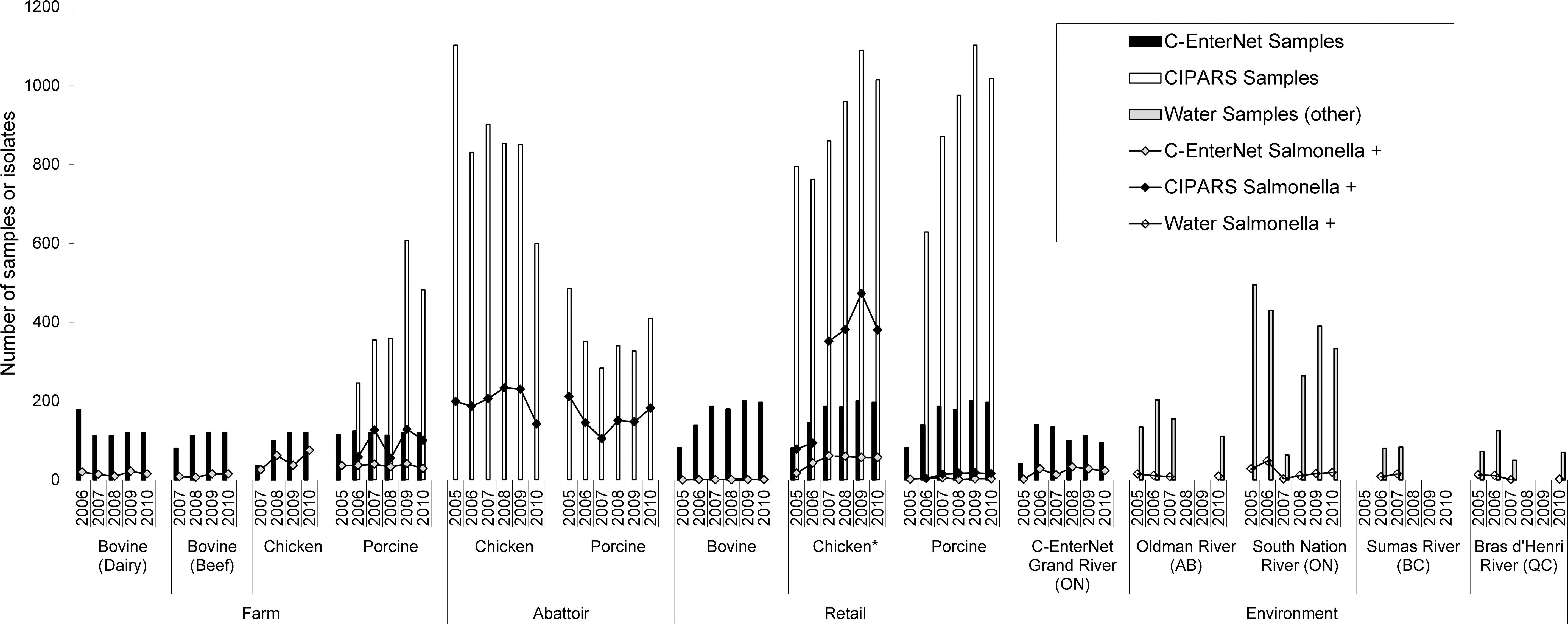
The total number of samples collected from agri-food sources and the number of Salmonella isolates recovered from each source, across several Canadian surveillance programs (2005–2010). C-EnterNet, National Integrated Enteric Pathogen Surveillance Program; CIPARS, Canadian Integrated Program for Antimicrobial Resistance Surveillance; ON, Ontario; AB, Alberta; BC, British Columbia; QC, Quebec City. *In 2007, CIPARS changed the method of bacterial isolates from retail chicken.
Within C-EnterNet Sentinel Site 1, 691 laboratory-confirmed human cases of Salmonella were reported (2005–2010). Of these, 193 (28%) were international travel–related and 498 (72%) were endemic (domestically acquired); 51 (10%) of endemic cases were outbreak-related, and 447 (90%) were sporadic cases. Endemic, sporadic cases are the focus of C-EnterNet surveillance efforts. During this time period, C-EnterNet recovered Salmonella from 53% (200/376) of manure samples from broiler chicken farms, 10% (45/432) from beef (cow–calf), 12% (80/643) from dairy cattle, and 30% (216/712) from swine (farrow to finish). At retail, Salmonella was recovered from 30% (295/995) of raw chicken breasts, 0.5% (5/984) of raw ground beef, and 2% (19/983) of raw pork chops (Fig. 2).
Across all species and sources within both integrated surveillance programs, the most common serovars identified were Salmonella enterica serovar Enteritidis, Salmonella Typhimurium, and Salmonella Heidelberg (Fig. 3). NESP reported the same top three serovars between 2005 and 2010 (PHAC, 2012b). Across the main agricultural food commodities (chickens, pigs, beef, and dairy cattle), a wide variety of serovars was detected but the serovar distribution differed: Salmonella Heidelberg and Salmonella Kentucky were common in all poultry sources; Salmonella Typhimurium emerged as a predominant serovar across all porcine sources, and bovine source distributions were mixed.
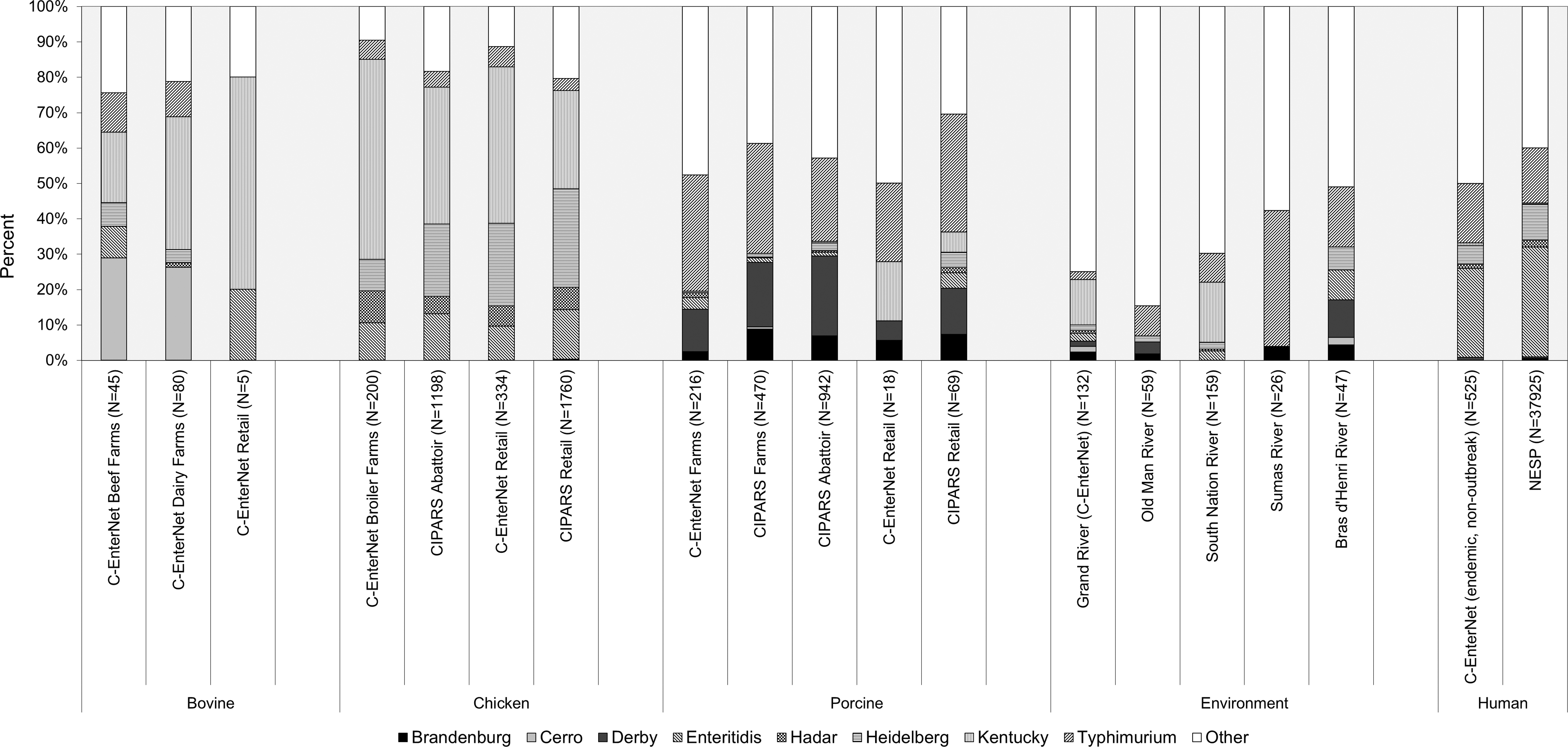
The distribution of Salmonella serotypes observed from National Enteric Surveillance Program (NESP), Canadian Integrated Program for Antimicrobial Resistance Surveillance (CIPARS), National Integrated Enteric Pathogen Surveillance Program (C-EnterNet), and other water surveillance initiatives between 2005 and 2010.
Environmental monitoring programs collected samples within multiple tributaries across Canada; for simplicity, the results are aggregated at the watershed level. Salmonella prevalence varied between watersheds, from 6% (125/1975) in the South Nation River to 20% (127/622) in the Grand River, as well as within watersheds (Table 2). Prevalence in the Grand River was consistently three times higher than in the South Nation River watershed, likely as a result of different point and nonpoint source pollution drivers (Wilkes et al., 2011; Government of Canada, 2011b). Across all five watersheds, the two most common serovars were Salmonella Typhimurium and Salmonella Thompson. Between watersheds, differences in serovar distributions were noted. For example, Salmonella Kentucky was never detected in the Oldman River, Sumas River, or the Bras d'Henri watersheds but was commonly found in the two Ontario watersheds (Fig. 3).
Qualitative results: Retrospective narratives
Detecting Salmonella on grocery store (i.e., retail) chicken
CIPARS and C-EnterNet use similar sampling designs for retail meat surveillance and have used the same laboratory methods since 2007 (Government of Canada, 2010b). However, there are two important differences between CIPARS and C-EnterNet retail chicken meat sampling designs: (1) C-EnterNet samples chicken breast meat but CIPARS samples chicken legs and thighs, and (2) C-EnterNet incubates a 50-g piece of chicken (to enumerate the bacterial contamination levels), whereas CIPARS incubates the whole chicken piece.
Between 2005 and 2007, C-EnterNet purchased skin-on chicken breasts. In 2008 sampling shifted to skinless chicken breasts, to reflect human consumption practices (Nesbitt et al., 2008). No difference in Salmonella prevalence was observed between skin-on and skinless chicken breasts (Cook et al., 2012). Between 2005 and 2010, Salmonella was recovered from 30% (295/995) of chicken breasts purchased by C-EnterNet.
In 2007, CIPARS modified their incubation technique used to isolate Salmonella from retail chicken after C-EnterNet demonstrated higher Salmonella recovery. The original laboratory method (2005–2006) resulted in 11% (172/1558) of chicken testing positive for Salmonella; after adopting the modified technique (2007–2010), Salmonella recovery was 40% (1588/3925). When CIPARS and C-EnterNet used the same incubation methods (2007–2010), the proportion of Salmonella-positive C-EnterNet chicken meat samples was significantly lower than the proportion of CIPARS samples (odds ratio=1.51 [95% confidence interval: 1.24, 1.83]). When Salmonella recovery from C-EnterNet chicken meat samples was compared to the Ontario-specific CIPARS samples (46%; 543/1191), the difference remained significant (odds ratio=1.85 [1.49, 2.30]).
The most likely explanation for the difference in recovery between the two programs is that C-EnterNet incubates 50 g of chicken meat, whereas CIPARS incubates the entire piece of chicken. In support of this hypothesis, C-EnterNet enumeration data show that when a given chicken breast tests positive, few Salmonella colony-forming units are detected (Government of Canada, 2011b). The discordance in recovery highlights the different objectives of the two programs. Where CIPARS aims to recover enough isolates to assess AMR trends, C-EnterNet's primary objective is to measure pathogen prevalence.
Salmonella Enteritidis
Since 2005, the number of Salmonella Enteritidis cases among Canadians has been increasing (Nesbitt et al., 2012); it is now the most commonly reported serovar from human cases in Canada. NESP collects aggregate data from provincial laboratories to identify national and cross-jurisdictional trends in human infections. These isolates represent laboratory-confirmed cases and have minimal epidemiological information associated with each isolate (e.g., no travel information). However, these national data provide important information that can be used to better understand the emergence of this serovar and potential routes and sources of exposure. While local and regional differences are critical to the epidemiology, national information can help identify important linkages with environmental and behavioral drivers of infection.
C-EnterNet is the only federally supported program that is able to routinely separate endemic from travel-related human cases. Among 259 Salmonella Enteritidis isolates from Sentinel Site 1, 91 (35%) were travel-related, and 168 (65%) were endemic. Of the endemic cases, 39 (23%) were outbreak-related and 129 (77%) were sporadic. CIPARS and C-EnterNet data demonstrate that Salmonella Enteritidis is frequently recovered from a variety of animal species along the farm-to-fork continuum and is particularly common among chicken samples: 14% (246/1760) of CIPARS and 9% (26/295) of C-EnterNet Salmonella isolates from retail chicken were Salmonella Enteritidis) (Fig. 3). The phage types recovered most often from chicken sources are the same as those observed among endemic human Salmonella Enteritidis cases: PT 13, 13a, and 8 (Nesbitt et al., 2012). Salmonella Enteritidis was rarely isolated from three watersheds. This serovar represented less than 3% (4/159 and 3/132) of Salmonella isolates from Ontario watersheds and 9% (4/47) of isolates from the Québec watershed, suggesting that water is not the predominant source of this pathogen.
CIPARS data provide an additional layer of information to the Salmonella Enteritidis story. In Canada, 18% (1008/5691) of human Salmonella Enteritidis isolates (2005–2009) demonstrated resistance to one or more antimicrobial agents tested; lower levels of resistance were observed among animal and food isolates collected during the same period (Nesbitt et al., 2012). Although the levels of resistance are low currently, it is important to continue to monitor resistance to ensure that recommended treatments remain effective. CIPARS data show that resistance can emerge quickly: in 2005, 69% (33/48) of Salmonella Kentucky isolates from chicken at slaughter and 77% (10/13) of isolates from retail chicken were fully susceptible to all antimicrobials tested (Government of Canada, 2007). By 2006, just 33% (26/80) of slaughter chicken isolates and 19% (4/21) of retail chicken isolates were fully susceptible (Government of Canada, 2009).
Although the majority of human Salmonella Enteritidis cases are sporadic, outbreaks provide unique opportunities to investigate exposure pathways. Among six Salmonella Enteritis outbreaks documented in Canada between 2003 and 2009, three were associated with eggs or chicken (Nesbitt et al., 2012). Internationally, chicken and eggs have also been identified as important risks for sporadic disease (Molbak and Neimann, 2002; Kimura et al., 2004; Marcus et al., 2007; Collard et al., 2008; Voetsch et al., 2009). Unfortunately, neither CIPARS nor C-EnterNet routinely captures Salmonella data from the layer sector. To begin to fill this gap, CIPARS sampled spent layer hens at slaughter (2009–2011). Forty-two percent (117/279) of samples tested positive for Salmonella; 15 Salmonella Enteritidis isolates were identified (CIPARS unpublished data, 2012). CIPARS also supported research to estimate Salmonella prevalence at egg-breaking stations: 2% (5/300) of samples were positive for Salmonella Enteritidis (Government of Canada, 2011a). Both programs continue to broaden their sampling to incorporate additional potential exposure sources: in 2010, C-EnterNet expanded their retail meat-sampling program to include ground poultry meat and prepared chicken nuggets and in 2011, CIPARS added chicken nuggets and ground turkey to their retail sampling protocol.
Salmonella Heidelberg
Salmonella Heidelberg is the third most common Salmonella serovar recovered from Canadians, representing 10% (3876/37,925) of all Salmonella isolates (PHAC, 2012b). Salmonella Heidelberg is more commonly isolated from people in Canada than in the United States [CDC, 2009]) and is more often isolated in North America than other regions of the world (WHO, 2006). C-EnterNet data support this finding; just one travel-related case of Salmonella Heidelberg was identified between 2005 and 2010. CIPARS and C-EnterNet animal and food data demonstrate that this serovar is frequently isolated from chickens on farm, at slaughter, and at retail (Fig. 3).
Since 2003, the national scope of CIPARS enabled identification of regional differences in the prevalence of ceftiofur-resistant Salmonella Heidelberg in retail chicken and humans (Dutil et al., 2010). Ceftiofur is an extended-spectrum cephalosporin widely used in veterinary medicine and is closely related to ceftriaxone (used in humans). Since cross-resistance is high, the use of ceftiofur in animal agriculture is a human health concern; ceftiofur is not approved for use in poultry in Canada.
Antimicrobial use is considered the major determinant of AMR, and changes in ceftiofur resistance in Québec appear to be associated with changing use practices (Dutil et al., 2010). As an integrated system, CIPARS was able to evaluate the success of an intervention. When ceftiofur use was voluntarily banned in Québec, CIPARS identified a decrease in the number of ceftiofur-resistant Salmonella Heidelberg isolates from chicken and humans. Subsequently, with a partial return to use, CIPARS identified an increase in ceftiofur resistance.
The national design of CIPARS allowed for elucidation of regional differences in the presence of AMR in this serovar. The C-EnterNet platform complements this national perspective by enabling more detailed investigation at the community level to better understand the drivers of resistance. Addition of AMR testing of C-EnterNet isolates could be used to test research hypotheses about AMR through community-level studies of the relationship between practices on farm, in the environment, along the food chain, and in human medicine.
Discussion
Enteric disease and AMR are complex public health issues. Established integrated surveillance programs help identify sources of infection and routes of transmission. This information helps identify serovar differences, data gaps, and potential points of intervention to reduce human and animal disease and AMR emergence.
Within a bacterial genus, different species and serovars behave differently in time, space, and across host species. Certain serovars are more common in one animal species than another (Fig. 3), and different Salmonella Enteritidis phage types are seen in different sources. The ability of bacteria to evolve and occupy novel ecological niches adds further complexity. Understanding the epidemiology of enteric pathogens requires a One Health approach, which is flexible and recognizes the changing relationships between pathogens, hosts, and the natural and socioeconomic environments that we share.
Surveillance is a mixture of imperfect subsystems that, when combined, are greater than the sum of their individual parts. Surveillance is critical to the policy-making process, providing evidence needed to target interventions to improve food and water safety and ultimately reduce the burden of disease. Policies and interventions have impact at multiple scales, ranging from the individual, to the community, to the world as a whole. In Canada, where enteric disease and the associated exposure sources fall under different jurisdictions, successful public health action requires various levels of surveillance data to support jurisdiction-specific policies and interventions. A community-focused surveillance program cannot feasibly capture the national picture, nor can a broad, national program capture the complex inter-relationships at the local level.
The surveillance data presented herein inform a multidimensional picture of the complex relationships between enteric pathogens, host and reservoir species, the natural environment, and the health of humans and animals. These programs do not capture information for every part of the system, but together they offer long-term capacity to better understand the system and identify points for intervention. One Health is not a short-term approach. Understanding and reducing human and animal disease are long-term goals that require consideration of the complex interactions along the exposure-to-disease continuum.
Salmonella infections are common around the world, but disease incidence and serovar distribution vary. In the United States, the three most common serovars are Salmonella Enteritidis, Salmonella Typhimurium, and Salmonella Newport (CDC, 2011); in Canada, Salmonella Enteritidis and Salmonella Typhimurium are also the most common serovars associated with human infections, but Salmonella Heidelberg was the third and Salmonella Newport was the sixth most commonly reported serovar (PHAC, 2012b). These differences demonstrate that surveillance data from one country cannot be directly applied to another.
The Salmonella Heidelberg and Salmonella Enteritidis stories demonstrate that regional differences in pathogen prevalence and AMR also exist. In order for interventions to effectively prevent and control future disease, these regional differences need to be recognized. While exposure routes may be localized, it is impossible to make linkages to primary drivers if surveillance and research are done only in the local context and in isolation.
We highlighted the utility of integrated enteric pathogen surveillance at different scales by focusing on three Salmonella stories. The differences observed in Salmonella recovery from chicken legs and breasts underscore the need to investigate potential reasons for this difference and help fuel research to address the following: (1) Which meat products are most commonly consumed by Canadians? (2) What factors drive consumer choices? and (3) Are different AMR patterns recovered from different cuts of meat?
The Salmonella Enteritidis story illustrates the importance of ongoing surveillance of human cases and exposure sources to inform domestic control strategies. This is particularly true for this serovar because source attribution is limited by the low discriminatory power of available molecular techniques. C-EnterNet data identified international travel as an important risk factor for certain Salmonella Enteritidis phage types and both programs (C-EnterNet and CIPARS) identified poultry as an important exposure source. Although the same Salmonella Enteritidis phage types are observed in broiler chicken and humans, most of the current and proposed policies in Canada (Keery, 2010; DeWinter et al., 2011) focus on eggs. This is likely due to historical and international data linking Salmonella Enteritidis outbreaks with eggs and may not fully include the current data available about this serovar in broiler chicken meat. Similar data from the United States also support the important role of domestically produced chicken in the epidemiology of Salmonella Enteritidis (Chai et al., 2012).
The ceftiofur-resistant Salmonella Heidelberg story demonstrates the ability of integrated surveillance to identify a concurrent issue in an exposure source and human disease and how integrated surveillance can be used to evaluate the success of an intervention. This issue would not have been identified without the broad CIPARS lens and illustrates how location can influence risk. It further highlights that the planned expansion of C-EnterNet to more sentinel sites and incorporation of AMR testing into the C-EnterNet framework will have benefits. CIPARS was designed to capture AMU and AMR data but, to date, collection of AMU data, particularly from livestock sectors, has been limited, reducing our ability to correlate use with emerging AMR patterns. CIPARS and C-EnterNet are working together to support surveillance and research activities to explain how and why antimicrobial agents are used, what drives the prescribing practice of veterinarians and medical doctors, what influences producer and practitioner decisions to use drugs, and what proportion of resistant infections may be related to travel. C-EnterNet has added questions to their standardized questionnaire about AMU and efforts are under way to test all C-EnterNet isolates for AMR.
Conclusions
Analyzing data from various surveillance and monitoring programs together provides an effective way to gain a more holistic understanding of enteric disease and AMR in Canada. Collectively, the work of CIPARS and C-EnterNet along with the findings from environmental monitoring programs is greater than the sum of their individual parts. Together they act synergistically to provide a multidimensional picture of the complex relationships between enteric pathogens, the environment, and the health of humans and animals. CIPARS and C-EnterNet, in conjunction with other government enteric-pathogen monitoring programs, represent One Health in action in Canada.
Footnotes
Acknowledgments
We thank all of the field workers for sample collection and laboratory technicians working in Provincial Public Health Laboratories and PHAC, Environment Canada (EC), and Agriculture and Agri-Food Canada (AAFC) laboratories for their technical assistance. Financial support for CIPARS is provided by the PHAC, Health Canada, AAFC, and the Canadian Food Inspection Agency. Financial support for C-EnterNet is provided by the PHAC.
Disclosure Statement
No competing financial interests exist.