




Abstract
To better understand the epizootiology of Escherichia coli O157:H7 among cattle, all E. coli O157 isolates recovered on a research feedlot during a single feeding period were characterized by multiple-locus variable-number tandem repeat analysis (MLVA). Three distinct MLVA subtypes (A, B, C), accounting for 24%, 15%, and 64% of total isolates, respectively, were identified. Subtypes A and B were isolated at the initiation of sampling, but their prevalence waned and subtype C, first isolated on the third sampling date, became the predominant subtype on the feedlot. Supershedding events, however, occurred with equal frequency for all three MLVA-types. Using a multilevel logistic regression model, we investigated whether the odds of shedding subtype C relative to subtypes A or B were associated with time, diet, or the presence of a penmate shedding high numbers of subtype C. Only time and exposure to an animal shedding MLVA-type C at 103 colony-forming units or greater in the pen at the time of sampling were significantly associated with increased shedding of subtype C. High-level shedding of those E. coli O157 subtypes better suited for survival in the environment and/or in the host appear to play a significant role in the development of predominant E. coli O157 subtypes. Supershedding events alone are neither required nor sufficient to drive the epidemiology of specific E. coli O157 subtypes. Additional factors are necessary to direct successful on-farm transmission of E. coli O157.
Introduction
E
One preharvest control measure is the manipulation of the intestinal environment by dietary modification. Previous studies by our research group have assessed the effects of moisture content of corn-based diets and microbial feed additives on shedding of E. coli O157:H7 (Cernicchiaro et al., 2010; Cernicchiaro et al., 2011). A statistically significant increase in the prevalence of E. coli O157 by fecal-immunomagnetic separation (IMS) detection in steers fed dry whole-shelled corn compared to high moisture corn was found. Similar models based on rectoanal mucosal swab (RAMS)-IMS testing indicated that the effect of corn type on the prevalence of E. coli O157 varied with the type of feed additive used. The only consistent variable of detecting positive E. coli O157, regardless of testing protocol, was exposure to another animal in the same pen experiencing a supershedding event at ≥104 colony forming units (CFU) of E. coli O157:H7 per gram of feces as based on the working definition of Chase-Topping et al. (2008).
Our research group is interested in defining the role of diet on the colonization and shedding of E. coli O157 subtypes and the role of supershedding events on the transmission dynamics and longitudinal shedding of E. coli O157 from individual steers within the feedlot. We hypothesized that the study diets modified the colonic environment and preferentially supported different E. coli O157 subtypes with different capacities for colonizing the bovine host. If E. coli O157 numbers are above the detection threshold of 100 CFU/g of feces (LeJeune et al., 2006), analysis of fecal grab samples will detect colonized animals and those transiently shedding E. coli O157. Swabs from the rectoanal mucosal region of the gastrointestinal tract can be used to detect colonized animals (Naylor et al., 2003; Rice et al., 2003). If the diets were preferentially supporting E. coli O157 subtypes with different capacities for colonization, the E. coli subtypes detected by each procedure would vary.
Multiple-locus variable-number tandem repeat analysis (MLVA) is a polymerase chain reaction–based technique for analyzing the epidemiological relationship between bacterial isolates. It has been used to identify and differentiate outbreak isolates of E. coli O157 (Noller et al., 2003; Konno et al., 2011; Lanier et al., 2011) and to establish transmission routes and population turnover in beef and dairy facilities (Murphy et al., 2008; Kondo et al., 2010; Williams et al., 2011). In this retrospective study, MLVA was used to establish the longitudinal distribution of subtypes among steers in the feedlot and to determine whether certain subtypes are preferentially supported by diets that modify the gastrointestinal environment. MLVA-typing was also used to gain a better understanding of the nature of E. coli O157 shedding from individual animals over an extended period of time.
Materials and Methods
Bacterial isolates
Escherichia coli O157 isolates used in this retrospective study were isolated during a 5-month study by our research group assessing the effects of corn-based diets and microbial feed additives (Table 1) on bacterial shedding (Cernicchiaro et al., 2010). During the previous studies, no colonies were stored following direct plating; MLVA analysis was only performed on RAMS-IMS and fecal-IMS isolates.
High, 2200 IU of vitamin A per kilogram of feed; low, no supplemental vitamin A.
HMC, high-moisture corn; DWSC, dry whole-shelled corn; AMF, Amaferm; LEV, Levucell; CON, no additive.
MLVA
Isolates confirmed as E. coli O157 by the presence of O157 antigen were subsequently subtyped by MLVA (Hyytia-Trees et al., 2006). The standardized and validated MLVA protocol (Hyytia-Trees et al., 2006; Hyytia-Trees et al., 2010) available from PulseNet International (
Analysis and statistical models
Overall period prevalence of each E. coli O157 subtype isolated from the feedlot was calculated as the proportion of steers producing a particular MLVA-type by at least one sample method (RAMS-IMS or fecal-IMS) divided by the total number of steers testing positive for E. coli O157. To assess the temporal steer-level shedding dynamics, individual steers were categorized by frequency and magnitude of shedding. The six categories include transient shedding (isolation occurred on a single sampling date), repeat shedding (isolation occurred on more than one nonconsecutive sampling date), consecutive repeat shedding (isolation occurred on more than one consecutive sampling date), a combination of transient and consecutive repeat shedding, and nonshedding (no shedding of E. coli O157 detected during the sampling period). Single or multiple MLVA-types could represent each category.
Various definitions of “supershedders” have been given in the literature, ranging from single fecal counts of ≥103 CFU of E. coli O157/ g of feces (Low et al., 2005) to shedding ≥104 CFU of E. coli O157/RAMS with ≥4 consecutive positive samples with a semiweekly sampling scheme (Cobbold et al., 2007). For this study, a supershedding event was defined as detection at a single time point when the E. coli O157 concentration is ≥104 CFU/g of feces (Chase-Topping et al., 2008). However, to investigate the association of E. coli O157 MLVA-type with the magnitude of shedding, both shedding levels of ≥103 CFU/ g and ≥104 CFU/g of feces were considered as independent variables in the logistic regression models due to concerns about achieving adequate statistical power.
The association between the predominant MLVA-type (subtype C compared to all others) being shed was determined with the following independent variables using multilevel logistic regression models: time in days from entry into the feedlot; corn type (high moisture versus dry whole-shelled); supplement (Amaferm, Levucell, or control); level of vitamin A supplementation (low versus high level); experiencing a shedding event at ≥104 CFU; experiencing a shedding event at ≥103 CFU; exposure to an animal shedding MLVA-type C at ≥104 CFU at the time of sampling; exposure to an animal shedding MLVA-type C at ≥103 CFU at the time of sampling; and farm of origin prior to entry in the feedlot. These models included random intercepts to account for clustering at the pen and animal levels and were constructed in MLwiN 2.25 (Bristol, UK; [Rasbash et al., 2009]) using re-weighted iterative generalized least squares with predictive quasilikelihood and the first-order derivative of the Taylor series expansion for linearization. MLwiN was accessed through the “runmlwin” module (Leckie and Charlton, 2011) in Stata 10.1 MP (College Station, TX). Full descriptions of statistical and epidemiological considerations in developing statistical models are provided in Supplementary Text S1 (Supplementary Data are available online at
Results
Repeated sampling (n=1777 steer-day samples) in the initial study yielded 245 steer-day E. coli O157–positive samples identified by either method (RAMS-IMS, 186 isolates; fecal-IMS, 169 isolates) (Cernicchiaro et al., 2010), and the resulting 355 isolates were analyzed by MLVA (Fig. 1). Three distinct MLVA-types (A–C) (Fig. 2) were isolated from feedlot cattle naturally exposed during the study period that accounted for 24% (59/245), 15% (36/245), and 64% (156/245) (χ2=97.061, df=2, p<0.0001) of isolates from positive animals during the feeding period, respectively. There were six steers that exhibited a different MLVA-type for the fecal isolate as compared to the corresponding RAMS isolate (Fig. 1), resulting in summation of period prevalence values equaling more than 100%. Subtypes A and B were isolated at the initiation of sampling but their prevalence waned as the study progressed (Fig. 3). Subtype C, first isolated on the third sampling date, became the predominant subtype in the feedlot (Fig. 3). Representative isolates from all three subtypes were eae +, stx2+, and stx1− (data not shown).
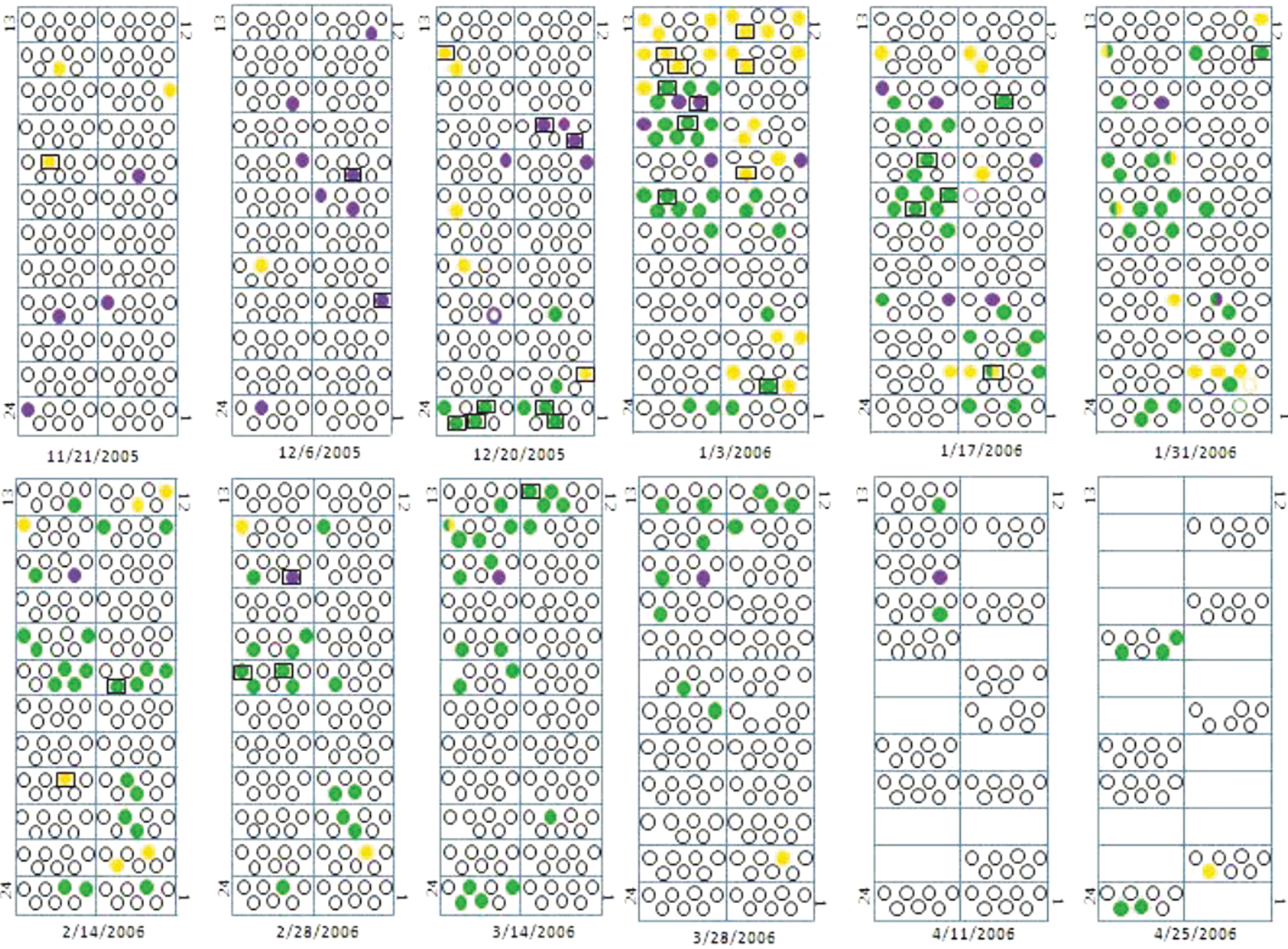
Longitudinal and spatial distribution of Escherichia coli O157 multiple-locus variable-number tandem repeat analysis (MLVA) subtypes from individual cattle during feeding period on a closed feedlot facility. The facility comprises 24 pens (rectangles). Each pen housed seven steers (circles). Steers positive for an MLVA subtype are indicated by a colored circle (subtype A, yellow; subtype B, purple; subtype C, green). If different MLVA subtypes were identified from different sampling methods, both colors will be shown with the fecal-immunomagnetic separation (IMS) shown on the left half of the circle and the rectoanal mucosal swab (RAMS)-IMS shown on the right half of the circle. Rectangles around individual steers indicate supershedding events at ≥104 colony-forming units/g of feces.
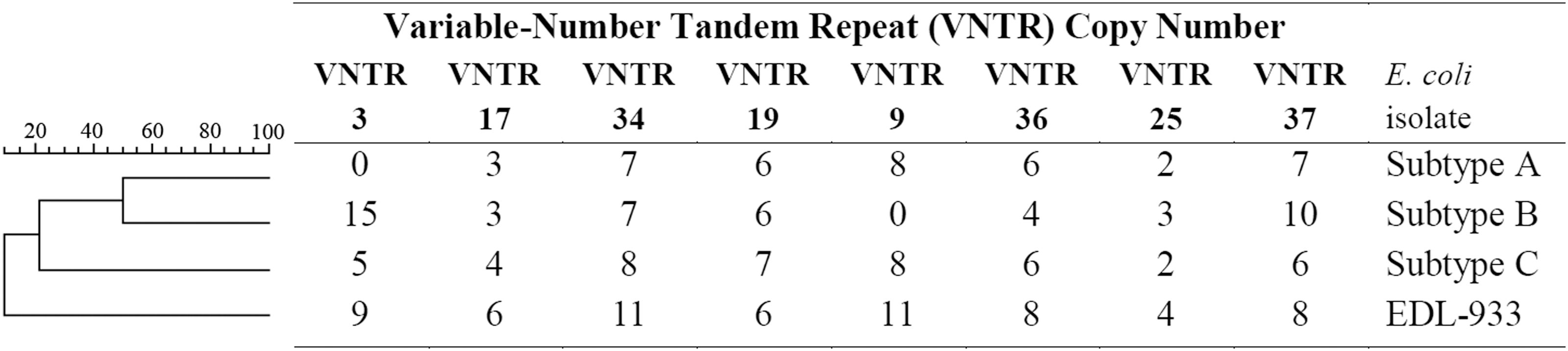
Allelic subtypes and associated dendrogram of relationships among Escherichia coli O157 isolates following multiple-locus variable-number tandem repeat analysis (MLVA). The dendrogram of MLVA subtypes was constructed using a categorical multistate coefficient and unweighted-pair group method with arithmetic mean clustering. EDL-933 is the E. coli O157:H7 isolate used for quality control.
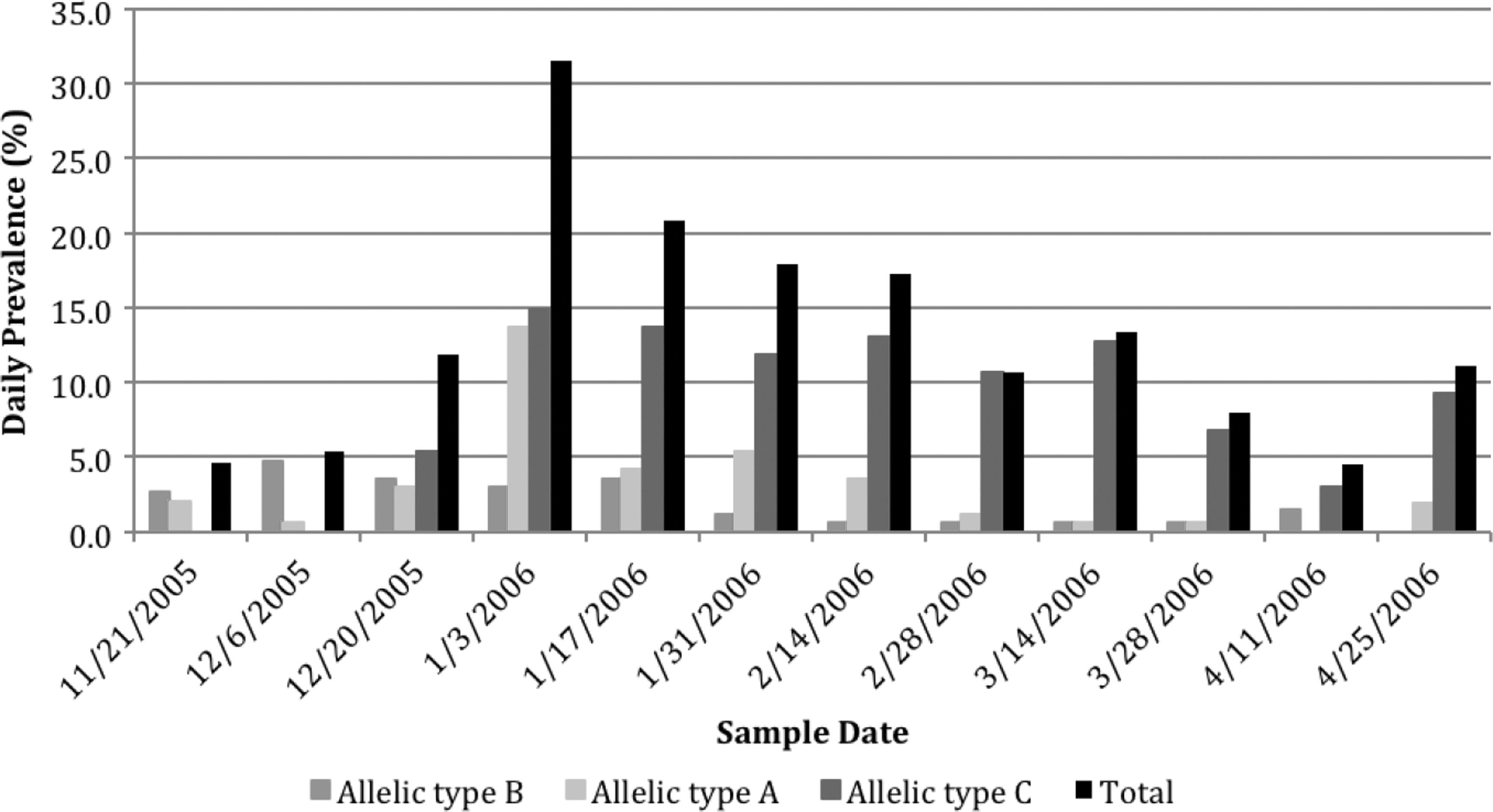
Daily animal-level prevalence of total Escherichia coli O157:H7 and corresponding multiple-locus variable-number tandem repeat analysis subtypes from a closed beef feedlot facility in Wooster, OH (2005–2006).
Individual steer sample data were classified based on the frequency of the E. coli O157 MLVA-types detected and magnitude of E. coli O157 shedding (Table 2 and Fig. 1). Fourteen steers (8% of the steers) had consecutive repeat shedding events of E. coli O157 with a unique MLVA-type and no evidence of a supershedding event from the same animal. Thirty-three animals (20% of the steers) were detected having a supershedding event during the study period with the majority of these events classified as transient shedding (Table 2). In the consecutive repeat shedding category, supershedding events associated with the first positive sample from the steer were recorded in eight instances (i.e., steer 1, pen 14, MLVA-type A; Fig. 1); whereas, seven steers in this category were observed to have supershedding events subsequent to the first positive sample (i.e., steer 4, pen 8, MLVA-type B; Fig. 1). Steer 6, pen 15 (MLVA-type B) was observed to have two supershedding events separated by three positive samples of lower-level shedding (Fig. 1). Supershedding events occurred with all three MLVA-types with a frequency of 17% for subtype A (10 steers), 17% for subtype B (6 steers), and 12% for subtype C (19 steers) (Fig. 1).
Frequency of E. coli O157 by either isolation method (fecal-immunomagnetic separation [IMS] or rectoanal mucosal swab [RAMS]-IMS).
Shedding<104 colony-forming units (CFU) per gram feces.
Supershedding ≥104 CFU per gram feces; if an individual animal had a supershedding event occur in a certain category, then that individual is listed as supershedding in the total number column.
Transient is defined as E. coli O157 isolation from an individual animal that occurred at a single sampling date.
Repeat shedding is defined as E. coli O157 isolation that occurred at more than one non-consecutive sampling date.
Consecutive repeat shedding is defined as E. coli O157 isolation that occurred at more than one consecutive sampling date.
One steer presented two consecutive repeat shedding events (see Fig. 1, steer 5, pen 24).
Statistical models
Based on univariable and multivariable analyses, for both the fecal and RAMS MLVA-type models, only the time in days and exposure to a penmate shedding MLVA-type C at ≥103 CFU at the time of sampling were statistically significant variables (Tables 3 –5). As the time in the feedlot increased, the odds of shedding MLVA-type C increased relative to other MLVA-types (Tables 3 –5). Similarly, exposure to a penmate shedding MLVA-type C at ≥103 CFU also increased the probability of an animal shedding MLVA-type C compared to other MLVA-types (Tables 3 –5). The remaining variables did not confound these associations, and the interaction term between the time and exposure to an MLVA-type C shedding animal (≥103 CFU) was not significant in the RAMS model (p=0.357). The fecal model did not converge when the above interaction term was included in the model. In both models, the greatest amount of variation in MLVA-type was explained at the sample level, and anywhere between 20% and 35% of the variation was explained at the pen- or animal-levels after accounting for the fixed effects in the model (Table 5).
Pseudo-likelihood method (reweighted iterative generalized least squares [RIGLS] and predictive quasi-likelihood—first order [PQL1]).
p-Value applies to the entire variable.
Testing whether MLVA type C is more likely to be part of a supershedding or high-shedding event than other subtypes.
Testing whether exposure to an animal supershedding or high-shedding MLVA type C in a pen during a sampling event is more likely to result in the shedding of MLVA type C compared to other subtypes.
OR, odds ratio; CI, confidence interval.
Pseudo-likelihood method (reweighted iterative generalized least squares [RIGLS] and predictive quasi-likelihood—first order [PQL1].
Confidence interval.
p-Value applies to the entire variable.
Testing whether MLVA type C is more likely to be part of a supershedding or high-shedding event than other subtypes.
Testing whether exposure to an animal supershedding or high-shedding MLVA type C in a pen during a sampling event is more likely to result in the shedding of MLVA type C compared to other subtypes.
Pseudo-likelihood method (reweighted iterative generalized least squares [RIGLS] and predictive quasi-likelihood—first order [PQL1]).
Confidence interval.
Testing whether exposure to an animal high-shedding MLVA type C in a pen during a sampling event is more likely to result in the shedding of MLVA type C compared to other subtypes.
Percent variation at each level estimated using the latent variable approach.
Discussion
During this grow-out period, the overall period prevalence of E. coli O157 as well as the individual subtypes followed a similar trend to the longitudinal study of LeJeune et al. (2004) and Cobbold et al. (2007). Like other studies, we identified a subtype that became the predominant subtype at the facility (Lahti et al., 2003; Sanderson et al., 2006). However, unlike these previous studies, the predominant isolate identified in this feedlot was not identified until the third sampling, 1 month into the study period. Although the delay in isolation of E. coli allelic subtype C does not preclude that this subtype originated from the cattle or was introduced at a later time through a wildlife vector, there is evidence that the subtype persisted in the environment of the feedlot: MLVA-type C was recovered from cattle on the same research facility during the first week of a study the following year (unpublished data). Environmental survival is also supported by the lack of statistically significant associations between the prevalence of subtype C related to the other subtypes and the different diets, indicating that another parameter was driving the success of this subtype.
This study highlights on-feedlot transmission dynamics by assessing longitudinal E. coli O157 subtype and shedding data of individual steers during natural exposure. A predominant E. coli O157 subtype was established within the feedlot that was unrelated to the supershedding events observed.
One hypothesis of this study was that conflicting results of the previous study's models resulted from the diets preferentially supporting E. coli O157 subtypes with different capacities for colonizing the bovine host that could be differentiated by MLVA. Based on fecal-IMS in the initial study, significant associations were identified for corn type, time of sampling, exposure to a supershedding penmate, and the interaction between corn type and exposure to a supershedding penmate (Cernicchiaro et al., 2010). In contrast, when this analysis was performed on the RAMS-IMS data, the effect of corn type on the prevalence of E. coli O157 varied with the type of feed additive given to the animal (Cernicchiaro et al., 2010). In this subsequent study, after analyzing these isolates for MLVA-type, we identified no significant associations between the diet type and the MLVA-type. There were also no differences in the association and significance of variables in the MLVA-type models regardless of the source of the sample (i.e., fecal versus RAMS). There may still be an effect of the study diets on the colonic microbial communities, and E. coli O157 subtypes specifically, but these changes were not discernible by MLVA-typing.
When the MLVA-types were compared at the individual steer level, regardless of study diet, these results supported novel ideas regarding persistence of detection, transmission dynamics, and the role of supershedding events. Several studies have shown the importance of supershedding events to the intrapen prevalence of E. coli O157 and therefore within farm transmission (Berg et al., 2004; Matthews et al., 2006; Chase-Topping et al., 2007; Cobbold et al., 2007; Cernicchiaro et al., 2010). Most of these studies reported enumeration of E. coli O157 using pens as the unit of analysis instead of individual animals or enumerated E. coli O157 from a single sampling point per animal. This study allowed the assessment of individual steer shedding status (supershedding, shedding, and nonshedding) over time to correlate shedding status with the MLVA-type of all the E. coli O157 isolates recovered from fecal-IMS or RAMS-IMS.
The second aim of the study was to provide insight to the role of supershedding events on the longitudinal shedding of E. coli O157 from individual steers and the transmission dynamics within the feedlot. In previous studies, the other researchers have suggested that supershedding would occur when an animal has been persistently colonized (Cobbold et al., 2007). During our study, E. coli O157 was detected most commonly during transient shedding (30% of the steers overall, 22% shedding<104 CFU/g feces, 8% were supershedding events with bacterial concentrations ≥104 CFU/g feces). In our study based on individual E. coli O157 subtypes, supershedding events (16/168; 10%) were observed occurring at both first and subsequent sample times from steers with consecutive repeat shedding of E. coli O157; however, consecutive repeat shedding events without supershedding were more commonly observed (26/168; 15% of the steers). Consecutive repeat shedding events in our study would be analogous to colonization as defined by Cobbold et al. (2007). In 22 instances (13%), steers were positive for the same MLVA-type during at least two consecutive samplings without observed supershedding events. This observation may result from our 2-week sampling intervals, as the supershedding event could be missed if it occurred during the nonsampling period. However, this observation also supports the idea that supershedding events may be a natural occurrence during the life cycle of this pathogen. The importance of sampling frequency and the need for reporting individual animal shedding data rather than pen data when analyzing shedding magnitude are emphasized by this study.
Previous research (Cobbold et al., 2007) would also indicate that dominant MLVA-types would result from a supershedding event, as the high concentration of bacteria shed in these instances poses a greater risk to the other animals that are exposed to this environment. Indeed, exposure to animals shedding higher levels of MLVA-type C increased the odds of another animal shedding subtype C; however, this finding was only significant (p≤0.05) when shedding levels of ≥103 CFU/g instead of ≥104 CFU/g were included in the model. This is consistent with the observation that animals exposed to another shedder will shed the same MLVA-type. Escherichia coli O157 allelic subtype C was detected more often during this study regardless of the shedding magnitude or frequency than the other allelic subtypes. No statistically significant difference in the prevalence of supershedding events of MLVA-type C as compared to the other two subtypes was found. In fact, supershedding events occurred with 17% of shedding events (steer-days) with both MLVA-types A (10/59) and B (6/36), but only 12% (19/156) of the shedding events (steer-days) with MLVA-type C. High-level shedding events introduce increased numbers of bacteria to the environment and therefore neighboring cattle; however, other intrinsic characteristics of the bacterium such as environmental or gastrointestinal survival following oral inoculation may have a more significant role in on-farm transmission of E. coli O157. Subtypes with better survival in harsh environmental conditions may be those subtypes that will predominate on a farm. Alternatively, predominant subtypes may be those that are best adapted to replication and survival in the exposed host.
Conclusions
A single E. coli O157:H7 subtype was found to predominate in this population. The different diets did not enrich for specific subtypes. Escherichia coli O157:H7 allelic subtypes isolated from individual animals on this feedlot indicate that high-level shedding of specific subtypes is a transient stage of the natural excretion process. High-level shedding of E. coli O157:H7 subtypes better suited for survival in the environment and/or host plays a significant role in the development of predominant E. coli O157:H7 subtypes. The relationship and control of individual E. coli O157:H7 subtypes may play an important role in persistence and bacterial transmission within the feedlot environment. Further research into the characteristics that enable the preferential survival of certain subtypes in the bovine host, and possibly the environment, could lead to the identification of control measures.
Footnotes
Acknowledgments
This research was supported by state and federal funds allocated to the Ohio Agricultural Research and Development Center. The computational infrastructure for this research was obtained with the support of the Canada Foundation for Innovation and the Ontario Ministry of Research and Innovation through funds granted to D.L. Pearl. The authors wish to acknowledge everyone who assisted with the original study without whom this project would not have been possible.
Disclosure Statement
No competing financial interests exist.
References
Supplementary Material
Please find the following supplemental material available below.
For Open Access articles published under a Creative Commons License, all supplemental material carries the same license as the article it is associated with.
For non-Open Access articles published, all supplemental material carries a non-exclusive license, and permission requests for re-use of supplemental material or any part of supplemental material shall be sent directly to the copyright owner as specified in the copyright notice associated with the article.
