




Abstract
Pork is a major cause of foodborne salmonellosis. Consequently, effective measures that could reduce the prevalence of Salmonella at the farm are of interest. In the present study, three field trials were performed to evaluate the effect of strategic administration of organic acids, at concentrations estimated by economic criteria, on the Salmonella prevalence in finishing pigs. Pigs received either a mixture of acids (lactic, formic, propionic, and acetic) added to their drinking water at a concentration of 0.035% (trial A), or a basal diet containing 0.5% potassium-diformate, KH(COOH)2, (trials B and C), during the last 6–7 weeks of the finishing period. Fecal Salmonella shedding and seroprevalence were monitored in the animals at four time points during the study. Mesenteric lymph nodes and cecal contents were collected from a subset of animals at the slaughterhouse and cultured for Salmonella. At the end of the finishing period in all three trials, the percentage of seropositive pigs was higher in the control group than in the experimental group, regardless of which cutoff value was used in the enzyme-linked immunosorbent assay (ELISA) assay. The frequency of fecal shedding was lower also in the treated pig groups from the trials A and B at the end of the finishing period. The results from the samples collected at the slaughterhouse did not yield differences between groups in trials A and B. However, Salmonella isolation was less frequent in the mesenteric lymph nodes from the experimental pigs in trial C. The seroprevalence reductions, together with some promising results in the reduction of shedding, support the idea that this intervention is a useful strategy to reduce Salmonella prevalence at the farm.
Introduction
S
The necessity of identifying strategies to mitigate the risk of Salmonella infections has prompted the evaluation of different on-farm control strategies for primary pig production (Dahl, 1997; Mikkelsen et al., 2004; Van Immerseel et al., 2006; Denagamage et al., 2007; García-Feliz et al., 2009). Addition of acidic compounds to control Salmonella in finishing pigs has been tested in challenge studies (Anderson et al., 2005; Taube et al., 2009), but also in field trials, some with promising results (Boyen et al., 2008; Creus et al., 2007; Visscher et al., 2009), and others without clear benefits (Dahl et al., 1996; Van der Wolf et al., 2001; De Busser et al., 2009). More research about dosage and duration of treatments is needed to evaluate their efficacy.
The objective of this study was to determine whether the strategic administration of organic acids in water or feed, at concentrations set by economic criteria, and during the last part of the finishing period had any effect on the prevalence of Salmonella in infected swine finishing herds.
Materials and Methods
Experimental design
Three field trials were performed at three different finishing farms (trials A, B, and C) where a Salmonella seroprevalence greater than 50% was reported in the previous batch of finishers. The main characteristics of the facilities and treatments are described in Table 1. The three farms were integrated into multisite production systems and followed a strict all-in/all-out management. Each selected farm consisted of two barns with harmonized characteristics and were filled at the same time with pigs that were approximately 70 days old and had the same origin. Organic acids were administered by water or feed; therefore, the treatments were set at the barn level. The acid treatment was administered to the pigs housed in one of the barns during the last 6–7 weeks of the finishing period (experimental group; EG), while no treatment was administered to the animals housed in the other barn (control group; CG). The veterinarians in charge of collecting the samples as well as the technicians who processed them at the laboratory were blinded.
Seroprevalence was determined by the analysis of 50 samples per herd.
MLN, mesenteric lymph nodes.
In the first experiment (trial A), a commercial acid (Acidvall®, MEVET) was administered by water to the EG animals. Forty pigs from each group were randomly selected at the start of the finishing period; these animals were ear-tagged and tracked during their finishing. Another 40 randomly selected pigs per group were sampled at the slaughterhouse, as it was not possible to ensure the correct tracking of the previously selected animals within the slaughterhouse. The experimental and control pigs were allocated in different trucks and holding pens and were slaughtered separately to avoid mixing the pigs or samples between the groups. The feed was supplemented for 14 days at the start of the finishing with a combination of colistin (120 ppm), oxibendazole (40 ppm), lincomycin (44 ppm), and spectinomycin (44 ppm) in both barns. Moreover, during the third week of finishing, both barns were medicated with doxycycline (100 ppm) and lincomycin (50 ppm) for 5 days, due to a respiratory problem. No antimicrobial treatment was used during the administration of the acid, and none of the monitored pigs received individual antimicrobial treatments. Individual treated pigs were identified and marked to avoid sampling them at the slaughterhouse.
Two finishing farms participated in a second experiment (trials B and C). During the last 7 weeks of the finishing period, the pigs in the experimental groups received their basal diet (Table 2) containing 0.5% potassium-diformate, KH(COOH)2 (Formi®, BASF). Forty pigs were randomly selected from each group at each sampling. Transport and slaughter were performed under the same conditions as those described in trial A. Regarding the antimicrobial use during these two trials, a prophylactic treatment with doxycycline-colistin (1 kg/100 L) was administered during 10 days at the beginning of the finishing in trial B, while initial feed in trial C was medicated with doxycycline (250 ppm) for 7 days. The same policy of antimicrobial restriction during the period of acid administration was followed in the trials B and C.
Both farms used nonpelleted feed.
Samplings performed and sample collection
Four samplings were carried out at the farm within each trial. A preliminary sampling (sampling 0) was performed at the beginning of the finishing period, followed by three samplings at the beginning, halfway through, and the last day of the treatment. In each of these samplings, blood and rectal feces (≥25 g) were directly recovered from the selected pigs. Pools of feces from pens, 10 of each group, were collected each sampling day during trials B and C (Table 1).
At the slaughterhouse, the gastrointestinal tracts from 40 randomly selected pigs per group were collected and processed in an adjoining facility to collect the MLNs and cecal contents as described elsewhere (Arguello et al., 2012).
The sample collection was conducted aseptically, and instruments and gloves were changed between samples. All of the samples were transported directly to the laboratory under cooling conditions and were processed immediately after their arrival.
Sample processing
Sample processing and bacteriological analysis was performed as previously described (Arguello et al., 2012), following the current International Organization for Standardization methodology 6579:2002/Amd 1:2007. A single confirmed Salmonella isolate from each positive sample was serotyped by slide agglutination using commercial antisera (BioRad) in accordance with the White-Kauffmann-Le Minor scheme (Grimont and Weill, 2007).
The serological analysis was performed with a commercially available indirect ELISA for the detection of porcine–immunoglobulin G anti-Salmonella lipopolysaccharide, according to the manufacturer's instructions (Herdchek Swine Salmonella Antibody Test Kit, Idexx Laboratories). Three different cut-offs were fixed at optical densities (OD) of 10%, 20%, and 40%. Using the interpretation of the results obtained with these three cut-offs, we tried to elucidate the effect of the treatments on Salmonella seroconversion and seroprevalence.
Statistical analysis
The number of sampled pigs within each sampling series (40 pigs per group) allowed for the detection of a reduction in prevalence of Salmonella from 40% to 15% with a confidence level of 95% and a power of 80%. The data were stored and analyzed using the EpiInfo™ for Windows software (CDC, USA). Within each trial, the chi-square test at α=0.05 was used to detect significant differences between the proportion of Salmonella-positive samples in the EG and CG (p<0.05). The strength of the association was estimated using relative risk (RR).
Results
Bacteriological results
The results of the bacteriological isolation of Salmonella from the samples collected at the farm and at the slaughterhouse are summarized in Table 3.
Salmonella prevalence was evaluated by checking pooled-pen (10 samples) and individual fecal samples at the farm, and cecal content and mesenteric lymph nodes (MLN) at the slaughterhouse (40 pigs).
Control group (CG) received no treatment. Experimental group (EG) received a treatment with acids during the last 6–7 weeks of the finishing period. Sampling series were distributed as follows: sampling 0 at the beginning of the finishing period, sampling 1 at the start of the treatment, sampling 2 at the middle of the treatment, and sampling 3 at the end of the treatment in conjunction with the end of the finishing period EG. EG received a treatment with acids during the last 6–7 weeks of the finishing period.
Thirty-nine were sampled in the CG at this sampling.
Statistically significant differences were achieved between groups (p<0.05).
In trial A, the prevalence of Salmonella shedders was significantly lower in the CG (1 of 40) compared to the EG (10 of 40) at sampling 2 (χ2=6.75, p<0.01). However, at the end of the finishing period, a lower prevalence was detected in the EG pigs (7 of 40) compared to the CG pigs (20 of 39) (χ2=8.57, p<0.01; RR=2.34, 95% confidence interval [CI] 1.41–6.25). Salmonella isolation from the cecal content and the MLN samples was also lower among the EG pigs compared to the CG pigs, although these differences did not reach statistical significance (χ2=1.83, p=0.18 and χ2=1.33, p=0.24, respectively). Salmonella Typhimurium was the serotype detected of all the isolates obtained during trial A.
The proportion of Salmonella shedders in trials B and C was always low and did not exceed 22.5% in any of the samplings. In trial B, statistically significant differences were reached in the sampling carried out at the end of the finishing period, when the prevalence of Salmonella shedders was significantly higher in the CG (9 of 40) compared to the EG (1 of 40) (χ2=5.60, p=0.017; RR=9.0, 95% CI 1.20–67.78). No significant differences were detected in the frequency of shedding between the EG and the CG in any of the samplings performed during trial C.
No differences were detected in the prevalence of Salmonella from any of the samples collected at the slaughterhouse in trial B. Salmonella was present in 15 MLN samples from the CG but was not detected at any of the 40 MLN samples analyzed from the EG pigs in trial C (χ2=16.08, p<0.001).
Salmonella Rissen was the serotype detected in the positive samples collected at the farm in trial B. It was also detected in the cecal content at the slaughterhouse, although two additional serotypes—Salmonella Derby and Salmonella Typhimurium—were recovered from MLNs. All of the isolates recovered during trial C were Salmonella Rissen.
Serological results
The serological results based on 10% OD, 20% OD, and 40% OD cut-off points are summarized in Table 4 and Figure 1.
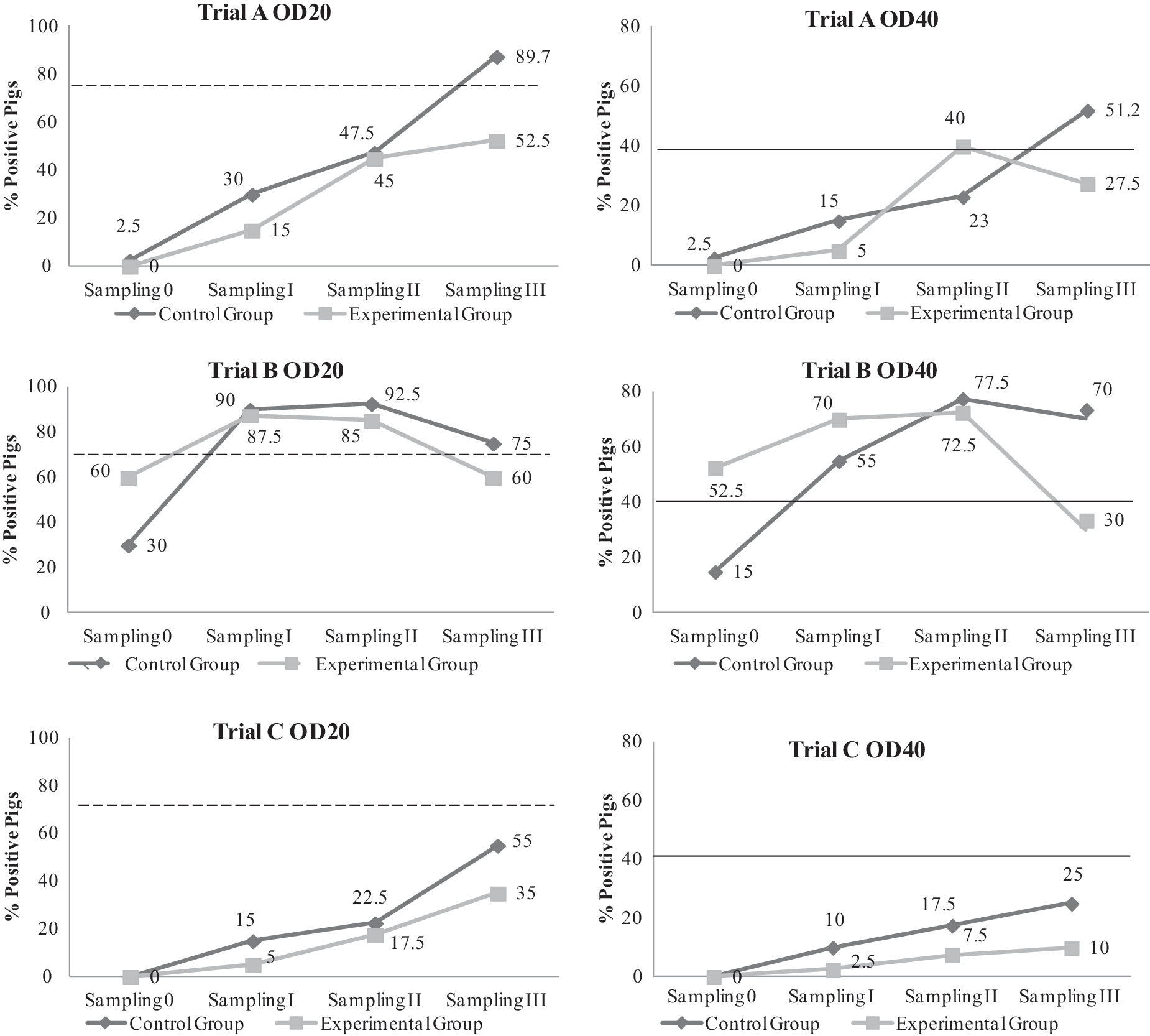
Assessment of the effect of two acid treatments administered by water (field trial A) or feed (field trials B and C) on Salmonella prevalence as determined by serological analysis. Seroprevalence was estimated by enzyme-linked immunosorbent assay using 20% optical density (OD) and 40% OD cut-offs. Control group received no treatment. Experimental group received a treatment with acids during the last 6–7 weeks of the finishing period. Sampling series were distributed as follows: sampling 0 at the beginning of the finishing period, sampling 1 at the start of the treatment, sampling 2 at the middle of the treatment, and sampling 3 at the end of the treatment coinciding in coincidence with the end of the finishing period. Solid line (—) represents the index 40% of seropositive pigs, while dashed line (---) the index 70% of seropositive pigs, which are the limits used in this study to establish high-contaminated farms for the respective OD cut-offs.
Number and percentage of positive pigs. Results provided by a commercial indirect enzyme-linked immunosorbent assay interpreted using three different cut-offs.
Control group (CG) received no treatment. Experimental group (EG) received a treatment with acids during the last 6–7 weeks of the finishing period. Sampling series were distributed as follows: sampling 0 at the beginning of the finishing period, sampling 1 at the start of the treatment, sampling 2 at the middle of the treatment and sampling 3 at the end of the treatment in conjunction with the end of the finishing period.
Thirty-nine pigs were sampled in the CG at this sampling.
Statistically significant differences were achieved between groups (p<0.05).
OD, optical density.
In trial A, few pigs had seroconverted at the beginning of the finishing period (sampling 0). Salmonella seroprevalence continued to rise in both groups until the end of the experiment, regardless of the cut-off used. The proportion of seropositive pigs was significantly lower in the monitored pigs from the EG compared to those from the CG at the end of the treatment for the 10% OD cut-off (χ2=4.04, p=0.044; RR=1.27, 95% CI 1.03–1.57) and the 20% OD cut-off (χ2=11.53, p<0.001; RR=1.71, 95% CI 1.25–2.34). The difference was also close to statistical significance based on the 40% OD cut-off value (χ2=3.37, p=0.053).
In trial B, at the beginning of the finishing period, significantly higher seroprevalence values were detected in pigs from the EG compared to pigs from the CG based on the results of the three cut-offs (χ2=4.06, p=0.043; χ2=6.11, p=0.013 and χ2=10.96, p<0.001, respectively). However, no statistically significant differences were detected at the beginning of the treatment (sampling 1) or half-way through the treatment period (sampling 2). At the end of the finishing period (sampling 3), the number of seropositive pigs was higher in the CG pigs compared to the EG pigs regardless of the cut-off, although statistically significant differences were only achieved by the 40% OD cut-off (χ2=11.25, p<0.001; RR=2.33, 95% CI 1.39–3.91).
The course of infection was different in trial C compared to the other two trials. Seroconversion mostly took place at the end of the finishing period, between samplings 2 and 3 (Fig. 1). Significant differences in the proportion of seropositive animals between groups were only achieved at the end of the treatment and based on the 10% OD cut-off. The percentage of seronegative pigs (less than 10% OD) was higher in the EG compared with the CG (χ2=8.07, p=0.0045; RR=4.00, 95% CI 1.47–10.92).
Discussion
Delivering pigs with reduced prevalence of Salmonella to slaughter would be expected to be beneficial for reducing the potential of horizontal spreading of the pathogen to noninfected animals and in reducing the overall Salmonella burden (Berends et al., 1996; Borch et al., 1996). With this premise, we aimed to determine the reduction in the prevalence of Salmonella at finishing farms that could be achieved by the addition of acids to water or feed. Considering that several studies have reported that acid administration is an expensive intervention (van der Gaag et al., 2004; Goldbach and Alban, 2006), the acid concentrations and treatment durations were estimated by economic criteria, together with the pig-producer companies involved. Although the treatment costs were limited to 1.4 € (€1=approximately US$1.18, UK£0.80 as of November 22, 2012) and 1.344 € per pig, for Acidvall and Formi, respectively, the concentrations used were within the theoretical effectiveness margins according to the manufacturers' recommendations. The three pig producers involved considered these costs of the treatments affordable.
If well performed, field trials are the best tool to assess the efficacy of therapeutic or prophylactic procedures under field conditions. In contrast, the control of external factors that can affect or alter the experimental outcomes analyzed is critical. In order to minimize these external factors, pigs from both groups were subject to the same husbandry practices at each of the studies performed. Prophylactic antimicrobial treatments in feed or water are a common practice in pig production at the beginning of the finishing period. The effect of these antimicrobial treatments on the gut microflora and particularly in the establishment of Salmonella was identical in the control and experimental groups, and therefore they should affect both similarly. The use of antimicrobials in water or feed was avoided during the acid treatment.
The serological results confirmed that the herds were infected with Salmonella in each of the three field trials. The onset of the infection in trial B occurred before the beginning of the finishing period while according to serological data, most of the pigs from units A and C became infected during finishing, since only a few of the sampled pigs at the beginning of this finishing period tested positive. Although no statistically significant differences between control and experimental groups were detected at the beginning of the acid treatment in any of the trials, differences in Salmonella seroprevalence between the groups were evident at the end of the finishing period regardless of the treatment used. This effect can be extrapolated to the classification of the groups in surveillance programs. While the experimental groups from trials A and B would be theoretically classified as moderately infected by the serosurveillance programs used in Denmark (Alban et al., 2002) or Germany (Osterkorn et al., 2001), the control groups from these farms would be included in highly contaminated farms. According to serological data from trial C, the infection was established later and the probability of finding a seronegative pig (OD<10%) at the end of trial was four times higher in treated pigs than in control pigs, supporting that a protective effect was also achieved by the acidification treatment. By this finding, it is demonstrated that due to variations in the infection onset and intensity, it is strongly advisable to use several cut-offs to interpret these serological results. The results obtained are in accordance with previous studies (van der Wolf et al., 2001; Creus et al., 2007; Visscher et al., 2009), and support the idea that organic-acid preparations administered by feed or water to finishing pigs can reduce the prevalence when they are used at effective concentrations and for a sufficient length of time. In contrast, other studies have failed to demonstrate any effect in the seroprevalence (Dahl et al., 1996; De Busser et al., 2009).
The use of organic acids has also been associated with decreased Salmonella shedding in challenge studies (Papenbrock et al., 2005; Taube et al., 2009), and a significant reduction in the number of Salmonella shedders was reported by Creus et al. (2007) in one of two herds that received an acidified feed. However, the intermittent fecal excretion of Salmonella from naturally infected pigs (Beloeil et al., 2003) makes it difficult to assess acidification interventions under field conditions; hence many studies have failed to demonstrate any clear effect on the prevalence of Salmonella shedders (Dahl et al., 1996; De Busser et al., 2009). Based on the results of our study, no clear reduction in Salmonella shedding was achieved by the acidification, although part of the results provided some insights in this respect. Significant differences among pigs from the control groups compared with pigs receiving acid treatment were achieved at the end of the finishing in trials A and B. In contrast, it must also be indicated that a significantly lower prevalence of Salmonella shedders was detected in control pigs compared to acid-treated pigs in the sampling performed halfway through the treatment in trial A. This result was not supported by serological results from the same or subsequent sampling.
In previous field trials, limited impact of acid treatments was achieved in the samples collected at the slaughterhouse (Dahl et al., 1996; Letellier et al., 2001; Creus et al., 2007; De Busser et al., 2009). In the present research, the Salmonella prevalence in the cecal contents was similar in pigs from both groups in the three trials, and a similar result was obtained for the MLNs in trials A and B. It must also be considered that a number of studies have shown that carriers can become active shedders or new infections can occur (Arguello et al., 2012; Hurd et al., 2002), therefore complicating the interpretation of slaughter results when evaluating on-farm interventions. However, a reduction in the proportion of Salmonella carriers in the MLNs was demonstrated in trial C. Contrary to the other two trials, the infection in trial C occurred at the end of the finishing period when the acid treatment had already started. In agreement with this result, Creus et al. (2007) proposed that organic acids could limit the colonization of MLNs if they are administered before the establishment of the infection.
Conclusions
In the present study, the administration of organic acidic compounds via drinking water or feed during the last part of the finishing was associated with a reduction in the seroprevalence and, to a lesser extent, a reduction in the prevalence of Salmonella shedders at the end of the finishing period. No benefits in the carriage of Salmonella in the gut were achieved at the slaughterhouse, although the acid administration could be linked to a decreased MLN colonization. The present study suggests that this intervention could be used at the farm to reduce Salmonella prevalence throughout the pork production chain.
Footnotes
Acknowledgments
We gratefully acknowledge the veterinarians, farmers, and slaughterhouses involved in this study for their active cooperation. We also appreciate the excellent technical assistance provided by G.F. Bayón and our lab colleagues. We also want to thank the reviewers for their useful suggestions, which have permitted us to improve the quality of our work. This work was funded by the Ministerio de Agricultura, Pesca y Alimentación, the Ministerio de Ciencia y Tecnología project No. GL2002-04161-C02-01, by the Centro para el Desarrollo Tecnológico Industrial Project No. IDI-20090375, IDI-20090376 included in the PROCADECO, and by the Junta de Castilla y León Project No. C.O. C137.s. Héctor Argüello was supported by a grant from the Consejería de Educación of the Junta de Castilla y León and the European Social Fund.
Disclosure Statement
No competing financial interests exist.