




Abstract
Salmonella is one of the most important foodborne pathogens, which causes a huge economic burden worldwide. To detect Salmonella rapidly is very meaningful in preventing salmonellosis and decreasing economic losses. Currently, isolation of Salmonella is confirmed by biochemical and serobased serotyping methods, which are time consuming, labor intensive, and complicated. To solve this problem, a hexa-plex polymerase chain reaction (PCR) method was developed using comparative genomics analysis and multiplex PCR technology to detect Salmonella and Salmonella Typhimurium, Salmonella Enteritidis, Salmonella Agona, Salmonella Choleraesuis, and Salmonella Pullorum simultaneously. The accuracy of this method was tested by a collection of 142 Salmonella. Furthermore, the strategy described in this article to mine serovar-specific fragments for Salmonella could be used to find specific fragments for other Salmonella serotypes and bacteria. The combination of this strategy and multiplex PCR is promising in the rapid identification of foodborne pathogens.
Introduction
S
The classical biochemical identification and serotyping for Salmonella are time consuming, labor intensive, and complicated (Kim et al., 2006a). Polymerase chain reaction (PCR) methods have shown promise in microbial identification over the past decades because of their rapidity and accuracy (Liu et al., 2012). There have been some studies on the detection of serovar-specific Salmonella. There are two strategies for detecting serovar-specific Salmonella with PCR: One is to find the serovar-specific target sequence by comparative genomics analysis and detect the targets (Kim et al., 2006b; Liu et al., 2012); another is to design primers to determine different genes responsible for surface polysaccharide (O) and flagellar (H) antigens (Hong et al., 2008). Genes encoding for O-antigens and H1 and H2 antigens are homologous, so it is hard to differentiate all the antigens based on PCR. An increasing number of genomic sequences are available at the National Center for Biotechnology Information (NCBI), which makes the first strategy more popular and convenient.
In this study, the specific sequences of Salmonella Typhimurium, Salmonella Enteritidis, Salmonella Agona, Salmonella Pullorum, and Salmonella Choleraesuis were mined using the BLASTN program. The first three have been described as the most frequent Salmonella serovars contaminating foodstuffs and humans in China (Wang et al., 2004; Ran et al., 2011), while Salmonella Choleraesuis and Salmonella Pullorum are the leading salmonellosis-causing agents in swine and poultry in China, resulting in serious economic burden (Pan et al., 2010). Specific fragments were used to design primers for use in a hexa-plex PCR assay to identify Salmonella and five serotypes.
Materials and Methods
A total of 12 Salmonella strains and 10 non-Salmonella strains (Supplementary Table S1; Supplementary Data are available online at
Genomic sequences of Salmonella including Salmonella Typhimurium, Salmonella Enteritidis, Salmonella Pullorum, Salmonella Agona, and Salmonella Choleraesuis were available from NCBI (
To develop a hexa-plex PCR, six pairs of primers based on the six fragments (Supplement 3) were designed by PrimerPlex 2.61 (Premier Biosoft, Palo Alto, CA). To ensure that fragments could be distinguished on a gel, the parameter of amplicon size difference was 50 bp to 200 bp. The specificity of the primer sets was tested against 12 Salmonella strains and 10 non-Salmonella strains. Primer mix (2.4 μL) (10 μM for each primer of six pairs) was used in a 20 μL reaction mixture. Each reaction mixture also contained 10 μL of Premix Ex Taq™ (TaKaRa, Dalian, China), 1 μL of template, and 6.6 μL of nuclease-free water. The negative control contained the reaction mixture except DNA template, and the positive control contained the reaction mixture and DNA templates of the five serotypes. The multiplex PCR amplification program was as follows: 95° for 5 min, followed by 32 cycles of 94° for 30 s, 60° for 30 s, and 72° for 30 s, and final extension at 72° for 8 min. The hexa-plex PCR products were separated on 3.0% agarose gels and visualized under ultraviolet light. The accuracy of the multiplex PCR was tested against 142 Salmonella strains, which were isolated from food animals.
Results and Discussion
Five serovar-specific fragments were selected based on comparative genomics analysis through the BLASTN program from NCBI. A stand-alone BLASTN program can be used to mine specific sequence markers that are specific for pathogens (Xu et al., 2002; Yu et al., 2011), but the process of sequence downloading from another genome database was required and the requirement for the computer configuration was high. Therefore, rapid mining of DNA fragments for specific bacteria via the servers and databases on NCBI was more convenient.
Six pairs of primers designed by PrimerPlex 2.61 were tested by hexa-plex PCR. The best reaction conditions were demonstrated in the Materials and Methods section. The result of hexa-plex PCR against 12 Salmonella strains and 10 non-Salmonella strains is shown in Supplementary Table S1 and Figure 1. Lane 24 was a positive control (i.e., the template comprised the five serotypes). All of the Salmonella strains were positive for the invA gene, and non-Salmonella strains were negative. Each serotype from the five serotypes was positive for the serovar specific primers, respectively, and no cross-reaction was observed for other serotypes or non-Salmonella isolates. To test the accuracy of the hexa-plex PCR assay, 142 Salmonella isolates stored by our laboratory were used to conduct a blind PCR assay. The results obtained were consistent with biochemical and serobased serotyping methods, except for two untyped Salmonella that were identified as Salmonella Typhimurium. This phenomenon may be due to the presence of a rough phenotype, or no expression of flagellar antigens (Cardona-Castro et al., 2009), which may indicate that the molecular detection methods have a certain advantage over serobased serotyping methods to some extent.
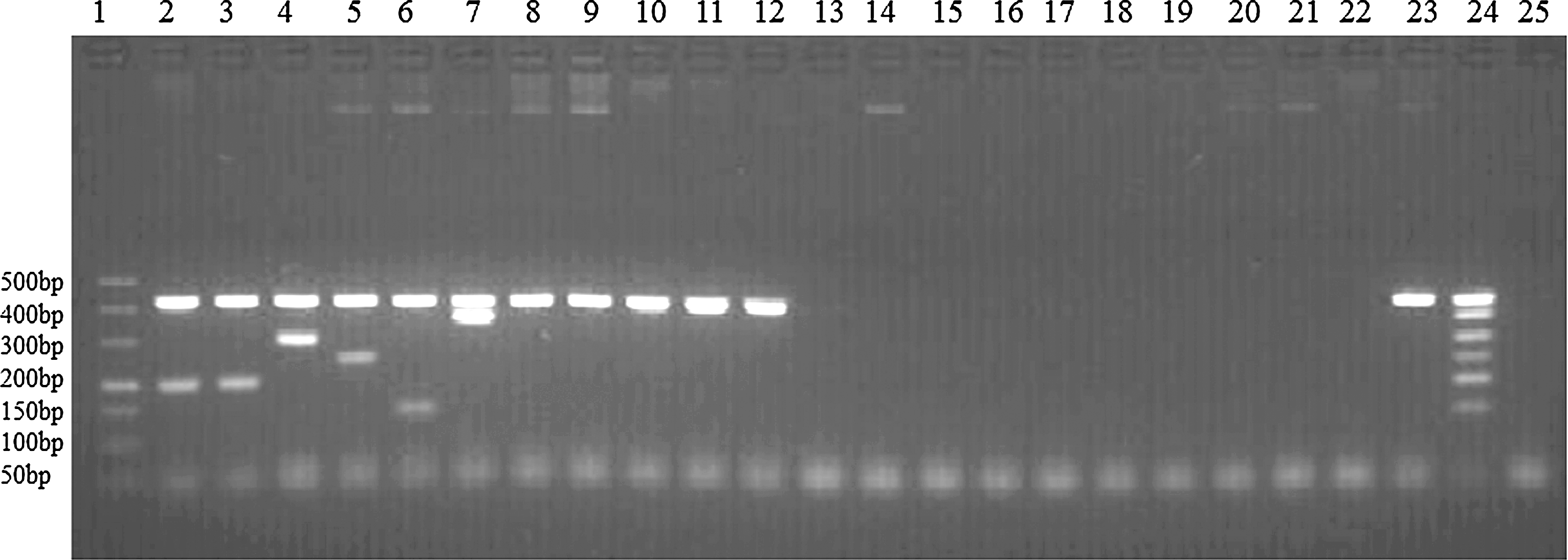
Agarose of hexa-plex polymerase chain reaction production of 12 Salmonella strains and 10 non-Salmonella strains. The interpretation of the results can be found in Supplementary Table S1.
The rapid detection of multiple serotypes could decrease the time and labor that conventional biochemical and serotyping methods consumed. In this study, we developed a hexa-plex PCR that can detect Salmonella and five important serotypes. The accuracy is good, but other serotypes that are rarer are needed to further validate and ensure no cross-reactions. Also, this method cannot replace the serobased serotyping method completely, because of the limited serotypes this method can detect.
In conclusion, there are two important points from this study. One is the strategy used to mine the specific fragments for serotypes without a stand-alone BLASTN program, which can be used to mine other serovar-specific fragments or specific fragments for other bacteria. The other is the hexa-plex PCR method used to identify Salmonella and five important serotypes, which can be used to identify isolates rapidly. With the growing number of sequences resources available in NCBI, more Salmonella serovar-specific fragments and specific fragments for other bacteria can be found and used as templates for molecular detection assays.
Footnotes
Acknowledgments
This work was supported by National Natural Science Foundation of China (no. 30972216 and U1031004), Special Fund for Agro-scientific Research in the Public Interest (201203040), and Key Projects in the National Science & Technology Pillar Program during the Twelfth Five-Year Plan Period (2012BAK01B02).
Disclosure Statement
No competing financial interests exist.
References
Supplementary Material
Please find the following supplemental material available below.
For Open Access articles published under a Creative Commons License, all supplemental material carries the same license as the article it is associated with.
For non-Open Access articles published, all supplemental material carries a non-exclusive license, and permission requests for re-use of supplemental material or any part of supplemental material shall be sent directly to the copyright owner as specified in the copyright notice associated with the article.
