




Abstract
A total of 982 individuals distributed in 11 lots belonging to 10 fish species from three Atlantic FAO fishing areas were sampled and examined to detect the presence of anisakid larvae in fish muscle. After hazard identification by genetic sequencing and exposure assessment by anatomic extent and demographic characterization of infection, all data were fitted for each fish species to a new proposed scoring schema of parasite prediction. In the absence of a criterion standard method for inspection and precise definition of the quantum satis for parasites in contaminated fish lots, the inspection rating scheme called SADE (Site of infection, Assurance of quality, Demography, Epidemiology) may help fish industries to precisely handle and to evaluate the likely outcome of infected fish lots after being diagnosed. For this purpose, a supporting flow diagram for decision was defined and suggested. This new performance assessment tool has the aim of staging fish lots, thus helping in planning manufacture, commercial, and research decisions during self-management programs. This novel scoring system provides an improved inspection format by implementing the occurrence stratification for parasites to guide Hazard Analysis and Critical Control Points (HACCP) programs for the uniform exchange of information among fish industries, administration and researchers, thus facilitating standardization and communication. In the future, this scoring version could be validated (in terms of classification and wording) for similar overall predictive purposes in other muscular parasites infecting seafood products.
Introduction
Most anisakid larvae are found in the viscera, mesentery, and gonads of the fish (Vidacek et al., 2009), and in a lower amount in the flesh (Wharton et al., 1999; Llarena-Reino et al., 2012). The number of muscular anisakids depends basically on the ecological niche of fish species (Holst et al., 1993; Stromnes and Andersen, 1998). It has been noted that there is some postmortem migration of the larvae from the viscera cavity into flesh (Smith, 1984), although it is not clear when, under what conditions, and in which fish species this occurs (EFSA, 2010).
Currently, invasive fish inspection methods are considered “better” or “truer” because they allow direct examination of flesh parasites and their spread in the edible part of fish, in contrast to nondestructive methods, which in the case of whole fish are clearly limited by the fact that the information is obtained by making indirect observations at parasites in the gut (Commission Regulation (EC) No. 2074/2005), resulting in biased estimations with no statistical confidence (Llarena-Reino et al., 2012). Several methods have been developed and used for detection, diagnosis, and identification of parasites in fish, from the oldest ones such as visual inspection (Hartmann and Klaus, 1988), light microscopy (Rijpstra et al., 1988), or candling (Wold et al., 2001; Butt et al., 2004), until some revised and recently updated ones such as the pepsin digestion protocol (Lysne et al., 1995; Lunestad, 2003; Thien et al., 2007; Thu et al., 2007; Llarena-Reino et al., 2013). These methods are being applied by fishery operators or laboratories. Recent techniques including ultraviolet illumination (Adams et al., 1999; Levsen et al., 2005; Marty, 2008), ultrasound (Hafsteinsson et al., 1989; Nilsen et al., 2008), X-rays and conductivity (Nilsen et al., 2008), electromagnetism (Choudhury and Bublitz, 1994), magnetometry (Jenks et al., 1996), immunological techniques (Xu et al., 2010; Rodríguez-Mahillo et al., 2010), polymerase chain reaction (PCR)-based (Zhu et al., 2002; Abe et al., 2005; Pontes et al., 2005), real-time PCR (Herrero et al., 2010; Fang et al., 2011), phage display (López et al., 2011), real-time fluorescence resonance energy transfer (Monis et al., 2005; Intapan et al., 2008), or imaging spectroscopy (Heia et al., 2007) are under continuous improvement processes.
Regardless of the inspection method employed, when facing up to an infected fish lot, correction measures settled at any step or procedure will depend on how relevant the parasite infection is. In other words, the Hazard Analysis and Critical Control Points (HACCP) works in an overall predictive assessment fashion that should include the parasite identity, the spread of parasites in the edible part of fish, and the food quality and safety implications of this biological hazard. This study was intended to help express and resolve all of these questions by designing a simple scoring system of parasite infection in fish flesh. In order to provide evidence-based criteria, we inspected and then scored several commercial frozen fish lots to offer a proof-of-concept of the applicability of the inspection system proposed.
Materials and Methods
Parasite diagnosis
As Regulation (EC) No. 2074/2005 specifies in Section 1 of Annex II, laying down specific provisions for visual inspection of eviscerated fish, fish fillets, and slices, a representative number of individuals will be submitted to a visual inspection at establishments on land and on board factory vessels. It also states that qualified technicians from establishments will determine the scale and frequency of inspections depending on the type of the fish products, their geographical origin, and the final use they are intended for. During the present work and as a proof-of-concept to demonstrate the feasibility of this scheme to be incorporated to routine quality control programs in fish industries, a total of 11 commercial lots, each one comprising 17–329 specimens of 10 fish species from three FAO fishing areas were sampled and characterized as summarized in Table 1. The whole musculature of each individual was inspected. Guts were not included in the examinations because these parts are usually discarded during fish-processing procedures. At the time of capture, fishes were frozen at −20°C in order to avoid migrations of anisakid larvae from visceral cavity to somatic muscle. Full necropsies, collection of parasites, and tissue sampling were carried out in every single fish. Then each fish was thinly sectioned and every fragment was visually inspected for parasites on a candling table with the aid of a Nikon SMZ800 stereomicroscope. Afterward, the whole fish muscle (hypaxial and epaxial regions separately) of each individual was digested in pepsin solution according to Llarena-Reino et al. (2013) to recover previously undetected parasites during the visual inspection. Any parasite found was identified on the basis of morpho-anatomical diagnostic characters (Berland, 1961, 1989; Fagerholm, 1982; Olson et al., 1983; Smith, 1983; Køie, 1993). Moreover, for some specimens molecular identification was performed by amplification and sequencing of the ITS1-rDNA region, using the primers NC5-NC2 (Zhu et al., 1998). DNA extraction of nematodes was carried out with NucleoSpin Tissue Kit (Macherey-Nagel). PCR reactions were performed in a total volume of 25 μL containing 1 μL of genomic DNA (150–200 ng), PCR buffer at 1× concentration, 1.5 mM MgCl2, 0.2 mM nucleotides (Roche Applied Science), 0.3 μM primers, and 0.625 U Taq DNA polymerase (Roche Applied Science). The cycling program was 2 min at 94°C, 35 cycles of 30 s at 94°C, 30 s at 55°C, and 75 s at 72°C, followed by 7 min at 72°C. PCR products were separated on a 1% agarose (in 1× Tris-acetic EDTA buffer) gel, stained with ethidium bromide, and scanned in a GelDoc XR documentation system (Bio-Rad Laboratories). PCR products were purified with MinElute PCR Purification Kit (Qiagen GmbH, Hiden, Germany). Sequencing was performed by Secugen Company (Madrid, Spain). The chromatograms were analyzed using ChromasPro v.1.41 (Technelysium Pty Ltd.). Sequences were subject to Basic Local Alignment Search Tool (BLAST) analyses against available sequences from GenBank, through web servers of the National Center for Biotechnology Information (USA).
The resulting SADE code and the final score for each lot after applying the staging system proposed here are also provided.
P, I, A, and D, prevalence, mean intensity, mean abundance, and density; CI, confidence interval; SD, standard deviation; SADE (scoring system), Site of infection, Assurance of quality, Demography, Epidemiology.
The terms prevalence (P), mean intensity (I), mean abundance (A), and density (D) of infection were determined for each fish lot following Bush et al. (1997) and Rózsa et al. (2000).
Scoring system
The scoring system, namely SADE (Site of infection, Assurance of quality, Demography, Epidemiology), presents a categorization of parasite infection. This tool is being presented in a highly visual and rapid-reference format. Fish lots are grouped according to four homogeneous categories (indices or “bins” of disease importance, namely S, A, D, and E), which are further divided with some accommodation into subcategories (denoted by numerals). The lower the number, the more advanced the hazard (i.e., “high-risk features”) tends to be. The objective of SADE is the score of fish lots. By summing the numerical values assigned to each batch along the four categories, the SADE system adopts a 10-point scale. Each company must determine the level of score that sets off the implementation of measures to ensure food safety and quality of processed batches. The highest score indicates parasite-free fish lots. The lowest scores refer to serious weaknesses in the fish evaluated; that means a fish lot that should be reprocessed to guarantee its visual quality and/or safety attributes.
•
S0: disseminated (spread throughout the whole flesh)
S1: located in the epaxial zone
S2: located in the hypaxial zone, including the visceral body cavity
S3: parasite-free
•
A0: both topics included in A1 (pathological changes and parasite motility)
A1: gross pathological changes in infected tissues (undesirable components such as nodules in belly-flaps, melanized capsules in fillets, milky flesh, hemorrhages in the vent areas (e.g., Beck et al., 2008) or commercial reject due to a live parasite, mostly associated with parasite motility in fresh fish (e.g., Pascual et al., 2010)
A2: neither pathological nor commercial problems
•
D0: density >5 parasites/kg
D1: density 2–5 parasites/kg
D2: density <2 parasites/kg
•
E0: zoonotic species of parasite (or its metabolites) associated with gastrointestinal diseases, other documented allergies, and/or clinical manifestations
E3: species of parasite with no published evidence-based data demonstrating human health affection. The importance of this point in terms of food security leads to assigning it a value of 3 points
Flow diagram: An easy tool to use the scoring system
Based on the SADE scoring system and following an HACCP schema, the flow diagram herein proposed was subsequently generated to standardize epidemiological stages provided by fish-inspection results. Figure 1 illustrates this flow diagram as a user-friendly tool that can be easily implemented and controlled by the technicians and followed by fish workers.

Flow diagram for the Site of infection, Assurance of quality, Demography, Epidemiology (SADE) Scoring System illustrates an ordered and structured work schema based on Hazard Analysis and Critical Control Point principles to be easily implemented and followed by fish industries. From stage 1 to 4, the user classifies each inspected fish lot according to the localization of parasites, the presence/absence of pathological or unaesthetic signs in the edible part of fishes, the density of infection, and finally to the epidemiological relevance of the etiologic agent. As result, a SADE code and a final score are obtained for each lot checked, in order to decide which industrial process or final destination may be followed.
Results
Parasite diagnosis
Table 1 gathers the characteristics of all the processed fish lots. Three nematode species belonging to Anisakis and Pseudoterranova genera were identified by molecular studies as responsible for muscular infection in the fish lots analyzed (Table 2). For every fish species, demography of infection showed higher values at the hypaxial region than in the epaxial muscle (Fig. 2). In fact, over 45% of the inspected lots were parasite free at the epaxial muscle, whereas all the lots showed some degree of infection at the belly-flap region surrounding the viscera (hypaxial region). Anisakid parasites were never exclusively found in epaxial flesh. Although these results showed that epaxial infection always took place simultaneously with hypaxial location and not vice versa (this may be related to migration routes from viscera to muscle), some authors have demonstrated that there is a positive relationship between the gut and muscular number of parasites at epaxial musculature as well (Llarena et al., 2012). Because of this, epaxial infection has to be taken into account during fish inspection processes. On the other hand, demographic values of parasite infection were the highest (from high to low) in Lophius budegassa, Merluccius merluccius, Micromesistius poutassou, and Lophius piscatorius. Coryphaenoides rupestris showed the lowest anisakid infection values. No fish species were found to be free of parasites.
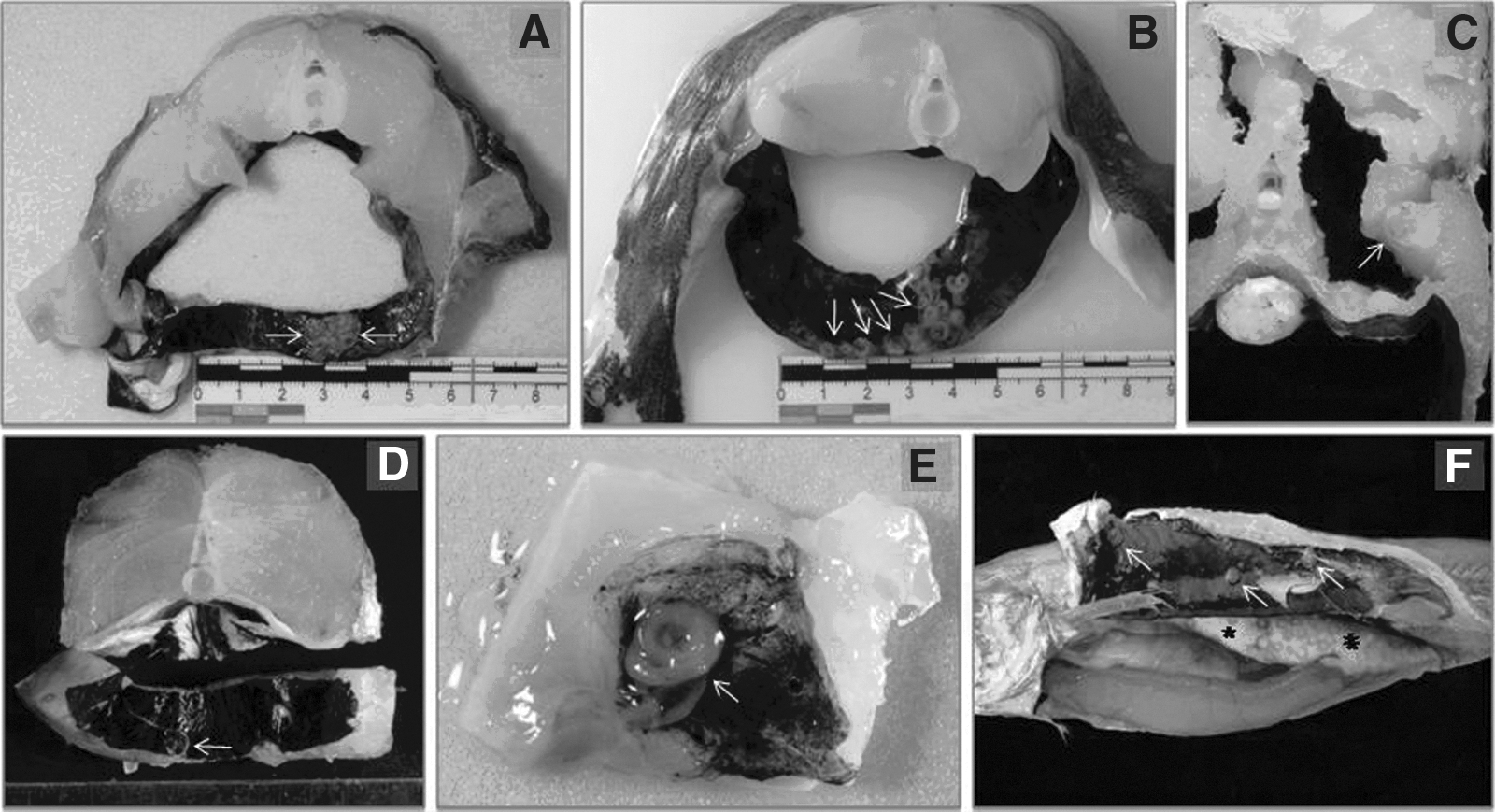
Transversal sections of Lophius budegassa (
NEAFC, North East Atlantic Fisheries Commission; ICES, International Council for the Exploration of the Sea.
Fitting the scoring system
Results based on epidemiological relevance of the parasite, pathological findings, and demographic values of infection for each fish lot fit easily into the scoring strategy. Table 1 reports the inspection results categorized by the SADE scoring system, thus showing for each fish species a “SADE Score” as results of the addition of the code points. For example, Merluccius merluccius from FAO 27 has a scoring of 1, which results after adding up the scoring in each code (“S0 A1 D0 E0”). The score refers to a fish lot with a disseminated Anisakis infection, which could produce gastrointestinal diseases, allergies, and/or other clinical manifestations for the consumer, relevant commercial repercussions (due to evident pathological signs in the infected areas), and density values of infection greater than five parasites per kilogram.
Regarding the resulting scores, all of the species had between 1 and 6 points, and FAO 27 species (except for Coryphaenoides rupestris and Sebastes mentella) were the lowest scoring species. It also was remarkable that the two lots whose fishes showed the largest body lengths (belonging to Coryphaenoides rupestris and Macruronus magellanicus, from higher to lower) were the groups with the highest resulting scores.
Discussion
Currently, the European fish industry complies with the current legislation, recommended practices, and guidelines implemented by the governments and regulatory agencies, to carry out parasite control on their facilities and products. Basically, official inspections and self-management programs based on the HACCP system comprise the current practices to eliminate or reduce the risk of this biological hazard in seafood products. Despite this, there is still a historical concern regarding consumer complaints or lawsuits in trade operations when a contaminated fish lot reaches any given susceptible step from the sea to the plate. These problems arise above all due to the absence of an established legal maximum limit for anisakids in fish lots. Specifically, Regulation EC 178/2002 states that food shall not be placed on the market if it is unsafe (i.e., injurious to health or unfit for human consumption). Regardless of the treatments that could be applied on parasitized fishes to prevent the ingestion of viable parasites (i.e, zoonoses), any parasitized fish is unfit for reasons of contamination by extraneous matter or otherwise. Moreover, the subjective application of some confusing concepts such as “visible parasite” and “clearly contaminated,” specified in the European Hygiene Package (2004), Council Regulation (EC) 2406/96, and Commission Regulations (EC) 1662–1664/2006, makes it possible that each operator follows its own rules. In fact, the absence of a criterion standard method and the lack of an analytical critical limit to distinguish an acceptable from an unacceptable infected fish lot provoke a heterogeneous modus operandi at self-management controls. This circumstance leads to multiple methods of managing parasitized fish lots and does not prevent rejections in the last points of fish value chain due to visually highly parasitized fish. This is the reason why in the absence of an inspection standard and a quantum satis statement for parasites, it is important that fish industries embrace a common language to operate (i.e., standard terminology) that guarantees inspectors and consumers an appropriate predictive scoring of parasitized fish.
SADE scores can be fitted to any commercial fish lot from a particular fishing ground, size–maturity–age of fish, fish cohort, or postharvest condition. This information could then be used to propose risk mitigation and prevention measures at harvesting, processing, and postprocessing. Moreover, SADE scoring is an added-value tool that improve the modus operandi at self-management processes by increasing (1) consumer, professional, and trade confidence (due to a standardized working method); and (2) competitive strengthening in fish operators by achieving a higher standard quality and preventing product losses. In fact, SADE may accurately predict outcomes for the fishery industries related to the unaesthetic images that significantly impact on the commercial value of the affected products. This fact has been forcing the seafood industry to discard large quantities of fish and to intensify quality-inspection protocols on seafood products.
Thereafter, the SADE scoring system can be adapted or modified as needed over time. The SADE lexicon could be multifold by adding variables (i.e., diagnostic factors) into subcategories. This illustrates the future increasing complexity of stage grouping, when factors other than S, A, D, and E, such as branches and leaves, are included and added to the main tree trunk. SADE was constructed to assess four basic indicative categories, but this nodal staging system can be adapted to build more “look-up” predictive classifications in other well-known muscular parasites in seafood products. Therefore, scoring would give a common language for evaluating parasite risk in fish inspections, becoming a technological tool operating in silico for research, industrial, and commercial use within HACCP programs. Scoring is also useful in harmonization and prospection of research results derived from large data sets and from the peer-reviewed literature (e.g., meta-analysis). In this way, the SADE system has been constructed as a “bin model.” That means that it can use the diagnosis of an infected fish lot already in the bin (i.e., in a given subcategory) to predict what will happen to a new fish lot placed in that bin.
Footnotes
Acknowledgments
We would like to thank the excellent technical assistance from the Ecobiomar staff. Xunta de Galicia has funded this work under Projects INCITE-07MMA015CT, IN841C, 10TAL001CT, and 10TAL033E. María Llarena-Reino thanks Fundação para a Ciência e a Tecnologia for financial support under Grant SFRH/BD/45398/2008.
Disclosure Statement
No competing financial interests exist.