




Abstract
Cattle are considered to be one of the primary reservoirs of Escherichia coli O157. In this study, the effects of weaning diets on E. coli O157 shedding, body weight, and fecal bacterial communities in beef calves were evaluated. A total of 60 calves (28 heifers and 32 steers) were weaned and randomly assigned into two groups. A peanut/soy hull–based diet (Dry Feed, DF) and a corn silage–based diet (High Moisture, HM) were fed to the two groups, respectively, during the weaning and preconditioning period. Calf body weight was measured before weaning (BW) and 14 days after weaning (AW14), and a fecal sample was collected from each calf at BW, AW14, as well as 56 days after weaning (AW56). The prevalence of O157 in feces was determined by CHROMagar™ O157 and polymerase chain reaction (PCR). Denaturing gradient gel electrophoresis (DGGE) was employed to analyze fecal bacterial communities. A significant decrease in body weight was observed during weaning, regardless of the calf diet (p<0.05). Calves fed the HM diet lost more weight than the DF-fed calves determined at 14 days after weaning (p<0.05). Both the CHROMagar™ and PCR results showed that the overall prevalence of O157 increased significantly during weaning. Based on the CHROMagar™ method, O157 increased from 16.6% at BW to 38.3% at AW14 (p<0.05) and stayed at the higher level during the preconditioning period (AW56). The increase in O157 prevalence was observed in HM-fed calves during weaning but not in DF-fed ones. Weaning also changed the profile of fecal bacterial communities (p<0.05). These results showed that weaning is a critical step in beef cattle production, not only because of its effects on body weight but also due to its impact on O157 shedding and gastrointestinal tract bacterial community establishment.
Introduction
E
Weaning is a critical step in the preharvest continuum of beef production (Enriquez et al., 2011). During weaning, the social separation of the calves from their dams and the dietary shift are likely to create stress in calves (Enriquez et al., 2011). Weaning stress in dairy calves can lead to depressed feed intake, depressed growth and immunity, and an increased opportunity for enteric pathogen colonization (Edrington et al., 2011; Enriquez et al., 2011; Kim et al., 2011). Garber et al. (1995) showed that O157 prevalence in dairy calves increased by three times after weaning compared to the prevalence before weaning. Weaning stress in dairy calves occurs very shortly after birth of the calf, whereas weaning stress in beef calves occurs several months after birth. This might have different outcomes relative to the susceptibility and carriage of E. coli O157 in these two types of weaning practices.
During the preharvest stage of beef production, studies have reported that diets can alter not only the calf growth but also O157 shedding (Owens et al., 1997; Sargeant et al., 2007). Studies have also shown that dietary intervention can reduce the calves' nutritional and social dependence on dams and ameliorate the immunity depression during weaning (Weary et al., 2008; Kim et al., 2012). However, the effects of dietary intervention on O157 shedding during weaning are still undetermined.
Cattle's gastrointestinal (GI) tracts contain complex bacterial communities (Dowd et al., 2008). During weaning, the dietary shift may change the calves' ruminal and intestinal microflora, which, in turn, might play an important role in calf health and pathogen shedding (Chaucheyras-Durand and Durand, 2010; Romero-Perez et al., 2011). It has been reported that a shift in the gut microbial profile (such as a higher Enterococcus population) induced by feeding hay exhibited a competitive exclusion effect on the E. coli O157 population (Gregory et al., 2000; Callaway et al., 2009). Unfortunately, few studies have been done focusing on the changes in beef calf fecal bacterial communities during weaning, and evaluating the effects of weaning diets on O157 shedding.
Learning how to better control O157 shedding during the preharvest stage is considered to be an important step in the multihurdle O157 elimination strategy for beef production. Thus, the objectives of this study were to (1) determine the effects of weaning diets on E. coli O157 shedding, body weight, and bacterial community establishment in calves; and (2) monitor the O157 shedding changes during the preconditioning period.
Materials and Methods
Animals
A total of 60 calves (British×Continental breed, 28 heifers and 32 steers) were raised with their dams and grazed on warm-season perennial grass pastures since birth. They were on dams' milk and pasture ad libitum for approximately 9 months until weaning. On the weaning day, calves were separated from their dams and their body weights were measured and fecal samples were collected (before weaning–BW). Calves were then randomly assigned to six pens (10 calves per pen): three pens were fed a peanut/soy hull–based dry feed (DF) diet, while the other three pens were fed a corn silage–based high moisture (HM) diet. The two diets were designed based on the nutrient requirements of beef cattle (National Research Council, 1996) targeting at approximately 1 kg of average daily gain (ADG). The nutrient compositions of the two diets are listed in Table 1.
Calves were weighed again on Day 14 (AW14), and fecal samples were collected. To monitor the O157 shedding of calves through the preconditioning period, fecal samples were collected one more time from all calves 56 days after weaning (AW56). The experimental protocol was approved by the Institutional Animal Care and Use Committee of Auburn University.
Fecal sample collection
Fecal samples were collected by rectal grab. To prepare samples for fecal bacterial DNA extraction, approximately 1 g of each fresh fecal sample was immediately transferred to a 15-mL sterile tube containing 5 mL of RNAlater solution and 0.5 g of 3-mm glass beads. The tubes were mixed manually for 10 s to preserve the samples. The remaining part of each fecal sample was then transferred to a 125-mL sterile specimen container (VWR, USA) and kept on ice. All samples were transported to the laboratory within 4 h and processed immediately. The RNAlater preserved samples were stored at 4°C until analyzed.
Culture detection of E. coli O157
Twenty-five grams of each fecal sample were weighed and transferred into a sterile Whirl-Pak sample bag (Nasco, USA) with 225 mL of lactose broth (Difco, USA). Samples were homogenized for 2 min in a Smasher (AES Chemunex, USA) and incubated at 35°C for 24 h. The enriched samples were then streaked onto CHROMagar™ O157 plates (CHROMagar™, France). After incubating at 37°C for 24 h, the presence/absence of presumptive E. coli O157 colonies was determined according to the user's manual.
Polymerase chain reaction (PCR) detection of O157 shedding
To confirm E. coli O157:H7 shedding, DNA was extracted from 1 mL of the enriched lactose broth samples (described above) following the procedures described by Matsuki et al. (2004). The PCR reactions were carried out via the Veriti Thermal Cycler (Applied Biosystems, USA) using the E. coli O157:H7 specific primers targeting the uidA gene (Cebula et al., 1995; Wang et al., 2007). To determine whether the fecal sample was positive for E. coli O157:H7, the presence of the uidA gene target band (227 bp) was confirmed on a 2% (wt/vol) agarose gel. To determine the limit of PCR detection, serial dilutions of pure cultures of E. coli O157:H7 were transferred into six tubes of autoclaved enriched fecal sample broth (1–106 colony-forming units (CFU)/mL, final concentrations), forming positive controls. DNA was then extracted from these positive controls and the PCR reactions were carried out as described above.
DNA extraction for bacterial community analysis
Each 15-mL RNAlater tube with fecal samples (BW and AW14) were mixed thoroughly by vortexing for 1 min, and DNA was extracted from 400 μL of homogenate according to the procedures described by Matsuki et al. (2004). The extracted DNA was stored at −20°C until DGGE analysis.
Bacterial community analysis via denaturing gradient gel electrophoresis (DGGE)
The bacterial 16S rDNA V3 variable regions from fecal DNA samples were amplified by PCR (Muyzer et al., 1993), and then DGGE analysis was performed by a D GENE System (Bio-Rad, USA). The 8% (wt/vol) polyacrylamide gels in 0.5×TAE buffer were prepared along a 30%–60% linear denaturing gradient. Electrophoresis was performed in 0.5×tris-acetate-EDTA (TAE) at 150 V and 60°C for 7 h. Gels were stained with GelRed (Biotium, USA) and photographed by a GelDoc system (Bio-Rad). In each gel, one “control” sample was loaded in the outside lanes as the markers, and all gel images were aligned and merged into one image relative to the “control” marker lanes. This was subjected to DGGE analysis.
The DGGE gel image was analyzed using Quantity One software (Bio-Rad) according to the user guide. The band type tables with relative intensity values (total intensity of all bands in each lane was defined as 100%) were exported to Excel (Microsoft, USA). To visualize the relationship of bacterial profiles, principal component analysis (PCA) was performed based on the band relative intensity in Canoco 4.5 (Biometrics, Netherlands), and the PCA plot was graphed by CanoDraw (one module of Canoco). To assess the effects of weaning/diets on bacterial communities, redundancy analysis (RDA) with unrestricted Monte Carlo permutation tests (499 random permutations, p<0.05) were also performed in Canoco 4.5 (Lepš and Šmilauer, 2003).
Statistical analysis
For statistical analysis, calves were treated as six groups: (1) before-weaning calves assigned to the DF diet (BW-DF), (2) before-weaning calves assigned to the HM diet (BW-HM), (3) 14-days-after-weaning calves fed the DF diet (AW14-DF), (4) 14 days-after-weaning calves fed the HM diet (AW14-HM), (5) 56 days-after-weaning calves fed the DF diet (AW56-DF), and (6) 56 days-after-weaning calves fed the HM diet (AW56-HM). The prevalence of E. coli O157 shedding in each group was calculated in two ways: (1) by individual calf: the percentage of O157 shedding-positive calves in relation to the total number of calves for each group was calculated; (2) by pen: the percentage of O157 shedding-positive calves was calculated in each pen, and then the mean percentage±standard deviation was calculated for each group. Chi-square tests (by individual calf) and Student t-tests (by pen) were employed to compare the O157 prevalence between groups, respectively (p<0.05). For calf body weight, the average weight was calculated for each pen, and then the mean weight±standard deviation for each group was calculated and used for analysis. Student t-tests were used to compare the body weight between groups (p<0.05). All data were analyzed using SPSS 16.0 (SPSS Institute, USA).
Results
Calf body weight
The effect of weaning on calf body weight is shown in Table 2. A significant decrease in body weight was observed during weaning (comparing BW and AW14) regardless of the diets (p<0.05). Calves fed the HM diet lost more weight (average 10.2±3.6 kg per calf) than those fed the DF diet (average 5.2±3.0 kg per calf) during weaning (p<0.05).
Average weight or weight loss was calculated in each pen, and the mean weight±standard deviations of three replicate pens for each group were analyzed.
Indicates a significant difference between before and after weaning under the same diet (Student t-test, p<0.05).
Indicates a significant difference between DF- and HM-fed cattle (Student t-test, p<0.05).
DF, dry feed; HM, high-moisture feed; BW, before weaning; AW14, 14 days after weaning.
E. coli O157 shedding prevalence
The E. coli O157 shedding prevalence was monitored by both CHROMagar™ and PCR (Table 3). No significant difference in the initial O157 prevalence (BW) was observed between the two diet groups (20.0% DF versus 13.3% HM, p>0.05), regardless of the E. coli O157 detection and calculation methods used. Based on the CHROMagar™ method, the overall O157 prevalence (by calf) increased significantly during weaning (from 16.6% at BW to 38.3% at AW14, p<0.05) and stayed at the higher level 56 days after weaning (AW56). The data indicated that the prevalence of O157 increased significantly at AW14 and at AW56 (40%) compared to BW (13.3%) for the HM-fed calves, while no difference was observed for the DF-fed calves (Table 3). When O157 prevalence was calculated by pen, the same results were obtained: The overall O157 prevalence increased significantly from BW (19.4%±11.7%) to AW14 (30.2%±18.9%) and kept at a high level at AW56 (33.2%±17.3%). The O157 prevalence increased significantly in HM-fed pens during weaning (AW14/AW56 versus BW), while no significant changes were observed in DF-fed pens.
Pooled DF- and HM-fed data into one group.
Indicates a significant difference between BW, AW14, and AW56 under the same diet (chi-square test, p<0.05).
Indicates a significant difference between BW, AW14, and AW56 under the same diet (Student t-test, p<0.05).
DF, dry feed; HM, high-moisture feed; BW, before weaning; AW14, 14 days after weaning; AW56, 56 days after weaning.
The PCR detection limit for O157 was 103 CFU per milliliter of enriched culture. The PCR results were consistent with the CHROMagar™ results and once more confirmed that the overall O157 prevalence increased significantly; the HM-fed calves had a 23.3% increase (AW14-BW, calculated by calf) in their O157 prevalence (Table 3).
Fecal bacterial communities
The fecal bacterial communities in calves were assessed by DGGE, and the PCA plot was performed to analyze the relationship of fecal bacterial profiles in the calves (Fig. 1). Principal components (PC) 1 explained 33.7% of the total variation, while PC1 and PC2 together explained 40.1% of the total variation. The fecal bacterial profiles were mainly grouped into three clusters (C1, C2, and C3). Forty-seven of 60 AW14 samples were clustered into C1, which also included three samples from BW. The majority of the BW samples were clustered into C2 and C3. In addition to the BW samples, the C2 and C3 also contained two and five AW14 samples, respectively. In the region between C2 and C3, two BW samples and six AW14 samples were clustered together. The differences in bacterial profiles between DF and HM samples were not observed using the PCA plot. This result was confirmed by RDA. The Monte Carlo permutation tests showed that weaning did affect the fecal bacterial communities significantly (p=0.004) but the diets (HM versus DF) did not.
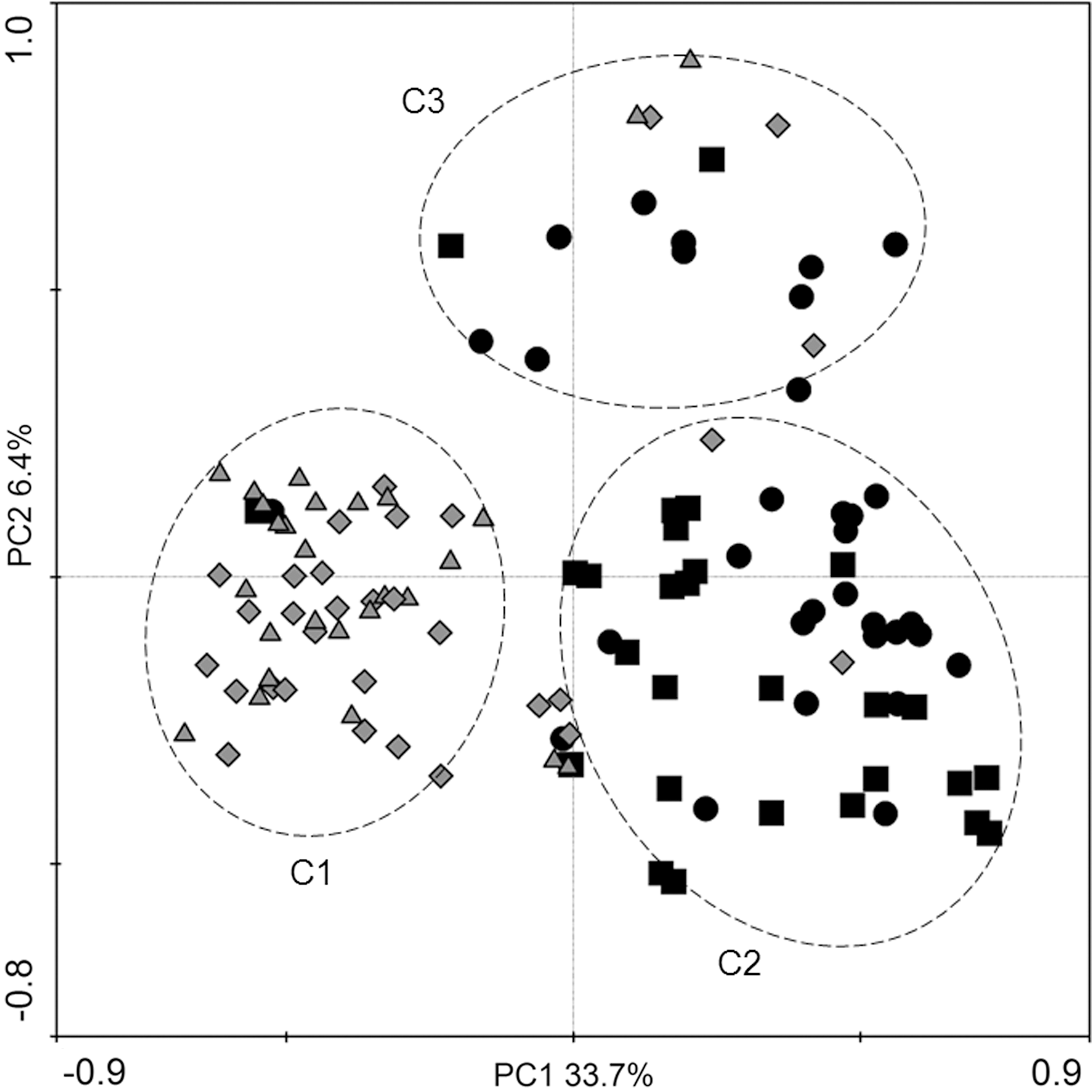
Principal component analyses plot for fecal bacterial communities. ●, before-weaning calves assigned to the dry-feed diet; ■, before-weaning calves assigned to the high-moisture diet; ▲, 14-days-after-weaning calves fed the dry-feed diet; ◆, 14-days-after-weaning calves fed the high-moisture diet. Three clusters (C1, C2, and C3) were observed. PC1, principal components 1; PC2, principal components 2.
Discussion
Relative to the nutrient analysis of the two weaning diets, the peanut/soy hull–based diet (DF) provided a higher dry mass, crude protein, and fiber than the corn silage–based diet (HM). However, approximately equal average daily gains were observed from the two diets (≈0.9 kg, Table 1), indicating the similar energy performance of the two diets.
Weaning stress caused temporary weight loss. Significant decreases in calf body weight were observed 14 days after weaning. At AW56, the calf body weight recovered and was higher than BW. However, statistical analysis showed that there was no significant difference between the two diets (p>0.05, data not shown). Similar results also have been observed by Phillips et al. (1989), who reported that calves lost 5.9% of their weight during weaning and did not recover the lost weight 4 days later. Due to the stress and dietary shifts during the weaning, calves reduce their feed intake during weaning (Enriquez et al., 2011). In this study (Table 2), calves fed the DF diet had less weight loss than HM-fed calves. One reason might be that the high dry matter of the DF feed satiated the calves better and increased the rates of ruminal digestion and passage, thus providing more nutrients during weaning (Shaver et al., 1988).
To avoid false-positive results, two methods were applied to each enrichment culture to assess the prevalence of E. coli O157 in calves during and after weaning. Although PCR found one false-positive sample, both the CHROMagar™ results and the PCR confirmation indicated the same trends of O157 prevalence changes during and after weaning. Results showed that the O157 prevalence increased during weaning and stayed high until AW56. A previous study reported that there was increased E. coli O157 prevalence in dairy calves during weaning (Garber et al., 1995). However, contrary results were reported by Synge et al. (2003) in a study conducted in Scotland. They reported that weaning did not affect O157 shedding by beef calves. The discrepancy between the studies might be due to the different weaning procedures used for dairy and beef calves (Edrington et al., 2011; Garber et al., 1995), as well as the different O157 detection methods used (antigen detection versus culture method), the different sampling seasons, and the different feeds (Synge et al., 2003; Edrington et al., 2011).
Two reasons might contribute to the increased O157 shedding during weaning stress and during the preconditioning period: (1) weaning stress might induce the attenuation of the immune function (Kim et al., 2012), which might then lead to higher O157 colonization (Naylor et al., 2003); and (2) the sudden dietary shifts from pasture/milk to feedlot-type feeds might contribute to an increase in E. coli populations (Diez-Gonzalez et al., 1998). Dietary effects on O157 prevalence were observed in this study. Peanut/soy hull–based feeds (DF) did not change the O157 shedding prevalence, while the HM-fed calves showed an increased shedding prevalence. Similar results have been reported from previous studies. Diez-Gonzalez et al. (1998) and Herriott et al. (1998) reported that a low-grain diet resulted in low O157 shedding, and feeding corn silage significantly increased the risk of enterohemorrhagic E. coli shedding among heifers. However, contrary results also were reported. Callaway et al. (2009) reported that changing from dry grain to corn silage reduced the E. coli shedding level. Although the mechanism has not been well defined, the concentrations of readily metabolizable substrates available for fermentation in the lower bovine intestinal tract might be a contributing factor to the higher level of O157 shedding (Callaway et al., 2009).
There is a complex microflora in the GI tract of cattle that are affected by many factors, such as cattle genomics, age, environment, and diets (Romero-Perez et al., 2011; Durso et al., 2012; Mayer et al., 2012). It has been reported that the GI tract microflora can affect calf health and pathogen shedding (Chaucheyras-Durand and Durand, 2010). In this study, the PCA plot revealed that the BW samples were grouped into two regions (C2 and C3), while AW14 samples were mainly congregated in one range (C1). This indicated that the BW samples had more interindividual differences than the AW14 samples. Both PCA plot and RDA indicated that weaning significantly influenced the bacterial communities. The results suggested that weaning and the feedlot-type diets could lead to a different calf fecal bacterial community, compared to the pasture/milk diet. Previous studies have reported that the presence of indigenous bacteria might have an inhibiting effect on the growth of O157 in vitro and in vivo (Kim and Jiang, 2010; Momose et al., 2008). Our study indicated that the shift in fecal bacterial communities in the calf GI tract during weaning appeared to have an impact on the prevalence of O157. Further research should focus on the changes in bacterial communities and the relationship between specific bacteria and E. coli O157 in the bovine GI tract.
Conclusions
In this study, changes in E. coli O157 shedding, calf body weight, and fecal bacterial communities were investigated in beef calves subjected to weaning stress. Two diets were fed to the calves during the weaning period to evaluate their effects on amelioration of weaning stress on the calves. The stresses of weaning increased E. coli O157 shedding prevalence and caused body weight loss. Weaning is a critical step for fecal bacterial community establishment. The byproduct feed diet composed of peanut/soy hull and corn gluten performed better than the corn silage–based diet in regard to O157 shedding and body weight gain. The mechanism of the advantage of the byproduct feed diet over the corn silage–based diet is not known and warrants future investigation.
Footnotes
Acknowledgments
The authors thank the Alabama Beef Forage Initiative grant and the Alabama Agricultural Experimental Station for their support of this research.
Disclosure Statement
No competing financial interests exist.