




Abstract
This study was conducted to determine the prevalence and characteristics of Listeria monocytogenes in the feces of black beef cattle reared in geographically distant areas in Japan. We surveyed 130 farms in the following three areas: northern (Hokkaido prefecture), central (Gifu and Mie prefectures), and southern (Oita, Miyazaki, and Kagoshima prefectures) areas and collected 1738 fecal samples. Our data showed the following isolation rate for each area: northern, 11.4% of 651; central, 2.8% of 572; and southern, 2.9% of 515, indicating that the isolation rate in the northern area was significantly higher than that in the central or southern areas (p<0.01). Moreover, serotyping of 996 isolates identified 1/2b as the most prevalent serotype (40.5%), followed by 1/2a (36.9%), 4b (21.6%), and 4ab (1.0%). In the northern area, multiple serotypes were isolated from 60% of L. monocytogenes–positive farms. In addition, multiple serotypes were isolated from individual fecal samples from 18 cattle. Pulsed-field gel electrophoresis (PFGE) characterization of 239 isolates detected 48 different PFGE types. We found that isolates from northern farms were genetically diverse compared to those from central and southern farms. Five isolates from human clinical cases and three isolates from animal clinical cases were identical to isolates from black beef cattle. Furthermore, the isolates from northern and central farms were characterized to possess epidemic clone II or III markers. We next showed that the isolates were susceptible to penicillin, ampicillin, amoxicillin, gentamicin, kanamycin, streptomycin, erythromycin, vancomycin, tetracycline, chloramphenicol, ciprofloxacin, and trimethoprim/sulfamethoxazole. Taken together, our survey provides crucial data regarding the prevalence and characteristics of L. monocytogenes in black beef cattle farms throughout Japan.
Introduction
L
Meat products have been implicated as sources of listeriosis outbreaks in many countries (CDC, 2002; Government of Canada, 2009; Smith et al., 2011). It is generally thought that cattle feces may be an important source of foodborne pathogens for beef meat contamination in processing plants (Adam and Brülisauer, 2010); therefore, the reduction of L. monocytogenes at the farm level is important for decreasing human exposure to the bacterium.
Investigations of molecular ecology and genetic diversity of isolates collected from dairy farms have previously been conducted to prevent contamination of L. monocytogenes in milk products and listeriosis outbreaks (Waak et al., 2002; Borucki et al., 2005; Ho et al., 2007; Latorre et al., 2009). Although deli meats were implicated in 25% of the 24 listeriosis outbreaks during 1998–2008 in the United States (Cartwright et al., 2013), few studies have investigated the prevalence and characteristics of L. monocytogenes isolated from beef cattle farms (Callaway et al., 2006; Lyautey et al., 2007; Mohammed et al., 2010). Specifically in Japan, to the best of our knowledge, no studies on molecular epidemiology and genetic diversity of L. monocytogenes in beef cattle farms have ever been carried out. To provide basic data for control of L. monocytogenes at the farm level, the objective of this study was to determine the prevalence and characteristics of the bacterium in black beef cattle (BBC) feces collected from farms across Japan.
Materials and Methods
Sample collection
Japanese BBC feces were collected from farms located in three areas of Japan: northern area (NA, Hokkaido prefecture), central area (CA, Gifu and Mie prefectures), and southern area (SA, Oita, Miyazaki, and Kagoshima prefectures; Fig. 1) between April and June (spring) 2011. Furthermore, fecal samples were collected from NA between July and September (summer) 2011. The numbers of tested farms and cattle are shown in Table 1. Fecal samples were obtained from apparently healthy cattle directly through the rectum of each cattle by using a clean plastic sleeve for each sample. Samples were chilled and transported to the laboratory, and the samples were analyzed within 12 h.
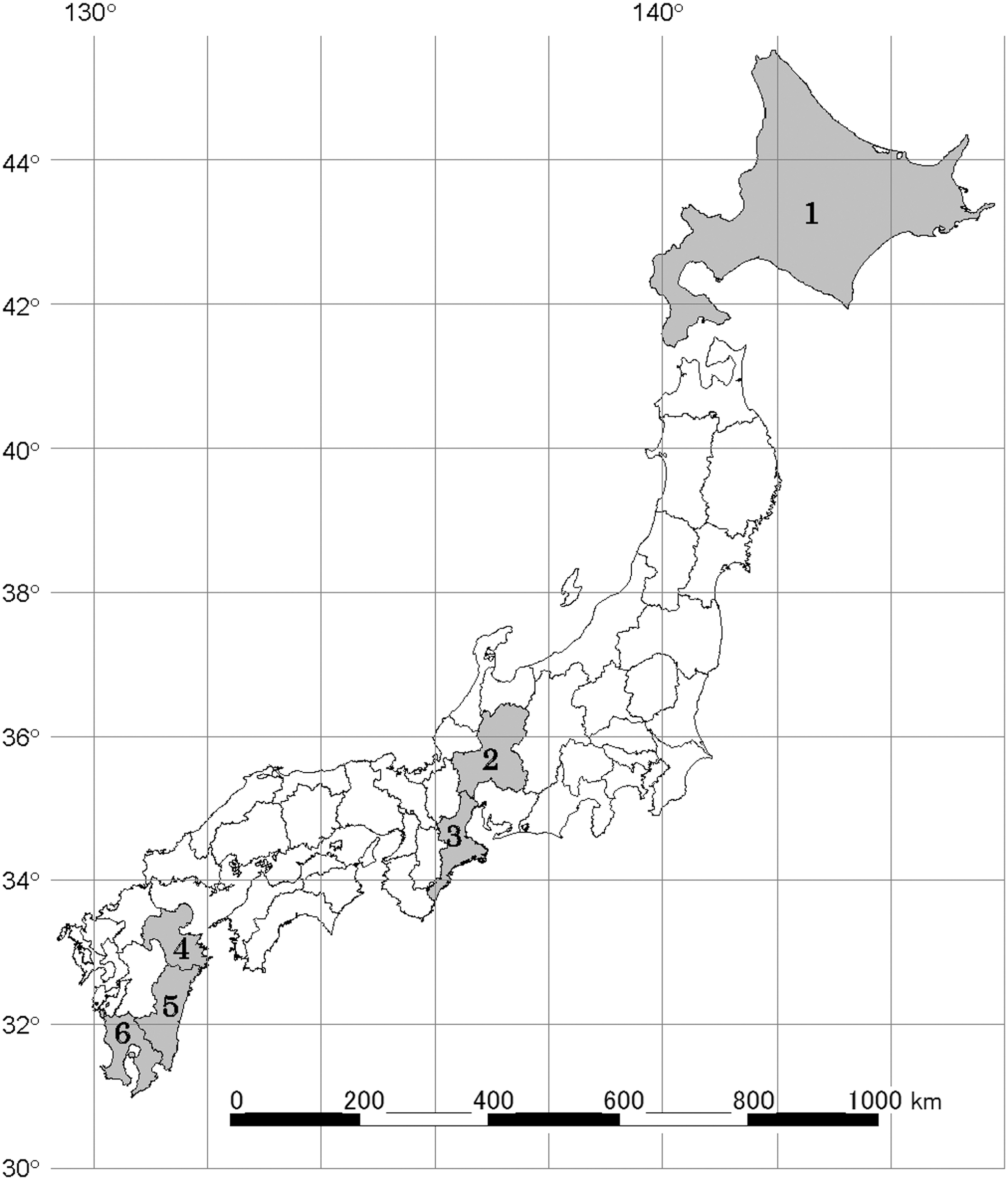
Map of Japan. The prefectures we selected are shown in gray and are coded as follows: 1, Hokkaido prefecture (northern area); 2, Gifu prefecture (central area); 3, Mie prefecture (central area); 4, Oita prefecture (southern area); 5, Miyazaki prefecture (southern area); 6, Kagoshima prefecture (southern area).
Northern, Hokkaido prefecture; central, Gifu and Mie prefectures; southern, Oita, Miyazaki, and Kagoshima prefectures.
Spring, April through June; summer, July through September.
Bacterial isolates
Cold enrichment followed by selective enrichment was used to isolate L. monocytogenes from fecal samples (Erdogan et al., 2002). Briefly, fecal samples (1 g) were added to 5 mL of Nutrient Broth (Nissui Seiyaku Co., Ltd., Tokyo, Japan) and enriched at 4°C for 2 weeks. Next, 5 mL of enriched samples were added to 45 mL of University of Vermont Modified Listeria Enrichment Broth (BD, Franklin Lakes, NJ). After incubation at 30°C for 24 h, cultures (0.1 mL) were incubated with 10 mL of Fraser Broth (BD) containing Fraser Selective Supplement (Oxoid, Basingstoke, UK) at 35°C for either 24 or 48 h. Each culture (0.1 mL) was then streaked onto CHROMagar Listeria plates (CHROMagar Microbiology, Paris, France) and incubated at 37°C for 24–48 h. Four to 10 typical Listeria-like colonies with halos were selected from plates and characterized by the Christie, Atkins, Munch-Petersen test, β-hemolysis reaction, catalase reaction, Gram staining, and motility test in semisolid media. L. monocytogenes isolates were stored in Brain Heart Infusion medium (BHI; Difco, Detroit, MI) with 10% glycerol at −80°C.
Serotyping of the isolates
Serotyping was performed using commercial Listeria antisera (Denka Seiken Co., Ltd., Tokyo, Japan), according to the manufacturer's recommendations.
Pulsed-field gel electrophoresis (PFGE) analysis
PFGE was carried out by following the CDC PulseNet protocol (Graves and Swaminathan, 2001). Chromosomal DNA of L. monocytogenes was digested with restriction enzymes, AscI (New England BioLabs, Beverly, MA) and ApaI (Takara, Shiga, Japan). PFGE patterns were compared using the BioNumerics program (version 5.0; Applied Maths, Kortrijk, Belgium). Similarities among restriction fragments of isolates were determined using unweighted pair group method with arithmetic mean.
Polymerase chain reaction of L. monocytogenes epidemic clone (EC) II and III markers
DNA was extracted from overnight BHI cultures using a commercially prepared extraction preparation (InstaGene Matrix; Bio-Rad Laboratories), according to manufacturer's instructions. The primers used for identification of isolates of the L. monocytogenes EC II and III markers have been described by Chen et al. (2007). The cycling program and electrophoresis conditions have been described previously (Hasegawa, 2013). Since none of the BBC isolates had PFGE profiles that were identical to those of the ECI clone, we did not investigate ECI marker.
Antimicrobial susceptibility testing
Antimicrobial susceptibility tests were performed for 315 of 996 L. monocytogenes isolates. Fourteen different antimicrobials, including penicillin, ampicillin, oxacillin, amoxicillin, gentamicin, kanamycin, streptomycin, erythromycin, vancomycin, tetracycline, chloramphenicol, fosfomycin, ciprofloxacin, and trimethoprim/sulfamethoxazole, were selected for susceptibility testing using the microbroth dilution method, according to the Clinical and Laboratory Standards Institute (CLSI) standards (CLSI, 2006). The breakpoints were determined as described previously (Hasegawa, 2013).
Bacterial strains
In total, 36 L. monocytogenes isolates from human listeriosis cases, livestock that had a diagnosis of listeriosis, and wild animals were used to study the relatedness with the isolates from BBC (Table 2).
Statistical analysis
All statistical analyses were performed using EZR (Saitama Medical Center, Jichi Medical University), which is a graphical user interface for R (The R Foundation for Statistical Computing, version 2.13.0). More precisely, it is a modified version of R commander (version 1.6-3) designed to add statistical functions that are frequently used in biostatistics. A chi-square test was used to compare the prevalence of L. monocytogenes. Differences were considered significant at a significance level of p<0.05.
Results
Prevalence of L. monocytogenes among feces of BBC
We surveyed farms from three areas of Japan, including NA, CA, and SA. Prevalence of L. monocytogenes among feces of BBC for each area was as follows: NA, 11.4% of 651; CA, 2.8% of 572; and SA, 2.9% of 515 (Table 1). Based on these data, the isolation rate in the NA was significantly higher than that in the CA or SA (p<0.01). In the NA, the isolation rate in spring was significantly higher than in summer (p<0.01).
Serotyping of the isolates
Serotyping of 996 isolates identified 1/2b as the most prevalent serotype (40.5%), followed by 1/2a (36.9%), 4b (21.6%), and 4ab (1.0%) (Table 3). In the NA, 12.1% of the isolates were classified as serotype 4b, whereas in the CA and SA, 46.3% and 44.8%, respectively, were classified as serotype 4b, indicating a significantly lower rate of serotype 4b in the NA (p<0.01). Notably, in the NA, multiple serotypes were isolated from 60% of L. monocytogenes–positive farms. In addition, multiple serotypes were isolated from individual fecal samples from 18 cattle (data not shown), with a maximum of three different serotypes isolated from one sample (Fig. 2). However, in the CA and SA, only one kind of serotype was isolated from individual farms.
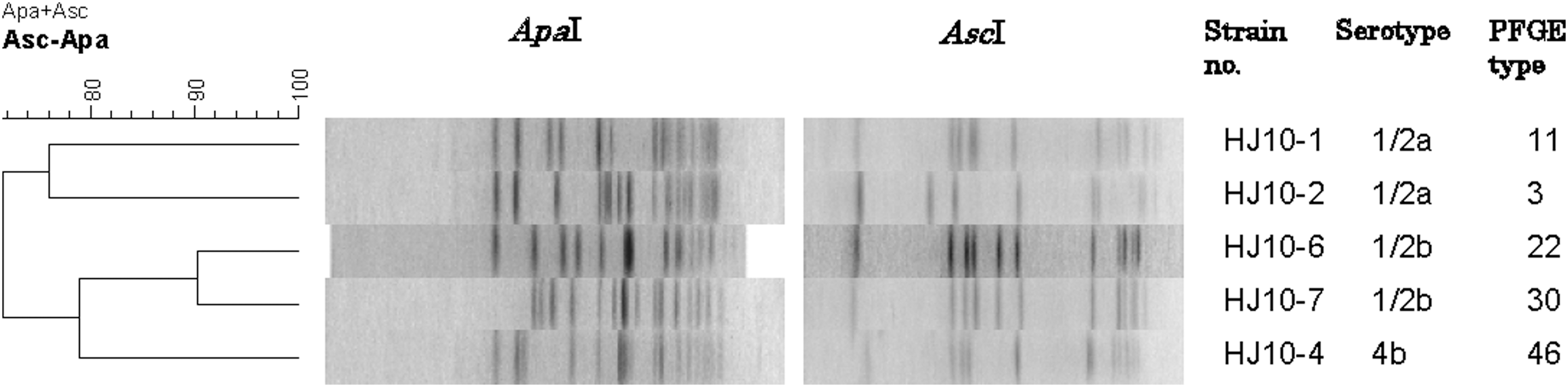
Pulsed-field gel electrophoresis (PFGE) types and serotypes of Listeria monocytogenes isolates from cattle on the N11 farm.
Northern, Hokkaido Prefecture.
Central, Gifu and Mie Prefectures.
Southern, Oita, Miyazaki, and Kagoshima Prefectures.
PFGE typing of the isolates
Of 996 L. monocytogenes isolates identified from BBC, 239 were analyzed by PFGE. As shown in Table 3, we detected 48 different PFGE types. Isolates from the NA, CA, and SA were characterized to consist of 43, five, and six different PFGE types, respectively. We found that the isolates from the NA were genetically diversified, with multiple PFGE types identified from two thirds of positive farms in the NA. Furthermore, nine PFGE types were isolated from the N11 farm, five of which were isolated from the same animal (Fig. 2). A dendrogram of L. monocytogenes PFGE types for isolates from BBC, human clinical cases, animal clinical cases, and wild animals is shown Figure 3. We observed that five of the isolates (strain nos. H12, D1, O03, MMS-03174, and Y25) derived from human clinical cases showed identical PFGE patterns to those from BBC. It is worth noting that two isolates from dairy cattle clinical cases (strain nos. BC07 and BC08) and one isolate from a sheep clinical case (strain no. BC11) were also identical to those from BBC. Importantly, one isolate from a BBC clinical case (strain no. BC02) shared 97.9% similarity with the isolates from BBC. The isolates from deer (strain no. Y21) and crow (strain no. Y22) were identical to those from BBC, as well as to those from human clinical cases.
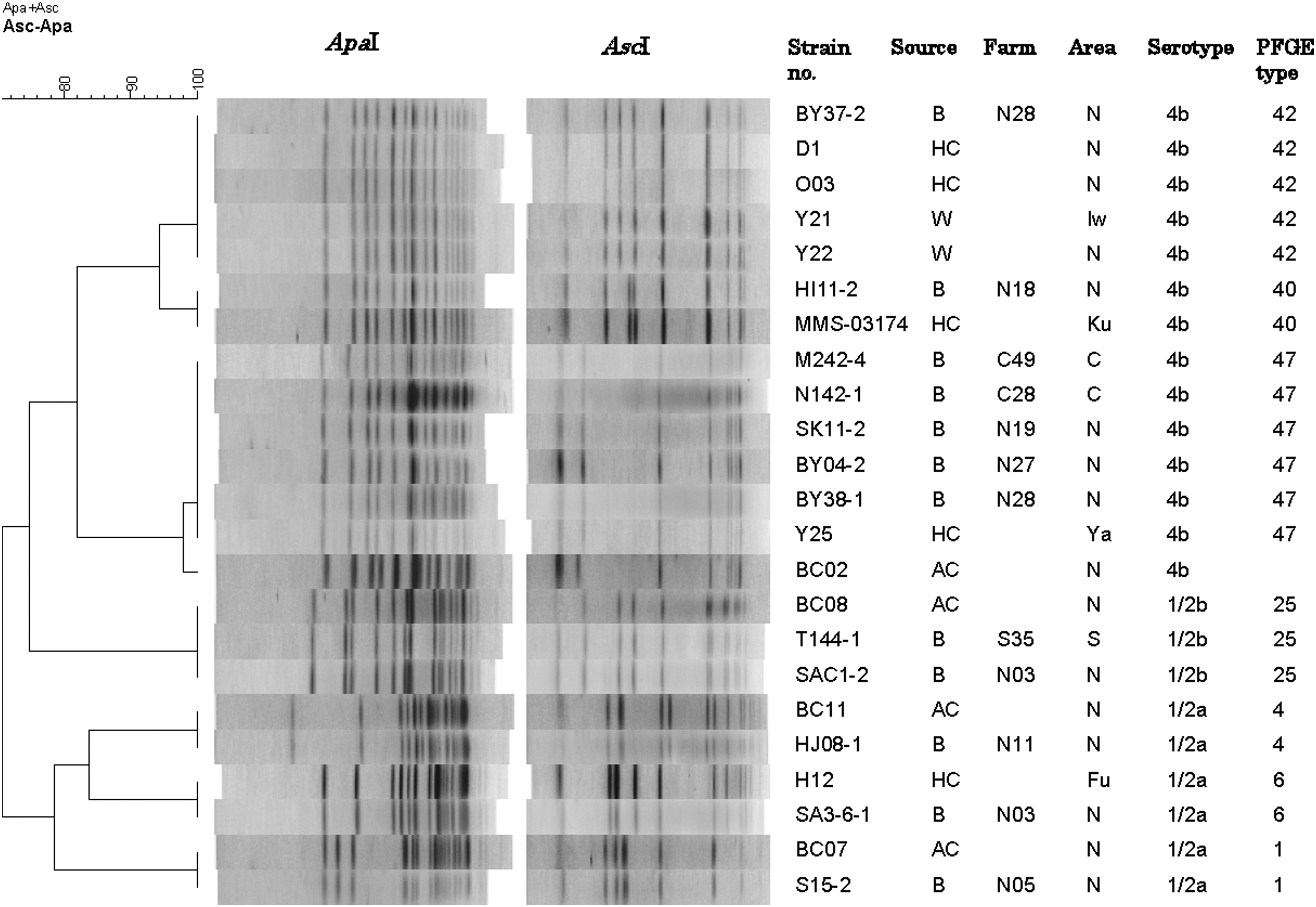
Dendrogram of Listeria monocytogenes pulsed-field gel electrophoresis types for isolates from black beef cattle (B), human clinical case (HC), animal clinical cases (AC), and wild animals (W). Areas are coded as follows: N, northern; C, central; S, southern; Fu, Fukuoka prefecture; Ku, Kumamoto prefecture; Iw, Iwate prefecture; Ya, Yamagata prefecture.
EC markers in the isolates
The isolates with PFGE type 47 were found to possess ECII marker (data not shown). These isolates were collected from five farms, three of which were in the NA and two were in the CA. Interestingly, the isolate from a BBC clinical case (strain no. BC02) also possessed ECII marker (data not shown). Moreover, the isolate with PFGE type 12 collected from the NA was found to possess ECIII marker.
Antimicrobial resistance phenotypes
The minimum inhibitory concentration (MIC) distributions of penicillin (<0.12–0.5 μg/mL), oxacillin (2–8 μg/mL), ampicillin (<0.12–1 μg/mL), amoxicillin (<0.12–0.5 μg/mL), gentamicin (<0.12–1 μg/mL), kanamycin (0.5–8 μg/mL), streptomycin (1–16 μg/mL), erythromycin (<0.12–0.5 μg/mL), vancomycin (0.5–1 μg/mL), tetracycline (0.25–1 μg/mL), chloramphenicol (4–8 μg/mL), fosfomycin (32 to >128 μg/mL), ciprofloxacin (0.5–4 μg/mL), and trimethoprim/sulfamethoxazole (0.16–0.62 μg/mL) were found to be monomodal, suggesting that all isolates tested were susceptible to these antibiotics. The MIC distributions of fosfomycin were higher than the range we surveyed. L. monocytogenes has been described to be naturally resistant to oxacillin and fosfomycin (Troxler et al., 2000).
Discussion
In this study, to determine the prevalence and characteristics of L. monocytogenes, fecal samples were collected from BBC in farms from three geographically distant areas of Japan: NA, CA, and SA. In the NA, the isolation rate was found to be significantly higher than in the CA or SA, and BBC were shedding genetically diversified clones in feces. Five isolates from human clinical cases and three isolates from animal clinical cases were identical to the isolates from BBC.
Previous studies conducted in the United States and elsewhere have shown that the prevalence of the bacterium in feces of beef cattle ranges from 0% to 8.3% (Bailey et al., 2003; Callaway et al., 2006; Lyautey et al., 2007; Madden et al., 2007; Esteban et al., 2009; Mohammed et al., 2010). In Japan, although L. monocytogenes was previously isolated in 0%–3.4% of cattle fecal samples (Iida et al., 1998; Takahashi et al., 2007; Ishii et al., 2010; Sasaki et al., 2013), to the best of our knowledge, the prevalence of L. monocytogenes in beef cattle among farms throughout Japan has never been examined. Since the investigation of livestock animals on farms is very important to elucidate the contaminant source of pathogenic bacteria and to reduce the carrier animals, our survey provides crucial data for control of L. monocytogenes at the farm level.
In our study, the isolation rate in the NA was found to be higher than that in the CA and SA. In a previous survey of beef-processing plants in the United States, Listeria species were prevalent among the hides of cattle presented for slaughter at plants in cooler climates and during the winter and spring seasons (Guerini et al., 2007). These observations may be attributed to the ability of Listeria species to outcompete and exclude other bacterial species at low temperatures. The higher prevalence in the NA is associated with cooler weather, consistent with the ability of Listeria species to grow at lower temperatures.
It has been reported that silage is a source of L. monocytogenes in dairy cattle (Ho et al., 2007; Wesley, 2007). In this study, the bacterium was also isolated from the silage-fed cattle. Meanwhile, the bacterium was also isolated from feedlot cattle that were not fed with the silage (data not shown). In feedlot operations, feeder cattle that were introduced to feedlot farms might be the source of pathogenic bacteria. We next observed that the isolates from wild animals were identical to those from BBC. We speculate that BBC farms might be the source of L. monocytogenes in wild animals, and that the wild animals might spread the bacterium to other farms. As other studies have shown (Wesley, 2007), it is thought that there might be various sources of the bacterium. Therefore, further investigation would be needed to reduce carrier animals of the pathogenic bacteria.
In the NA, the prevalence of serotype 4b was lower than that in the CA and SA. In the SA, the prevalence of serotype 1/2a was lower than that in the NA and CA. We hypothesized that the difference in the distribution of serotypes may arise from the characteristics of each serotype. Buncic et al. (2001) reported that serotype 1/2a isolates tended to be more resistant to the bacteriocins at 4°C than serotype 4b isolates were. It was also reported that there is varied distribution of serotypes among L. monocytogenes isolates from bulk tank milk in different regions of the United States (Van Kessel et al., 2004). Therefore, difference in the characteristics of various serotypes might vary their abilities to get established in the environment. Another hypothesis is that the difference in the serotype distribution may be explained by the sample shortage in this investigation. Further investigation on a larger scale would be needed.
We observed that isolates from northern farms were genetically diverse, compared to those from central and southern farms. It is not yet clear why the isolates from northern farms, but not central and southern farms, were genetically diverse. We postulate that low temperatures might affect the genetic diversity of L. monocytogenes in northern farms as follows. First, low temperatures might inhibit the growth of competing bacteria. Second, L. monocytogenes might grow more easily in silage, manure, and field soil, and therefore, persist in the environment. In addition, other strains might be introduced by feed, wild animals, or other contributing factors in these areas. Third, more than half of the dairy cattle in Japan are reared in the NA, and the ratio of the ranch area in the NA is the highest among the three areas. It has been reported that dairy cattle contribute to the amplification and the dispersal of L. monocytogenes into the farm environment, and the bovine-farm ecosystem maintains a high prevalence of L. monocytogenes (Nightingale et al., 2004).
In this study, five PFGE types were isolated from a fecal sample from one BBC. A similar result was reported by a previous survey, in which six PFGE types were identified from a fecal sample of one dairy cow (Borucki et al., 2005). Hence, investigating more than 10 isolates from a sample is a more reliable method to gauge the genetic diversity of L. monocytogenes. Because we did not characterize all of the isolates from the BBC with PFGE, further characterization of the isolates might be needed to elucidate more precisely the genetic diversity of L. monocytogenes in the BBC farms.
The isolates possessing ECII marker were isolated from five farms, three of which were northern farms and two were central farms, whereas the isolate possessing ECIII marker was isolated from a northern farm. A previous study showed that epidemic clonal markers might be correlated with the pathogenic potential and environmental persistence of the strains (Franciosa et al., 2007). In addition, ECII strains have been shown to be resistant to broad-host-range phages, when grown at temperatures lower than 37°C; such an advantage of ECII bacteria may enhance their fitness in a cooler environment (Kim and Kathariou, 2009). Based on these findings, we conclude that the isolates possessing ECII marker might have the ability to survive in various environments.
Our results show that the L. monocytogenes isolates from BBC were susceptible to all antimicrobial agents tested, except oxacillin and fosfomycin. Antimicrobial agents are used for growth promotion by improving animal husbandry. Unfortunately, veterinary antimicrobial use is a selective force that promotes the appearance and prevalence of antimicrobial-resistant bacteria in food-producing animals (Srinivasan et al., 2005; Iwabuchi et al., 2010; National Veterinary Assay Laboratory Ministry of Agriculture Forestry and Fisheries, 2009). In the Japanese BBC, 44.4% of 1397 Escherichia coli isolates were resistant to at least one type of antibiotic (Yamamoto, 2013). It was also shown that L. monocytogenes became resistant to antibiotics through the acquisition of mobile genetic elements (Poros-Gluchowska and Markiewicz, 2003). To date, there have been very few studies on antibiotic resistance of L. monocytogenes in Japan (Okada et al., 2011); therefore, it is important to protect public health by continuously monitoring antibiotic resistance of L. monocytogenes on BBC farms.
In conclusion, our study suggests that the BBC in Japan may be a reservoir of genetically diversified L. monocytogenes. Moreover, we observed that the prevalence of L. monocytogenes, the distribution of serotypes, as well as the diversity of PFGE types varied according to the area. In the NA, it is necessary to monitor pathogenic bacteria such as L. monocytogenes that can grow at low temperatures.
Footnotes
Acknowledgments
This study was supported by grants-in-aid from Tenshi College (Hokkaido, Japan). We would like to acknowledge the generosity of this organization. We are grateful to many veterinarians and the owners of the BBC farms for their cooperation in this study. We wish to express our gratitude to Drs. S. I. Makino (Obihiro University of Agriculture and Veterinary Medicine, Hokkaido, Japan), F. Ueda (Nippon Veterinary and Life Sciences University, Tokyo, Japan), T. Yoshida (Public Health and Welfare Department, Nagano Prefectural Government, Nagano, Japan), A. Nakama (Tokyo Metropolitan Institute of Public Health, Tokyo, Japan), K. Kobayashi (Daiichi Clinical Laboratories, Sapporo, Japan), and M. Ito (Sapporo Clinical Laboratory, Sapporo, Japan) for providing the human- and wild animal–derived strains, as well as the officer of the Agricultural Administration Division, Department of Agriculture, Hokkaido, Japan, for the livestock-derived strains. In addition, we acknowledge many technical assistants and graduates of Tenshi College.
Disclosure Statement
No competing financial interests exist.