




Abstract
Cronobacter spp. (formerly known as Enterobacter sakazakii) are foodborne pathogens that cause rare but life-threatening diseases in neonates and infants through consumption of contaminated powdered infant formula. This study was conducted to investigate the occurrence of Cronobacter spp. in powdered formula in China and to further characterize Cronobacter isolates. Isolates were identified to the species level based on the fusA gene sequence, and strains of C. sakazakii were further subtyped by applying the polymerase chain reaction (PCR)–based serotyping method. A total of 23 strains of Cronobacter spp. isolated from 530 powdered formula samples were identified using conventional biochemical methods and duplex PCR. Cronobacter spp. were detected in 6.25%, 1.82%, 3.64%, 5.45%, and 2.50% of the general formula, infant formula (age <6 months), follow-up formula (6–12 months of age), growing-up formula (1–3 years of age), and children's formula (3–6 years of age), respectively. The individual species were identified as C. sakazakii (22 isolates) and C. malonaticus (1 isolate). Among 22 C. sakazakii isolates, representatives of all but two O-antigen serotypes (serotypes O5 and O6) were recognized.
Introduction
C
To date, the genus Cronobacter consists of seven different species: C. sakazakii, C. malonaticus, C. turicensis, C. muytjensii, C. dublinensis, C. universalis, and C. condiment (Joseph et al., 2012a). Cronobacter spp. have been isolated from a variety of food sources, including plant foods, dairy-based foods, meats, water, and other sources (Baumgartner et al., 2009; Chap et al., 2009; Hochel et al., 2012). Problems with Cronobacter spp. have drawn worldwide attention, and considerable research has been completed on this organism in recent years (Baldwin et al., 2009; Jarvis et al., 2011; Sun et al., 2011; Chen et al., 2012; Joseph et al., 2012b).
Cronobacter species have been reported to show differences in virulence factors (Caubilla-Barron et al., 2007; Healy et al., 2009; MacLean et al., 2009), and not all Cronobacter species have been linked with infections. It was reported that only strains from C. sakazakii, C. malonaticus, and C. turicensis have been associated with neonatal infections (Kucerova et al., 2010). It is not possible to differentiate between C. sakazakii and C. malonaticus based on the rpoA and 16S rRNA gene sequences alone (Strydom et al., 2012). However, a quick way of determining the species is to use the fusA allele; none of the fusA profiles were shared between two or more species (Joseph et al., 2012b).
On the other hand, serotyping has been the most widely used method for identifying strains for epidemiological purposes. The O-antigen serotyping scheme for C. sakazakii was established using traditional immunological technologies (Sun et al., 2011). Moreover, some polymerase chain reaction–based O-antigen serotyping methods were developed (Mullane et al., 2008; Jarvis et al., 2011; Sun et al., 2012). Therefore, it is necessary to serotype C. sakazakii.
There is little known about the presence of Cronobacter spp. in commercially available powdered formula in China. Thus, the objective of the present study was to investigate the occurrence of Cronobacter spp. in powdered formula, in order to yield insights into the exposure to this microorganism at the consumption level. In addition, the genetic diversity of isolates was characterized based on the fusA gene sequences and the multiplex serotyping PCR.
Materials and Methods
Sample collection
Samples were collected strictly following the principle of randomness and without prejudice. They were purchased in different types of markets, including large shopping malls, supermarkets and bazaars, etc. At each sampling point, we tried to collect a variety of powdered formula samples. Finally, a total of 530 commercial powdered formula samples were collected from 12 provinces (20 cities) in China, from January to December 2011. The sampling sites are shown in Supplementary Figure S1 and Supplementary Table S1 (Supplementary Data are available online at
Conventional biochemical methods
The enrichment and isolation of Cronobacter spp. were performed according to the International Organization for Standardization (ISO) methods with modification (ISO, 2006). In brief, 100 g of formula was mixed with 900 mL of buffered peptone water (Huankai, Guangzhou, China); after incubation at 37°C for 18 h, 0.1 mL of the culture was inoculated into 10 mL of lauryl sulfate broth supplemented with vancomycin to a final concentration of 10 μg/mL (Huankai), and incubated at 44°C for 24 h. One loop of the selectively enriched broth was streaked onto chromogenic medium (Huankai) and incubated at 44°C for 24 h. Green or blue–green colonies were termed presumptive Cronobacter spp. and their identity was confirmed using API 20E diagnostic strips (bioMérieux Company, La Balme, France) and duplex PCR (Zhou et al., 2008). All primers used in this study are shown in Table 1.
F, forward; R, reverse.
DNA isolation and PCR
Genomic DNA was prepared from 1 mL of overnight culture grown in tryptone soy broth (Huankai) using a Universal DNA Extraction Kit (Sangon, Shanghai, China) according to the manufacturer's instructions. Amplification and nested sequencing primers for the fusA gene were as previously described (Baldwin et al., 2009).
The PCR reaction mixture (25 μL) contained 1× PCR buffer (Promega, United Kingdom) containing 1.5 mmol/L, 0.8 mmol/L deoxynucleoside triphosphates and 1.25 U Taq (Promega, United Kingdom), 20 pmol forward and reverse primer, and 1 μL DNA template (40–60 ng/μL). The PCR reaction conditions for the primers were as follows: initial denaturation at 94°C for 2 min, 30 cycles of denaturation at 94°C for 1 min, primer annealing at 58°C for 1 min, and extension at 72°C for 2 min, and a final extension step of 72°C for 5 min.
Sequences analysis
Sequencing of the PCR products was performed using an automated sequencer (ABI 3730 DNA Analyzer, Applied Biosystems). To identify the species level of Cronobacter spp. strains in this study, the concatenated sequences of the fusA loci were aligned with the corresponding Cronobacter spp. sequences from an open access database (
Nucleotide sequence accession numbers
Nucleotide sequences were deposited in the GenBank database under accession numbers KF300928–KF300950.
The following fusA loci were used as the reference sequences in this study: fusA-2, Enterobacter spp.; fusA-6, Citrobacter koseri; fusA-1, C. sakazakii; fusA-3, C. sakazakii; fusA-11, C. sakazakii; fusA-12, C. sakazakii; fusA-15, C. sakazakii; fusA-16, C. sakazakii; fusA-18, C. sakazakii; fusA-36, C. sakazakii; fusA-67, C. sakazakii; fusA-7, C. malonaticus; fusA-13, C. malonaticus; fusA-40, C. malonaticus; fusA-19, C. universalis; fusA-32, C. universalis; fusA-33, C. universalis; fusA-26, C. turicensis; fusA-28, C. turicensis; fusA-49, C. turicensis; fusA-27, C. condiment; fusA-4, C. muytjensii; fusA-24, C. muytjensii; fusA-35, C. muytjensii; fusA-21, C. dublinensis; fusA-23, C. dublinensis; fusA-30, C. dublinensis; and fusA-31, C. dublinensis.
Multiplex serotyping PCR
The serotypes of C. sakazakii isolates were identified using the PCR-based O-antigen serotyping technique. A primer mix for the seven serotypes (O1–O7) was used in the multiplex PCR assays, with primer concentrations and amplification conditions as recently described (Sun et al., 2012).
Results
Cronobacter spp. in powdered formula samples
A total of 23 positive samples were detected among the 530 powdered formula samples. The API 20E diagnostic strips identified all isolates as E. sakazakii, with percentage identification values ranging from 97.5% to 99.9% (Supplementary Table S3). The 23 isolates gave positive results for duplex PCR confirmation (Supplementary Fig. S2). Of these samples, 10/160 (6.25%) were obtained from general formula samples, 2/110 (1.82%) were obtained from infant formula samples, 4/110 (3.64%) were obtained from follow-up formula samples, 6/110 (5.45%) were obtained from growing-up formula samples, and 1/40 (2.50%) was obtained from children's formula samples.
Phylogeny based on the fusA gene
The phylogenetic tree based on the fusA gene sequences (438 nucleotides) and using the maximum likelihood algorithm in MEGA5 showed clear separation between the Cronobacter isolates and the outgroup strains, Enterobacter spp. and Citrobacter koseri (Fig. 1). A total of 22 strains isolated from powdered formula were clustered to C. sakazakii strains from the multilocus sequence typing (MLST) database (
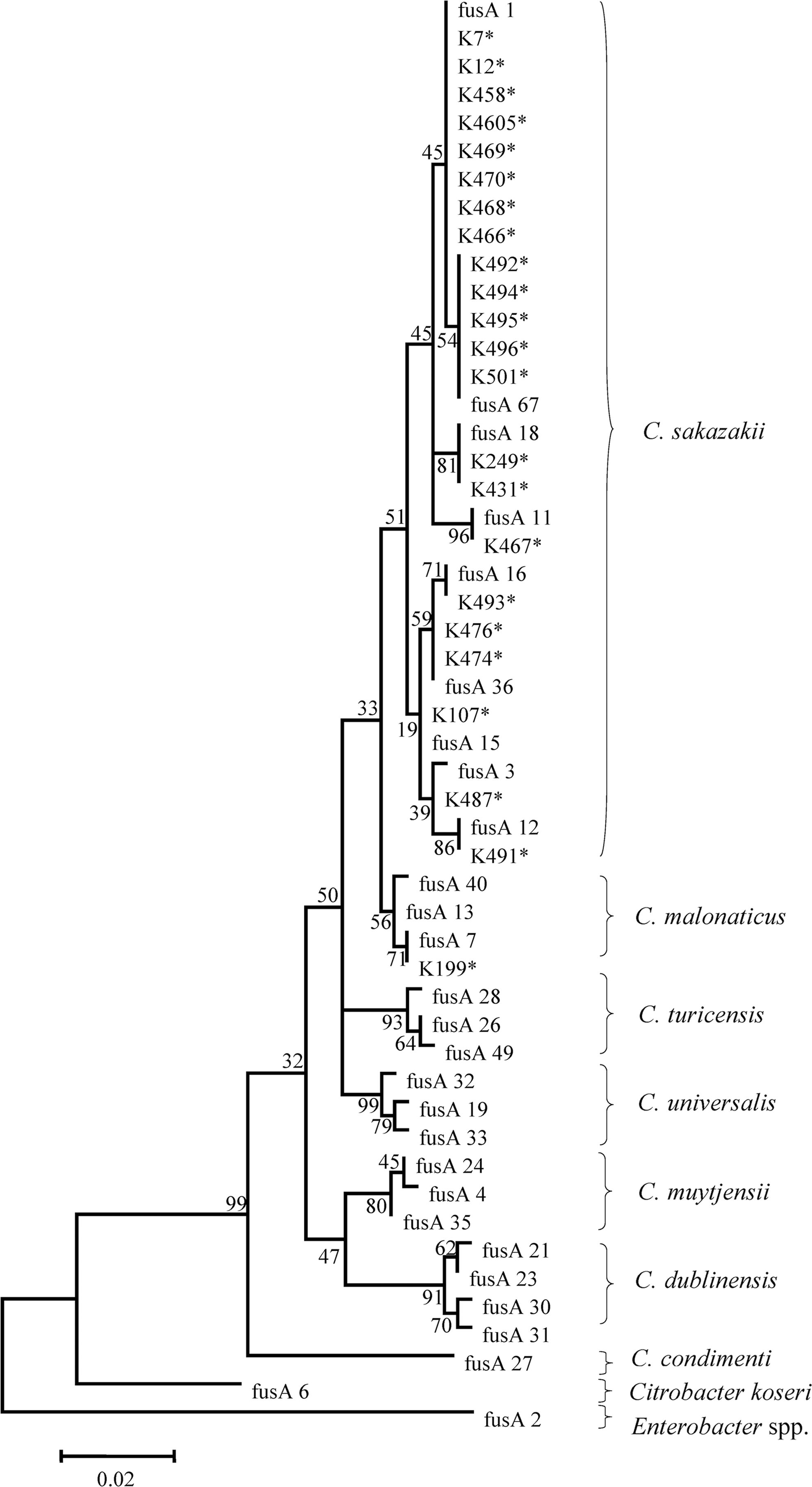
Maximum likelihood tree of the new isolates and related species in the genus Cronobacter based on the fusA alleles (438 bp) of the Cronobacter multilocus sequence typing data set. This tree was generated using the ClustalX (version 1.83) algorithm and the MEGA (version 5.05) with 1000 bootstrap replicates. *Identification numbers of strains sequenced in this study.
Serotyping by multiplex PCR
C. sakazakii isolates from powdered formula were determined by the previously described PCR-based O-antigen serotyping technique. With the exception of serotypes O5 and O6, all other serotypes were found among the isolates. Serotype O2 was the most prevalent serotype (eight strains), followed by serotype O1 (seven strains). The results of the O-antigen serotyping for all 22 strains are shown in Table 2.
Discussion
Cronobacter spp. have come to prominence due to their association with infant infections. Several Cronobacter spp. infections associated with contaminated PIF consumption have highlighted the need to enforce guidelines in order to guarantee public health (Bowen and Braden, 2006). Considering its widespread distribution in dairy-based foods, intensive and continuous monitoring of Cronobacter spp. is strongly recommended in order to assess human health risks arising from powdered formula consumption.
The overall prevalence of Cronobacter spp. recorded in our study was 4.34%. The prevalence of Cronobacter spp. in ready-to-eat foods was 8.96% in Switzerland (Baumgartner et al., 2009), while in the Czech Republic, 13% of retail foods were contaminated with Cronobacter spp. (Hochel et al., 2012). Concerning prevalence in infant formula samples, 6.70% samples were positive for Cronobacter spp. in 120 dried infant formula samples collected from the Canadian retail market (Nazarowec-White and Farber, 1997), while the prevalence of Cronobacter spp. in 82 infant formula samples was 2.44% (Iversen and Forsythe, 2004). In the present study, 6 (2.73%) samples positive for Cronobacter spp. were detected among 220 powdered formula samples (0–12 months), which was consistent with the previous study (Kandhai et al., 2010). Our results in follow-up formula samples (6–12 months) were higher than those reported from seven countries (0.7%) (Chap et al., 2009). In addition, we found Cronobacter spp. in other powdered formula samples, such as general formula, growing-up formula, and children's formula.
The diversity of E. sakazakii was well acknowledged prior to the taxonomic revision to the Cronobacter genus, which was based on DNA–DNA hybridization, 16S rRNA sequence analysis, and biotyping (Iversen et al., 2008). Phylogenetically, the species of Cronobacter are very closely related based on the rpoA and 16S rRNA genes. These two genes were not divergent enough to sufficiently distinguish between all the Cronobacter species (Strydom et al., 2012). To overcome various limitations of phenotyping and 16S rRNA and rpoA sequence analysis of Cronobacter bacteria, the phylogeny of Cronobacter isolates was evaluated based on the fusA gene sequence. The fusA gene encodes for the elongation factor and has proven to be useful in the identification and differentiation of species in the Cronobacter spp. This gene has also been sequenced for numerous Cronobacter spp. strains, and these sequences have also been made available on the Cronobacter MLST database.
In the present study, of 23 confirmed Cronobacter isolates, 22 were identified as C. sakazakii and 1 as C. malonaticus. This study supports the finding that C. sakazakii is the most common species in terms of isolation frequency (Lehner et al., 2010; Muller et al., 2013). The five other Cronobacter species were absent from the powdered formula. Since only powdered formulas were investigated in this study, it is possible that strains from the other Cronobacter species will be identified when a wider variety of sources are studied.
C. sakazakii comprises seven serotypes (O1–O7) (Sun et al., 2011). The conventional serotyping method using antisera is routinely used; however, this technology is limited by the high cost of antisera. PCR-based typing methods targeting O-antigen–specific genes are reliable and rapid for typing isolates of Escherichia coli and C. sakazakii (DebRoy et al., 2004; Muller et al., 2013). In this study, serotype O2 was found to be the most prevalent serotype and serotype O5 was absent from C. sakazakii isolates, which were consistent with the previous study (Muller et al., 2013).
The recent study revealed that most serious meningitis clinical cases caused by Cronobacter spp. in neonates during the previous 30 years in 6 countries were caused by C. sakazakii ST4 (Joseph and Forsythe, 2011). The cerebrospinal fluid isolates from the 2011 Cronobacter cases in the United States are not evenly spread across the 7 Cronobacter species and are instead predominantly in C. sakazakii ST4 (Hariri et al., 2013). On the other hand, it was reported that a correlation was observed between ST4 and serotype O2 (Muller et al., 2013). Moreover, our results showed that serotype O2 was the most prevalent serotype. The relationship between ST4 and serotype O2 will be of greatest concern. To our knowledge, the present study was the first large study to report the presence of Cronobacter spp. in powdered formula in China. The presence of Cronobacter spp. in powdered formula indicates a potential public health risk. Therefore, intensive and continuous monitoring of Cronobacter spp. is strongly recommended in order to evaluate the human health risks associated with consumption of powdered formula.
Footnotes
Acknowledgments
We would like to thank Editage for providing editorial assistance. This work was supported by the National Natural Science Foundation of China (31201292, 31371780) and Guangdong Province, Chinese Academy of Comprehensive Strategic Cooperation project (2011B090300077).
Disclosure Statement
No competing financial interests exist.
References
Supplementary Material
Please find the following supplemental material available below.
For Open Access articles published under a Creative Commons License, all supplemental material carries the same license as the article it is associated with.
For non-Open Access articles published, all supplemental material carries a non-exclusive license, and permission requests for re-use of supplemental material or any part of supplemental material shall be sent directly to the copyright owner as specified in the copyright notice associated with the article.
