




Abstract
Food sold over the internet is an emerging business that also presents a concern with regard to food safety. A nationwide foodborne disease outbreak associated with sandwiches purchased from an online shop in July 2010 is reported. Consumers were telephone interviewed with a structured questionnaire and specimens were collected for etiological examination. A total of 886 consumers were successfully contacted and completed the questionnaires; 36.6% had become ill, with a median incubation period of 18 h (range, 6–66 h). The major symptoms included diarrhea (89.2%), abdominal pain (69.8%), fever (47.5%), headache (32.7%), and vomiting (17.3%). Microbiological laboratories isolated Salmonella enterica serovar Enteritidis, Salmonella Virchow, Staphylococcus aureus, Bacillus cereus, and enterotoxigenic Escherichia coli from the contaminated sandwiches, Salmonella Enteritidis and Salmonella Virchow from the patients, and Salmonella Enteritidis and Staphylococcus aureus from food handlers. Pulsed-field gel electrophoresis genotyping suggested a common origin of Salmonella bacteria recovered from the patients, food, and a food handler. Among the pathogens detected, the symptoms and incubation period indicated that Salmonella, likely of egg origin, was the probable causative agent of the outbreak. This outbreak illustrates the importance of meticulous hygiene practices during food preparation and temperature control during food shipment and the food safety challenges posed by online food–shopping services.
Introduction
S
Online food shopping has become popular in Taiwan over the past few years, and online shopping is often more convenient and economical compared to shopping in brick-and-mortar stores. The food products sold via the internet can quickly reach a wide geographic area. However, contaminated foods sold via the internet are also likely to be widely distributed, causing illnesses in multiple locations, and this type of outbreak may be difficult to identify as outbreaks. Nonetheless, foods sold in this way have the potential to have an enormous impact on public health. However, to the authors' knowledge, no foodborne disease outbreak associated with online shopping has been reported to date.
From July 7 to July 9, 2010, the Taiwan Centers for Disease Control (TCDC) was notified of several gastroenteritis clusters by local health departments. Many of the victims complained to the local health authorities and suspected that their illness was linked to the consumption of sandwiches purchased online from a bakery located in central Taiwan. The TCDC conducted epidemiological investigations and collected specimens for etiological examination. This article reports a large-scale salmonellosis outbreak associated with food bought via an online shopping service.
Materials and Methods
Epidemiological investigations
Local public health authorities conducted an on-site environmental investigation of the bakery, banned the bakery from operation during the investigation period, and reviewed the sales records of the bakery from July 1 to July 9. The preliminary investigation of the consumers indicated that only those who consumed sandwiches prepared on July 6 and July 7, 2010 had become sick. Epidemiologists from the TCDC and local health departments then performed telephone interviews with a structured questionnaire to obtain demographic data, the time and date of consumption and onset of illness, and symptoms. A case was defined as illness when a person developed at least two of the following symptoms within 5 days after eating the July 6 and July 7 sandwiches: nausea, vomiting, fever, diarrhea, and abdominal pain. Those who had developed diarrhea prior to the consumption of the sandwiches were excluded. The data were analyzed using Epi Info™ 7 software. Demographic data between the cases and non-cases were compared by a Mann–Whitney U test. Categorical data were analyzed using a chi-square test. Because this was an outbreak investigation, it was exempted from ethics review.
Microbiological examination and genotyping
A stool specimen or a rectal swab was collected from each of 27 patients who sought medical care, and the samples were examined in the TCDC laboratories or hospitals. Eight sealed sandwiches prepared on July 6 and July 7 were obtained from the purchasers and examined for bacterial pathogens in the laboratories of the Taiwan Food and Drug Administration (TFDA) and a local health department. A rectal swab, a hand swab, and a nasal swab were obtained from each of 20 food handlers working in the bakery and were examined at the TCDC. Environmental swabs and the food ingredients used for sandwich production were obtained from the bakery on July 9 and were examined at the TFDA. Selective media were used to isolate Salmonella spp., Shigella spp., Escherichia coli, Vibrio spp., Staphylococcus aureus, and Bacillus cereus. Three to five suspected colonies were selected from each specimen for identification. B. cereus in the food specimens was quantified as the colony-forming unit per gram. Enterotoxigenic E. coli was identified using polymerase chain reaction to detect heat-labile and heat-stable enterotoxin genes using a TFDA standard protocol. One Salmonella isolate and/or one S. aureus isolate from each specimen were subjected to serotyping, enterotoxin typing, and pulsed-field gel electrophoresis (PFGE) genotyping at the TCDC. The serotypes of Salmonella isolates were determined using a Luminex-based DNA serotyping method (Fitzgerald et al., 2007; McQuiston et al., 2011) and confirmed using the conventional serotyping method. The S. aureus isolates were screened for the expression of staphylococcal enterotoxins A (SEA), SEB, SEC, and SED using reverse passive latex agglutination according to the manufacturer's instructions (Denka Seiken, Co., Tokyo, Japan). S. enterica isolates were characterized using a PulseNet PFGE protocol (Ribot et al., 2006), and S. aureus isolates were analyzed using a previously described PFGE protocol (Chiou et al., 2000).
Results
According to the sales records, a total of 5145 sandwiches were sold on July 6 and July 7, and at least 1126 persons consumed the products. A total of 886 provided information for the questionnaire, and 324 (36.6%) met the case definition. Of the cases and noncases, 134 (41.4%) and 232 (41.3%) were male, respectively (p=0.98), and the median ages were 34 (range, 1–85) and 31 (range, 4–51) years, respectively (p=0.17). The median incubation period was 18 h (range, 6–66 h). The main symptoms of the cases were diarrhea (289, 89.2%), abdominal pain (226, 69.8%), fever (154, 47.5%), headache (106, 32.7%), and vomiting (56, 17.3%). Of the cases, 152 (46.9%) sought medical advice, 7 were hospitalized, and none died. The investigation revealed that the cases of illness were distributed in seven administrative divisions in northern and southern Taiwan at a distance of approximately 100 km or further from the bakery (Fig. 1). No cases were reported in central Taiwan.
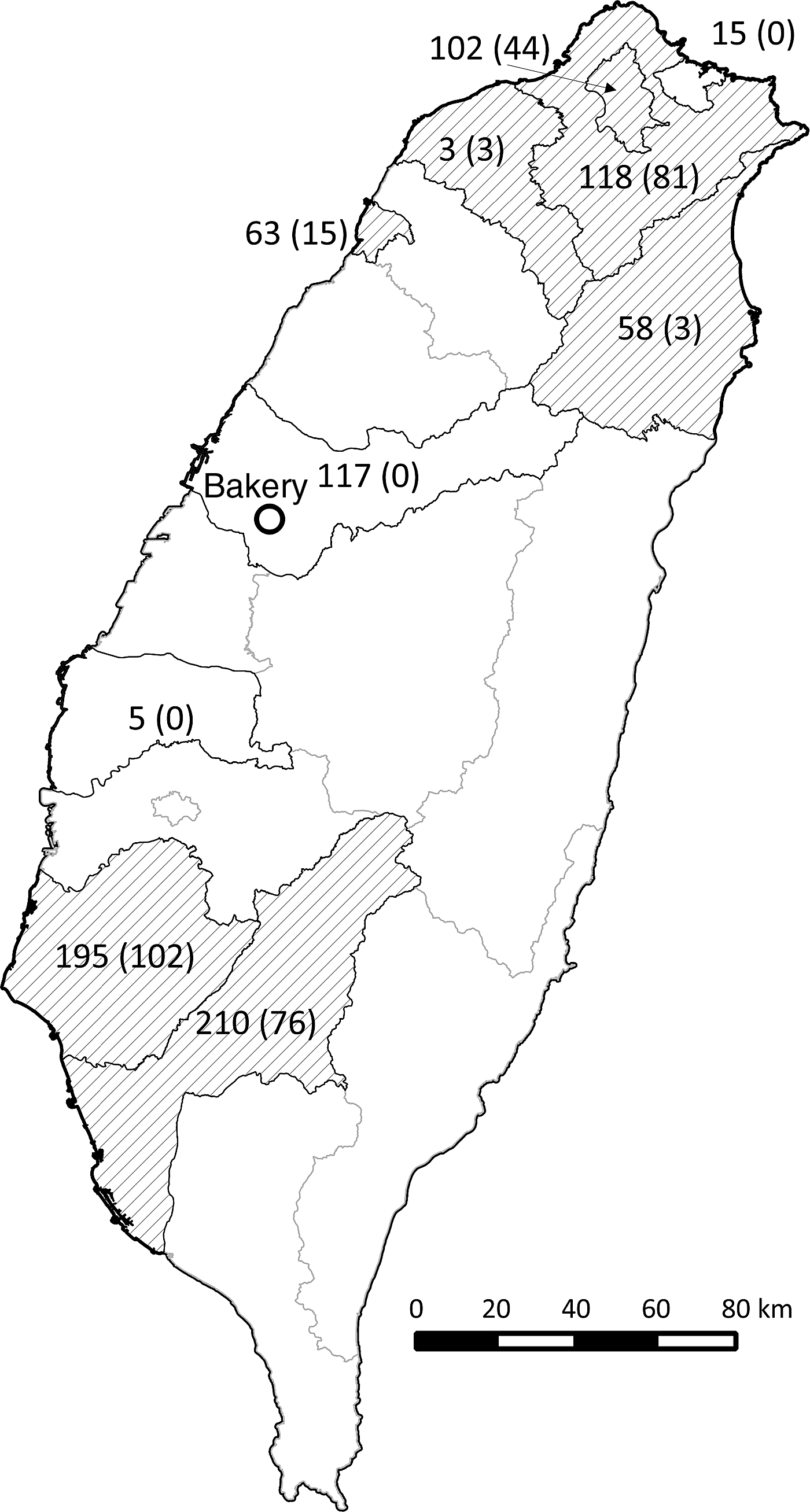
Geographic distribution of 886 consumers and 324 cases (in parentheses) by administrative division.
Twenty-one Salmonella isolates were recovered from 27 patients who sought medical care, of these, 19 were serovar Enteritidis and 2 were serovar Virchow (Table 1). Among the eight sandwiches, Salmonella spp. were isolated from seven, S. aureus were isolated from eight, B. cereus were isolated from two, and enterotoxigenic E. coli were isolated from one. Of the seven Salmonella isolates recovered from the sandwiches, two were Salmonella Enteritidis and five were Salmonella Virchow. Staphylococcus aureus was isolated from 4 rectal, 2 hand, or 13 nasal swabs from 14 food handlers and Salmonella Enteritidis was isolated from the rectal swab of a food handler who ate sandwiches prepared on July 6. He denied having symptoms of gastroenteritis, and none of his family members had gastroenteritis before or after the outbreak. All the environmental swabs and sandwich ingredients, including home-made thin omelet and mayonnaise, ham, and cheese, collected from the bakery on July 9 tested negative for bacterial pathogens.
Enterotoxin A, B, C, or D were not detected.
Enterotoxin B was detected.
One sandwich yielded 1.7×10⁵ colony-forming units (CFU)/g Bacillus cereus; the other yielded 9.5×10² CFU/g B. cereus.
Genotyping revealed that all 22 Salmonella Enteritidis isolates recovered from the patients, foods, and one food handler had an identical PFGE type, SEX.001. The seven S. Virchow isolates from the patients and food also shared a common PFGE type, SVX.003. The eight S. aureus isolated from food fell into four PFGE types: SAS.003, SAS.004, SAS.005, and SAS.006. Among these, SAS.005 was also found in an isolate recovered from the nasal swab of a food handler; SAS.006 was found in isolates recovered from three contaminated sandwiches and in isolates recovered from both the nasal and rectal swabs of two food handlers. No S. aureus isolates recovered from the sandwiches produced enterotoxin A, B, C, or D.
Discussion
This large-scale outbreak potentially affected more than 1000 people across Taiwan. To our knowledge, this is the first gastroenteritis outbreak caused by a food vehicle purchased over the internet. Because online shopping services have the potential to distribute contaminated products to a large geographic area within a short time period, nationwide or multinational outbreaks could occur. This outbreak illustrates the food safety challenges posed by online food shopping services.
Foodborne disease outbreaks linked to multiple pathogens could be common yet are rarely reported (Berkelman et al., 1983; Naimi et al., 2003; Wang et al., 2013). In this case, multiple pathogens were detected in the specimens from the outbreak. Two Salmonella serovars, Enteritidis and Virchow, were recovered both from the patients and the tainted sandwiches, and the symptoms and incubation period manifested among the patients indicated that Salmonella was the most likely causative agent for this outbreak. As the S. aureus isolates from the tainted sandwiches were not producers of enterotoxins A, B, C, and D, S. aureus was not likely to be the causative agent.
Salmonella Enteritidis is the most common serovar causing human gastroenteritis associated with contaminated eggs (Braden, 2006). Salmonella Virchow is also frequently detected in poultry farms; eggs are considered to be a potential vehicle for transmitting Salmonella Virchow into the food chain (Lublin and Sela, 2008; Snow et al., 2008; Barua et al., 2013). In Taiwan, SEX.001 was the most common PFGE type for Salmonella Enteritidis, accounting for 43.6% (2233/5124) of the Salmonella Enteritidis isolates from human salmonellosis collected between 2004 and 2012. During the same period, SVX.003 was the most prevalent PFGE type for Salmonella Virchow, accounting for 23.4% (69/295) of the Salmonella Virchow collection. The sandwich ingredients—bread, mayonnaise, and thin omelet—were freshly prepared in the bakery on each working day. Because mayonnaise was the only ingredient containing raw egg, we speculated that it was the most probable ingredient carrying Salmonella. The sandwiches were concurrently contaminated with other pathogens, and the S. aureus isolates from the sandwiches had the PFGE patterns found in the isolates from several food handlers, indicating poor hygiene management of the food production in this bakery. Therefore, Salmonella could also have been introduced to any sandwich ingredient and kitchen utensil via cross-contamination with eggs. These findings indicate that proper food handling and preparation could have prevented this outbreak.
The bakery that sold the tainted sandwiches is located in central Taiwan; it is a brick and mortar store and also sells sandwiches via the internet. The minimum order is 2 boxes of 10 sandwiches and the customers pay a shipping fee. Due to this requirement, many transactions represent group purchases, and foodborne disease clusters associated with group purchases could be easier to identify and report to the health department. In this case, the first disease cluster was reported by the media, and more disease clusters were soon after reported by the purchasers to the local health departments. The sandwiches from the bakery were delivered by a logistics company, which delivered the food product to any location in the country in 1–2 days. The delivery process was as follows. Sandwich packages were collected from the bakery and transported by a refrigerated car. The packages were transported to and sorted at a central hub before shipping to customers in central Taiwan. For the customers in northern and southern Taiwan, the packages were transported from the central hub to northern and southern hubs, and the packages were sorted again at these hubs and then shipped to the customers. It is likely that the chain of cold treatment was broken at the central hub; thus, the tainted sandwiches for the customers in northern and southern Taiwan would have a higher pathogen load resulting from a longer holding time at an improper temperature.
In conclusion, this large salmonellosis outbreak was associated with a food vehicle purchased via the internet. The Salmonella bacteria found could be of egg origin, introduced into the sandwiches during preparation and proliferating during shipment. The cases of illness were distributed only in the northern and southern parts of the country, which could be the result of the sandwiches being held for a longer time at an improper temperature during shipment. This outbreak demonstrates the importance of kitchen hygiene with regard to food preparation, temperature control during shipment, and the food safety challenges posed by online food shopping services.
Footnotes
Acknowledgments
The study was supported by a grant (DOH101-DC-2201) from the Centers for Disease Control, Ministry of Health and Welfare, Taiwan. We thank the Food and Drug Administration, Ministry of Health and Welfare, Taiwan, for providing the bacterial isolates recovered from the food and assisting with the epidemiological investigation.
Disclosure Statement
No competing financial interests exist.