




Abstract
Ready-to-eat (RTE) meat and poultry products manufactured with natural or organic methods are at greater risk for Listeria monocytogenes growth, if contaminated, than their conventional counterparts due to the required absence of preservatives and antimicrobials. Thus, the objective of this study was to investigate the use of commercially available natural antimicrobials and postlethality interventions in the control of L. monocytogenes growth and recovery on a RTE ham product. Antimicrobials evaluated were cranberry powder (90MX), vinegar (DV), and vinegar/lemon juice concentrate (LV1X). Postlethality interventions studied were high hydrostatic pressure at 400 (HHP400) or 600 (HHP600) MPa, lauric arginate (LAE), octanoic acid (OA), and postpackaging thermal treatment (PPTT). Parameters evaluated through 98 days of storage at 4±1°C were residual nitrite concentrations, pH, aw, and viable L. monocytogenes on modified Oxford (MOX) media. On day 1, OA, 90MX, DV, and LV1X yielded lower residual nitrite concentrations than the control, whereas HHP400, HHP600, and LAE did not. LAE, HHP400, and OA reduced L. monocytogenes population compared to the control after 1 day of storage by 2.38, 2.21, and 1.73 log10 colony-forming units per gram, respectively. PPTT did not achieve a significant reduction in L. monocytogenes populations. L. monocytogenes recovered and grew in all postlethality intervention treatments except HHP600. 90MX did not inhibit the growth of L. monocytogenes, while DV and LV1X did. Results of this study demonstrate the bactericidal properties of HHP, OA, and LAE and the bacteriostatic potential of natural antimicrobial ingredients such as DV and LV1X against L. monocytogenes.
Introduction
R
Listeria monocytogenes is a foodborne pathogen of concern (CFR, 2003). Ready-to-eat (RTE) meat and poultry products have been associated with listeriosis outbreaks and, consequently, factors affecting growth of L. monocytogenes in such products have received considerable attention.
RTE meat and poultry products manufactured with natural or organic methods and labeled as such as required by regulation (USDA FSIS, 2005) are at increased risk for L. monocytogenes growth if contaminated (Schrader, 2010; Sullivan, 2011, Sebranek et al., 2012; Sullivan et al., 2012a, 2012b).
The use of postlethality interventions for control of L. monocytogenes in RTE natural or organic meat and poultry products is of interest because some of these technologies are allowed for these products. For example, high hydrostatic pressure processing (HHP) is a postlethality intervention that is acceptable for natural and organic products (USDA FSIS, 2012). Other examples of acceptable postlethality interventions include sprays or solutions such as lauric arginate (lauramide arginine ethyl ester or LAE) and octanoic acid (sometimes referred to as caprylic acid or OA) as well as postpackaging thermal pasteurization.
Consequently, investigating commercially available natural antimicrobial ingredients and postlethality interventions currently allowed for meat and poultry products labeled as natural or organic to inhibit L. monocytogenes was the objective of this study.
Materials and Methods
Manufacture of hams
Nine ham formulations (eight experimental and one control) were manufactured for comparison of individual treatments; no treatment combinations were included. Hams were produced at the Iowa State University Meat Laboratory using 18.14 kg of ham insides, 3.66 kg water, 0.50 kg salt, 0.30 kg sugar, and 74.84 g celery powder plus the selected antimicrobials or postlethality interventions. The ham muscles were obtained from a local processor, coarse ground (9.53-mm hole plate) (Biro Manufacturing Co., Marblehead, OH) and mixed with nonmeat ingredients for 2 min (Leland Southwest, Fort Worth, TX). All products were formulated to contain 50 mg/kg natural nitrite from celery powder (VegStable 504, Florida Food Products, Inc., Eustis, FL). Mixed samples were then reground (6.35-mm-diameter hole plate) and stuffed into a 50-mm-diameter impermeable plastic casing (Nalobar APM 45, Kalle USA, Gurnee, IL). All treatments were then placed in a smokehouse (Maurer, AG, Reichenau, Germany), heated to 71.1°C internally, and placed in a 0°C cooler to stabilize. The next day, the hams were sliced into 12.0-mm-thick slices (SE 12 D, Bizerba, Piscataway, NJ), placed into barrier bags (B2470, Cryovac Sealed Air Corporation, Duncan, SC; oxygen transmission rate of 3–6 cc/m2 at 4°C (0% RH, 24 h) and water vapor transmission rate of 0.5–0.6 g/0.6 m2 at 38°C (100% RH, 24 h) as single slices in each bag, and vacuum sealed (UV 2100, Multivac, Inc., Kansas City, MO). Hams for chemical analyses were stored at 4±1°C. Hams for microbial analyses were transferred to the Iowa State University Microbial Food Safety Laboratory for immediate inoculation, then stored at 4±1°C. Two independent replications were produced.
Three natural antimicrobial ingredients were evaluated; cranberry powder (90MX; Ocean Spray International, Middleboro, MA), vinegar (DV; WTI Ingredients, Inc., Jefferson, GA), and vinegar/lemon juice concentrate (LV1X; WTI Ingredients, Inc., Jefferson, GA) (wt/wt). Each ingredient was added to the hams at a concentration (1.0%, 1.0%, and 2.5%, respectively) recommended by the supplier.
On day 0, five randomly selected slices of ham from the control, 90MX, DV, and LV1X formulations were weighed and measured (n=20 per replication) to obtain representative weight and surface area measurements, which were then used to calculate log10 colony-forming units (CFU) per square centimeter, and OA and LAE volumes per slice to be used in the study, respectively.
Analytical Measurements
Proximate analysis was conducted on duplicate samples for fat, moisture, and protein on all formulations on day 0 using Association of Official Analytical Chemists (AOAC) methods 960.63, 950.46, and 992.15, respectively (AOAC, 1990a, 1990b, 1993).
Product pH was measured on duplicate samples by placing a pH probe (FC20, Hanna Instruments, Woonsocket, RI) into homogenized (KFP715 food processor, Kitchenaid, St. Joseph, MI) ham samples (Sebranek and others, 2001), using a pH/ion meter (Accumet 925 pH/ion meter, Fisher Scientific).
Available moisture (Aw) was determined on duplicate samples of all formulations using a water activity meter (AquaLab 4TE, Decagon Devices Inc., Pullman, WA).
Residual nitrite was determined utilizing AOAC method 973.31 (AOAC, 1990c) for duplicate samples.
Preparation of inoculum and sample inoculation
L. monocytogenes strains Scott A NADC 2045 serotype 4b, H7969 serotype 4b, H7962 serotype 4b, H7596 serotype 4b, and H7762 serotype 4b were obtained from the Iowa State University Microbial Food Safety Laboratory. Each strain was cultured in tryptic soy broth supplemented with 0.6% yeast extract (TSBYE; Difco, Becton Dickinson, Sparks, MD) for 24 h at 35°C. A minimum of two consecutive 24-h transfers of each strain to fresh TSBYE (35°C) were performed. The bacterial cells from all strains were harvested by centrifugation (10 min at 10,000 rpm and 4°C) in a Sorvall Super T21 centrifuge (American Laboratory Trading, Inc., East Lyme, CT), and the pelleted cells were resuspended together to form a 5-strain mixed culture in 30.0 mL of sterile buffered peptone water (BPW; Difco, Becton Dickinson). The concentration of the mixed culture was approximately 109 CFU/mL based on plate counts using TSBYE agar. Two serial dilutions (100-fold each) of the cell suspension were prepared in BPW to give a final inoculum concentration of 105 CFU/mL to be used for ham inoculations.
For inoculation, each packaged sample was reopened and the product surface aseptically inoculated with a 0.2-mL aliquot of the diluted five-strain mixed culture. The cell concentration at inoculation was approximately 103 CFU/g (101.4 per cm2) of ham slice. The bags were then vacuum sealed and stored at 4±1°C.
Postlethality interventions
Four postlethality interventions were evaluated: HHP, OA, LAE, and postpackaging thermal treatment (PPTT). All postlethality interventions were applied to the products, including controls, within 2 h after inoculation; consequently there was no concern for biofilm formation by L. monocytogenes as reported by several authors (Gandhi and Chikindas, 2007; Desai and others, 2012).
HHP was evaluated at two pressure levels: 400 MPa, 4-min dwell time at 12±2°C (initial temperature of the pressurization fluid) or 600 MPa, 4-min dwell time at 12±2°C, with 600 MPa the commercial standard. Inoculated hams were subjected to the appropriate HHP treatment using a FOOD-LAB 900 Plunger Press system (Standsted Fluid Power Ltd., Standsted, UK). The pressurization fluid was a 50.0% propylene glycol (GWT Koilguard; GWT Global Water Technology, Inc., Indianapolis, IN) and 50.0% water solution (vol/vol). The average rate of pressurization was 350 MPa/min and depressurization occurred within 7 s. Adiabatic heating of the pressurization fluid was 4.6±0.8 °C /100 MPa.
A 23.4% Octa-Gone solution (vol/vol) (Octa-Gone; EcoLab, Inc., Eagan, MN) was prepared by mixing OA with sterile de-ionized water at 4±1°C. Based on average surface area measurements, the OA solution was aseptically dispensed into the bag containing the ham slice (0.0186 mL/cm2) and vacuum sealed.
A 2.5% Protect-M (Protect-M; Purac America, Lincolnshire, IL) and 97.5% water solution (vol/vol) was prepared by mixing Protect-M (LAE) with sterile de-ionized water at 4±1°C, aseptically dispensed into the bag containing the ham slice (0.007192 mL/cm2) and vacuum sealed.
PPTT was conducted by immersing packages of ham in water at 71.0±1.0°C for 30 s using a water bath (Isotemp-228, Fisher Scientific), based on results reported by Chen and others (Chen et al., 2004). Packages were held in heated water for 30 s, placed on ice to chill, then stored at 4±1°C.
Microbial analysis
Microbial analysis of ham samples for viable L. monocytogenes was conducted on days 1, 14, 28, 42, 56, 70, 84, and 98. On the appropriate day, two packages for each treatment were opened aseptically, and their contents were placed inside a sterile Whirl-Pak stomacher bag (Nasco, Ft. Atkinson, WI). Fifty milliliters of sterile BPW were added and the bags were shaken by hand for approximately 30 s. The rinse solution was then serially diluted (10-fold) in BPW. Either 1.0 or 0.1 mL of the appropriate dilution was surface-plated on modified Listeria-selective agar (Oxford, MOX; Difco, Becton Dickinson). Agar plates were incubated at 35°C for 48 h, after which colonies typical of L. monocytogenes were enumerated. The populations (CFU/mL) were averaged and then converted to log10 CFU/cm2 using the average area of the ham slices (n=40). The detection limit of our sampling protocols was ≥0.30 log10 CFU/g based on a sample weight of 25.0 g.
Statistical analysis
The overall design of the experiment was a factorial design. The generalized linear mixed models (GLIMMIX) procedure of Statistical Analysis System (version 9.3, SAS Institute Inc., Cary, NC) was used for statistical analysis. All data were analyzed for treatment effects within day. Day and treatment×day interactions were also analyzed. Where significant effects (p<0.05) were found, pairwise comparisons between the least squares means were computed for each day using Tukey's HSD adjustment.
Results and Discussion
Mean surface area and weight results
The mean weight of the ham slices was 25.24±0.58 g, while the mean surface area was 53.68±1.44 cm2, respectively (data not shown; n=40). These dimensions resulted in LAE and OA treatment volumes of 0.39 and 1.00 mL per package, and concentrations of 38.24 and 333.27 mg/kg, respectively.
Physicochemical traits of hams
The LV1X and DV treatments resulted in significantly lower aw values (Table 1) than the 90MX and control treatments (p<0.05). The 90MX treatment, in turn, resulted in significantly lower aw values than the control (p<0.05). Final product pH was also affected by the antimicrobial added. The pH of the control was not different from that of the DV treatment (p>0.05), but differed from both the LV1X and 90MX treatments (p<0.05). Cranberry contains phenolic acids with a high titratable acidity (Lee et al., 2006), and vinegar and vinegar/lemon juice concentrates are also reservoirs of acidic compounds, such as acetic and citric acid.
Values are least-squares means. Within a column, means with different superscripts (A through D) are significantly different (p<0.05).
Control, alternatively cured control; 90MX, cranberry powder; DV, vinegar; LV1X, vinegar and lemon juice concentrate.
Standard error of the differences of least-squares mean.
Residual nitrite concentration
Treatment and day exerted a significant effect (Fig. 1) on residual nitrite (p<0.05). Additionally, a significant treatment×day interaction was observed (p<0.05). Although all ham formulations were manufactured with 50 mg/kg natural nitrite, the highest residual nitrite concentration observed on day 1 of the study was 41.67 mg/kg, indicating that part of the nitrite was depleted in curing reactions that took place during product manufacture (Honikel, 2008). On day 1 of the study, the OA, 90MX, DV, and LV1X treatments exhibited lower residual nitrite concentrations than the control (p<0.05), probably due to the acidic nature of the natural antimicrobials.
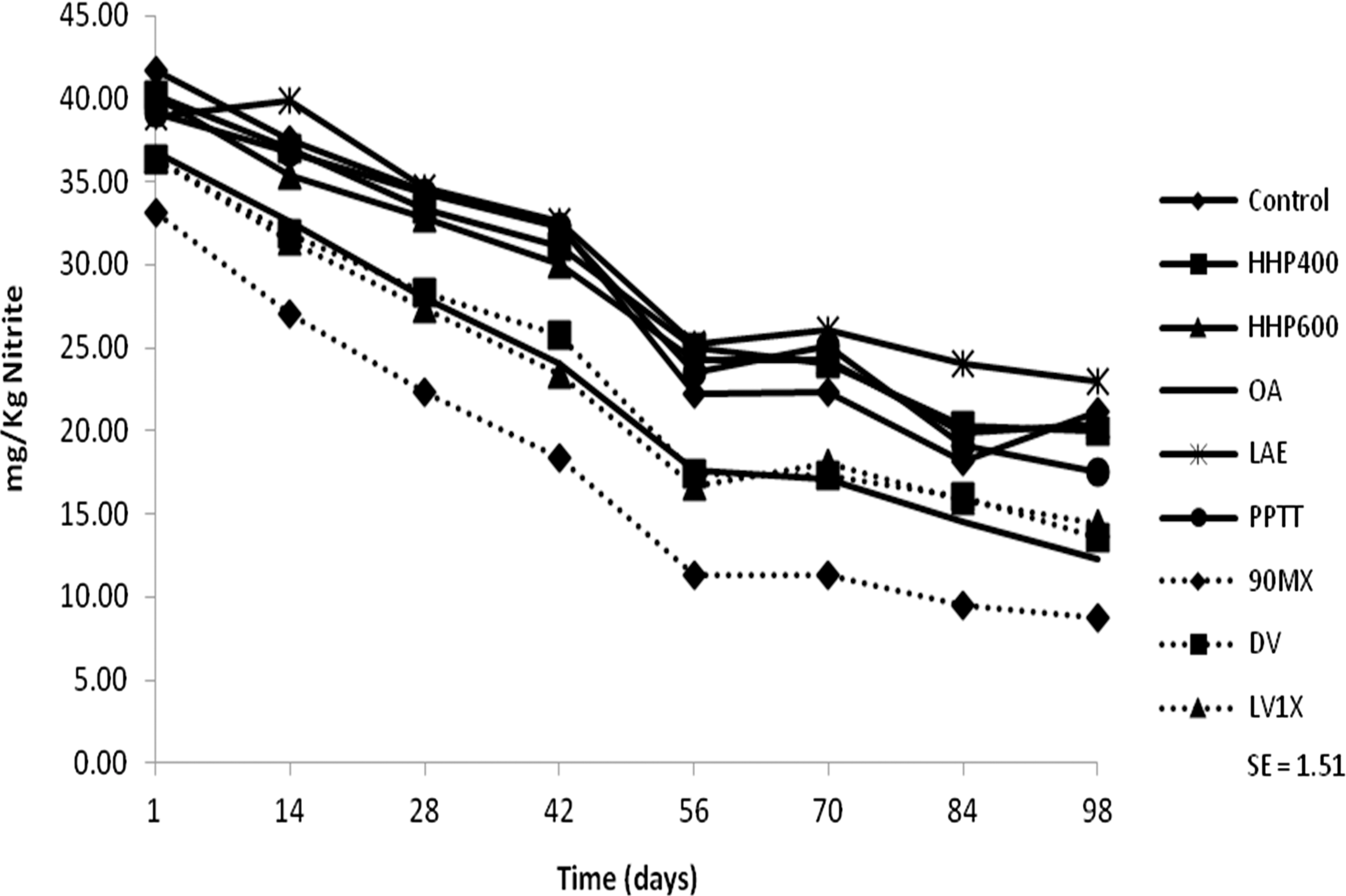
Effect of treatment on residual nitrite concentration of alternatively cured ready-to-eat ham stored at 4±1°C.
Bacteriological results
Treatment and day had a significant (p<0.05) effect on viable L. monocytogenes populations (Fig. 2). However, the natural antimicrobials did not affect L. monocytogenes populations after 1 day of storage (p>0.05) when compared to the control treatment.
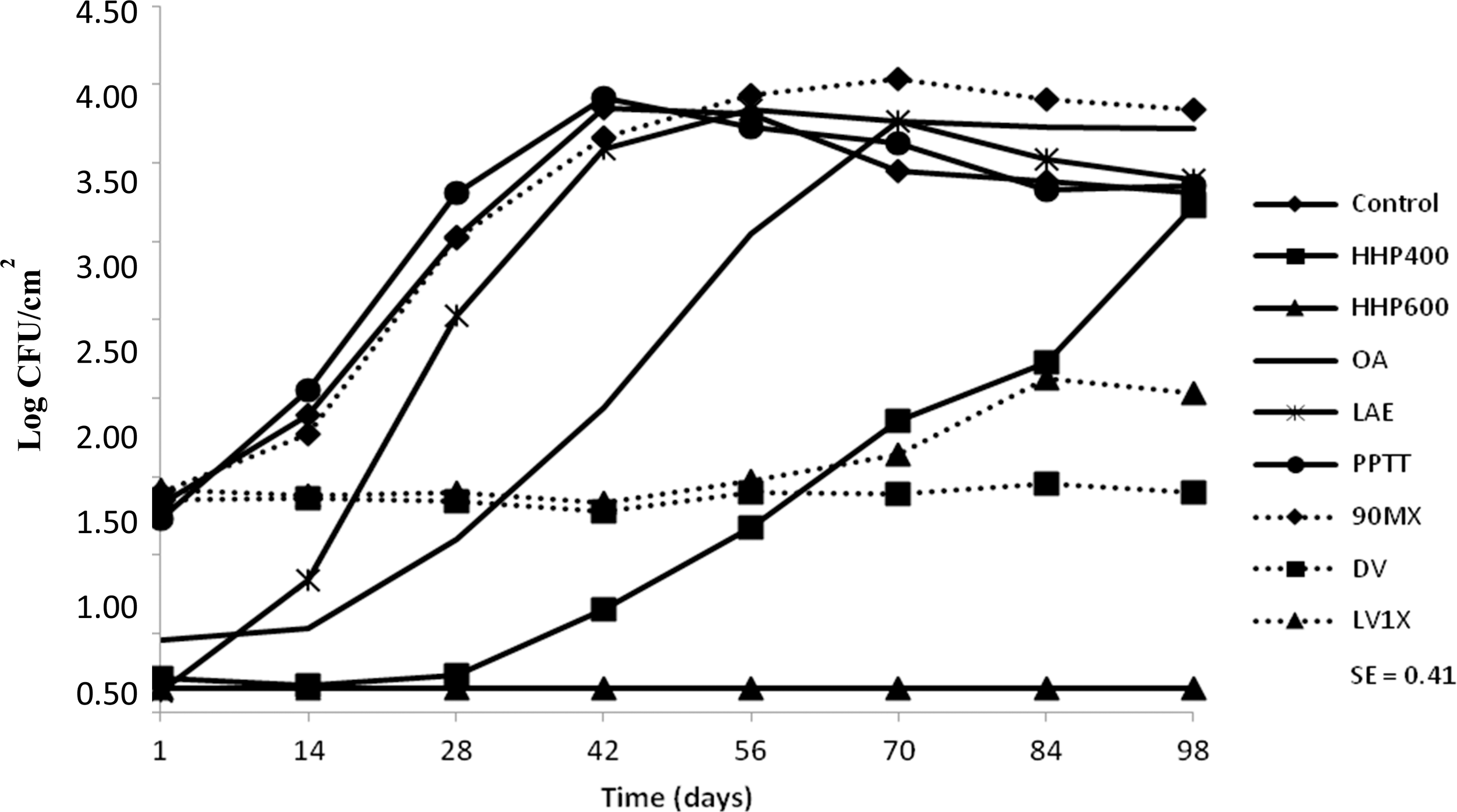
Effect of treatment on a five-strain mixed culture of viable Listeria monocytogenes (log colony-forming units (CFU)/cm2) on modified Oxford medium on alternatively cured ready-to-eat ham stored at 4±1°C.
The DV treatment did not show changes in L. monocytogenes populations throughout the study (p>0.05), while the LV1X treatment did not exhibit increased L. monocytogenes populations until day 84 (p<0.05). L. monocytogenes populations found in the LV1X treatment on days 84 and 98, however, were still lower than those of the control (p<0.05). These results suggest that, at the levels used in this study, DV and LV1X exhibited bacteriostatic properties against L. monocytogenes.
The HHP600 treatment resulted in L. monocytogenes populations below the detection limit of our sampling protocols (≥0.30 log10 CFU/g) throughout the study. These results agree with those obtained by Myers and others (2013a, 2013b), who found that an HHP treatment of 600 MPa for 3 min and 17°C resulted in a 3.85–4.35 log10 CFU/g reduction in L. monocytogenes populations on RTE meat products. The LAE, HHP400, and OA treatments resulted in 2.38, 2.21, and 1.73 log10 CFU/g reductions in viable L. monocytogenes populations, respectively, compared to the control, on day 1.
The PPTT did not significantly decrease initial viable L. monocytogenes populations (p>0.05) compared to the control. These results contrast to those by Chen and others (2004), who observed that a postpackaging thermal treatment of 71±1°C for 30 s resulted in a 1.4 log10 CFU/g reduction in L. monocytogenes populations on frankfurters when using a 3.4 log10 CFU/g initial inoculation. It is not clear why our results differed from those reported by Chen and others (2004).
Although initial bactericidal effects of the HHP400, OA, and LAE treatments were observed, bacteriostatic properties of these treatments were limited. The HHP400 treatment resulted in an (p<0.05) increase in viable L. monocytogenes populations after 56 days. In fact, by day 98, there was no difference between the control and the HHP400 treatments (p>0.05).
Similarly, the OA and LAE treatments showed significant (p<0.05) increases in L. monocytogenes populations by days 28 and 14, respectively, with both of these treatments showing no difference compared to the control by day 70 (p>0.05). The LAE treatment, in fact, resulted in viable L. monocytogenes populations that were not different from those found in the control as early as day 28 (p>0.05). These findings agree with Porto-Fett and others (2010), who reported that only in combination with lactate or diacetate did lauric arginate exert a bacteriostatic effect. Thus, although they may provide initial lethality, lauric arginate and OA alone do not inhibit any L. monocytogenes that may survive. Our study indicates that, while beneficial for initial lethality, HHP400, OA, and LAE did not offer protection against the growth of surviving L. monocytogenes during storage.
Conclusions
At the levels used and under the conditions of this study, DV and LV1X exhibited bacteriostatic properties against L. monocytogenes and represent viable options for manufacturers of organic and natural processed meat and poultry products, but did not exhibit bactericidal properties. Although beneficial for initial lethality, the HHP400, OA, and LAE postlethality interventions did not prevent growth of surviving L. monocytogenes during storage. The HHP600 treatment, however, which is currently used by the industry, was very effective. Thus, additional research on combining natural antimicrobial ingredients and postlethality interventions that are not fully effective by themselves as well as assessing the organoleptic effects of the added ingredients used as antimicrobials in the manufacture of organic and natural processed meat and poultry products is warranted.
Footnotes
Acknowledgments
Special thanks to Devin Maurer and Daniel Fortin. This project was supported by the American Meat Institute Foundation, Florida Food Products, WTI Ingredients, Ocean Spray International, EcoLab, Purac America, and Kalle USA.
Disclosure Statement
No competing financial interests exist.