




Abstract
After a series of outbreaks associated with sprouts in the mid-1990s, the U.S. Food and Drug Administration (FDA) published guidelines in 1999 for sprouts producers to reduce the risk of contamination. The recommendations included treating seeds with an antimicrobial agent such as calcium hypochlorite solution and testing spent irrigation water for pathogens. From 1998 through 2010, 33 outbreaks from seed and bean sprouts were documented in the United States, affecting 1330 reported persons. Twenty-eight outbreaks were caused by Salmonella, four by Shiga toxin–producing Escherichia coli, and one by Listeria. In 15 of the 18 outbreaks with information available, growers had not followed key FDA guidelines. In three outbreaks, however, the implicated sprouts were produced by firms that appeared to have implemented key FDA guidelines. Although seed chlorination, if consistently applied, reduces pathogen burden on sprouts, it does not eliminate the risk of human infection. Further seed and sprouts disinfection technologies, some recently developed, will be needed to enhance sprouts safety and reduce human disease. Improved seed production practices could also decrease pathogen burden but, because seeds are a globally distributed commodity, will require international cooperation.
Introduction
O
Because of concern over sprouts-associated illnesses, steps have been taken in the United States to make sprouts safer. In 1999, the US Food and Drug Administration (FDA) recommended soaking seeds with an antimicrobial agent such as 20,000 mg/L (ppm) calcium hypochlorite solution before sprouting and testing the spent sprout irrigation water for Salmonella spp. and STEC O157:H7 before distribution (FDA, 1999). This 20,000 mg/L (ppm) calcium hypochlorite treatment was the most effective chemical seed treatment known (Beuchat, 1997), although various other chemical, physical, and biological control methods have been identified subsequently. Although lot-by-lot testing is generally not advocated as a safety strategy for other foods, it was advised for sprouts because seed antimicrobial treatments did not guarantee complete elimination of pathogens and because the rapid bacterial amplification that can occur during sprouting makes detection more likely (FDA, 1999; Thomas et al., 2003; Fu et al., 2001). A previous review summarized sprouts-associated outbreaks from 1973 through 1997 (Taormina et al., 1999). We evaluate sprouts-associated outbreaks from 1998 to 2010 to assess the effect of the recommended control measures, and we also review new seed and sprouts treatment technologies that offer the possibility of enhanced control of sprouts contamination.
Methods
Sprouts-associated outbreaks
Data on foodborne disease outbreaks in the United States were obtained from the Centers for Disease Control and Prevention's (CDC) Foodborne Disease Outbreak Surveillance System (FDOSS). FDOSS collects information reported voluntarily by local, state, tribal, and territorial health departments, defining an outbreak as two or more illnesses associated with consumption of a common food. This analysis includes outbreaks occurring between 1998 and 2010 reported to FDOSS by July 5, 2012. Information routinely collected includes the magnitude (number of illnesses, hospitalization, and deaths), location, pathogenic etiology, and food vehicle of the outbreak. All outbreaks reported as sprouts-associated that identified a pathogenic etiology were included. Information on the location of the sprouts grower, the origin of seed, and the grower's implementation of FDA guidelines were obtained from FDA when available. Finally, the literature was searched for additional sprouts-associated outbreaks during this period that had not been reported to CDC or FDA and for further information on reported outbreaks.
Whether guidelines for sprouts antimicrobial treatment had been implemented was determined from FDA reports, or, when these reports were not available, from summaries by the investigating state health departments. Although FDA guidelines for sprouts include multiple additional recommendations, sprouts growers were categorized as having complied with key guidelines if they both (1) conducted an antimicrobial treatment such as soaking seeds in 20,000 mg/L calcium hypochlorite solution and (2) tested the spent sprout irrigation water for Salmonella and STEC O157 before distribution.
Seed and sprouts treatment strategies
The scientific literature was reviewed for chemical, physical, biological, or combination treatments to inactivate bacterial human pathogens on sprouts, alfalfa seeds, and mung beans. Public and private literature databases were searched: PubMed (U.S. National Library of Medicine, National Institutes of Health), Scopus (Elsevier B.V., Amsterdam, The Netherlands), and Google Scholar (Mountain View, CA). Search terms included “alfalfa seeds,” “mung beans,” “sprouts,” or “seed sprouts,” in combinations with “pathogens,” “Salmonella,” or “Escherichia coli,” and “disinfection,” “sanitization,” or “decontamination.” Treatments that were reported to cause ≥2-log colony-forming units (CFU)/g reductions of the bacterial pathogens Salmonella, STEC O157:H7, or the native bacterial flora on seeds without significant (p<0.05) reduction in germination percentage are summarized.
Results
Sprouts-associated outbreaks
From 1998 through 2010, 14,956 U.S. foodborne disease outbreaks were reported to FDOSS. Among the 8366 for which a food vehicle was reported, 33 were sprouts associated. The sprouts-associated outbreaks were associated with 1330 illnesses (median of 22 illnesses per outbreak), 123 hospitalizations, and 2 deaths (Table 1). Alfalfa sprouts were implicated in 20 outbreaks, bean sprouts in 8, clover sprouts in 3, alfalfa and clover together in 1, and unspecified sprouts in 1. Fourteen were single-state outbreaks, and 19 were outbreaks in which the exposure occurred in more than 1 state.
The key FDA guidelines include (1) disinfecting seeds with a treatment such as soaking seeds in 20,000 ppm calcium hypochlorite solution and (2) testing spent sprout irrigation water for pathogens. Compliance is recorded as “no” unless both key guidelines were followed by all sprouts growers involved.
When all seed came from the same supplier, traceback to seed origin was not always explored because outbreak source was deemed controlled.
Exact seed source could not be determined.
FDA, U.S. Food and Drug Administration; STEC, Shiga toxin–producing Escherichia coli.
Compared with outbreaks associated with other foods, sprouts-associated outbreaks had more illnesses (median of 22 versus 7) and hospitalizations (median of 2 versus 0) and were more likely to involve multiple states (58% versus 2%). The annual number of sprouts-associated outbreaks ranged from one to four, with no apparent trend over time (Fig. 1).
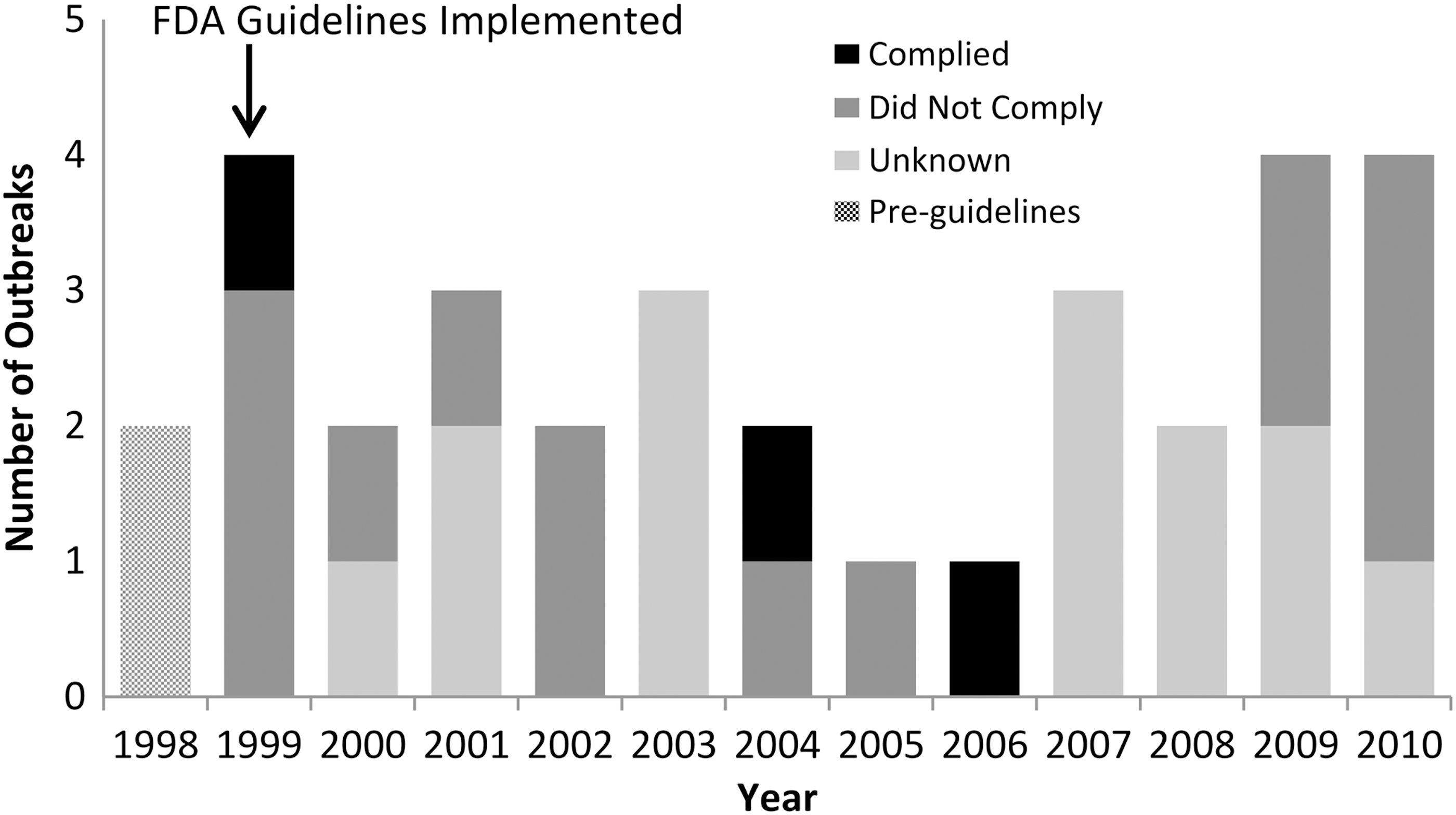
Sprout outbreaks and implementation of U.S. Food and Drug Administration (FDA) guidelines by year, 1998–2010.
Twenty-eight of the sprouts-associated outbreaks were caused by Salmonella, four by STEC O157, and one by Listeria. Fifteen serotypes of Salmonella were reported; the most common were Enteritidis (4), Mbandaka (3), Typhimurium (3), Cubana (3), Saintpaul (3), Newport (2), and Braenderup (2). Of the four STEC O157 outbreaks, two were caused by O157:NM and two by O157:H7.
Information on the origin of the seeds was available for 20 outbreaks. Six were caused by sprouts produced from domestically grown seeds, 13 by sprouts produced from imported seeds, and 1 by sprouts produced from seeds of both domestic and foreign origin. Three countries—Australia, China, and Italy—were identified as the source of imported seed. Two of the 13 outbreaks from imported seed had 2 or more reported seed sources; therefore, a source could not be definitively identified. Seeds from Australia were implicated in all outbreaks caused by STEC in which the seed source was known.
Eighteen outbreak reports included information about whether sprouts growers had implemented FDA's guidelines at the time of the outbreak. In 3 outbreaks, sprouts growers reportedly followed FDA guidelines; in 15 outbreaks, at least 1 sprouts grower that produced sprouts involved in the outbreak did not adhere to the guidelines. Data regarding the time interval between seed harvest and sprouting were not available for any outbreaks.
Seed and sprouts treatment strategies
Numerous studies of seed treatments have reported reductions of Salmonella and STEC O157:H7 by >2.0-log CFU/g from mung bean or alfalfa seed while preserving germination. Fewer studies reported ≥5-log reductions (Table 2), as evidenced by microbiologic enrichment of seeds or analysis of sprouts produced from treated seeds. A combination of peroxyacid, caprylic and capric acids, lactic acid, and glycerol monolaurate eliminated >6.90-log CFU/g of Salmonella and STEC O157:H7 from alfalfa seeds (Pierre and Ryser, 2006). Dry-heating alfalfa seeds at 55°C for 8 days eliminated 2-log CFU/g of Salmonella and >8-log CFU/g of STEC O157:H7 (Feng et al., 2007), and similar results were reported for mung beans (Weiss et al., 2007). Other treatments that achieved elimination of >5 logs of both pathogens on alfalfa seeds included high hydrostatic pressure of 500 MPa for 2 min at 45°C (Neetoo and Chen, 2010) and the combination of dry heating followed by 600 MPa for 2 min at 35°C (Neetoo and Chen, 2011).
Treatments causing ≥2-log reductions of both pathogens (colony-forming units per gram) on seeds without significant reduction in germination percentage.
Incomplete reduction (i.e., recovery by microbiologic enrichment of treated seeds and/or detection of pathogen on sprouts subsequently grown from treated seeds).
Complete reduction (i.e., elimination from seed as determined by microbiologic enrichment of treated seed samples and/or absence of pathogen on sprouts subsequently grown from treated seeds).
Sprout yield and/or lengths significantly affected by treatment.
Direct treatments of sprouts have also been evaluated. Blanching alfalfa sprouts eliminated STEC O157:H7 from 72% of contaminated samples (Neetoo and Chen, 2011), and hot water or 5% acetic acid treatments eliminated Salmonella from mung beans and alfalfa sprouts (Pao et al., 2008). Waje et al. (2009) reported that γ-irradiation at 1 kGy eliminates Salmonella but not STEC O157:H7 in mature broccoli and red radish sprouts. A solution of 200 ppm stabilized oxychloro-based sanitizer eliminated both Salmonella and STEC O157:H7 from mung bean sprouts (Hora et al., 2007). Continuously sparging, submersing samples in process water injected with small bubbles of ozone gas, at an ozone concentration of 21 ppm O3 for 2–64 min followed by high hydrostatic pressure treatment of alfalfa sprouts reduced E. coli O157:H7 by 2-log CFU/g (Sharma et al., 2003).
Discussion
This study shows that outbreaks of bacterial enteric infections associated with contaminated seed sprouts are an ongoing challenge in the United States. Compared with other foodborne-disease outbreaks, sprouts-associated outbreaks tend to be larger and are more likely to involve multiple states. This is especially striking given that, in a 2006–2007 survey, only 8% of the general population reported consuming any kind of sprouts during the previous week (CDC, 2006–2007). Although some of the outbreaks we reviewed might have been prevented if the sprouts grower implemented the FDA guidance to pre-soak sprout seeds with a treatment such as 20,000 mg/L (ppm) calcium hypochlorite solution and to test spent irrigation water, other outbreaks were linked to sprouts produced by growers who said they had implemented the guidelines (Thomas et al., 2003). The FDA recognizes the inability of this process to completely eliminate pathogens (FDA, 1999).
Our review of research on processes and control measures to ensure sprouts safety shows that several new approaches are promising. The sprouting industry itself has been instrumental in collaborating with researchers on many of these investigations. The National Advisory Committee on the Microbiological Criteria for Foods in the United States recommended seed disinfection using methods demonstrated to achieve ≥5-log reductions in the numbers of STEC O157 and Salmonella (National Advisory Committee, 1999). Therefore, numerous studies have aimed for ≥5-log reduction of both pathogens on seeds intended for sprouting—without reducing germination or sprouts quality. For several effective seed disinfection treatments, especially irradiation, cost and consumer concerns may preclude adoption. Most treatments disinfect incompletely, allowing low-level survival of pathogens on seeds, even though organisms are susceptible to chlorine. Combination treatments, such as heat and high pressure or heat and chemical treatment, tended to be most effective in eliminating pathogens on seeds (Peñas et al., 2008, 2010); using multiple control points may be most successful in producing safe sprouts. During sprouting, seed treatment could be followed by a sprouts-disinfection step. Treatment of maturing sprouts, such as application of Salmonella-specific lytic bacteriophage (Kocharunchitt et al., 2009; Ye et al., 2010) or commensal bacteria (Wilderdyke et al., 2004; Weiss et al., 2007), holds promise for limiting growth of any pathogens that survive seed treatment.
Seed contamination is an inherent risk. Salmonella and STEC, the pathogens most often identified in sprouts-associated outbreaks, are typically harbored in animals' intestinal tracts (Swartz, 2002). Between seed production and sprouts consumption, frequent opportunities, many of them likely unapparent, exist for contamination. On the farm, birds, rodents, and other animals, such as grazing livestock or deer, may defecate pathogens onto the plant producing the seeds or may defecate intact seeds along with pathogens in the manure. It has been suggested that Salmonella may cycle between herbivores and plants in this way (Fletcher, 2013). Alfalfa (i.e., lucerne) is typically grown primarily for animal feed. Only a small proportion of a given seed lot may be used to produce sprouts for human consumption (NACMCF, 1999). Consequently, the seed used for sprouting often is not grown, harvested, and cleaned using good agricultural practices to prevent contamination of the seed with human pathogens. While most developed countries have traceability guidelines, they usually suggest only a “one-step back” and “one-step forward” approach. Since the international seed trade includes multiple steps through brokers (Gill et al., 2003; Emberland et al., 2007), sprouts growers could unknowingly obtain seed that was produced for animal feed.
Several international outbreaks have been traced to single seed supplies (Mahon et al., 1997; Taormina et al., 1999). In our review, two outbreaks that occurred in Minnesota and Colorado at different times in 2003 were caused by STEC O157:NM with indistinguishable pulsed-field gel electrophoresis patterns. The implicated alfalfa seed, although sprouted in different facilities, originated from the same seed supplier in Australia (Ferguson et al., 2005), strongly suggesting contamination before sprouting. STEC O157:NM was isolated in half of STEC outbreaks. While STEC O157:NM only accounts for 2% of all E. coli O157 isolates from humans in the United States (Unpublished data, U.S. Department of Health and Human Services, CDC, 2012), it is the dominant type in Australia (78%) (Fegan and Desmarchelier, 2002).
After seeds are harvested, they are often scarified by rubbing between two hard surfaces to create microscopic cracks to facilitate water uptake and more rapid and consistent germination of the seed during sprouting. This process may lead to infiltration of bacteria into areas that allow evasion of chemical treatment (Holliday et al., 2001). Pathogens can be internalized into the seed and remain dormant until sprouting (Ferguson et al., 2005). The sprouting process, which occurs in a warm, moist environment, can amplify the number of bacteria on the sprout (Fu et al., 2008). Five- to 6-log increases of Salmonella (Jacquette et al., 1996) and STEC O157:H7 (Taormina et al., 1999) from inoculated seed have been observed during sprouting. Seeds remain viable for years, so they may be transported long distances and held for a long time. In addition, human pathogens such as Salmonella can remain viable on alfalfa seeds in dark storage for 2 years (Inami et al., 2001). If pathogenic bacteria are already present in or on the seed, one contaminated lot distributed widely can lead to contaminated sprouts produced over time and in disparate locations, adding to the challenge of detecting and investigating associated outbreaks.
Because most seed disinfectant treatments reduce risk of contamination but do not always eliminate pathogens, the FDA has maintained that testing spent irrigation water for pathogens is a key to verifying that pathogens are not present in sprouts and preventing contaminated sprouts from entering commerce (FDA, 1999). Sprouts-growing firms could conduct environmental testing for Listeria monocytogenes as an additional precaution.
In January 2013, the FDA published a proposed regulation on Standards for Produce Safety, which would establish science-based minimum standards for the safe growing, harvesting, packing, and holding of produce on farms. This proposed regulation would establish specific requirements for sprouts production that reflect the fact that sprouts production provides a hospitable environment for growth of many human pathogens. For example, sprouts growers would be required to treat seeds or beans before sprouting using a validated method to reduce pathogen load. In addition, sprouts growers would be required to test either a representative sample of spent irrigation water from each batch of sprouts for pathogens (Salmonella spp. and E. coli O157:H7) or an appropriate sample of the sprouts themselves from each batch. Also, sprouts growers would be required to test the sprouts production environment regularly for either Listeria species or L. monocytogenes (FDA, 2013).
This review of sprouts-associated outbreaks has certain limitations, and several important unanswered questions remain. An assessment of trends in the risk of an outbreak or illness per unit of sprouts consumed would be of great interest but for several reasons is not possible with our data. First, the advent of PulseNet, the nationwide molecular subtyping network for bacterial foodborne pathogens that was launched in 1996, greatly increased the detection of dispersed foodborne outbreaks, such as many of the sprouts-associated outbreaks we report (Olsen et al., 2000). Second, FDOSS was enhanced in 1998, leading to a marked increase in outbreak reports (Gould et al., 2013). Both advances complicate comparisons of our data with previous reports. Third, although information about trends in sprouts consumption in the United States would provide a helpful context for our findings, such information is not available. It is also important to note that the true burden of sprouts-associated illnesses is undoubtedly substantially greater than we report. Foodborne outbreak detection systems rely heavily on detection of laboratory-confirmed infections and may not detect outbreaks caused by pathogens for which testing is not routine. Geographically dispersed cases may not be recognized as part of an outbreak, and even since 1998, many outbreaks that are likely foodborne are not investigated or reported. Sprouts are sometimes referred to as a “stealth” vehicle, meaning persons may not be aware of having eaten them in, for example, a sandwich or a salad. It is not uncommon for less than 40% of ill persons in sprouts-associated outbreaks to recall sprouts consumption (Mahon et al., 1997; Van Beneden et al., 1999). In the German outbreak of E. coli O104:H4 infections in 2011, an analysis based on the ingredients of menu items was required to implicate the sprouts, as few diners remembered eating them (Buchholz et al., 2011). Data on seed sources and implementation of FDA guidelines are not available for some outbreak investigations, in most cases because of inadequate records for definitive traceback, but it seems unlikely that these outbreaks would differ dramatically from the outbreaks for which information was available. In seed disinfection studies, the varying methods of seed and sprouts inoculation, treatment, and pathogen enumeration may make it difficult to compare efficacy directly across studies (Wu et al., 2001).
Although progress has been made in the sprouts industry to reduce contamination, the continued occurrence of outbreaks shows that room still exists for improvement. Sprouts safety is an international concern; while pathogen control measures for sprouts production vary, guidelines or regulatory requirements for disinfection of seed exist in many other industrialized countries (Freshfel Europe, 2014). International cooperation, including among countries that export seed and those that import it, will be essential. To this end, determining the source of seed implicated in sprouts-associated outbreaks will continue to be important. In addition, ongoing educational efforts for the sprouts industry, which is largely composed of small firms, some of which lack personnel with formal food safety training, will be key to improving the safety of sprouts in the food supply. Continued progress is vital both to reduce illnesses and to retain consumer confidence in the sprouts industry itself.
Footnotes
Acknowledgments
We thank Heena Joshi and Leeza Kondos for their contributions in data gathering.
Disclosure Statement
No competing financial interests exist.