




Abstract
Dairy cattle are considered a Campylobacter reservoir in the epidemiology of campylobacteriosis. Currently, very little data on the prevalence of Campylobacter in dairy herds are available in the Province of Quebec, Canada. The objectives of this study were to evaluate the prevalence of Campylobacter associated with management practices in 40 dairy cattle herds as well as to characterize the bacterial genetic diversity. Fecal samples from 797 lactating cows of 40 dairy farms, water provided to animals, milk from bulk tank, and fecal matters from pens were analyzed for the presence of Campylobacter. Management information was collected using a short survey and the geographical positioning was mapped for each farm. Bacterial genetic characterization was performed by pulsed-field gel electrophoresis and flaA-typing. In total, 29 farms (72.5%) were found positive for Campylobacter spp. and 20 (50%) of them were positive for Campylobacter jejuni. In animals, 27.6% of the fecal samples were positive for Campylobacter spp. C. hyointestinalis was the most prevalent species (19.3%) in herds, followed by C. jejuni (6.5%). No Campylobacter were recovered from water or milk samples. Component-fed ration systems and the lack of biosecurity measures were associated with an increased prevalence of C. jejuni on the studied farms. Campylobacter-positive farms were scattered throughout the region, and bacterial genetic heterogeneity was observed between farms and inside the herds. This study is the first one to characterize C. jejuni isolates from dairy herds in the Province of Quebec. These observations may be useful in order to elaborate risk-mitigation strategies.
Introduction
C
The bacteria also have a high level of genetic diversity, and frequent recombination events, such as genomic rearrangements, intra- or intergenomic recombination, and natural transformation, are observed (Ragimbeau et al., 2008). Nevertheless, genotyping methods are widely used to characterize the various strains. Pulsed-field gel electrophoresis (PFGE) is a highly discriminatory method used for defining clones and lineages within Campylobacter population (On et al., 1998; Fitzgerald et al., 2001). It is based on the digestion of intact genomic DNA with rare-cutting restriction enzymes followed by polymorphism analysis. Another genotyping technique is the flagellin A typing (flaA-typing) where the enzymatic digestion of the amplification product from the flaA gene of C. jejuni, associated with strain virulence, shows a great genetic polymorphism. The technique is easy to perform and inexpensive, as it relies on the digestion of a polymerase chain reaction (PCR) product. Because the technique targets one gene, it is found to be less discriminatory than the whole genome analysis. On the other hand, it makes it possible to see whether more isolates from a defined farm share some homologies.
It is known that different farm characteristics and management practices, such as indoor housing or water supply, can affect bacterial abundance or distribution (Ellis-Iversen et al., 2009). Moreover, each farm is a unique combination of numerous environmental characteristics that could set baseline conditions for the presence of pathogenic bacteria (Strawn et al., 2013). In that perspective, geographic information systems (GIS) are powerful tools that can provide information at a spatial level by mapping parameters such as roads, rivers, soil types, or nearby farms. Identifying those attributes can contribute to the understanding of the distribution and persistence of bacterial pathogens.
The objectives of this study were to evaluate the prevalence of Campylobacter at the herd level and its association with management practices in dairy cattle farms, and to characterize the bacterial genetic diversity among certain herds, given that few data are available on the occurrence of these bacteria in the Province of Quebec, Canada.
Materials and Methods
Samples collection
A cross-sectional study was conducted between June and August 2011. Forty dairy herds were selected and visited once during the study period. Herd selection was based on convenience for being located within 30 km of the bovine ambulatory clinic of the Université de Montréal (St-Hyacinthe, Quebec, Canada) and for having a regular (monthly or more frequently) veterinary herd health visit. Animal use was approved by the “Comité d'éthique sur l'utilisation des animaux” of the Faculté de Médecine Vétérinaire (Université de Montréal, Canada). The average number of lactating cows was 60.4 animals and Holstein was the only breed present. During farm visits, stool samples were collected from the rectum of 20 lactating cows selected all across the barn, and a questionnaire was completed by the farmer. The questionnaire focused on dairy farm management practices (listed in Table 1). Also, a pool of stools from replacement animal (calves and heifers) pens were collected from the floor with a maximum of five pools when there were more than five pens in the herd. Water samples (1 L) were collected from the milking shed tap (same piping for cattle troughs), and milk samples (1 L) were obtained from the bulk tank using the duct at the bottom.
Bacterial isolation and identification
C. jejuni ATCC 33291 was used as control strain. Fecal samples were examined by an enrichment method followed by plating on a selective media. Briefly, 1 g of stool was added to 9 mL of Bolton broth (CM983, supplement SR0183E, 5% laked horse blood, Oxoid) and incubated 48 h at 42°C in a microaerophilic atmosphere. Water samples (250 mL) were filtered through a 0.22-μm membrane (Millipore) and the filters were incubated in 20 mL of Bolton broth the same way as for fecal samples. Milk samples (100 mL) were centrifuged at 16,000× g for 20 min at 4°C (Hunt et al., 2001). Fat and supernatant were discarded, and the pellet was suspended in 100 mL of Bolton broth and incubated as previously described. A loopful was then transferred onto Karmali media (CM0935, supplement SR0167E, Oxoid) and incubated 48 h at 42°C in a microaerophilic atmosphere. Typical colonies were isolated and cultured on tryptic soy agar (TSA)–5% sheep blood. A herd was considered positive when one sample from either lactating cows or replacement animals was positive for Campylobacter. The negative herds referred to herein correspond to herds in which it was not possible to detect the bacteria using these techniques.
Bacterial DNA was extracted from typical isolated colonies using a QIAamp DNA Mini extraction kit as recommended by the manufacturer (Qiagen). PCR amplifications were performed for species identification as described by Yamazaki-Matsune et al. (Yamazaki-Matsune et al., 2007) for C. jejuni, C. coli, C. lari, C. hyointestinalis, C. fetus, C. upsaliensis and as described by Inglis and Kalischuk for C. lanienae (Inglis and Kalischuk, 2003).
PFGE characterization
PFGE was performed according to the PulseNet protocol for C. jejuni (Ribot et al., 2001) and the method described by Hunter et al. (Hunter et al., 2005). Six C. jejuni–positive farms with at least two positive isolates were randomly selected. Briefly, bacteria were suspended in 10 mL of phosphate-buffered saline and adjusted to an optical density (610 nm) of 1.0 using a spectrophotometer. Plugs were made using 400 μL of this suspension mixed with an equal volume of 1.0% wt/wt low-gelling-temperature agarose (Seakam Gold Agarose, Lonza) containing 1.0% sodium dodecyl sulfate (Gibco) and 25 μL of proteinase K. Plugs were placed in 5 mL of lysis buffer (50 mM Tris, 50 mM EDTA [pH 8.0], 1.0% N-lauroyl-sarcosine) with 25 μL of proteinase K (20 mg/mL, Qiagen) during 15 min at 54°C in a shaker bath with constant agitation (60 rpm). The restriction enzymes used for Salmonella serotype Braenderup and Campylobacter were XbaI (50 U of enzyme at 37°C for 4 h; Roche) and SmaI (50 U of enzyme at room temperature for 4 h; Roche), respectively. Gel patterns were analyzed with the FPQuest software version 5 (Bio-Rad) using Dice similarity coefficient with 0.5% optimization and 1.25% position tolerance. The strains were clustered by the unweighted-pair group method using average linkages.
flaA-typing
Flagellin A gene typing was performed according to Hanel et al. (Hanel et al., 2007). The flaA gene PCR product (1.7 kb) was digested with 0.2 U/μL of DdeI (New England Biolabs) restriction enzyme and analyzed by electrophoresis on 2% agarose gels. The gel patterns were analyzed as for PFGE patterns.
GIS analyses
A geodatabase was built by combining the farms database (addresses, longitude and latitude coordinates, management practices, and presence or absence of C. jejuni in herds) and layers of existing information (namely, road network and surface water). Maps were then created with ArcMap™ (ArcGIS desktop 10, ESRI®, Redlands, CA) to observe geographic distribution of C. jejuni–positive farms among the studied farms. Visual observations were performed to identify farms proximity clusters or associations with the road network and surface water parameters.
Statistical analyses
Statistical analyses were performed with SAS (version 9.3, SAS Institute Inc., Cary, NC). Descriptive statistics were calculated using the MEANS procedure in SAS. Univariable linear regression models between herd management practices (predictors) and C. jejuni herd prevalence (dependent variable) were computed using the MIXED procedure in SAS. Predictors with p≤0.15 were retained for multivariable modeling. A multivariable linear regression model was built with C. jejuni herd prevalence (dependent variable) and retained variables (predictors) using the MIXED procedure in SAS. A backward elimination procedure was used to build the multivariable model until all p≤0.05. Pairwise comparison was performed using a Tukey–Kramer test. Least-square means of C. jejuni herd prevalence for every predictor remaining in the multivariable model were calculated.
Results
A total of 29 herds (72.5%) were positive for Campylobacter spp., and 20 of them were positive for C. jejuni. The average herd prevalence of C. jejuni in lactating cows was 6.5 % (SD=11.2; minimum=0%; maximum=55%). C. hyointestinalis was the most frequent bacterial species isolated (Table 2). No C. lari, C. fetus, C. upsaliensis, or C. lanienae were detected. Among herds with Campylobacter-negative lactating cows, feces from replacement animals were also found to be Campylobacter-negative 85% of the time.
In the studied farms, the average number of lactating cows was 60.4 animals. Holstein cows were present in every herd. Management variables among the 40 farms are shown in Table 1. Univariable linear regression models were built to screen for potential predictors of C. jejuni herd prevalence. Univariable predictors offered to the multivariable model were feeding system (p=0.02) and presence of biosecurity measures (cleaning boots and/or washing or disinfecting the stalls; p=0.03). In the end, the final multivariable model consisted of the predictors feeding systems (p=0.03) and presence of biosecurity measures (p=0.04). Least-square means of C. jejuni herd prevalence for feeding systems were 3.3% for total mixed rations and 10.9% for component-fed rations. Least-squares means of C. jejuni herd prevalence for biosecurity measures were 2.3% when present and 8.8% when absent.
C. jejuni genetic diversity from six positive herds was analyzed by PFGE and flaA-typing. Among the 36 analyzed strains, 3 were untypeable by PFGE as well as 1 by flaA-typing. A total of 15 genetic patterns were observed by PFGE and 17 by flaA-typing. Results are presented in Table 3. A unique profile (one strain per profile) in both techniques was observed for 14% of the tested strains. The most frequent PFGE pattern (F) was distributed among three farms. Overall, the genetic diversity was frequent in each farm with different combinations of profiles observed, except for the F27 farm. There, PFGE profiles were homogeneous except for one strain. The number of different genetic profiles varies between farms and within farms are shown in Figure 1.
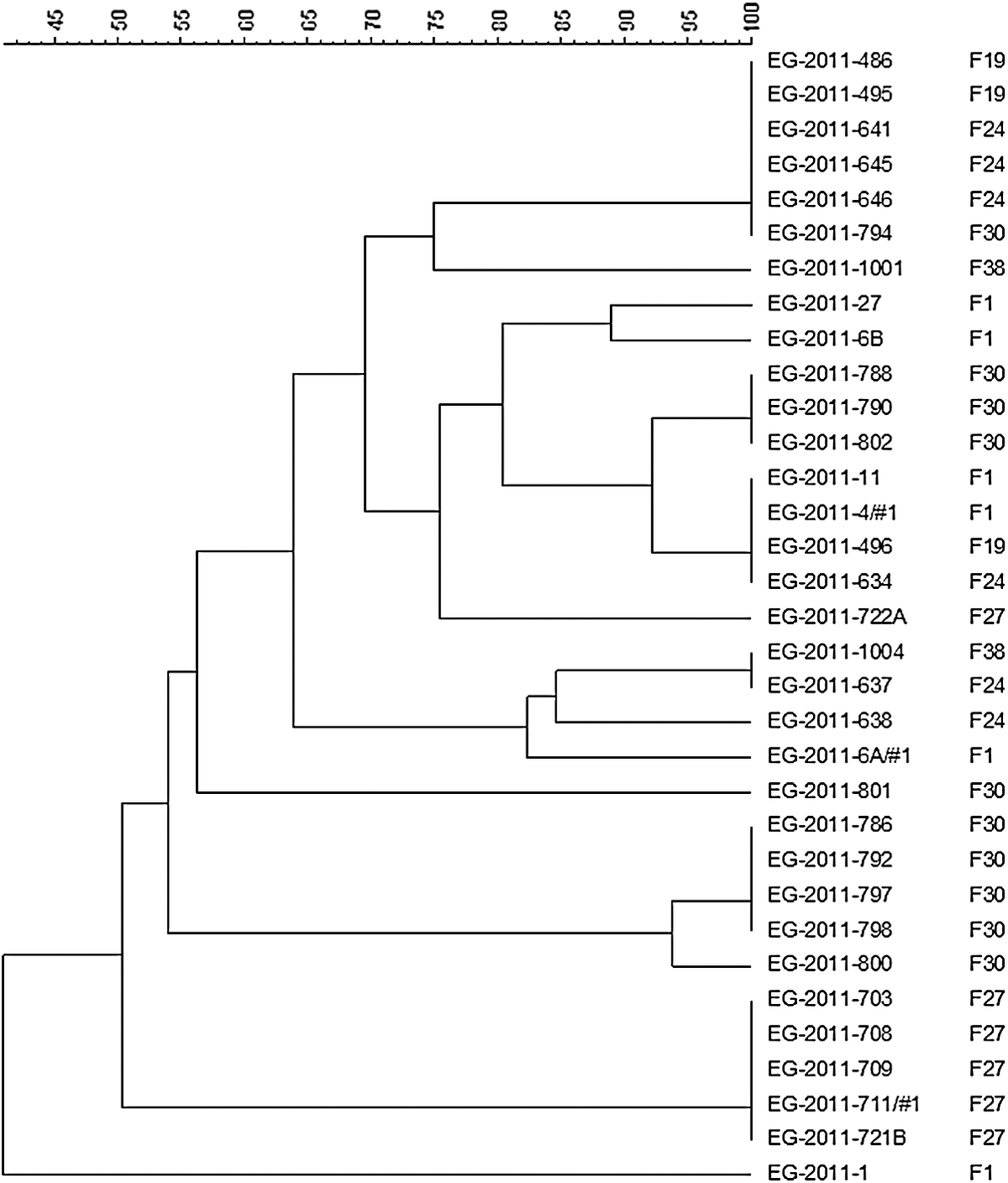
Dendrogram showing the distribution of pulsed-field gel electrophoresis profiles for SmaI restricted dairy cattle Campylobacter jejuni isolates from six dairy farms. The EG-numbers are the strain identification and the F-numbers are the farm identification. Levels of similarity were calculated with Dice coefficient, and the unweighted-pair group method using average linkages was used for cluster analysis.
All samples were constituted of stools from lactating cows except for b that came from replacement animals.
Not determined.
Untypeable.
Regarding the geographical distribution, C. jejuni–positive farms were scattered throughout the studied region, and no clusters based on proximity were observed (Fig. 2). No associations with the studied parameters (i.e., no river or road could be associated with positive farms) were found with GIS analyses.
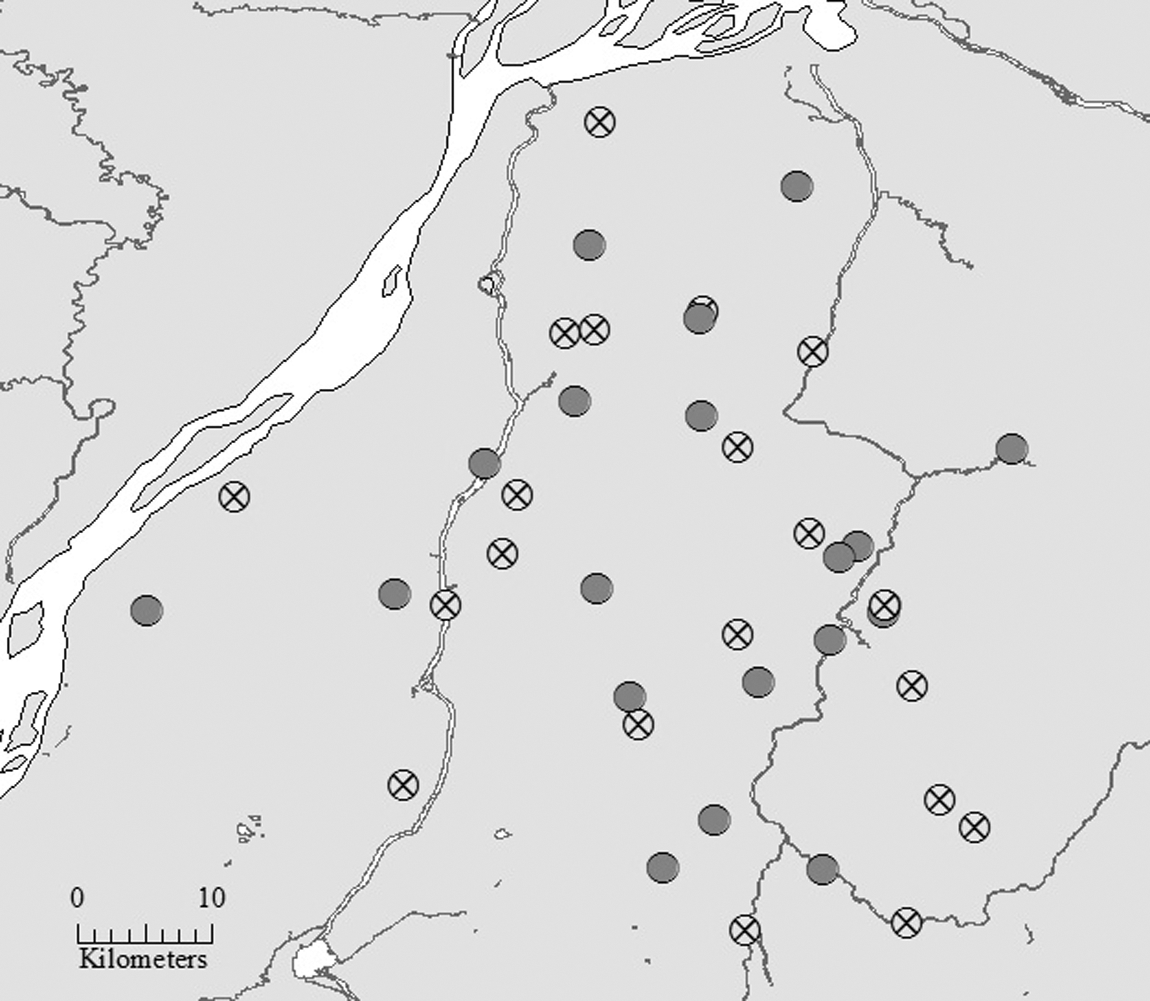
Geospatial distribution of the dairy herds (dark circle: Campylobacter jejuni–positive farms; X-marked circle: negative farm). Note: Farm 25 (positive) and farm 32 (negative) are shown as one negative spot on the figure as they were located <50 m apart.
Discussion
This is the first study to assess the prevalence of Campylobacter in dairy cattle herds of Quebec, a province where milk production is a very important agricultural activity accounting for nearly 37% of Canada's farm cash receipts from milk production (Fédération des Producteurs de Lait du Québec; available at:
Risk practices can influence the colonization of animals with Campylobacter by introducing the bacteria into the herd or maintaining the population already in place. The component-fed ration feeding system, often distributed by hand, was identified as a potential risk factor for the increased prevalence of C. jejuni compared to feeding total mixed rations. A possible explanation could be the dispersion of bacteria from the producers' soiled boots or potentially contaminated tools, as they often walk in feeders when distributing the food. The mechanical cart used to distribute the total mixed ration is located in front of the cows, so there is no contact with feces, possibly reducing the risk of contamination. Also, the cleaning and/or disinfection of stalls were associated with a lower prevalence of C. jejuni in herds, which is consistent with the effects of biosecurity measures in reducing bacterial contamination.
Elsewhere, reported risk factors such as indoor housing, private water supply, presence of horses, and feeding hay were associated with the presence of Campylobacter in farms (Ellis-Iversen et al., 2009). It was not possible to measure any other associations between C. jejuni status among herds and the tested variables. Factors such as the presence of other production animals or the source of water were the same among the majority of farms. In the same way, few differences were observed in farm facilities and practices such as housing and manure storage. No environmental samples (milk or water trough) were found to be positive for Campylobacter.
The geographical localization of the studied farms was mapped in order to visualize trends on the occurrence of C. jejuni. Farms were selected based on the veterinarian visits during the sampling period, and it was not possible to visualize a concentration of positive herds on the studied territory. Besides, further investigations on different parameters such as soil type surrounding animal productions (such as poultry), manure spreading, or milk-collecting network using GIS in-depth analysis could provide more information associated with the C. jejuni farm status. It was demonstrated that the proximity to a large poultry slaughterhouse as well as high ruminant density were associated with a higher incidence of campylobacteriosis (Arsenault et al., 2012).
The genetic profiles recovered in the tested isolates showed a great diversity in C. jejuni populations. Similar observations were reported in cattle in other countries (Gilpin et al., 2008b; Sanad et al., 2013). In Finland, a study conducted on three dairy cattle herds showed similar results: one to four different PFGE profiles were observed depending on the number of C. jejuni–positive samples recovered (Hakkinen and Hanninen, 2009). By using a combination of two restriction enzymes, Gilpin et al. (Gilpin et al., 2008b) identified 53 different profiles from the 89 isolates of C. jejuni from bovine sources. This genetic diversity highlights the fact that dairy cattle can act as a reservoir of genetically diverse C. jejuni strains that can be transmitted to humans directly or spread through the environment.
Conclusion
Even if the herd prevalence was low, it was possible to demonstrate and characterize for the first time C. jejuni isolates recovered from dairy herds in the Province of Quebec. Among the evaluated management practices, using the component-fed system as well as the lack of biosecurity measures can influence the prevalence of C. jejuni in herds. The genetic profiles of bacteria within specific herds are not homogeneous and there is variability between herds. These observations from dairy cattle reservoirs may be useful for understanding the ecology of Campylobacter in order to elaborate risk mitigation strategies.
Footnotes
Acknowledgments
The authors would like to thank the participating farmers for their collaboration as well as Mr. Pierre Ward for his review of this article. The authors are grateful to Agriculture and Agri-Food Canada and the Growing Forward Initiative for funding this study.
Disclosure Statement
No competing financial interests exist.