




Abstract
This study was performed in order to determine whether a combined treatment of ultrasound and sodium hypochlorite (NaOCl) is more effective than individual treatment on reducing Listeria monocytogenes ATCC19118 on stainless steel and iceberg lettuce. The bactericidal effect of ultrasound and NaOCl was investigated in tryptic soy broth (TSB), on stainless steel and iceberg lettuce. Various concentrations of NaOCl (50, 100, 150, and 200 ppm) were tested along with various ultrasound treatment times (5, 20, 40, 60, 80, and 100 min). The combined treatment of ultrasound and NaOCl resulted in greater bacterial reductions than either treatment alone, without causing any significant changes in lettuce texture. The synergistic values of combined ultrasound and NaOCl treatments in TSB, on stainless steel, and on iceberg lettuce were 0.01–0.99 log10 colony-forming units (CFU)/mL, 0.01–0.62 log10 CFU/g, and 0.12–1.66 log10 CFU/g, respectively. These results suggest that the combination of ultrasound and NaOCl was more effective than each treatment against Listeria monocytogenes, and that this combination can effectively sanitize fresh products such as iceberg lettuce.
Introduction
T
Listeria (L.) monocytogenes, a psychotropic foodborne pathogen, commonly occurs in the environment (Shan et al., 2012; Botticella et al., 2013; Ding et al., 2013). In general, L. monocytogenes can be isolated from many types of foods including beef (Kang et al., 1991), chicken (Bailey et al., 1989; Kang et al., 1991), milk (Kang et al., 1991; Marshall et al., 1999), vegetables (Heisick et al., 1989; Botticella et al., 2013) and fish (Farber and Daley, 1994). In addition, L. monocytogenes causes listeriosis, which can lead to septicemia, meningitis, and spontaneous abortion (Gellin and Broome, 1989; Pinner et al., 1992; Shan et al., 2012). For this reason, many researchers are focusing on controlling L. monocytogenes contamination in various foods, especially fresh produce.
In general, chlorine is the most widely used disinfectant in fresh-cut food due to the low cost and convenience. It is available on the commercial market in the form of sodium hypochlorite solution (NaOCl) (Kim et al., 2000; Niemira, 2007; Allende et al., 2008). However, when it is used at high concentration for a long time, NaOCl can cause deterioration in organoleptic quality, an unpleasant odor, residual chlorine, and production of byproducts including trihalomethane, which is a carcinogenic substance (Chang et al., 2000; Kim et al., 2008). In addition, it is difficult to completely remove bacteria from the lettuce leaf surface with a single treatment of NaOCl. Lettuce leaves may have stomata and folds that encourage attachment of bacteria (Babic et al., 1996) and allow microorganisms to form biofilms (Fett, 2000; Ryu and Beuchat, 2005). Thus, novel techniques to disinfect food products need to be developed to reduce the carcinogenic effects of sodium hypochlorite and address other issues associated with the substance.
Recently, hurdle technology—combining chemical and physical techniques—has been developed to reduce pathogenic bacteria in fresh-cut produce (Leistner, 2000; Lombard et al., 2000; Chawla and Chander, 2004). Physical treatment techniques used for applying hurdle technology include high hydrostatic pressure (Cecile et al., 2004), ultrasound (Brilhante and Dantas, 2012; Demirdoven and Baysal, 2009; Sagong et al., 2011; Zhou et al., 2009), and ultraviolet radiation (Ukuku and Geveke, 2010; Ha et al., 2011). Among these technologies, ultrasound has been identified as a potential physical technique with antimicrobial effects (Piyasena et al., 2003; Baumann et al., 2005; Arroyo et al., 2011).
Ultrasound in the food industry is generally used at frequencies from 20 kHz to 10 MHz, and it acts as an antimicrobial by producing powerful cavitation bubbles that disrupt the lipid membrane of bacteria and detach bacteria attached to the surfaces of fresh-cut produce (Scouten and Beuchat, 2002; Seymour et al., 2002; Piyasena et al., 2003). Thus, the disinfecting efficacy of NaOCl could be increased when combined with ultrasound treatment, as ultrasound might help NaOCl penetrate inaccessible sites such as stomata and folds in the leaves of fresh-cut produce (Sagong et al., 2011).
Therefore, the objective of this study was to assess the synergistic effect of combined NaOCl and ultrasound treatment on L. monocytogenes in tryptic soy broth (TSB) on stainless steel and iceberg lettuce, compared to treatments of NaOCl or ultrasound alone.
Materials and Methods
Bacterial strains
L. monocytogenes ATCC19118 isolated from chicken was used to evaluate the bactericidal effects of single or combined treatments of chemical disinfection and ultrasound. Stock culture was maintained at −70°C in 0.1 mL of TSB (Difco Laboratories, Detroit, MI) with the addition of 50% (vol/vol) glycerol (Fisher Scientific, Itasca, IL). Working cultures were cultured twice at 37°C for 24 h in TSB, streaked onto a tryptic soy agar (TSA; Difco, Becton Dickinson, Franklin Lakes, NJ) plate, incubated at 37°C for 24 h, and examined for typical and homogeneous colony morphology.
Inoculation of TSB, stainless steel, and iceberg lettuce
Populations of L. monocytogenes ATCC19118 used for the inoculums comprised 7–8 log10 CFU/mL. The inoculum was prepared in 10 mL TSB by incubation at 37°C for 24 h. The cell suspension was centrifuged at 13,000×g for 10 min at 4°C and resuspended in 10 mL 0.1% peptone water (Oxoid, Basingstoke, Hampshire, England).
Iceberg lettuce was purchased from a local market in Anseong, Korea and stored at 4°C before the experiment. Iceberg lettuce was washed with distilled water for 2 min, treated with the sanitizer for 2 min to remove natural bacterial contamination. Fresh iceberg lettuce was uniformly cut into 10-g pieces (±0.5) using a sterile stainless-steel knife, and the sliced iceberg lettuce was used at room temperature. The surfaces of the stainless steel chip (20×20 mm) and the sliced iceberg lettuce were inoculated with 0.1 mL of the strain suspension. The inoculated samples were dried for 1 h on a clean bench at room temperature. The initial pathogen level inoculated on stainless steel and iceberg lettuce was about 6–7 log10 CFU/g.
Ultrasound
Ultrasound (P 300 H model, 230 V; Hucom System Co., Elmasonic, Germany) was chosen as physical treatment to inactivate or detach bacteria from TSB, stainless steel, or iceberg lettuce. For the ultrasound treatment, an ultrasound tank was filled with 28 L of distilled water and used at an operating frequency of 37 kHz and a power up to 1200 W. A 500-mL sterile glass beaker was placed in the ultrasound tank and filled with 90 mL of sterile water. Inoculated samples were immersed in the glass beaker and treated with ultrasound alone for 5, 20, 40, 60, 80, and 100 min.
Sanitizing solution and evaluation of chemical disinfectants
Sodium hypochlorite (NaOCl, 12%; Shimadzu Co., Kyoto, Japan) dissolved in distilled water was used as the chemical disinfectant at 50–200 ppm. All NaOCl solutions were prepared immediately before use. The efficacy of NaOCl was estimated using the European CEN EN 1276 method (dilution neutralization method) based on quantitative suspension testing (AOAC, 1995; BSI, 1997).
Eight milliliters of NaOCl solution was added to a mixture containing 1 mL of TSB or one piece of stainless steel or sliced iceberg lettuce (7–8 log10 CFU/g) and 1 mL of interfering substance. This mixture was treated at 20±1°C (mean±standard deviation) for 5 min and then agitated, and 1 mL of the mixture was added to a different mixture containing 8 mL of neutralizing agent and 1 mL of distilled disinfecting product. This mixture was maintained for 5 min at 20±1°C to ensure complete neutralization, after which 1 mL of the mixture was immediately applied to a sterilized Petri dish with an Oxford agar base with Bacto Oxford antimicrobial supplement (MOX, Difco) to count the number of surviving bacteria.
The sterile interfering substance samples, designed to simulate clean and dirty conditions, were prepared by melting 0.3 g of bovine serum albumen (Sigma, St. Louis, MO) in 100 mL of water, which was then filtered with a membrane filtration system prior to use (0.45-μm pore diameter; Sartorius AG 3770770, Gottingen, Germany).
The neutralizing agent used to stop the chemical reaction was created by mixing 3 g of lecithin (Fluka, Buchs, Switzerland), 30 g of polysorbate 80 (Fluka), 5 g of sodium thiosulfate (Sigma), 1 g of
Combined ultrasound treatment and sodium hypochlorite
The method described by Koivunen and Heinonen-Tanski (2005) was used for the combined ultrasound and NaOCl treatments. Ultrasound treatments and NaOCl disinfectant were performed at room temperature. Disinfectant efficacy of the combined treatment was compared with each treatment of ultrasound and NaOCl treatments to estimate any synergistic effects. The combination was conducted by applying ultrasound as a primary disinfectant and NaOCl as a secondary disinfectant.
The efficacy of different treatment was assessed based on the population reduction of Listeria. The synergistic effect values of combined ultrasound and NaOCl disinfection were calculated using the following equation:
A synergistic effect was confirmed with any positive values, while antagonistic and no effects were confirmed with negative and zero value, respectively.
Bacterial enumeration
After combined ultrasound and NaOCl treatments, L. monocytogenes in TSB was enumerated by plating on TSA, which was incubated at 37°C for 24 h. L. monocytogenes on the stainless steel chips were detached from the chips by vortexing with glass beads and then cultured on TSA with the pour-plate technique and incubated at 37°C for 24 h. Finally, the prepared lettuce-leaf samples were transferred into a sterile stomacher bag (Nasco Whirl-Pak, Janesville, WI) containing 90 mL of sterile 0.1% peptone water and then homogenized for 1 min using a stomacher (Bag mixe® 400; Interscience Co., France). Media for enumeration of L. monocytogenes was prepared using an Oxford agar base with Bacto Oxford antimicrobial supplement (MOX, Difco). All plates were incubated at 37°C for 24 h.
Texture measurement
In order to identify the change in iceberg lettuce quality treated with combined ultrasound and NaOCl, the texture of all treated samples was measured. The texture analysis was performed according to procedures described earlier (Sagong et al., 2011). Changes in iceberg lettuce–leaf texture were evaluated with a Texture analyzer (Model TAHDi, 500; Stable Micro Systems, Boochun, South Korea) with SMSP/2 probe. Samples measuring about 5 cm×5 cm×1.5 cm (1 piece, ∼2.5 g of green tissue) was placed onto the press holder and penetrated by a probe. Maximum force was recorded, and all experiments were replicated three times with independently prepared samples.
Statistical analysis
Experiments were repeated three times, with duplicate and average of duplicate plate from three replications calculated. Data were analyzed by the analysis of variance procedure using SAS software (Version 9.1; SAS Institute Inc., Cary, NC) for a completely randomized design. When the effect was significant (p<0.05), mean separation was accomplished with Duncan's multiple-range test. The results were expressed as log10 CFU/g, and the response surface was described using the SigmaPlot software system (SigmaPlot 7.0).
Results
Bactericidal effects of ultrasound with NaOCl treatments
Figure 1 shows the bactericidal effects on L. monocytogenes under different ultrasound treatment times (0–100 min) and NaOCl concentrations (0–200 ppm). Reduction of L. monocytogenes by 5–100 min ultrasound treatment in TSB, stainless steel, and iceberg lettuce were between 0.03 and 0.27, 0.38 and 1.09, and 0.13 and 0.68 log10 CFU/g depending on the treatment time, respectively. Reductions in the populations of L. monocytogenes in TSB, on the surface of stainless steel, and iceberg lettuce were between 1.22 and 4.20, 1.48 and 3.79 and 1.25 and 4.17 log10 CFU/mL, depending on the NaOCl concentration (50–200 ppm), respectively.
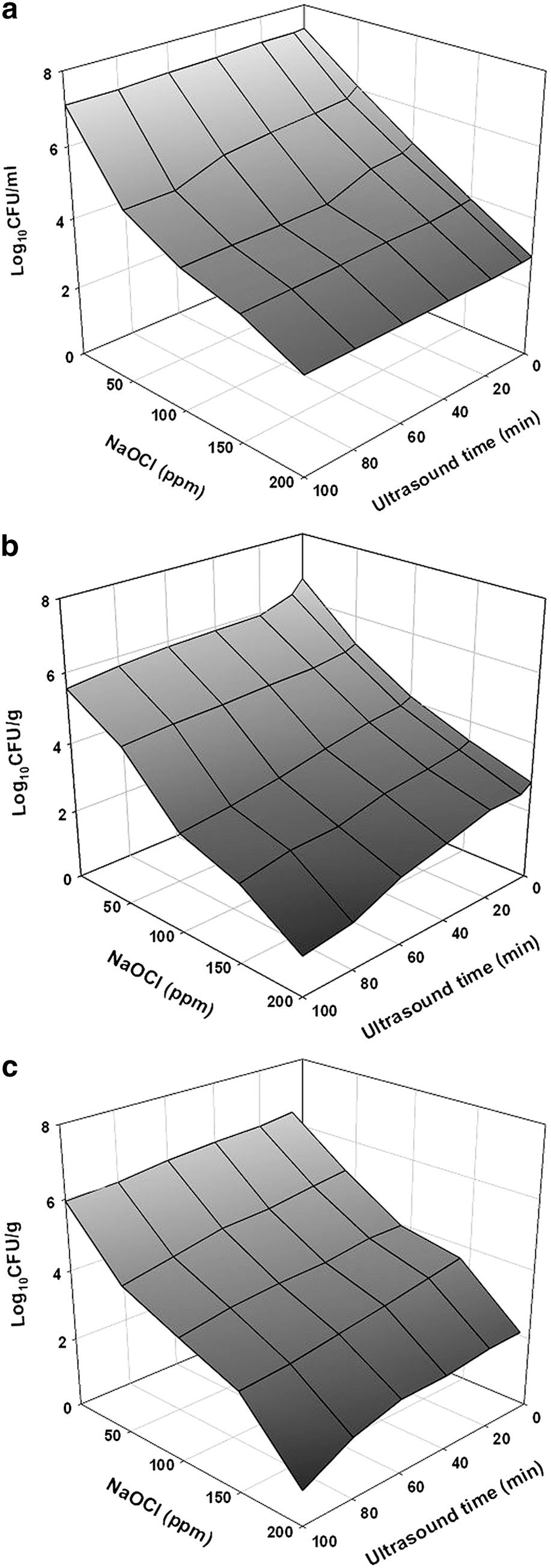
Reduction in Listeria monocytogenes number (log10 colony-forming units (CFU)/mL) from combined ultrasound and NaOCl treatment in tryptic soy broth
Treatment with NaOCl alone had a significant impact on L. monocytogenes populations when compared to no treatment, while ultrasound alone did not have a significant effect on L. monocytogenes populations. However, when samples were treated with combined treatment using 200 ppm (maximum concentration) of NaOCl and 100 min of ultrasound (maximum treatment time), L. monocytogenes populations were reduced by 4.54, 5.50, and 6.51 log10 CFU/mL in TSB, on stainless steel, and on iceberg lettuce, respectively. The results of these experiments demonstrated that the combined ultrasound and NaOCl treatment resulted in a greater reduction in L. monocytogenes than the treatments applied individually.
Synergistic effects of ultrasound with NaOCl treatments
Table 1 shows the synergistic effects of combined treatment of ultrasound and NaOCl against L. monocytogenes in TSB, on the surface of stainless steel or iceberg lettuce. Synergistic effects were observed in all combined treatments, although most synergistic values were well below 1 log10 CFU/mL. The highest synergistic values in TSB, on the surface of stainless or iceberg lettuce were 0.99 (50 ppm NaOCl/100 min ultrasound), 0.62 (200 ppm NaOCl/100 min ultrasound), and 1.66 log10 CFU/g (50 ppm NaOCl/100 min ultrasound). The results suggested that the synergistic effects against L. monocytogenes were not dependent on NaOCl concentration or ultrasound treatment time, unlike reduction levels of L. monocytogenes.
Unit: log10 CFU/g±SE (average±standard error).
Synergistic effect values=(reduction achieved with the ultrasound treatment and the NaOCl treatment) – (reduction achieved by the ultrasound+NaOCl treatment). Within the same column, means with different letters (a, b, or c) differ significantly (p<0.05). Within the same row, means with different letters (x, y, or z) differ significantly (p<0.05).
Texture measurement
Iceberg lettuce is primarily used for salads, and thus texture property for crispness is measured using the loading value (N) of a Texture analyzer. Table 2 shows the texture results of iceberg lettuce treated with combined ultrasound and NaOCl under different NaOCl concentrations and ultrasound treatment times. There was no significant difference in maximum load values among all tested samples (p>0.05). The combined treatment did not significantly change iceberg lettuce quality.
Values are mean±standard error.
Discussion
Hurdle technology using a combination of physical and chemical techniques was conducted to compare the effects of ultrasound, NaOCl, or a combination of ultrasound and NaOCl in reducing the L. monocytogenes population on iceberg lettuce.
When ultrasound alone was applied to TSB, stainless steel, or iceberg lettuce inoculated with L. monocytogenes, there were reduction effects for all treatment times. Increased ultrasound treatment time led to decreased numbers of L. monocytogenes. The overall magnitude of reduction was stainless steel>iceberg lettuce>TSB. This suggests that the type of sample surface may influence antimicrobial activity and that ultrasound might help NaOCl remove L. monocytogenes by detaching the bacteria from flat surfaces such as stainless steel.
In this study, the treatment with ultrasound alone resulted in maximum reductions in L. monocytogenes of 0.20, 1.09, and 0.68 log10 CFU/g in TSB, on stainless steel, and iceberg lettuce, respectively, with an ultrasound treatment time of 100 min (Fig. 1). These results suggested that the treatment with ultrasound alone may be not effective for food industry applications. Piyasena et al. (2003) reported that the bactericidal effects of food treated with ultrasound alone is localized and does not affect a large area. For this reason, ultrasound techniques should be refined to improve sterilization effectiveness by combining with other chemical sanitizers (Yuting et al., 2013).
NaOCl alone significantly reduced the number of L. monocytogenes in TSB, on stainless steel, and on iceberg lettuce. Also, NaOCl solutions were more effective against L. monocytogenes in TSB compared to stainless steel or iceberg lettuce. Mustapha and Liewen (1989) reported that 0–400 ppm chlorine treatments for 1–5 minutes in TSB decreased L. monocytogenes by 3–4 log10 CFU/mL, whereas the same treatments on stainless steel resulted in a decrease in L. monocytogenes in the range of 1–4 log10 CFU/g (Mustapha and Liewen, 1989). The bactericidal effects of NaOCl on food were relatively low compared to TSB or stainless steel. This suggests that NaOCl solution is less effective on food items such as iceberg lettuce, which have folded leaves and hydrophobic pockets that make it difficult to remove bacteria (Babic et al., 1996).
The goal of this study was to overcome the limitations of ultrasound or NaOCl as an individual treatment against L. monocytogenes on iceberg lettuce. The combination of ultrasound and NaOCl increased disinfection efficiency and showed synergistic benefits, with the highest synergy values in TSB, on stainless steel, and on iceberg lettuce reaching 0.99, 0.62, and 1.66 log10 CFU/mL for L. monocytogenes, respectively.
Synergy involves a multiple-damage mechanism in which two different disinfection methods increase reduction effects by damaging the microorganisms in different ways (Koivunen and Heinonen-Tanski, 2005). In this experiment, ultrasound attacks cell membranes via localized heating and production of free radicals (Piyasena et al., 2003), resulting bacteria detaching from the surface of food (Povey and Mason, 1998; Piyasena et al., 2003; Demirdoven and Baysal, 2009). In the case of ultrasound alone, the damage may be minimal and repairable. However, when bacteria are treated with both ultrasound and NaOCl, the cumulative damage may be irreparable.
In the present study, all of the combined treatments had synergistic effects without causing significant texture change. However, synergistic effects were not dependent on the concentration of the sanitizer or ultrasound treatment time. Other researchers have studied the combined effects of ultrasound and sanitizer on killing and detaching foodborne pathogens in a variety of fresh produce. Zhou et al. (2009) reported that the reduction of the Escherichia coli O157:H7 population on spinach leaves was 3.1 log10 CFU/g after a combined treatment of ultrasound and 200 ppm of chlorinated water. This is an additional 1.1 log10 CFU/g reduction compared to chlorinated water alone for 2 min. In addition, Sagong et al. (2011) reported that the combined treatment of ultrasound and organic acids for Escherichia coli O157:H7, Salmonella Typhimurium, and L. monocytogenes resulted in an additional 0.8–1.0 log10 CFU/g reduction compared to single treatments. Another study showed that Salmonella Typhimurium on lettuce was reduced by 2.7 log10 CFU/g when ultrasound and 100 ppm chlorinated water were applied. This reduction was 1.0 log greater than the reduction obtained by ultrasound or chlorinated water only for 10 min (Seymour et al., 2002).
Conclusions
The present study demonstrated that the combination of ultrasound and NaOCl resulted in synergistic benefits for reducing L. monocytogenes in TSB, on stainless steel, and on iceberg lettuce. The use of ultrasound alone against L. monocytogenes is currently not feasible, but ultrasound can reduce the concentration of NaOCl required to eliminate bacteria. Therefore, combined ultrasound and NaOCl treatments could be used to effectively sanitize fresh-cut products such as iceberg lettuce against L. monocytogenes. However, reduction values and synergistic effects depend on the microbial strain, which may be resistant to combined ultrasound and NaOCl treatment (Piyasena et al., 2003). For this reason, further research on other foodborne pathogens should be conducted with the various conditions before applying these treatments in food-processing plants, which will enhance the safety of minimally processed fresh produce.
Footnotes
Acknowledgments
This research was supported by Basic Science Research Program through the National Research Foundation of Korea (NRF) funded by the Ministry of Science, ICT & Future Planning (2013005051).
Disclosure Statement
No competing financial interests exist.