




Abstract
Objectives:
This study investigated the occurrence of extended spectrum cephalosporinase (ESC)–producing Escherichia coli in a broiler production with no cephalosporin use and a low use of antimicrobials in general. Furthermore, it investigated whether the current consumption of aminopenicillins selects for ESC-producing E. coli and whether certain clones or plasmids spread from imported parent flocks to the meat.
Materials and Methods:
ESC-producing E. coli was isolated using MacConkey broth with 1 mg/L of ceftriaxone. ESC genes were identified using polymerase chain reaction and sequencing. Isolates with bla CMY-2 were subtyped by pulsed-field gel electrophoresis (PFGE), phylotyping, and antimicrobial susceptibility testing. Selected isolates were used as donors in filter-mating experiments, multilocus sequence typing (MLST), and plasmid replicons were typed. Aminopenicillin use at the farm (not flock) level was obtained from VetStat, a database for mandatory registration of veterinary prescriptions in Denmark.
Results:
ESC-producing E. coli occurred in 93% (27/29) of broiler parent farms in 2011, 27% (53/197) of broiler flocks in 2010, and 3.3% (4/121) of Danish retail broiler meat in 2009 and 8.6% (16/187) in 2010. The ESC producing E. coli contained bla CMY-2, bla SHV-2 or bla CTX-M-1. Isolates with bla CMY-2 represented 35 PFGE groups. One group dominated (39 isolates) and included isolates with indistinguishable PFGE patterns from parents, broilers, and meat. Most bla CMY-2 isolates were susceptible to non-β-lactams, and bla CMY-2 was mostly present on horizontally transferable incI1 or incK plasmids. Phylogroup D was most common and E. coli MLST types previously found in humans were observed. Broiler farms with registered aminopenicillin use had significantly higher occurrence of ESC E. coli.
Conclusions:
ESC-producing E. coli from flocks of imported broiler parents spread clonally and horizontally to broiler meat (including potentially human pathogenic types) even in a country with no cephalosporin use. Use of aminopenicillins may influence the persistence of ESC-producing E. coli in the broiler production, but other factors should be investigated.
Introduction
E
The aim was to investigate the occurrence of ESC-producing E. coli in a broiler production with no use of cephalosporins and a low use of antimicrobial agents in general. Furthermore, this study investigated whether the current consumption of aminopenicillins selects for ESC-producing E. coli and whether certain clones or plasmids spread from imported parent flocks to retail broiler meat.
In Denmark, ESC-producing Escherichia coli in the Danish produced broiler meat was identified for the first time in 2009 (Agersø et al., 2012). The occurrence was low (less than 10%) in 2009 and in 2010 when compared to broiler meat imported into Denmark (DANMAP 2010, 2011). In 2011, ESC-producing E. coli increased significantly in the Danish-produced broiler meat to the same level as in imported broiler meat (44% and 48%, respectively) (DANMAP 2011, 2012). Cephalosporins have never been approved for use in poultry in Denmark, and no use of cephalosporins for poultry has been registered for at least a decade. In general, the consumption of antimicrobials in the Danish broiler production is low compared to other production animals, as only approximately 30% of the farms have had antimicrobials prescribed (414 kg, 182 prescriptions) corresponding to only 3% of the flocks treated in 2011 (DANMAP 2010, 2011; DANMAP 2011, 2012). However, in 2011, the consumption of aminopenicillins, the major drug of choice, was two to five times higher than in previous years (DANMAP 2010, 2011, 2012). ESC-producing E. coli produces β-lactamases that can degrade aminopenicillins, but to what extent aminopenicillins select for ESC-producing bacteria is unknown.
Materials and Methods
Sampling procedure
Samples were collected from all conventional parent flocks hatching broiler eggs, from randomly selected broiler flocks at slaughter, and from randomly selected Danish broiler meat. Boot swab samples (sock samples) were collected from the parent flock houses by the farm owners during September 2011. Sterile gauze socks were placed on clean boots, the sample collector walked around in the parent flock, and a house (flock) was sampled once. Up to four socks from different houses within the same herd were pooled and sent to the National Food Institute for analysis. Farms with one to four houses were examined as one pooled sample consisting of one sock from each house, while farms with more than four houses were examined as two pooled samples. No farm had more than six houses. In total, 29 farms were sampled, resulting in 70 sock samples pooled into 32 samples.
The broiler flocks were sampled weekly before slaughter at the five slaughterhouses in Denmark slaughtering conventional produced broilers from May through November as part of the DANMAP program, and the Central Husbandry Register (CHR) number of the farm was registered (DANMAP 2010, 2011). Cloacal swabs from five broilers of the same flock were randomly collected by slaughterhouse personnel and pooled into one sample representing approximately 60% of all broiler farms in Denmark. No flock was sampled more than once. This procedure resulted in sampling of 87 different farms with 1–2 flocks sampled and 13 farms with 3–15 flocks sampled.
Three milliliters of 0.9% NaCl was added to each sample of pooled swabs before sending it to the regional laboratories for analysis.
The meat samples were collected randomly in retail stores and outlets in all regions of Denmark as part of the DANMAP program (Agersø et al., 2012; DANMAP 2010, 2011).
Analysis of the samples
Presumptive ESC-producing E. coli was isolated from meat as previously described (Agersø et al., 2012). From parent farms, 1 to 4 sock samples were added to 225 mL of MacConkey (Oxoid CM5a, Basingstoke, England) broth supplemented with 1 mg/L of ceftriaxone (Sigma C5793-1G, Steinheim, Germany) and incubated for 16–18 h at 44°C. Ten microliters of this enrichment broth was then streaked on a MacConkey agar supplemented with 1 mg/L of ceftriaxone incubated at 44°C, and a maximum of three colonies were subcultured and stored for further analysis (Agersø et al., 2012).
The samples of five pooled cloacal swabs from broiler flocks were mixed in 3 mL of saline. Thereafter, 1 mL of suspension was transferred to 9 mL of MacConkey broth supplemented with 1 mg/L of ceftriaxone. The same procedure as described for sock samples was followed. E. coli was identified on CHROM Orientation agar (Becton Dickinson A/S, Brøndby, Denmark).
Detection of ESC genes and minimal inhibitory concentration (MIC) testing
The genetic background for ESC-producing E. coli was examined as previously described (Agersø et al., 2012). In brief, all cephalosporinase-producing E. coli were initially tested by polymerase chain reaction (PCR) for bla CMY-2. If negative, the isolates were subsequently tested for bla CTX-M genes, bla SHV and bla TEM genes by PCR and sequencing (Agersø et al., 2012).
MIC were determined for bla CMY-2-positive isolates for the following non-β-lactam antimicrobial agents: tetracycline (2–32 mg/L), chloramphenicol (2–64 mg/L), florfenicol (2–64 mg/L), sulfamethoxazole (64–1024 mg/L), trimethoprim (1–32 mg/L), apramycin (4–32 mg/L), gentamicin (0.5–16 mg/L), neomycin (2–32 mg/L), spectinomycin (16–256 mg/L), ciprofloxacin (0.015–4 mg/L), nalidixic acid (4–64 mg/L) by use of Sensititre (Trek Diagnostic Systems Ltd., West Sussex, UK), and following Clinical and Laboratory Standards Institute guidelines as previously described (CLSI, 2008). Resistance was determined by use of European Committee on Antimicrobial Susceptibility Testing epidemiological cutoff values (EUCAST, 2012). The E. coli strain ATCC 25922 was used for quality control.
Pulsed-field gel electrophoresis (PFGE), phylogrouping, and multilocus sequence typing (MLST) typing
All isolates positive for bla CMY-2 (Table 1) were subtyped by use of PFGE with some modifications to the method described by Brolund et al. (Brolund et al., 2010). In brief, the DNA was digested with XbaI at 37°C. The electrophoresis was performed with a CHEF DR III System (Bio-Rad Laboratories, Hercules, CA) using 1% SeaKem Gold (Lonza, Rockland, ME) agarose in 0.5× Tris-borate-EDTA. Running conditions were 6 V/cm and included angle 120°C in 14°C Tris-borate-EDTA buffer, with pulse times linearly increased from 12 s initial switch time to 40 s final switch time for 20 h. XbaI digested DNA from Salmonella Braenderup H9812 was included as normalization standard on every gel.
PFGE type, pulsed-field gel electrophoresis patterns with less than 80% similarity; NAL, nalidixic acid; PF, parent farm; BF broiler flock; meat’09, broiler meat sampled in 2009; meat’10, broiler meat sampled in 2010; NEO, neomycin; SMX, sulfamethoxazole; TET, tetracycline; TMP, trimethoprim; NT, nontypeable.
PFGE analysis was performed using BioNumerics v. 4.61 (
Phylogrouping was performed on all bla
CMY-2-positive isolates as previously described (Clermont et al., 2000). MLST was performed on selected isolates by use of whole genome sequencing and the web-server MLSTfinder (
Characterization of plasmid replicons and horizontal gene transfer
Selected isolates carrying bla CMY-2 were used as donors in filter-mating experiments to the recipient E. coli 1005RN, rifR, nalR (Table 2) as previously described (Agersø and Sandvang, 2005). Fifty microliters of the mating suspension was spread on one half of a Brain Heart Infusion agar supplemented with 1 mg/L ceftriaxone and 100 mg/mL of rifampicin, and on the other half the suspension was further spread with a loop to ensure single colonies of presumptive transconjugants. Suspected transconjugants were subcultured and checked for resistance to nalidixic acid. The presence of bla CMY-2 in the transconjugants was verified by PCR.
PFGE, pulsed-field gel electrophoresis; NT, nontypeable; ND, not determined; NAL; nalidixic acid; SMX, sulfamethoxazole; TET, tetracycline.
PCR-based replicon typing was used to characterize plasmids in the isolates chosen for mating experiments (Carattoli et al., 2005). If no transconjugants were obtained, or if more than one replicon was found in a transconjugant, plasmids were purified and electroporated into E. coli 1005RN. Transformants were subjected to S1 nuclease PFGE to ensure the presence of a single plasmid as previously described (Bielak et al., 2011).
Consumption of aminopenicillin in the Danish broiler flocks
Data on consumption of aminopenicillins on the farm level was obtained from the VetStat database as previously described (Agersø et al., 2012). Information on date of sale, amount of drug prescribed, animal species, and code for farm identity (CHR number) was extracted from VetStat on November 7, 2012. The consumption of aminopenicillins in the broiler farms was defined as the consumption registered in the VetStat database for use in poultry on the given CHR number. The consumption was analyzed in two ways: (1) consumption of aminopenicillins at the farm at least once within the preceding 3 months prior to sampling, and (2) consumption of aminopenicillins at least once within the preceding 6 months prior to sampling.
Statistical analysis
Statistical significance tests of difference between proportions of samples positive for ESC-producing E. coli with or without use of aminopenicillins were calculated using chi-square, or Fisher exact test (two-tailed) when the number of positive samples was low (<5) (StatCalc in EpiInfo™ v. 6, Centers for Disease Control and Prevention,
Results and Discussion
The Danish conventional broiler production is almost exclusively based on import of day-old parent animals from Sweden. In Sweden, day-old grandparent animals are imported from Scotland (P. Johanssen, DanHatch Ltd., personal communication). In Sweden, batches of imported day-old grandparent animals were found positive for ESC-producing E. coli, and the genotypes found were bla CMY-2 and bla CTX-M-1 (SVARM 2010, 2011).
In our study, cephalosporinase-producing E. coli were isolated from 93% (27/29) of the parent farms, from 27% (53/197) of the broiler flocks, and from 3.3% (4/121) and 8.6% (16/187) of Danish broiler meat sampled in 2009 and in 2010, respectively. The use of selective enrichment with ceftriaxone revealed ESC-producing E. coli in all the tested sample types. The method did not reveal the concentration of ESC-producing E. coli in the samples, and the infective concentration to humans is also unknown. The high prevalence of ESC-producing E. coli found in parent and broiler flocks was surprising, since cephalosporins have not been used in either the Danish or the Swedish broiler production, and in general the consumption of antimicrobials is low compared to other production animals (DANMAP 2010, 2011; SVARM 2010, 2011). In January 2012, the British Poultry Association agreed to stop using cephalosporins in broiler production, but until then cephalosporins had been used in the United Kingdom (World Poultry, 2011; British Poultry Council, 2013). Therefore, the use of cephalosporins in the United Kingdom before 2012 may have selected for the ESC-producing E. coli occurring in the animals exported into Sweden and spread vertically from grandparents to parents imported into Denmark, but other (e.g., environmental) sources may also exist.
The most prevalent gene found to confer cephalosporinase-producing E. coli in our study was bla CMY-2. This gene was found in all ESC-producing E. coli from parent flocks, in 89% (47/53) from broiler flocks, and in 50% (2/4) and 75% (12/16) from broiler meat in 2009 and 2010, respectively. Other genes were found in six isolates from broiler flocks (bla SHV-2) and six isolates from broiler meat (bla CTX-M-1), but not in parent flocks. Either they are present at a low level in the parent flocks or other routes of transmission such as cross-contamination or the outer environment exist. In other countries, large proportions of ESC-producing E. coli from broiler and broiler meat carry bla CMY-2 are found, and due to the wide distribution to many countries of animals from the top of the breeding pyramid, it is suspected that the occurrence of cephalosporinase-producing E. coli may be due to the continuous introduction of imported animals carrying these bacteria (MARAN-2009, 2010; EFSA BIOHAZ, 2011; SVARM 2010, 2011). In Sweden, the same E. coli clones with bla CMY-2 were found in imported grandparent animals and in all levels of the Swedish broiler production, indicating spread (Nilsson et al., 2014).
PFGE was performed on all bla
CMY-2-positive isolates in order to reveal whether the bla
CMY-2 isolates from parent flocks (29), broiler flocks (47), and broiler meat (14) were clonally related. Based on the PFGE patterns, the isolates grouped into 35 different PFGE groups with less than 80% similarity (Table 1, Supplementary Fig. S1; Supplementary Data are available online at
Phylogrouping of the bla CMY-2-positive isolates showed phylotypes previously associated with disease in humans such as urinary tract infections (D and B2) and followed the PFGE type except for a few nontypeable isolates (Table 1) (Jakobsen et al., 2010a, b; Johnson et al., 2005). In the Netherlands, similar ESC-producing E. coli in poultry meat and from human infections has been described (Leverstein-van Hall, 2011; Kluytmans et al., 2013). So it is likely that some ESC-producing E. coli clones from the Danish broiler meat production cause infection in humans and should be further investigated. E. coli blood infections are mandatory for reporting in Denmark and may be MLST typed. E. coli MLST types formerly involved in human infection were found, including ST131, a global-spread human clone; ST48, recently found with bla CMY-2 causing human clinical infection in Denmark; ST88, causing human infection; ST10, suspected to cause foodborne human infections; and the most dominant clone (43% of the isolates) ST38, also a type found in clinical E. coli (Table 2) (Guillouzouic et al., 2009; Jørgensen et al., 2010; Poirel et al., 2011; Manges and Johnson, 2012). MLST types uncommon in human infections were also found, but these could be involved in horizontal spread of bla CMY-2 to human pathogens.
Twenty-eight isolates representing 27 different PFGE types were used as donors in mating experiments, and 25 could transfer bla CMY-2 to an E. coli recipient (Table 2). Moreover, bla CMY-2 was found to be located on two types of plasmids: IncI1 (20) and IncK (8), so the presence of different clones can be explained by horizontal transfer of such plasmids, but may also be due to other introduction routes (e.g., from the outer environment, and contact to humans, insects, or animals). A study from Sweden found E. coli from broilers carrying bla CMY-2 on IncK plasmids, and E. coli isolates with bla CMY-2 carried by IncI1 or IncK plasmids have previously been found in humans, meat, and production animals (Börjesson et al., 2013). Moreover, bla CMY-2 has also been found to be associated with other plasmids such as IncI2 and IncA/C (Verdet et al., 2009; Antunes et al., 2012; Börjesson et al., 2013).
Susceptibility testing of the bla CMY-2 positive isolates showed most isolates being pansusceptible to all other non-β-lactam antimicrobials tested (Table 2). However, 11% (10/90) of the isolates were resistant to tetracyclines, the second most used antimicrobials in Danish broiler production. Single isolates were resistant to nalidixic acid, sulfamethoxazole, trimethoprim, and neomycin, respectively. As ESC-producing E. coli are resistant to aminopenicillins, we investigated whether ESC-producing E. coli more often originated from broiler farms that used aminopenicillins. One hundred eighty-eight of 197 flocks had information on farm origin. The flocks originated from 99 different farms. Seventeen and 29 flocks had registered use of aminopenicillins on farm level up to 3 and 6 months prior to slaughter, respectively. It was not possible to tell whether the aminopenicillins were used for the flock sampled, for a flock in another house, or for a flock previously raised in the same house, but a significantly higher occurrence of ESC-producing E. coli was observed in flocks from farms with use of aminopenicillin up to 3 months (52.9% [9/17], confidence interval [CI] [27.8–77.0%] vs. 26.9% [46/171] CI [20.4–34.2%], [p=0.02]) and 6 months (44.8% [13/29], CI [26.4–64.3%] vs. 26.4% [42/159], CI [19.8–34.0%], [p=0.046]) prior to slaughter (Fig. 1). Although the use of aminopenicillins is registered on farm level and not on flock level, the results indicate that aminopenicillins may have selected for ESC-producing E. coli and may thereby contribute to maintenance of ESC E. coli in the broiler flocks. Thus, the presence of ESC-producing E. coli on farms may be due to continuous introduction (e.g., with day-old parent chicks carrying ESC-producing E. coli), and/or due to carryover from one flock to the next and/or antimicrobial consumption. However, the relative importance of these factors is unclear, and carryover from litter or other environmental routes may also influence the presence of ESC-producing E. coli. Most of the broiler flocks (159) originated from farms with no use of aminopenicillins at least up to 6 months prior to slaughter, so the main reason for occurrence of ESC-producing E. coli is most likely the continuous introduction of animals, but a low fitness cost of ESC plasmids could also affect persistence.
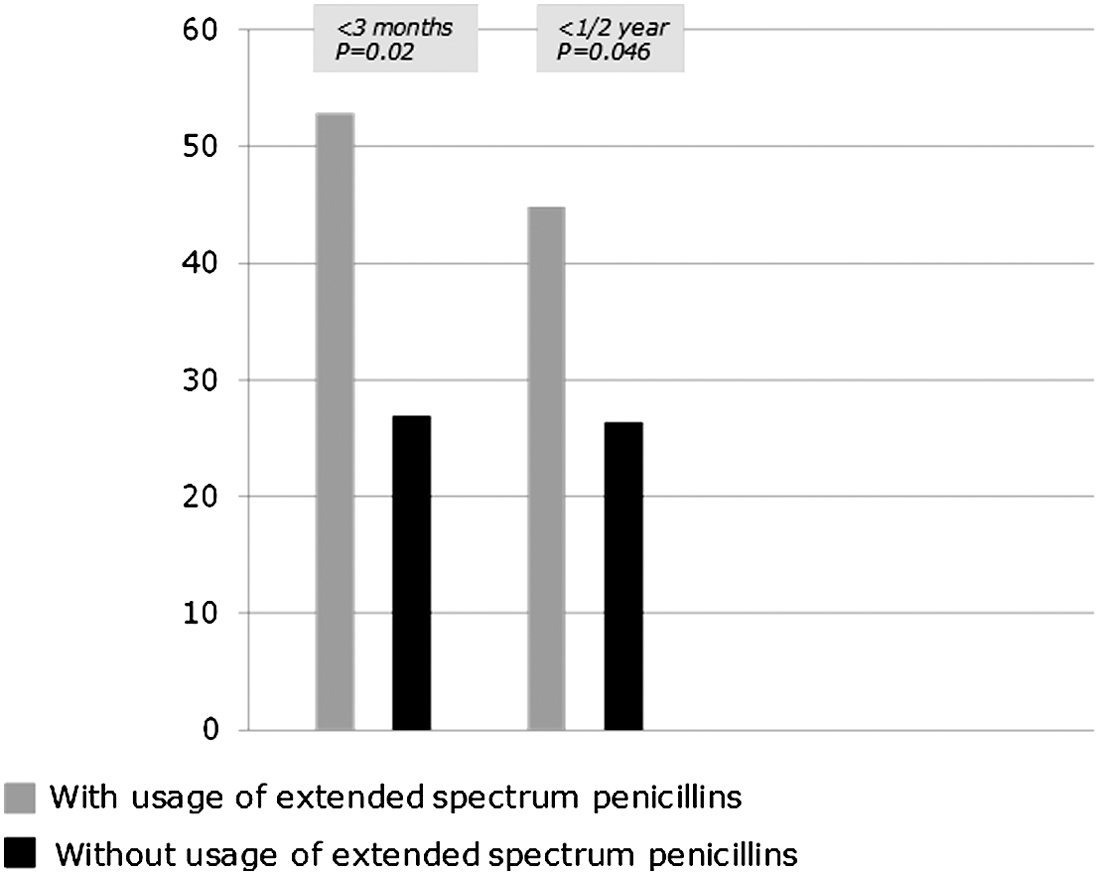
Occurrence of extended-spectrum cephalosporinase-producing Escherichia coli in broiler flock with and without registered use of aminopenicillins on farm level up to 3 and 6 months prior to slaughter. The numbers on the y-axis represent the percentage of samples positive for ESC-producing E. coli.
In conclusion, ESC E. coli from imported parent animals spread clonally and horizontally even in a country with no use of cephalosporins in the poultry production. ESC-producing E. coli from imported animals is to some extent selected for by aminopenicillins. Therefore, the focus should be on reducing both use of cephalosporins and aminopenicillins. Even though E. coli carrying bla CMY-2 often is polyclonal, some clones, including MLST types involved in human infections, seem to establish better than others. Therefore, factors important for persistence and spread of ESC-producing E. coli should be investigated.
Footnotes
Acknowledgments
We would like to thank Peter Johannsen, DanHatch Ltd., for useful information about the Danish broiler production, the regional laboratories administered by the Danish Veterinary and Food Administration. The skillful technical assistance of Marianne Sarstad is also gratefully acknowledged. The project was partly funded by the Danish Veterinary and Food Administration the centrally coordinated projects.
Disclosure Statement
No competing financial interests exist.
References
Supplementary Material
Please find the following supplemental material available below.
For Open Access articles published under a Creative Commons License, all supplemental material carries the same license as the article it is associated with.
For non-Open Access articles published, all supplemental material carries a non-exclusive license, and permission requests for re-use of supplemental material or any part of supplemental material shall be sent directly to the copyright owner as specified in the copyright notice associated with the article.
