




Abstract
The precise detection of Toxoplasma gondii infection in cattle has important public health significance. In the present study, recombinant granule antigen protein GRA7 was evaluated as a potential diagnostic marker for T. gondii infection in cattle by an indirect enzyme-linked immunosorbent assay (ELISA) using the reference serum samples determined by immunofluorescence assay and Western blotting, showing that GRA7-ELISA has a sensitivity of 96.4%, and a specificity of 98.6%. The detection results by GRA7- and Toxoplasma lysate antigen–based ELISAs were compared, indicating that no significant difference (p>0.05) and perfect agreement (κ=0.74) was observed between the two tests. Receiver operating characteristic analysis showed a relative sensitivity and specificity of 100% and 97.3% at the cut-off value of 0.3 for GRA7-ELISA. These data demonstrate that GRA7 is a promising serodiagnostic marker for T. gondii infection in cattle.
Introduction
T
Diagnosis of T. gondii infection is based on isolation of the parasite, DNA detection, and demonstration of the parasites in the tissues by detection of specific antibodies using serological tests (Su et al., 2010). Despite the satisfactory results of serological tests, development of reliable and standard reagents remains a major constraint in serodiagnosis of T. gondii infection. Most conventional tests using tachyzoites grown in mice or in tissue culture are usually difficult to standardize, making the test results difficult to evaluate (Kotresha and Noordin, 2010). Therefore, use of recombinant proteins is the only alternative for specific and sensitive results.
T. gondii dense granule antigen proteins (GRAs) are secretory proteins, which are potentially diagnostic antigens for toxoplasmosis (Redlich and Muller, 1998; Nam, 2009; Saadatnia et al., 2012). GRA7 is a member of this family earlier identified by immunoscreening of a cDNA library using human positive sera, which accumulates in the cytoplasm of bradyzoite-infected cells and within the parasitophorous vacuole (PV) and the parasitophorous vacuole membrane (PVM) in tachyzoite-infected cells (Fischer et al., 1998; Jacobs et al., 1998). Several reports have demonstrated the usefulness of GRA7 as a serodiagnostic marker of toxoplasmosis in humans and animals (Aubert et al., 2000; Koethe et al., 2011; Hester et al., 2012). GRA7-based enzyme-linked immunosorbent assay (ELISA) shows overall specificity of 98–100% and sensitivity of 81–88% with sera from patients (Jacobs et al., 1999; Velmurugan et al., 2008; Terkawi et al., 2013). In addition, the ELISA with GRA7 has the highest positive rate, compared with other T. gondii antigens, including the rhoptry (ROP1) and matrix antigens (MAG1), the major surface antigen (SAG1), and GRA8 (Pfrepper et al., 2005). In the present study, the recombinant granule antigen protein GRA7 was evaluated as a potential diagnostic marker for T. gondii infection in cattle by an indirect ELISA using cattle serum samples.
Materials and Methods
Preparation of Toxoplasma lysate antigen (TLA)
T. gondii tachyzoites of GT1 strain were routinely maintained in African green monkey kidney (Vero) cell monolayer, and purified from freshly lysed host cells by Percoll-density gradient centrifugation (Wu et al., 2012). The parasites were washed twice in phosphate-buffered saline (PBS) and sonicated 3×30 s at 5 kHz. The cell debris was spun down, and the supernatant containing T. gondii soluble antigens (TLA) was collected, and diluted to a final concentration of 1 mg/mL in PBS.
Expression and purification of recombinant GRA7
Based on the nucleotide sequence of GRA7 (JX045574, GT1 strain) (Fischer et al., 1998), the polymerase chain reaction (PCR) primers (forward: 5′-ATT
The recombinant protein was analyzed by sodium dodecyl sulfate–polyacrylamide gel electrophoresis (SDS-PAGE) using a 12% polyacrylamide gel. The reactivity with T. gondii–positive sera was tested by immunoblot. The electrophoretic transfer of recombinant proteins to a nitrocellulose membrane was carried out as described before. Blots of recombinant GRA7 were incubated with mice sera (dilution, 1:100) as primary antibodies, followed by anti-species alkaline phosphatase conjugate, both diluted in PBS–1% skimmed milk. The recombinant GRA7 protein was purified using a Ni-NTA purification system (Qiagene, Hilden, Germany) according to the manufacturer's protocol.
Serum samples
The blood samples were collected from cattle slaughtered in abattoirs for human consumption in administrative regions of Jilin Province, Northeastern China from September to October, 2011. Sera were separated by centrifugation at 1500×g for 5 min and stored at −20°C until use. The positive and negative serum samples for T. gondii infection were determined by immunofluorescence assay (IFA) and Western blot as described elsewhere (Pardini et al., 2012; Basso et al., 2013). Briefly, tachyzoites of T. gondii GT1 strain grown in Vero cells were used as antigen, and goat anti-cattle immunoglobulin G (IgG) conjugated with fluorescein isothiocyanate at a 1:100 dilution in PBS pH 7.2 was used as secondary antibody. Sera were diluted twofold from 1:64 and a titer ≥64 was considered positive. For Western blot, TLA was separated by SDS-PAGE, and transferred to PVDF membranes. The membranes were incubated with sera diluted 1:100 in blocking solution, and horseradish peroxidase–conjugated anti-bovine IgG antibodies. Sera were considered positive when reactivity to TLA was observed (Ge et al., 2014).
ELISA
Microplates were coated overnight at 4°C with TLA or GRA7 diluted in 0.1 M carbonate-bicarbonate buffer (pH 9.6), and washed three times with 0.01 M PBS (pH 7.2)–0.5% Tween-20 and blocked with 150 μL of a 5% skim milk solution in 0.01 M PBS for 1 h at room temperature. After washing, 100 μL of cattle serum diluted in 0.01 M PBS (pH 7.2)–5% milk (dilution, 1:50) was added to each well for 3 h at 37°C. After washing, 100 μL of a horseradish peroxidase–conjugated anti-bovine IgG antibodies diluted 1:1500 in 0.01 M PBS (pH 7.2)–5% milk were added for 1 h at 37°C. After incubation for 1 h at room temperature and washing, color was developed by the addition of 100 μL per well of a substrate solution containing tetramethylbenzidine chromogenic substrate (TMB; Thermo Fisher Scientific, Waltham, MA), and stopped by the addition of 50 μL of 2 M H2SO4. The optical densities (ODs) were measured at 450 nm in a microplate reader (BioTek, Winooski, VT). ELISA results were determined for each serum in duplicate. The cut-off point of OD values of positive samples was set to be at least two times higher than that of the negative samples at any dilution point.
Data analysis
The significance of association between the results of the GRA7-ELISA and the TLA-ELISA was analyzed using the McNemar chi-square test. The degree of agreement between the results from the two tests was quantified using kappa statistics. Distribution of OD values for the negative and positive samples tested by TLA- and GRA7-ELISA were analyzed by Student t-test and Wilcoxon test method, respectively. The expected performance of the ELISAs at different cut-off points was examined using the receiver operating characteristic (ROC) curves.
Results
Cloning and expression of T. gondii GRA7
Previous studies had shown that the precursor of GRA7 is encoded by an open reading frame of 750 bp with a predicted primary translation product of 250 amino acids. The sequence was found to contain a predicted signal sequence of 25 amino acids; thus, the resultant mature protein was predicted to be 225 amino acids. In order to optimize expression of GRA7 in E. coli, the 675-bp gene fragment encoding the GRA7 protein, which lacks the 25 N-terminal amino acids, was subcloned into the pET-28a expression system. The resulting recombinant pET28-GRA7 expressed a histidine fusion protein of approximately 27 kDa (as shown in Fig 1A), which was analyzed by SDS-PAGE. The immunoreactivity of the expressed protein was confirmed by Western blotting using the mice serum sample positive for anti-T. gondii IgG antibodies (Fig. 1B). The recombinant GRA7 protein was purified using a Ni-NTA purification system. Coomassie blue stained–gel analysis showed that the recombinant GRA7 represented more than 95% of the stainable material (Fig. 1C).
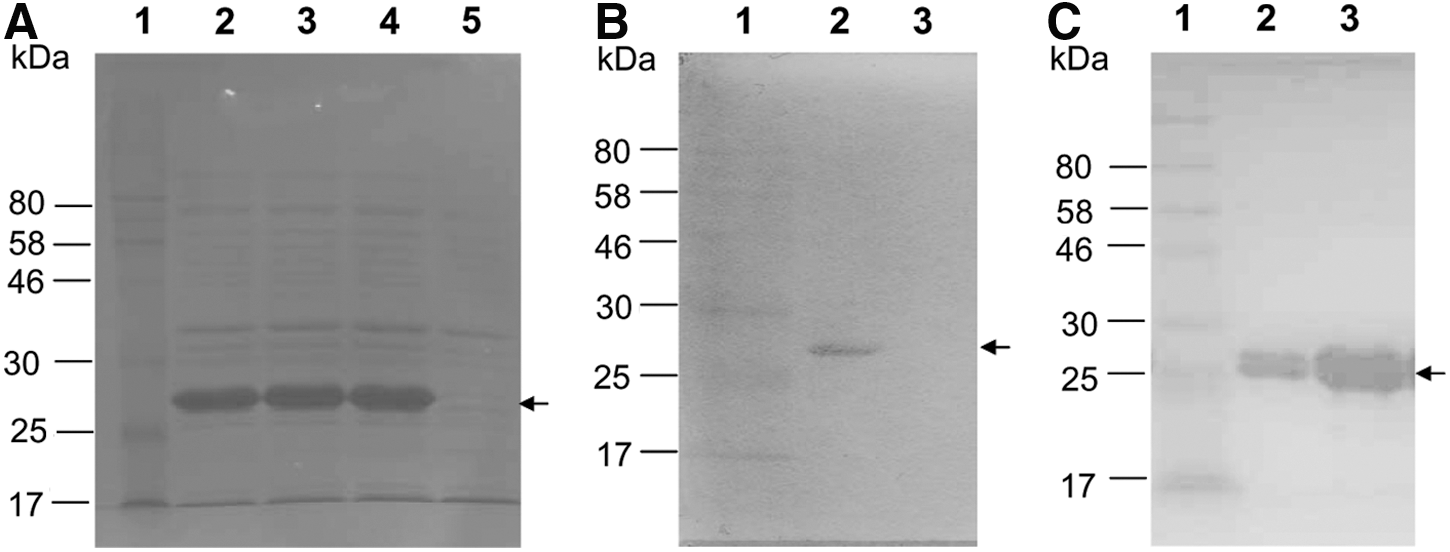
Expression and identification of recombinant GRA7 of Toxoplasma gondii in Escherichia coli.
Development of ELISA based on TLA and recombinant GRA7
To evaluate the potential of the antigens for the serodiagnosis of T. gondii infection in cattle, two separate IgG ELISAs were developed using the recombinant GRA7 and TLA as coating antigens. The optimal working dilution was shown to be 2.5 μg/mL for GRA7 and 10 μg/mL for TLA (50 μL/well), which was determined by checkerboard assays using serial dilutions of antigens and sera. The OD ratios of the positive sample to the negative one (P/N) were above 2.0. When the concentration of the coating antigens ranged from 10 μg/mL to 160 μg/mL for GRA7, and from 40 μg/mL to 640 μg/mL for TLA, the P/N value was significantly increased in GRA7-ELISA in comparison to TLA-ELISA (p<0.01) (Fig. 2).
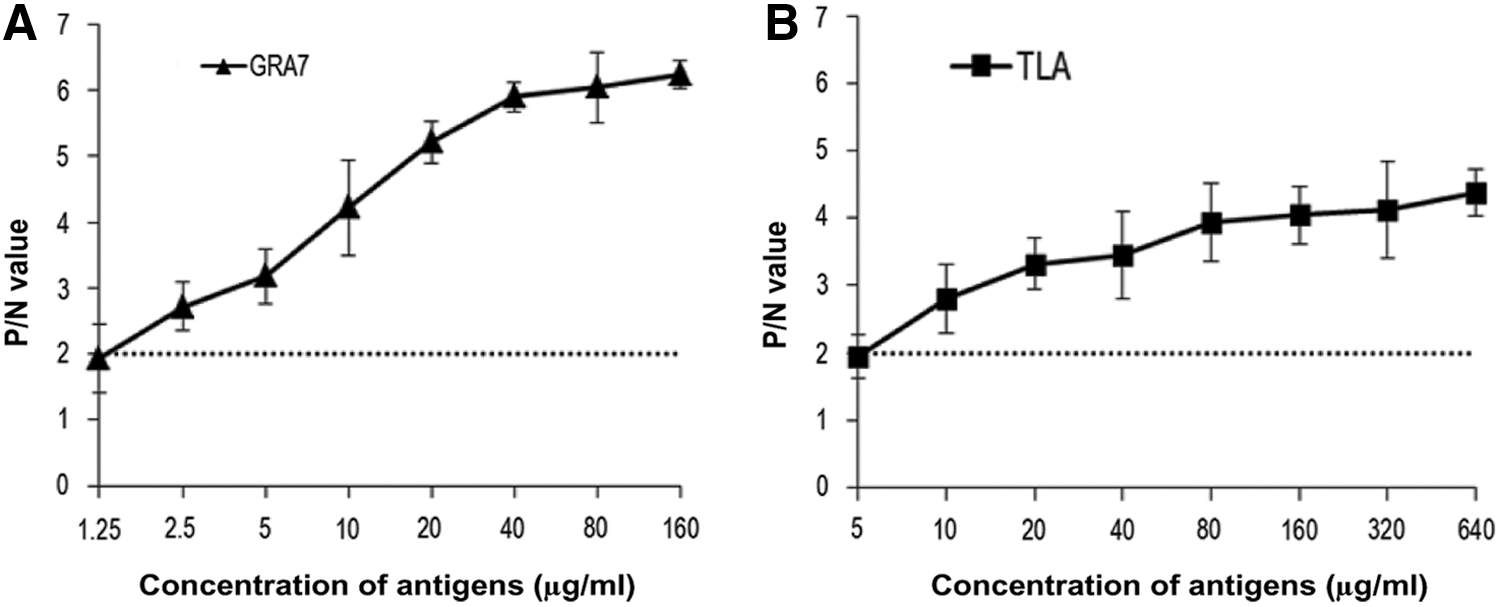
The optical density ratios of the positive sample to the negative one (P/N) detected by granule antigen protein 7 enzyme-linked immunosorbent assay (GRA7-ELISA)
Evaluation of the diagnostic performance of TLA and recombinant GRA7
Cattle serum samples were first determined for anti-T. gondii antibodies by IFA and Western blot, respectively. In Western blotting, the reactivity to TLA was observed in positive samples, and no bands were seen with negative serum sample (Ge et al., 2014). The samples, showing positive or negative result by the two methods, were used to evaluate GRA7 as a potential diagnostic marker for T. gondii infection, while the samples, which had different results, were removed from the study. A total of 101 cattle serum samples were tested for anti-T. gondii IgG antibodies by GRA7-ELISA and TLA-ELISA, respectively. As shown in Table 1, there were 22 positive and 79 negative samples by TLA-ELISA, while there were 28 positive and 73 negative samples tested by GRA7-ELISA (Table 1), and the seroprevalence was 21.8% by TLA-ELISA and 27.7% by GRA7-ELISA. There was no significant difference between positive and negative results when comparing TLA-ELISA and GRA7-ELISA results using McNemar chi-square (p=0.06), and perfect agreement was observed between the two tests (κ=0.74; 95% confidence interval [CI], 0.58–0.89).
GRA7, granule antigen protein 7; ELISA, enzyme-linked immunosorbent assay; TLA, Toxoplasma lysate antigen; IFA, immunofluorescence assay.
Compared with the true results tested by IFA and Western blotting, 7 false-positive and 1 false-negative samples were found in TLA-ELISA, 1 false-positive and 1 false-negative samples were found in GRA7-ELISA (Table 1), showing a higher sensitivity (96.4%, 27/28) and specificity (98.6%, 72/73) in GRA7-ELISA, compared with that of TLA-ELISA, whose sensitivity was 95.5% (21/22) and specificity was 91.1% (72/79).
Distribution of OD values showed that the positive samples were significantly higher in GRA7-ELISA than that in TLA-ELISA (p<0.01), with the median difference of approximately 0.1, and the values for negative samples were significantly decreased in GRA7-ELISA than that of TLA-ELISA (p<0.05), with the median difference of approximately 0.05 (Fig. 3), showing a high sensitivity of GRA7-ELISA for diagnosis of T. gondii infection in cattle.
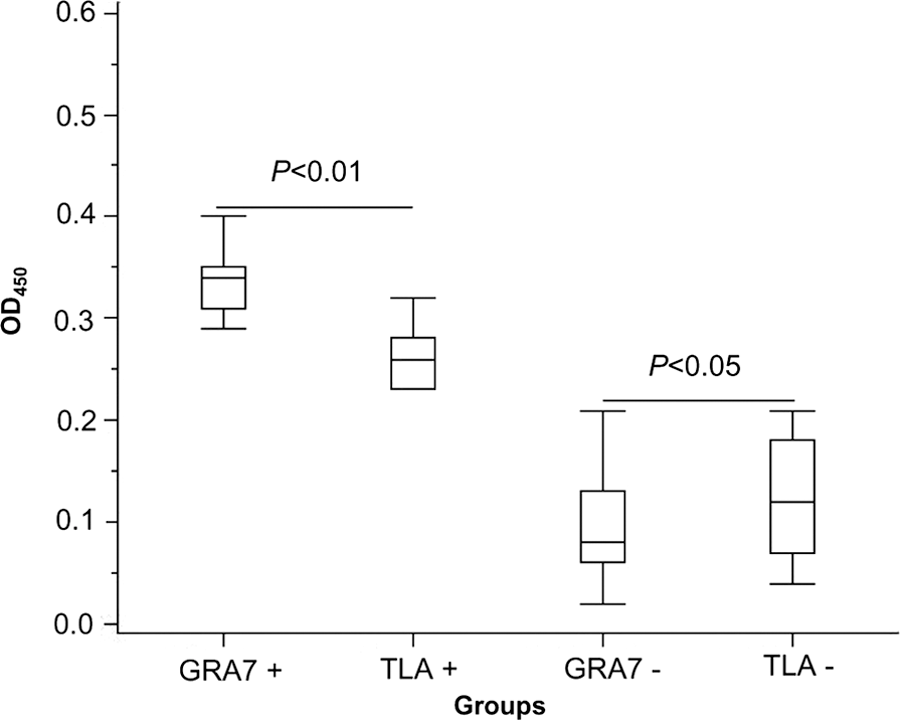
Distribution of optical density (OD) values for the negative (–) and positive (+) samples tested by Toxoplasma lysate antigen (TLA)- and granule antigen protein 7 (GRA7)–enzyme-linked immunosorbent assay. The interquartile range values (25–50–75%) are shown as boxes and whiskers.
ROC analysis
ROC analysis of TLA-ELISA and GRA7-ELISA revealed an area under curve (AUC) of 0.911±0.041 (95% CI 0.831–0.992) and 0.997±0.003 (95% CI 0.991–1.000), respectively (Fig. 4). The estimated sensitivities and specificities for different OD ratio cut-off values were obtained from ROC analysis (Fig. 5), indicating that a cut-off value of 0.30 for GRA7-ELISA showed a sensitivity of 100% and a specificity of 97.3%, and a cut-off of 0.25 for TLA-ELISA showed a sensitivity of 85.2% and a specificity of 94.6%, which were considered as the most appropriate cut-off for the two tests.
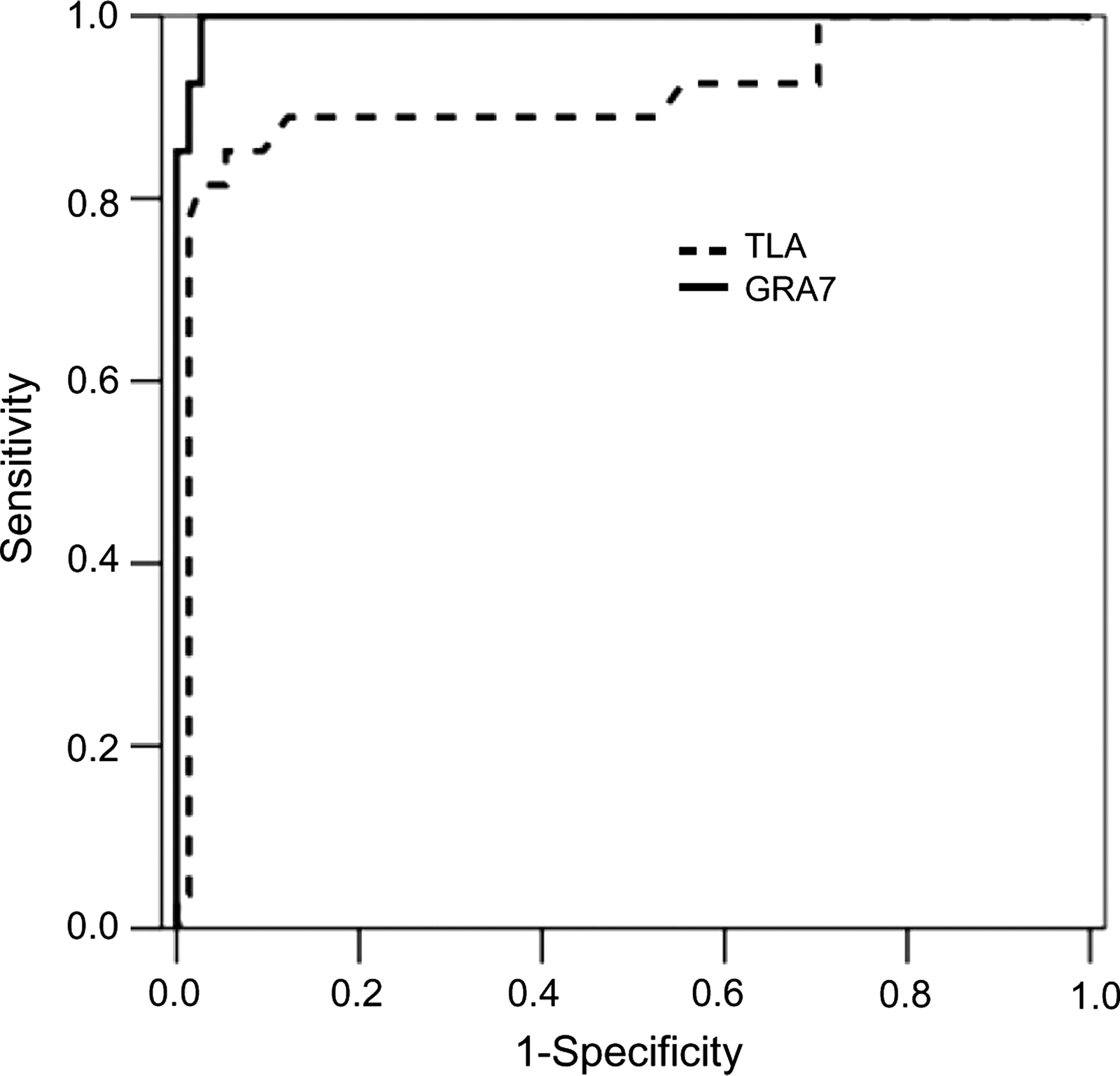
Receiver operating characteristics analysis of Toxoplasma lysate antigen (TLA)–enzyme-linked immunosorbent assay (ELISA) and granule antigen protein 7 (GRA7)–ELISA shows an area under the curve of 0.911±0.041 (95% CI 0.831–0.992) for TLA-ELISA and 0.997±0.003 (95% CI 0.991–1.000) for GRA7-ELISA.
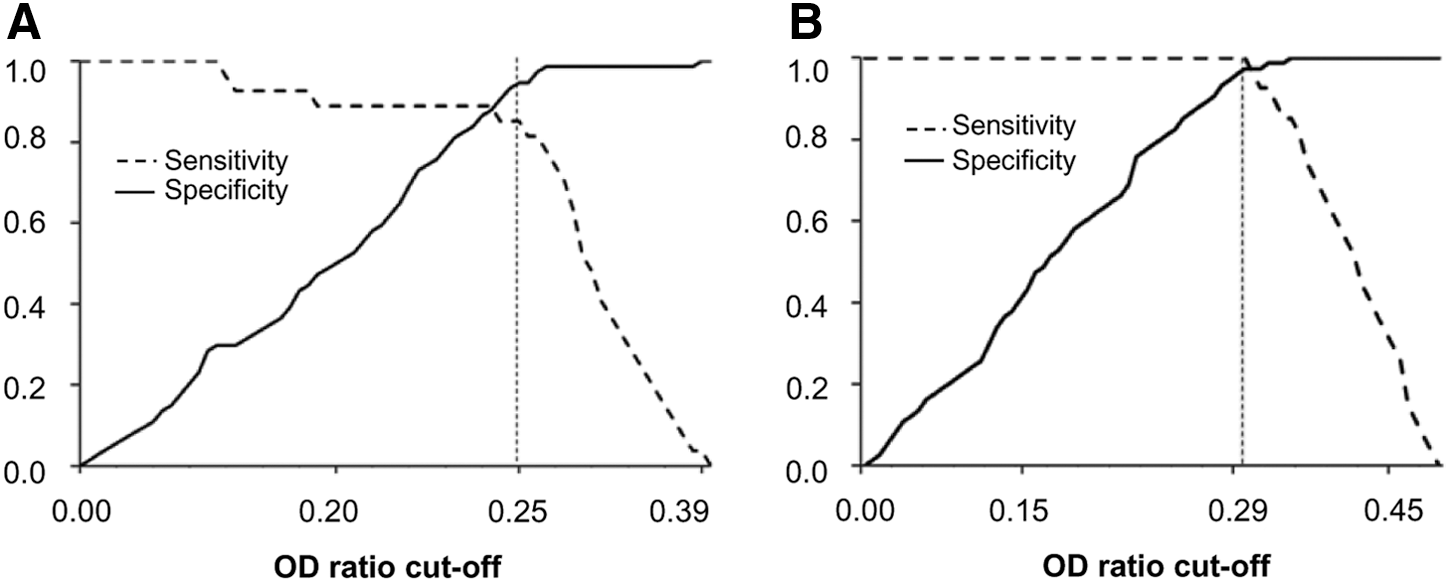
Relative sensitivity and specificity of Toxoplasma lysate antigen (TLA)- and granule antigen protein 7 (GRA7)–enzyme-linked immunosorbent assay (ELISA) at different cut-offs. Vertical line shows the selected cut-offs of 0.25 for TAL-ELISA
Discussion
Toxoplasmosis is an important foodborne parasitic disease in the world. The major sources of infection for humans are undercooked meat, including pork, lamb, and beef (Opsteegh et al., 2011; Jones and Dubey, 2012). It is necessary to accurately detect T. gondii infection in these animals for management and control of toxoplasmosis. To date, a large number of recombinant antigens have been expressed in E. coli, and their potentials as diagnostic markers have been evaluated (Kotresha and Noordin, 2010). It is an important control strategy to detect T. gondii infection in slaughterhouses before meat processing to reduce the spread of T. gondii infection and the risk of infection to humans.
Various serological tests have been used to detect T. gondii infection in cattle, including latex agglutination test (Schoonman et al., 2010), indirect hemagglutination test (Qiu et al., 2012), modified agglutination test, IFA (Costa et al., 2012), and ELISA (Dehkordi et al., 2013). Most of these methods use native tachyzoite antigens, which may vary significantly between laboratories, or between batches. One approach is to develop serological tests using recombinant proteins, with an advantage of the precise antigen composition. Moreover, the methods based on recombinant antigens can easily be standardized (Holec-Gasior, 2013).
Previous studies have evaluated recombinant GRA7-, GRA14-, and SAG2-based ELISA using sera from experimentally T. gondii–infected mice and field pigs, showing that GRA7-ELISA can determine acute and chronic stages of T. gondii infection (Holec-Gasior et al., 2010; Terkawi et al., 2013). In addition, GRA7 showed high sensitivity in detecting T. gondii infection in the pig samples, which can be used as a predictor of the presence of infectious cysts in pigs (Verhelst et al., 2011). Recombinant GRA7 can effectively differentiate T. gondii infection from other parasitic infections or diseases, including Neospora caninum infection, echinococcosis, malaria, leishmaniasis, fascioliasis, and strongyloidiasis (Selseleh et al., 2012; Terkawi et al., 2013). In the present study, GRA7 was also demonstrated as a potential diagnostic marker for detecting T. gondii infection in cattle, showing a high sensitivity and specificity in comparison to TLA.
GRA7 can detect anti-T. gondii antibodies in chronic and acute infection, but it is more associated with acute toxoplasmosis (Nigro et al., 2003; Pietkiewicz et al., 2004; Kotresha et al., 2012). GRA7 appears significantly earlier than other antigens in human sera, such as SAG1 and MAG1 (Pfrepper et al., 2005), and is expressed by all developmental stages, including tachyzoites and bradyzoites, and is abundant on the surface and cytoplasmic matrix of host cells, the PVM, and within the PV lumen (Fischer et al., 1998; Neudeck et al., 2002). When GRA7 is released from tachyzoites and bradyzoites, it has direct contact with the host immune system, and induces strong antibody responses in both early and late stages of infection (Jacobs et al., 1998, 1999). These antigenic properties of GRA7 make it a good serological marker for the detection of anti-T. gondii antibodies in chronic and acute infection.
ROC analysis enabled us to compare the relative sensitivity and specificity of the developed ELISAs at various cut-offs, in which the AUC represents a statistical summary of the overall diagnostic performance of the test (Swets, 1988; Greiner et al., 2000). In the present study, the AUC of 0.997 for GRA7-ELISA suggests that it represents a highly accurate test with good discrimination of positive from negative samples. A cut-off of 0.30 revealed the most appropriate sensitivity and specificity (100% and 97.3%, respectively), which were significantly high, compared with TLA-ELISA with a sensitivity of 85.2% and specificity of 94.6%.
Conclusions
The present study evaluated recombinant GRA7 as a potential diagnostic marker for T. gondii infection in cattle by ELISA, showing a sensitivity of 96.4%, and a specificity of 98.6%. In addition, no significant difference (p>0.05) and perfect agreement (κ=0.74) was observed between the detection results by GRA7- and TLA-ELISAs. ROC analysis showed a relative sensitivity and specificity of 100% and 97.3% at the cut-off value of 0.3 for GRA7-ELISA. These data demonstrate that GRA7 is a promising serodiagnostic marker for T. gondii infection in cattle.
Footnotes
Acknowledgments
This study was supported by the National Basic Research Program of China (“973” Program) (2012CB722501), the Special Fund for Agro-scientific Research in the Public Interest (201303042), and the Chinese National Nature Science Foundation (31372430).
Disclosure Statement
No competing financial interests exist.