




Abstract
Contact with poultry or poultry meat is a well-known risk factor for campylobacteriosis, but prospective studies on transmission of Campylobacter from chickens to humans during slaughter are scarce. In this study, we monitored transmission of Campylobacter from slaughtered chicken to originally culture-negative abattoir workers during the peak season of colonized chicken and human Campylobacter infection. Stool samples were obtained from 28 abattoir workers together with data on health status once a month between June and September 2010, with a follow-up sample collected in February 2011. Campylobacter-positive individuals and chicken flocks were identified by culture, and isolates were further characterized using molecular techniques. Campylobacter was isolated from seven asymptomatic individuals. Four of them had been newly employed and had not reported any previous Campylobacter infection. Four human isolates had matching genetic fingerprints with isolates from recently slaughtered chickens. Our results further support the role of chicken as the source of human Campylobacter infection but suggest that asymptomatic Campylobacter infection may occur even in individuals with only limited earlier exposure to Campylobacter.
Introduction
C
Materials and Methods
Participants and stool cultures
The study was performed at two chicken abattoirs in Sweden. All abattoir workers directly involved in the chicken slaughter were asked to participate in the study. Initial stool samples were collected from 28 volunteering abattoir workers at the end of June and thereafter once a month from July to September 2010. In addition, a follow-up stool sample was collected at the end of February 2011. Participants sent stool samples in Amies transport medium with charcoal (Sarstedt, Nümbrecht, Germany) to the Clinical Microbiology Laboratory at Uppsala University Hospital. A total of 113 stool samples were cultured for Campylobacter on modified charcoal–cefoperazone–deoxycholate agar plates (Oxoid, Basingstoke, England) (Engberg et al., 2000). Identification of Campylobacter was preliminarily based on colony appearance, oxidase test, and microscopy, and the isolates were stored at −70°C until further analysis. Data on underlying diseases, medication, use of tobacco, previously confirmed Campylobacter infection, length of employment at a poultry abattoir and so on were obtained by questionnaires filled out by the participants at the start of the study. Further information about intake of probiotics, proton pump inhibitors, and antimicrobials as well as gastrointestinal and other symptoms was obtained by questionnaires at each sampling occasion. These characteristics were compared between infected and noninfected participants using Fischer's two-tailed exact test (data not shown).
Chicken isolates
Through the Swedish Campylobacter surveillance program (Hansson et al., 2007), we had access to all Campylobacter isolates from colonized chicken flocks that had been slaughtered at the two abattoirs during the study period. At the two abattoirs, a total of 135 Campylobacter-positive chicken flocks were slaughtered between June 2010 and February 2011. To search for the source of infection among the Campylobacter-positive chicken flocks, the human isolates were analyzed with pulsed-field gel electrophoresis (PFGE) together with isolates from all chicken flocks (N=28) slaughtered at the corresponding abattoir within 1 month before the positive human samples were obtained. For human isolates for which no chicken isolates with matching PFGE patterns were found within a month from the positive human stool culture, chicken isolates at the corresponding abattoir from within 2 months were tested (eight additional isolates).
Characterization of isolates
All 42 Campylobacter isolates from humans and chickens in the study were identified to the species level by polymerase chain reaction according to methods described earlier (Linton et al., 1997; Denis et al., 1999). PFGE was performed according to the “Campynet” standardized protocol, using the restriction enzyme SmaI (
Ethical considerations
The study was approved by the regional board of the ethical committee at Uppsala University. All participants gave their written informed consent.
Results
In total, 28 workers at 2 poultry abattoirs in Sweden were included; 17 women (mean age 33.9 years) and 11 men (mean age, 32.2 years). Twelve participants had been employed ≤1 year (median, 1.3 months) at the beginning of the study (Table 1). All human stool cultures were Campylobacter negative at the beginning of the study in June, but follow-up samples revealed positive Campylobacter stool cultures from a total of seven abattoir workers: five of them in September (Table 1). Importantly, no symptoms were reported by any of the Campylobacter-positive participants at the time of positive stool culture. Four of the Campylobacter-positive participants had been employed within a year from the beginning of the study. These individuals had not reported any previous employment at a poultry abattoir or any previously documented Campylobacter infection. Two of the five participants with earlier confirmed Campylobacter infection also became culture positive during the study.
Length of employment at the first stool sample.
The isolate could not be resuscitated from the frozen stock.
Chicken isolate with identical genotype verified (Fig. 1).
Five of the seven human Campylobacter isolates were identified as C. jejuni and one as C. lari. One isolate was lost as it could not be resuscitated from the frozen stock. The five human C. jejuni isolates were further identified by MLST to belong to four different clonal complexes: ST-48CC, ST-658CC, ST-677CC, and ST-45CC (two isolates) (Fig. 1). Four of the human isolates—three C. jejuni and one C. lari—had a SmaI pattern identical to that of chicken isolates from flocks slaughtered within 1 month (Fig. 1). For two positive abattoir workers, no chicken isolates with matching PFGE patterns were found at the corresponding abattoir even within 2 months of infection.
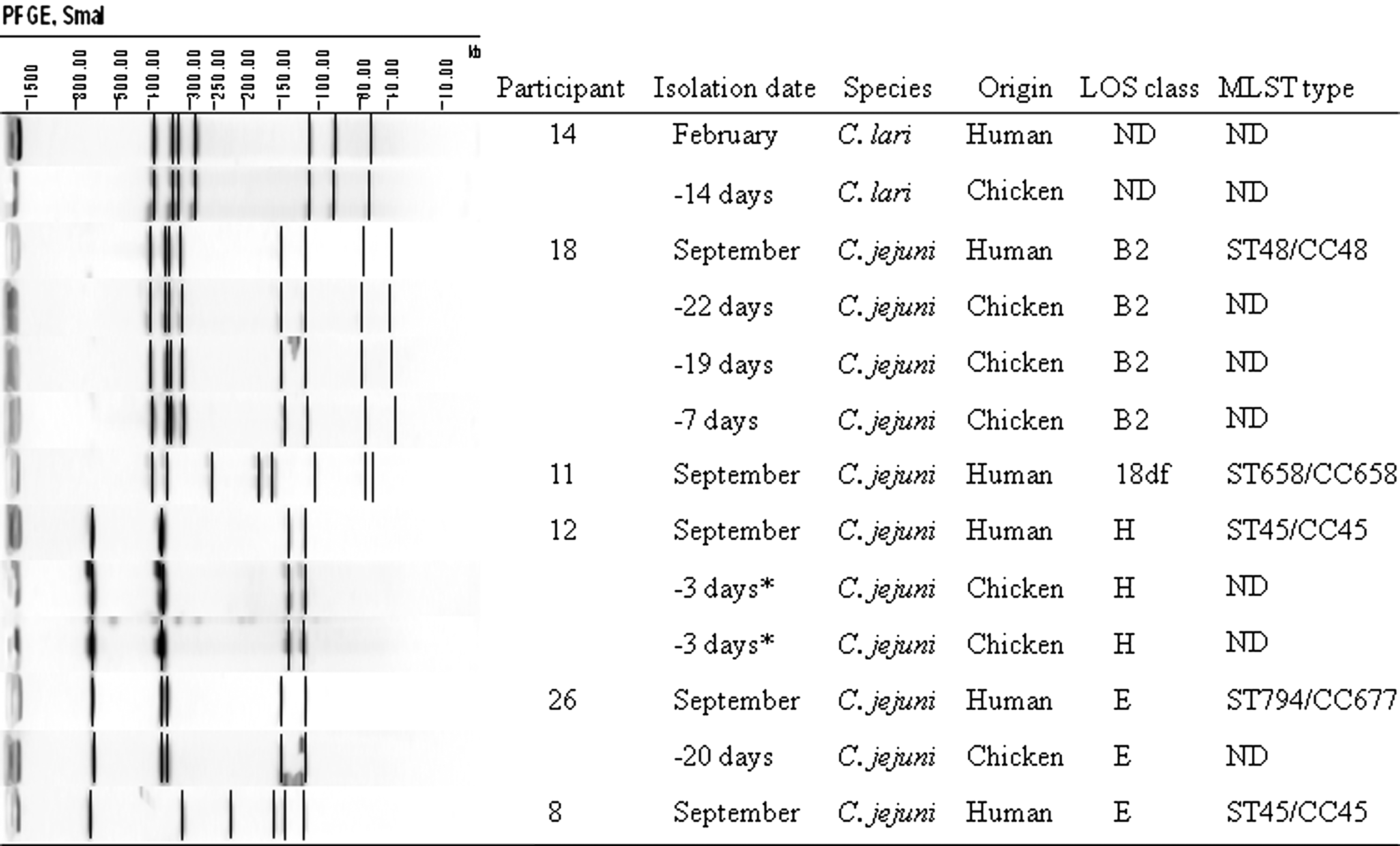
SmaI restriction patterns after pulsed-field gel electrophoresis (PFGE) for the six human Campylobacter isolates and the corresponding chicken isolates with identical patterns. The column “Isolation date” denotes in which month each positive human sample was obtained as well as how many days earlier the corresponding chicken isolates with matching PFGE patterns were obtained. *Isolates from different flocks of the same breeder. LOS class, lipooligosaccharide locus class (range from A to S); MLST, multilocus sequence typing; ST, sequence type (specific combination of sequence data from seven housekeeping genes in the C. jejuni genome); CC, clonal complex (related STs with at least 4 identical alleles); 18df, the isolate harbored the open reading frame orf18 and thus had any of the LOS locus classes D, F, I, J, K, N, S, or Q which all are unable to incorporate sialic acids; ND, not determined.
To determine whether any specific LOS locus class was over-represented among the isolates only causing asymptomatic infections, the LOS locus class was determined for the five human C. jejuni isolates and the corresponding chicken isolates with matching PFGE patterns. The isolates belonged to four different LOS locus classes and hence there was no over-representation of a specific LOS locus class (Fig. 1). In this study, none of the host characteristics collected in the questionnaires was significantly associated with positive stool cultures.
Discussion
Poultry is an important source of human Campylobacter infections. During this prospective follow-up study on 28 poultry abattoir workers, 7 participants became stool culture– positive for Campylobacter by routine diagnostic methods. Four of the human isolates had PFGE SmaI restriction patterns identical to isolates from chickens slaughtered at the corresponding abattoir within a month of human infection, providing evidence for transmission of Campylobacter from chicken to the personnel at the abattoirs. Immunity developed after years of employment at chicken abattoir might explain the asymptomatic infections of the long-term abattoir workers. However, it is noteworthy that four of the Campylobacter-positive asymptomatic individuals had most probably only had very limited earlier exposure to Campylobacter: short duration of employment at any poultry abattoir, employment before the study mostly during the season with only few contaminated chicken flocks, and no previously verified Campylobacter infection.
Campylobacter infection has been reported previously among poultry abattoir workers (Christenson et al., 1983; Cawthraw et al., 2000; de Perio et al., 2013). However, in all these studies asymptomatic Campylobacter infection has been exclusively reported among experienced workers, whereas all newly employed Campylobacter-positive staff members have reported symptoms of the infection. In a study of a Campylobacter outbreak at an abattoir in Sweden, 17 of 24 newly employed workers were infected together with 20 of 70 experienced workers. Only five asymptomatic Campylobacter-positive individuals were detected; all of them were among the experienced staff members (Christenson et al., 1983). In another study, eight Campylobacter culture-positive abattoir workers were identified and one of them, the only short-term worker, developed symptoms (Cawthraw et al., 2000). Furthermore, in a register-based study of Campylobacter-positive symptomatic poultry-processing workers at an abattoir in the United States between 2008 and 2011, 83% of the infected individuals had worked at the plant for <1 month before the infection (de Perio et al., 2013). Together, these studies indicate that continuous bacterial exposure may protect to some extent the experienced workers from symptomatic Campylobacter infection. However, our findings in the present prospective study, although with a low number of participants, show that asymptomatic infection may also occur among employees with only limited earlier exposure to Campylobacter and thus could further suggest that all Campylobacter isolates of chicken origin might not be equally virulent and cause symptomatic infection in humans. The C. jejuni isolates from the newly employed participants in this study belonged to clonal complexes previously found among symptomatic humans, and it is possible that host factors may explain the lack of symptoms even among these individuals. On the other hand, virulence determinants and phenotypes have been shown to vary even within clonal complexes (Revez et al., 2011).
One suggested virulence trait in the pathogenesis of Guillain-Barré syndrome is the ability of some C. jejuni strains to incorporate sialic acids in the LOS, resulting in structures mimicking human gangliosides (Godschalk et al., 2004). Such strains also displayed increased invasion of epithelial cells in vitro, but results are conflicting regarding their ability to cause more severe symptoms in patients (Louwen et al., 2012; Ellström et al., 2013a). Screening for LOS locus class of the C. jejuni isolates in the present study did not reveal any obvious association between a certain LOS locus class and the asymptomatic infections among the abattoir workers. However, the numbers are too small to draw any further conclusions.
Conclusions
This prospective follow-up study further supports the role of chicken as the source of human Campylobacter infection but suggests that asymptomatic Campylobacter infection might occur even in individuals with only limited earlier exposure to Campylobacter.
Footnotes
Acknowledgments
The skilled technical assistance of Anna Nilsson, Boel Harbom, Mattias Myrenås, and Ninni Pudas is gratefully acknowledged. This work was financially supported by grants from the Swedish Research Council (grant number: 521-2011-3527) and the Swedish Research Council FORMAS (grant number: 221-2012-1442). The funding sources had no involvement in any part of the study.
Disclosure Statement
No competing financial interests exist.