




Abstract
Translocation of foodborne pathogens into the interior tissues of pork through moisture enhancement may be of concern if the meat is undercooked. In the present study, a five-strain mixture of Campylobacter jejuni or Salmonella enterica Typhimurium was evenly spread on the surface of fresh pork loins. Pork loins were injected, sliced, vacuum packaged, and stored. After storage, sliced pork was cooked by traditional grilling. Survival of Salmonella Typhimurium and C. jejuni in the interior tissues of the samples were analyzed by enumeration. The populations of these pathogens dropped below the detection limit (10 colony-forming units/g) in most samples that were cooked to 71.1°C or above. The general linear mixed model procedure was used to model the association between risk factors and the presence/absence of these pathogens after cooking. Estimated regression coefficients associated with the fixed effects indicated that the recovery probability of Salmonella Typhimurium was negatively associated with increasing level of enhancement. The effects of moisture enhancement and cooking on the recovery probability of C. jejuni were moderated by storage temperature. Our findings will assist food processors and regulatory agencies with science-based evaluation of the current processing, storage condition, and cooking guideline for moisture-enhanced pork.
Introduction
M
To meet consumer demands, a pork processor must consistently produce a high-quality product that is microbiologically safe. In industry, brines are usually recirculated within the equipment used for injecting pork. A significant increase in the numbers of Listeria monocytogenes has been observed in brine with time during this process (Greer et al., 2004). Moisture enhancement also has the potential to introduce bacteria from the surface into the interior muscle (Bohaychuk et al., 2003). For these reasons, injection with brine contaminated with bacteria may increase the incidence and severity of contamination in the interior tissues of pork. Concerns about the microbiological safety of moisture-enhanced pork have been raised because consumers preparing dishes with such products may regard them as an intact product, and may thoroughly cook the surface by grilling without raising all deep tissues to temperatures that are sufficient to destroy all pathogenic microorganisms.
Salmonella enterica and Campylobacter jejuni were isolated in moisture-enhanced pork samples from retail stores in the United States (Duffy et al., 2001). Up to now, there has no available information to determine whether commonly used cooking temperatures are lethal for internalized S. enterica and C. jejuni in moisture-enhanced pork. During the processing and storage, microbial contaminants may be exposed to food-related stresses, such as salt and cold, which may influence their thermal tolerance during cooking. Using information regarding the effects of processing and storage conditions on the survival of S. enterica and C. jejuni in moisture-enhanced pork after cooking, food processors and regulatory agencies can develop decision-support systems for monitoring, controlling, or optimizing processes for this meat product. Unfortunately, such information is scarce. Thus, the objective of the present study was to examine the survival of Salmonella enterica serovar Typhimurium and C. jejuni in moisture-enhanced pork after cooking. The effects of processing and storage conditions on the survival were also assessed.
Materials and Methods
Bacterial strains
Five strains of Salmonella Typhimurium phage type DT104 and five strains of C. jejuni were studied. The five strains of Salmonella Typhimurium were human clinical isolates. Strains G29, G30, G32, and G33 were obtained from the Food Microbiology Research Laboratory in Iowa State University, whereas strain G34 was obtained from the Centers for Disease Control and Prevention. The five strains of C. jejuni were obtained from Dr. Zhang (Department of Veterinary Microbiology and Preventive Medicine, Iowa State University, Ames, IA). Of these strains, three strains (CT 1:1, CT 2:2, CT 3:7) were isolated from turkeys and two strains (Clev 9100, F 12469) were isolated from humans.
The individual strains of Salmonella Typhimurium were maintained on tryptic soy agar (TSA; Difco, BD, Sparks, MD) slants at 4°C. A loopful of culture from a TSA slant was individually transferred into 10 mL of trypticase soy broth (Difco) and incubated for 24 h at 35°C. The individual strains of C. jejuni were stored in glycerol broth at −70°C and resuscitated by streaking on Columbia Blood Free agar (Oxoid, United Kingdom) with CCDA Selective Supplement (Oxoid). Plates were incubated for 24 h at 37°C in a CO2 incubator (model 3130, Thermo Forma, Marietta, OH). The atmosphere in the incubator was programmed and automatically adjusted to be 5% O2, 10% CO2, and 85% N2. A loopful of culture from the plate was transferred to 20-mL Bolton selective enrichment Broth (Oxoid) with 5% lysed horse blood and incubated for 24 h at 37°C in the CO2.
To prepare inoculums of each pathogen, a 1-mL aliquot of culture was removed from each individual strain, and the aliquots were combined to give a 5-mL mixed culture; 2 mL of this mixed culture was transferred to 98 mL of peptone water, with a final population of approximately 106 colony-forming units (CFU)/mL.
Inoculation and injection
For each experiment, three boneless pork loins were inoculated with Salmonella Typhimurium and three boneless pork loins were inoculated with C. jejuni. The inoculum of Salmonella Typhimurium or C. jejuni was evenly spread on the surface of each whole boneless pork loin by using a 2.5-cm-wide foam paintbrush. The bacteria were allowed to adhere for 5 min. A brine solution (18.925 L) was prepared in a 19-L (5-gallon) bucket with sterile distilled water. The brine was formulated to produce a final concentration of 0.2% sodium chloride and 0.3% sodium tripolyphosphate in the enhanced loins. Inoculated pork loins were enhanced by 10% and 20% (wt/wt) of their initial weight using a needle injector (P-10 Pokomat Injector; Quality Food Equipment, El Monte, CA). The pork loins were weighed before and after injection to determine enhancement level. All the equipment was cleaned and sanitized with Vanquish disinfectants (Total Solutions, Milwaukee, WI) and hot water.
Slicing
After injection, each pork loin was aseptically sliced into ten 1-cm thick slices with a sterile scalpel. An inoculated pork loin without injection (enhancement level was 0%) was also sliced in the same way. The experiment was independently replicated on 3 different days. The total number of slices in the present study was 180.
Storage and cooking
Each slice was placed individually in a vacuum bag (CryovacPackaging, Duncan, SC). All packages bags were sealed under vacuum (model A300 vacuum packager, Multivac Inc., Kansas City, MO) and stored at 4°C for 21 days or at 10°C for 14 days. After storage, individual packages were aseptically opened with a sterile knife and each slice was cooked in a George Foreman clamshell grilling machine (Lake Forest, IL). All experimental units (pork loin and sliced pork) were randomly allocated to treatments including bacterial inoculation, injection, vacuum-packaged storage, and cooking.
Sampling procedure
The target endpoint temperatures for cooking were 0°C (control), 68.3°C, 71.1°C, 73.9°C, and 76.7°C. A type J thermocouple (Oakton Instruments, Vernon Hills, IL) was sterilized in alcohol and inserted into the geometric center of each slice to monitor internal temperature. When slices reached their target endpoint temperatures, they were immediately removed from the grill, and then a 20-g portion was aseptically excised from the interior tissues of a meat slice with a sterile scalpel and forceps. Samples were homogenized by stomaching in a laboratory blender (Stomacher 400; Seward Medical, London, UK) for 60 s with 0.1% peptone water in a sterile Whirl-Pak stomacher bag (Nasco, Ft. Atkinson, WI).
Microbial analysis
Serial dilutions of sample homogenate were surface plated in duplicate onto xylose lysine desoxycholate (BD, Franklin Lakes, NJ) medium for enumerating Salmonella Typhimurium. Plates were incubated at 37°C for 24 h and colony-forming units were manually counted. Serial dilutions of sample homogenate were surface plated in duplicate onto Columbia Blood Free agar (Oxoid) with CCDA Selective Supplement (Oxoid) for enumerating C. jejuni. Plates were incubated at 42°C for 48 h in the CO2 incubator, and colony-forming units were manually counted. The populations of Salmonella Typhimurium and C. jejuni obtained from enumeration were converted to log10 CFU/g.
When counts of Salmonella Typhimurium and C. jejuni were under the detection limit for surface plating (10 CFU/g), presence or absence of viable cells in these samples was investigated. For Salmonella, homogenates were incubated for 48 h at 37°C, then 100 μL of an enriched homogenate was transferred onto 9.9 mL of Rappaport-Vassiliadis (Oxoid) broth. After incubation at 42°C for 48 h, 10 μL of the enrichment culture was streaked onto BBL™ CHROMagar™ Salmonella (BD, Sparks, MI), and incubated at 37°C for 48 h. For C. jejuni, 10 mL of a homogenate sample was transferred to 90-mL Bolton Broth (Oxoid). The enrichment cultures were incubated at 42°C in the CO2 incubator. After 48 h, 10 μL of the enrichment culture was streaked onto Columbia Blood Free agar (Oxoid) with CCDA Selective Supplement (Oxoid).
Presumptive Salmonella colonies were confirmed by using the Reveal Salmonella test kits (Neogen Corp., Lansing, MI) and BAX® PCR System Salmonella test kit (Du Pont Qualicon, Germany). Presumptive C. jejuni colonies were confirmed by using the DrySpot Campylobacter test kit (Oxoid) and BAX® PCR System Campylobacter test kit (Du Pont Qualicon).
Model fitting
Separate statistical analyses for Salmonella Typhimurium or C. jejuni were performed by using the statistical software package R (version 2.11.1, R Development Core Team, 2010). The experimental design for each pathogen was a split-plot design. Pork loin was the whole plot unit with moisture enhancement (0%, 10%, 20%) as the whole-plot factor. Sliced pork was the split-plot unit with storage temperature (4°C and 10°C) and cooking temperature (68.5°C, 71.1°C, 73.9°C, 76.7°C) as the split-plot factors (Fig. 1).

Flow diagram of the experimental set-up in the split-plot design. Pork loin (□) was the whole-plot unit and sliced pork () was the spilt-plot unit.
After cooking, enumeration results of Salmonella Typhimurium or C. jejuni were presence or absence. A logistic General Linear Mixed Model with random effect was used to model the association between potential risk factors and the presence/absence outcome. Sliced samples within a pork loin were not independent; therefore, pork loin was included in the model as a random effect. All the fixed-effect terms M i, S j, C j and the random-effect term γi in the model are described in Table 1.
A Likelihood Ratio Test (Self and Liang, 1987) was conducted to test whether the variance of the random effect differs significantly from zero. A stepwise backward deletion of nonsignificant terms was performed. The coefficients retained in the reduced model were those significant at a p value of <0.05. Analysis of deviance, based on a likelihood-ratio test (LRT), was used to assess the statistical significance of the exclusion of each variable. When the coefficient for the logistic regression varied as a function of a retained term in the reduced model that moderated the impact of an independent variable on the dependent variable, the 95% confidence interval of the coefficient was calculated with the asymptotic covariance matrix (Preacher et al., 2006). Contour plots with 50% recovery probability of Salmonella Typhimurium and C. jejuni were created to assess the interaction effects that were in the reduced models.
Results
Survival of Salmonella Typhimurium and C. jejuni after cooking
Survival of Salmonella Typhimurium and C. jejuni in samples after cooking is shown in Figures 2 and 3. The populations of Salmonella Typhimurium and C. jejuni in the interior tissues of samples without cooking (control) ranged from 4.08 to 5.94 log10 CFU/g and from 4.12 to 5.94 log10 CFU/g, respectively. There were 18 samples inoculated with Salmonella Typhimurium or C. jejuni and cooked to each endpoint temperature. Salmonella Typhimurium was recovered from 10 samples that were cooked to 68.3°C, 3 samples that were cooked to 71.1°C, and 3 samples that were cooked to 73.9°C. When the internal temperature reached 76.7°C, the populations of Salmonella Typhimurium dropped below the detectable level. The surviving populations of Salmonella Typhimurium ranged from 1.3 to 2.94 log10 CFU/g. C. jejuni were recovered from the interior tissues for every endpoint temperature. C. jejuni was recovered from 6 samples that were cooked to 68.3°C, 4 samples that were cooked to 71.1°C, 4 samples that were cooked to 71.1°C, and 1 sample that was cooked to 76.7°C. The surviving populations of C. jejuni ranged from 1.3 to 3.15 log10 CFU/g.
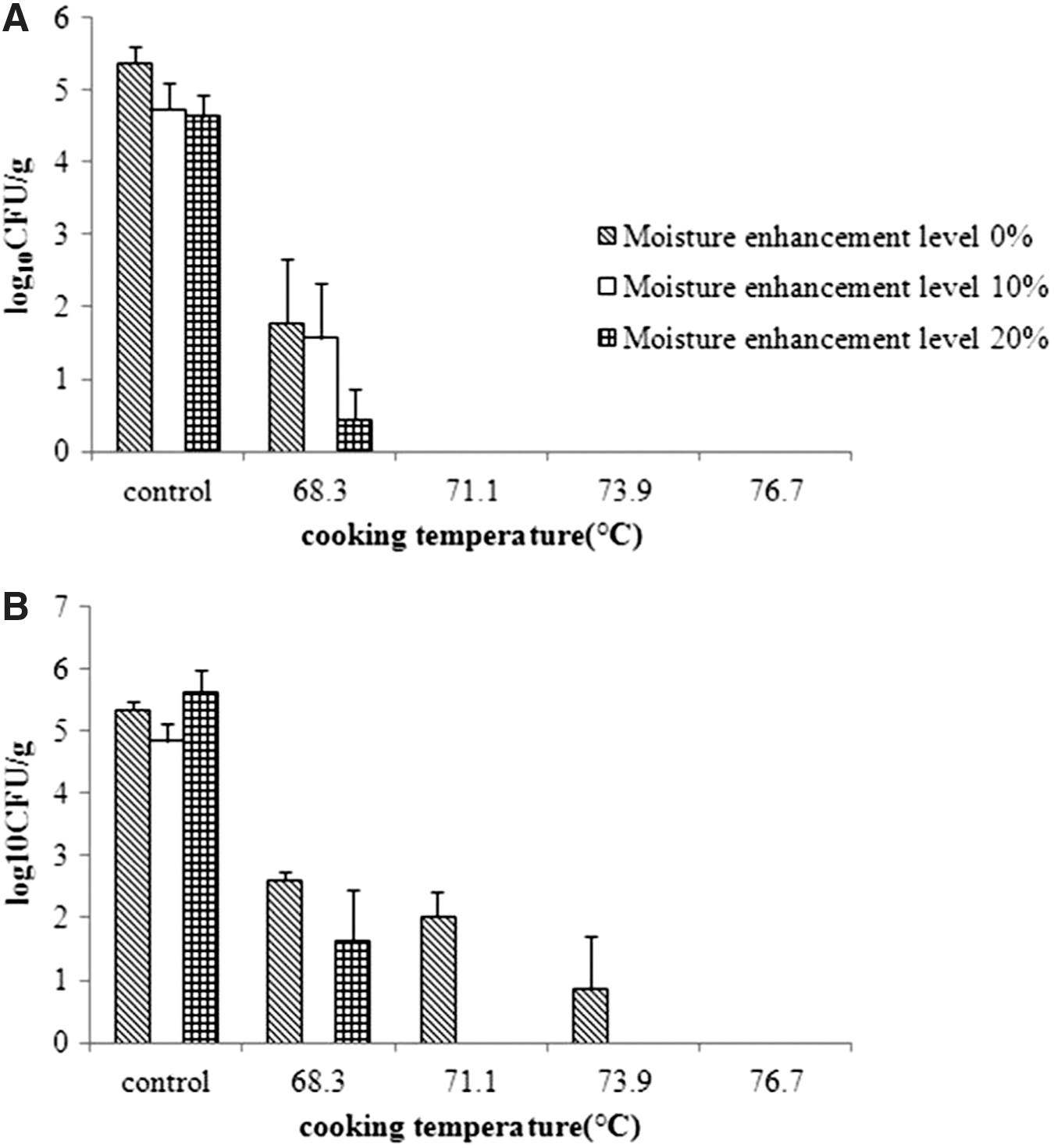
Survival of Salmonella Typhimurium in moisture-enhanced pork after cooking. Before cooking, all inoculated samples were stored at 4°C for 21 days
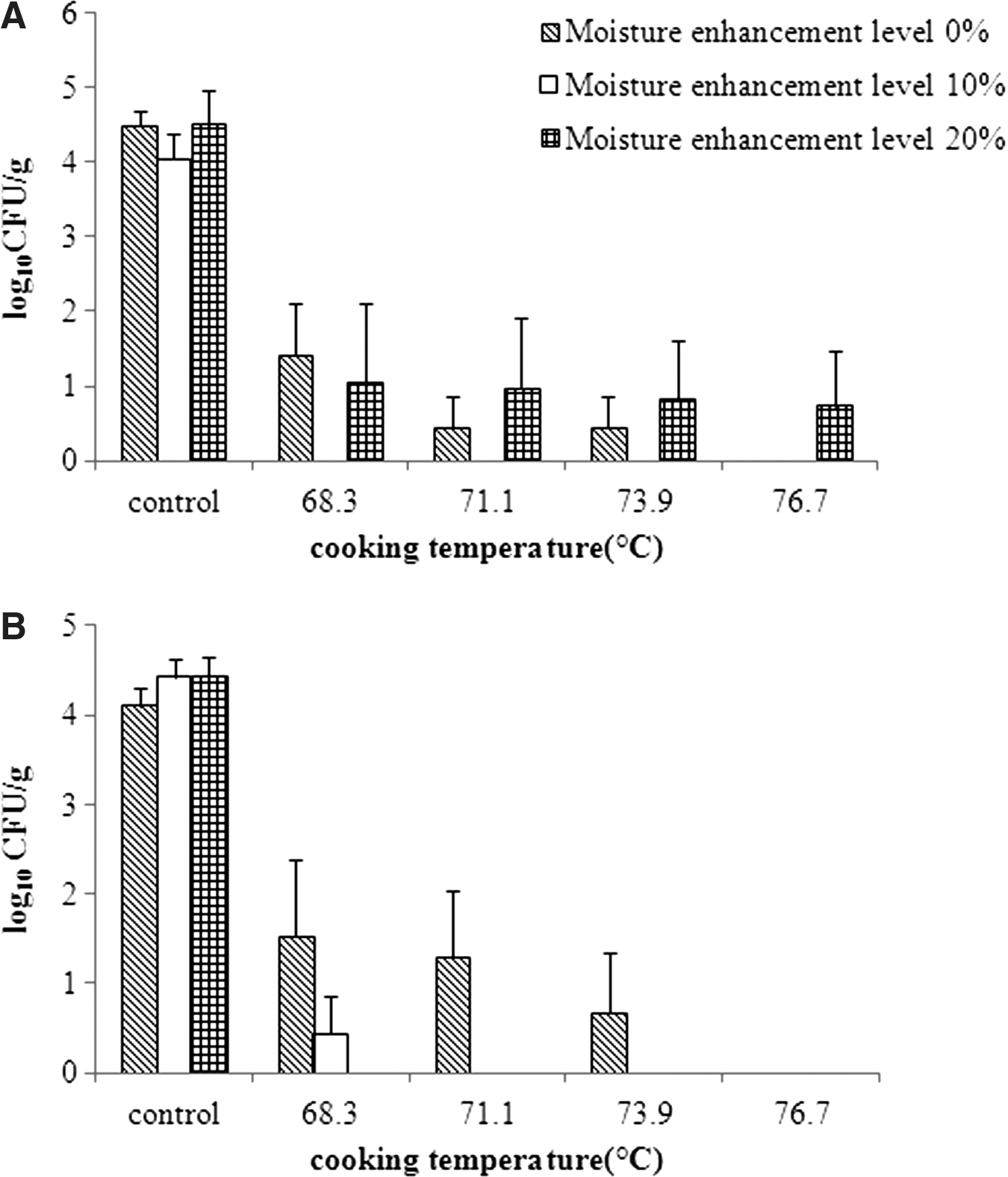
Survival of C. jejuni in moisture-enhanced pork after cooking. Before cooking, all inoculated samples were stored at 4°C for 21days (A) or stored at 10°C for 14 days (B). Control samples were analyzed for C. jejuni after storage. Other samples were cooked to target endpoint temperatures (68.3°C, 71.1°C, 73.9°C, and 76.7°C). After cooking, these samples were analyzed for C. jejuni. The bars represent the mean±standard error. CFU, colony-forming units.
Model development
There was substantial and significant variation (p<0.05) between the loins that were inoculated with Salmonella Typhimurium, and the variance of the random effect (σγ
2) was 1.85. The variation between the slices (σ1
2) was 0.35. After variable selection, a reduced model used to describe the logit(pij
) of Salmonella Typhimurium was obtained as follows:
where pij is the probability of Salmonella Typhimurium presence in the ith loin, jth slice.
There was also substantial and significant variation (p<0.05) between the loins that were inoculated with C. jejuni and the variance of the random effect (σγ’
2) was 105.37. The variation between the slice (σ2
2) was 0.11. After variable selection, a reduced model that used to describe the logit(pij
) of C. jejuni was obtained as follows:
where i=10,11,…,18th loin.
All the coefficients retained in the reduced model (1) and (2) were significantly nonzero. Comparing the full model and the reduced model suggested that the difference between these models was not statistically significant (p>0.05), based upon the LRT.
Risk factors associated with Salmonella Typhimurium and C. jejuni contamination
Effects of moisture enhancement, storage, and cooking temperature on the recovery probability of Salmonella Typhimurium and C. jejuni are presented in Tables 2 and 3, respectively. The upper bounds of the confident intervals for the estimated coefficients associated with M i and Cj in equation 1 were negative. The estimated coefficients associated with M i and Cj in equation 2 were dependent on storage temperature. At 4°C, the confident intervals for these coefficients included zero. At 10°C, the upper bounds of the confident intervals for these coefficients were negative. The lower bounds of the confident intervals for the estimated coefficients associated with S j in equation 1 were positive when enhancement levels were 0% and 10%, but the confident interval included zero when enhancement level was 20%. The estimated coefficients associated with S j in equation 2 were dependent on enhancement level and cooking temperature. For a particular cooking temperature, the estimated coefficients decreased with increasing enhancement level. For a particular enhancement level, the estimated coefficients decreased with increasing cooking temperature.
CI, confidence interval.
CI, confidence interval.
Discussion
To assure the microbiological safety of meat products, 71.1°C is recommended as the safe minimum internal cooking temperature for pork (USDA-FSIS, 2009). In the present study, after samples were cooked to 71.1°C or above without holding time, the abundance and frequency of recovery of C. jejuni and Salmonella Typhimurium in samples of enhanced pork were both lower than those in samples of intact pork (without injection). This result may imply that C. jejuni and Salmonella Typhimurium are less heat resistant in the interior of moisture-enhanced pork than in intact pork. It is generally agreed that the intact pork is safe. Thus, cooking to a temperature above 71.1°C should be adequate for assuring the microbiological safety of moisture-enhanced pork. C. jejuni and Salmonella Typhimurium were still recovered from some samples that were cooked above 71.1°C. During cooking, the heating of the slices maybe uneven and consequently bacteria survived at cold spots within slices (Luchansky et al., 2012). The levels of inoculum used in the present study were relatively high compared to levels of natural contamination and this may also affect the results.
Examination of the coefficient showed that moisture enhancement had a negative effect on the survival of Salmonella Typhimurium. Although moisture enhancement has the potential to carry Salmonella Typhimurium from the surface to the interior of pork, the vacuum storage and final cooking practices that were followed did not result in a higher heat resistance of Salmonella Typhimurium in moisture-enhanced pork than in intact pork. Moisture enhancement also had a negative effect on the survival of C. jejuni when pork samples were stored at 10°C. However, the effect of moisture enhancement was uncertain on the survival of C. jejuni when pork samples were stored at 4°C.
We further observed that the effect of cooking on the survival of C. jejuni was moderated by storage temperature. After pork samples were stored at 10°C, cooking had the inactivation effect on the survival of C. jejuni. However, cooking may not have an inactivation effect after pork samples were stored at 4°C. The low-temperature response of C. jejuni is very different from that of Salmonella (Park, 2005; Rychlik and Barrow, 2005). For example, C. jejuni cells are unable to alter their fatty-acid composition during rapid chilling, and the unaltered fatty-acid composition is more suited to survive when cells are exposed to subsequent heat stresses (Hughes et al., 2009). In the meat industry, vacuum packaging and storage at strictly controlled temperatures of 4°C are widely used to store and export raw meat. It is therefore recommended to reconsider the effect of chilling by including our results to avoid underestimation of potential risks and to enhance food safety for moisture-enhanced pork.
The effect of storage temperature on the survival of Salmonella Typhimurium decreased with increasing of enhancement level. When the enhancement level was 0% or 10% and other variables were fixed, increasing the storage temperature would increase the survival of Salmonella Typhimurium. However, increasing the storage temperature would decrease the survival of Salmonella Typhimurium when the enhancement level was 20%. It is generally assumed that microorganisms grown at higher temperatures have greater resistance to heat (Ng et al., 1969; Dega et al., 1972; Pagán et al., 1999). The results in the present study may be attributable to the increasingly negative effect of moisture enhancement on the survival of Salmonella Typhimurium.
Considerable variations in the chemical compositions of meat (fat content and dry-matter content) were observed among pork loins (Corino et al., 2009). Fat content and dry-matter content are the nuisance factors in the present study that may influence the heat resistance of foodborne pathogens in pork (Ghazala et al., 1995; Veeramuthu et al., 1998). Thus, pork loins are created as blocks in which these nuisance factors are held constant. Within blocks, it is possible to assess the effect of different levels of the risk factors without worrying about variations due to changes of the nuisance factors. The contour plot with the 50% recovery probability shows that the random effect of pork loin contributed the largest amount of variance on the survival than other fixed effects (not shown). Compared with Salmonella Typhimurium, the inactivation of C. jejuni by cooking was much more affected by the variation among pork loins.
Research previously conducted to investigate cooking inactivation of foodborne pathogens in nonintact meat products has been focused on evaluating the inactivation efficacy of common cooking practices on Escherichia coli O157:H7 internalized in nonintact beef. This study provides quantitative data to evaluate the effects of moisture enhancement and storage condition on the cooking inactivation of Salmonella Typhimurium and C. jejuni in moisture-enhanced pork. The findings will assist food processors and regulatory agencies in evaluating the current processing, storage condition, and cooking guidelines for moisture-enhanced pork.
Footnotes
Acknowledgments
The authors would like to thank Dr. Philip Dixon (Department of Statistics, Iowa State University) for providing consultation with the statistical modeling, and Mr. Steven Niebuhr (Department of Animal Science, Iowa State University) for his technical assistance.
Disclosure Statement
No competing financial interests exist.