




Abstract
On April 17, 2012, two adult females presented to the hospital with symptoms of botulism. Patient A displayed shortness of breath, increasing lethargy, ptosis, and fixed and dilated pupils, and was intubated after admission. Patient B presented with shortness of breath, vomiting, and stridor. Both patients consumed a meal consisting of a traditionally prepared salted fish, fesikh, on the evening of April 16 during a gathering to celebrate Sham el-Nessim, an Egyptian holiday marking the beginning of spring. Foodborne botulism was suspected based on symptoms and consumption of potentially hazardous food. Antitoxin was administered to both patients on April 18. Another attendee of the Sham el-Nessim gathering (patient C), who also consumed the implicated food, developed symptoms consistent with botulism on April 18. Clinical specimens from all three symptomatic attendees tested positive for either Clostridium botulinum or type E botulinum neurotoxin. Fesikh remaining from the shared meal contained both type E botulinum neurotoxin and C. botulinum type E organisms. Unsold fesikh shad and fesikh sardines tested positive for C. botulinum type E, while unsold fesikh mullet pieces in oil tested positive for both C. botulinum type E and type E botulinum neurotoxin. After consultation with public health investigators, all fesikh products were voluntarily withheld from sale by the manufacturer prior to laboratory confirmation of contamination. Additional illnesses were likely prevented by these precautionary holds, which underscores the importance of timely public health action based on epidemiological evidence available in advance of laboratory results. This is the first documented outbreak of foodborne botulism associated with fesikh to occur in Canada.
Introduction
F
Materials and Methods
Clinical investigation
On April 17, 2012, two adult females (patients A and B) were admitted to a hospital in the Regional Municipality of Peel with symptoms of chest tightness, difficulty breathing, and fatigue, which began that morning. Patient A developed fixed and dilated pupils and bilateral ptosis in the hospital and was intubated. Patient B presented with shortness of breath, vomiting, and stridor. Electromyography (EMG) was performed on all three patients and six asymptomatic attendees who shared the implicated meal. Attending physicians noted that a salt-cured fish product was consumed on the evening of April 16 during a gathering to celebrate Sham el-Nessim, an Egyptian holiday marking the beginning of spring. The attending physicians diagnosed probable botulism intoxication based on the patients' symptoms and food history. Antitoxin was administered on April 18.
Epidemiological investigation
On April 18, the local public health unit in the Regional Municipality of Peel was notified that botulism antitoxin had been provided to local hospital physicians for the treatment of two patients. A sample of the fish consumed by the patients and clinical specimens (serum, gastric liquid, and/or stool) from both patients were sent to the Health Canada Botulism Reference Service laboratory for testing. Follow-up by a public health inspector was undertaken with hospital staff and patients' families. Family members indicated that the salted fish product was fesikh, commonly served during Sham el-Nessim. Contact information was obtained for other attendees of the gathering, and each person was contacted to assess their potential exposure to fesikh. Attendees were instructed to seek medical attention if they developed signs or symptoms of botulism intoxication. A third attendee (patient C), who also consumed the fesikh product, developed symptoms consistent with botulism on April 18, and was admitted to the hospital and treated with antitoxin.
An Important Health Notice was issued on April 19 to inform healthcare providers across Ontario about the botulism cluster. That day, Public Health Ontario distributed an enhanced surveillance directive to public health units and released a national alert through the Canadian Network for Public Health Intelligence. Both initiatives were targeted at enhanced case finding.
Environmental investigation
On April 18, the inspector from the Regional Municipality of Peel determined that the fesikh product was prepared at a retail food premises in Toronto. The inspector obtained a purchase receipt from the host of the gathering, which indicated the fesikh was purchased on April 13. One patron who purchased a large but unknown quantity of fesikh was notified of the associated illnesses by the operator. Patrons who called or visited the premises and were believed to have purchased fesikh were also notified by the operator.
On April 18, the Ontario Ministry of Natural Resources, the Canadian Food Inspection Agency (CFIA), and Toronto Public Health conducted a joint inspection of the food premises. Inspectors confirmed that fesikh had been produced on site and verified the preparation steps with the operator. Fesikh was prepared using three species of fish: grey mullet (Mugil cephalus), shad (Alosa sapidissima), and sardines (species unknown). The grey mullet and shad originated from the Gulf and southern Atlantic coasts of the United States, respectively. Fesikh grey mullet was sold both as whole fish and as cut pieces packed in oil. Samples of all four fesikh products (grey mullet, shad, sardines, and mullet pieces in oil) were submitted to Health Canada for testing. In consultation with inspectors, the operator agreed to withhold the remaining stock of fesikh products from sale.
Laboratory investigation
Patient serum specimens, stool specimens, and food samples were tested for botulinum toxin with use of the mouse bioassay. Stool specimens and food samples were also cultured for C. botulinum (Austin and Sanders, 2009). Pulsed-field gel electrophoresis (PFGE) was performed as previously described (Leclair et al., 2006).
Results
Epidemiological and clinical investigations
Three patients with foodborne botulism were identified in this outbreak. All three attended a Sham el-Nessim gathering at a private home on April 16, 2012 and consumed fesikh purchased from a retail food premises in Toronto. Two patients (patients A and B) shared a symptom onset date of April 17; one patient (patient C) began exhibiting symptoms on April 18. Times to symptom onset fell within the expected range of 12–48 h. All three patients recovered after receiving antitoxin and were discharged from hospital within 11 days. Additional suspected cases, not associated with the gathering, were identified during the investigation, but were ruled out based on clinical features or negative laboratory results.
In addition to the 3 patients described, 12 individuals attended the gathering, of whom 10 reported consuming fesikh. None of the additional ten attendees who reported consuming fesikh developed symptoms. EMG results showed abnormal neuromuscular transmission for the three patients displaying symptoms, as well as two asymptomatic attendees who consumed fesikh.
Upon identification of commercially produced fesikh as a common exposure for all three patients, the Ontario Ministry of Health and Long-Term Care issued a news release on April 20 warning Ontarians not to consume fesikh purchased from the premises under investigation and to seek medical attention should they develop symptoms of botulism intoxication. The news release was translated into Arabic and distributed to Egyptian community leaders and local media outlets. None of the other patrons contacted by the operator of the food premises reported symptoms.
Environmental investigation
Fesikh products were sold only at the retail food premises where they were prepared, and were not distributed to other retailers. The operator reported producing fesikh to coincide with Sham el-Nessim for 17 years. The Ontario Ministry of Natural Resources, which regulates the preparation of fish for market in the province, was not informed that the location was producing fesikh. No written recipes or formulations were used. Preparation details were obtained by interviewing the operator. Fish (grey mullet, shad, and sardines) were received at the food premises uneviscerated on ice and were processed the same day. It was reported that each species was processed individually, but using the same preparation method. Shad was packaged one fish per vacuum-sealed bag, while grey mullet was packaged two fish per bag. The quantity of sardines and cut pieces of mullet in each package is unknown. There were no identifying labels or lot numbers on the products.
Fesikh was prepared using regular table salt, which was placed in the gills. Fish were placed in 19-L plastic buckets lined with a salt layer approximately 1 cm deep. Fish were arranged side by side, with layers of fish separated by salt. Fish were held at room temperature during processing, which lasted approximately 5–6 h before the resulting liquid was drained. The fish were then placed in a walk-in refrigerator. Liquid drawn from the fish due to the salting process was drained after 3 days of refrigeration, and the fish were refrigerated for an additional 18 days. Thereafter, fish were vacuum-packed and offered for sale in a refrigerated display. Fish remained uneviscerated throughout preparation. The exception was the mullet pieces in oil, which were further processed prior to sale, as follows: Fish were eviscerated and cut into several pieces, oil was added, and pieces were vacuum-packed together in deli-style plastic containers. Inspectors noted that the temperature of the display cooler was 4°C. Temperature records were not kept during processing or storage of the product.
At the time of the initial inspection on April 18, it was believed the product served at the gathering was fesikh grey mullet, based on the number of fish (two) contained in the packages purchased on April 13. On April 19, CFIA issued a Health Hazard Alert and the food premises initiated a voluntary recall for the implicated fesikh grey mullet, which had been withheld from sale by the operator the day prior, due to available epidemiological evidence. After the preparation steps for fesikh mullet pieces in oil were clarified, it was determined that this product posed a similar risk of botulism, resulting in an updated Health Hazard Alert and expanded recall on April 21.
Through discussions with the operator and the host of the Sham el-Nessim gathering, it was revealed that fesikh served to attendees was made from shad, not grey mullet. Despite being a larger fish and typically packaged individually by the operator, shad purchased for the gathering was prepared as a special order and sold as two fish per package. This discovery led to a further updated Health Hazard Alert and expanded recall on April 24 to include fesikh shad. A formal recall was not issued for fesikh sardines, as they were not in distribution. The outbreak was declared over on May 4 following the recall of the implicated product and after no further reports of cases linked to the gathering.
Laboratory investigation
Laboratory results for clinical specimens and food samples collected during the outbreak investigation are summarized in Table 1. At least one specimen from each of the three patients tested positive for either C. botulinum or botulinum neurotoxin type E. Both were detected in leftover fesikh collected from the host of the gathering. Results for the retail samples revealed that fesikh shad, fesikh sardines, and fesikh grey mullet pieces in oil were culture positive for C. botulinum type E. PFGE analysis indicated that C. botulinum type E isolated from patient A gastric liquid and patient C stool (neither stool nor gastric liquid were received from patient B) were indistinguishable from C. botulinum type E isolated from the leftover fesikh (Fig. 1). Interestingly, C. botulinum type E isolated from sardines and mullet pieces in oil also yielded the same PFGE profile as the other strains. Of the retail samples, only mullet pieces in oil were positive for toxin. Five separate samples of fesikh were analyzed for pH and water activity. The average pH of the muscle tissue was 7.3, while the viscera was 7.0. Both the muscle tissue and viscera had a water activity of 0.92.
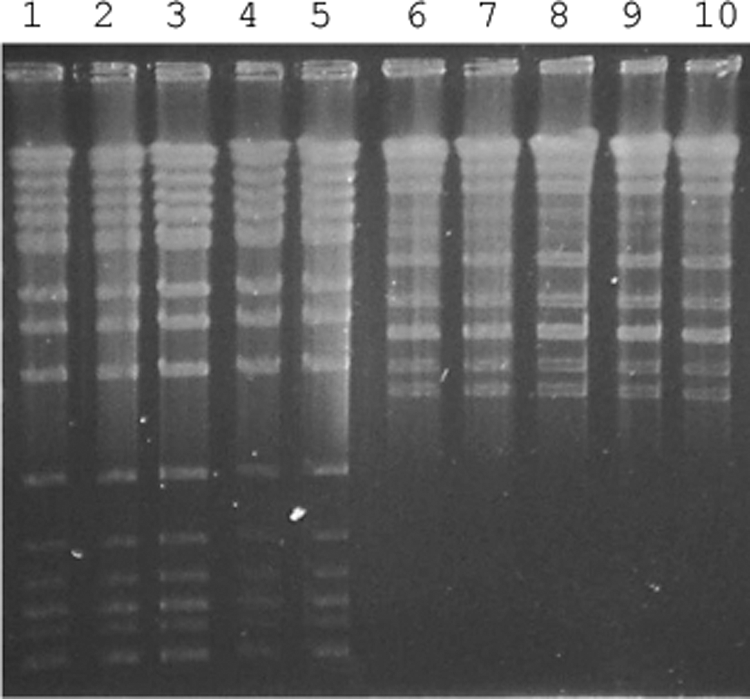
Results of pulsed-field gel electrophoresis of Clostridium botulinum type E isolates from clinical and food samples. Lanes 1, 6: C. botulinum type E isolated from sardines; lanes 2, 7: C. botulinum type E isolated from stool sample of patient C; lanes 3, 8: C. botulinum type E isolated from mullet pieces packed in oil: lanes 4, 9: C. botulinum type E isolated from gastric liquid of patient A; lanes 5, 10: C. botulinum type E isolated from fish remaining from meal. Samples in lanes 1–5 were digested with SmaI; samples in lanes 6–10 were digested with XhoI.
Discussion
This article describes an outbreak of type E foodborne botulism among attendees of a Sham el-Nessim gathering at a private home. Epidemiological and laboratory evidence demonstrated that the illnesses resulted from consumption of a traditionally prepared, salted fish product, fesikh, which had been manufactured and sold at a retail food premises in Toronto. Three patients were diagnosed with foodborne botulism based on clinical features and laboratory results. All three patients were hospitalized.
Thirteen of 15 attendees consumed fesikh, yielding an attack rate of 23% (3/13). The basis for a lack of illness in 10 attendees who consumed the implicated dish is unknown, but could be related to the quantity or portion of the fish consumed. EMG results had a limited role in distinguishing patients from asymptomatic attendees due to the clinical presentation of classic botulism symptoms. Abnormal EMG results, detected for two asymptomatic attendees, have previously been identified in individuals with mild forms of botulism (Padua et al., 1999).
The swift identification of fesikh as a risk factor by attending physicians facilitated a timely public health response. The concurrent presentation of multiple epidemiologically linked foodborne botulism patients, especially in the same emergency department or hospital, has been noted as a characteristic feature of rapid outbreak detection (Newkirk and Hedberg, 2012). The amount of contaminated fesikh sold from the food premises prior to the voluntary hold is unknown. Physician notifications and enhanced public health surveillance should have led to the detection of additional patients had they occurred.
Illness from type E botulinum toxin has been associated with consumption of improperly prepared foods of aquatic origin, either freshwater or marine (Dolman and Iida, 1963; Austin and Smith, 2006; Horowitz, 2010). Fesikh has previously been implicated in foodborne botulism outbreaks, including a large outbreak of 91 patients in Egypt (Weber et al., 1993). Other traditional dishes prepared with salt-cured uneviscerated fish have similarly been linked to botulism (French et al., 1992; Shaffer et al., 1990; Slater et al., 1989; Telzak et al., 1990; Sobel et al., 2007). While the premises had been in business for 21 years and had been producing fesikh to coincide with Sham el-Nessim for 17 years, the operator had not notified the Ontario Ministry of Natural Resources that they were processing fish for sale. Since 2004, such notifications have been a requirement in the province. The facility had not previously been issued any major food-handling violations during routine inspections conducted by Toronto Public Health.
There is currently no prohibition against the production, sale, or distribution of salt-cured uneviscerated fish products in Canada. Uneviscerated products pose a particular risk due to the presence of C. botulinum spores in fish viscera (Huss et al., 1979), and the time required for diffusion of salt into the lumen of the intestine. Fish size is an important consideration, as larger fish require higher concentrations or increased durations of salt treatment to achieve effective diffusion (Kosak and Toledo, 1981). In the United States, the Food and Drug Administration (FDA) prohibits the sale of uneviscerated fish greater than 5 inches in length that is salt-cured, dried, or smoked (FDA, 2005).
The high incidence of contamination of fishery products with C. botulinum type E (Austin and Dodds, 2000, Lund and Peck, 2001; Austin and Smith, 2006), the ability of C. botulinum type E to grow and produce toxin at 3°C (Graham et al., 1997), the use of uneviscerated fish, and a processing step that included incubation at room temperature all combined to provide conditions conducive to the production of botulinum toxin. Since the fish were arranged side-by-side in stacked layers in a 19-L plastic container, it is likely that fish in the center of the stack may have taken a considerable time to cool after being refrigerated, allowing growth of C. botulinum type E within the relatively low-salt “protective” environment of the viscera (Austin and Smith, 2006). The water activity of both the muscle tissue and viscera of the fesikh was determined to be 0.92, a value well below the 0.97 required to inhibit C. botulinum type E, indicating that toxigenesis occurred prior to penetration of the salt into the viscera. The isolates of C. botulinum type E were indistinguishable using PFGE, suggesting that the shad, mullet in oil, and sardines may have been cross-contaminated during preparation.
Confusion about the production of a special order for the Sham el-Nessim gathering delayed the correct identification of the fish species served to the patients, which hindered the issuance of a Health Hazard Alert and recall for fesikh shad. Notably, control samples of fesikh shad tested positive for C. botulinum but were negative for botulinum neurotoxin, while the leftovers from the gathering tested positive for both. Despite not being served at the event that triggered the public health investigation, fesikh mullet pieces in oil, later determined to be toxigenic, were withheld from sale following the initial inspection. The swift identification of fesikh as a high-risk food item and voluntary withholding of all related products likely prevented additional botulism cases.
Conclusions
This is the first documented foodborne botulism outbreak associated with fesikh in Canada. From a public health perspective, monitoring and controlling traditionally prepared products such as fesikh can be difficult because inspections may not coincide with timelines for production of holiday-specific food items. In Canada and other multicultural societies, it can be challenging for public health and healthcare professionals to stay abreast of culture-specific risk behaviors. To mitigate these challenges, routine inspections should seek to describe all food-processing activities that take place within premises, including those that are intermittent or seasonal. Monitoring and education of facilities known to prepare salt-cured fish products, particularly those using uneviscerated fish, will help to prevent future foodborne botulism outbreaks prior to, or in the absence of, further regulatory legislation in Canada.
Initial confusion around the particular product that was served at the Sham el-Nessim gathering highlights the need for proper labeling of food intended for commercial sale. Additional illnesses were likely prevented by the voluntary withholding of the implicated products from sale, which reaffirms the value of timely public health action based on epidemiological evidence and the cooperation of food premises. As a result of this outbreak investigation, Health Canada has issued ongoing warnings to Canadians about the high risk of botulism from uneviscerated salted fish products.
Footnotes
Acknowledgments
The authors thank all individuals and organizations that collaborated on the outbreak investigation including Toronto Public Health, CFIA, Health Canada, the Public Health Agency of Canada, the Ontario Ministry of Natural Resources, and the Ontario Ministry of Health and Long-Term Care. Brian Burdick (Ministry of Natural Resources), Anis Nasr, Maria Rapallo, Rosella Suppa, and Adrienne Kong (CFIA) were instrumental to the investigation. The authors would also like to thank Dr. Elizabeth Powell for her clinical expertise and timely reporting of cases, and Dr. Vincenzo Basile for conducting EMG assessments. We are grateful to the families of the patients and the food premises staff for their willingness to help expedite the investigation. Poly Das, Edward La, and Annita Pucci (Toronto Public Health) are acknowledged for their investigative work.
Disclosure Statement
No competing financial interests exist.