




Abstract
Epidemiological data have implicated contaminated raw or undercooked chicken as primary vehicles of Campylobacter transmission to humans. Risk assessment relating to Campylobacter contamination of poultry products in China is frequently hampered by the lack of quantitative data. In this study, whole chicken carcasses (n=240) were collected from the retail markets of Beijing. The level of Campylobacter contamination was enumerated by the plate-counting method. The representative Campylobacter isolates were characterized for antimicrobial resistance. Selected representative isolates were further analyzed by the multilocus sequencing typing method for genetic relatedness. Overall, 26.3% (63/240) of the retail whole chicken carcasses were contaminated by Campylobacter, and the values ranged from 2.5 to 7050 colony-forming units (CFU)/g. The 50th percentile of Campylobacter value was 45 CFU/g in chicken carcass. Multidrug-resistant profiles were observed in 33 (39.2%) C. jejuni isolates (from 27 chicken carcasses) and 57 (86.4%) C. coli isolates (from 30 chicken carcasses). One dominant ST (ST6322) and one dominant clonal complex (CC828) consisting of multidrug-resistant C. coli isolates were identified. Our findings showed a high prevalence of Campylobacter contamination in retail chicken carcasses, which could be a source of exposure to multidrug-resistant isolates for consumers. This study provided baseline enumeration data for the quantitative risk assessment and evaluation of new control measures of Campylobacter contamination in retail chicken products in China.
Introduction
C
Risk assessments relating to food safety in China are frequently hampered by the lack of quantitative data. As a key element of Campylobacter transmission to the consumers, retail chicken products have been recognized as a priority for risk assessment in different agencies to obtain an estimate of the risk of human campylobacteriosis due to consumption of chicken. The prevalence and contamination load of Campylobacter in retail chicken carcass are the key parameters in models development for quantitative risk assessment of dietary exposure to Campylobacter as well as strategies to reduce the risk from this pathogen. However, no study has been conducted for Campylobacter enumeration in retail chicken products in China to date.
In order to provide the scientific data for quantitatively assessing the impact of Campylobacter on Chinese populations and safety resulting from consumption of retail poultry products, whole chicken carcasses were collected from 43 retail markets of Beijing and the level of Campylobacter contamination was enumerated; then the isolates were further characterized for antimicrobial resistance and genetic typing.
Materials and Methods
Sample collection and preparation
From August 2012 to July 2013, a total of 240 fresh whole chicken carcasses were randomly collected from 27 supermarkets and 16 farmer's markets monthly in Beijing. From supermarkets, individually packed chicken carcasses were collected and from farmer's markets, birds were processed and packaged on site. On each sampling day, no more than five chicken carcasses were randomly selected from each sampling site and transported on ice to the laboratory within 1 h. Each sample was immediately aseptically removed from the package and placed in a 3500 stomacher bag (Seward, Thetford, Norfolk, UK) followed by the addition of 500 mL buffered peptone water (Becton-Dickinson, Beijing, China) per kilogram of carcass. The carcasses were manually massaged for 3–5 min and the rinse was used for Campylobacter enumeration analysis. Microbial analysis of samples was completed within 2 h of purchase.
Campylobacter enumeration, isolation and identification
Campylobacter enumeration in chicken carcass rinse was determined using modified Karmali agar and modified Preston agar. The modified Karmali agar was prepared by adding extra 100 IU/mL polymyxin B and 6.25 μg/mL rifampicin in Karmali agar base (Oxoid, Basingstoke, Hampshire, UK) based on the recommendation of Karmali and Bai (Karmali et al.; 1986; Bai et al., 2014). The modified Preston agar was prepared by adding extra 32 μg/mL cefoperazone in Preston agar base (Oxoid) according to the reference (Bolton and Robertson, 1982). An aliquot of 100-μL chicken rinse and 1:10 diluted rinse was plated onto two modified Karmali agar and two modified Preston agar plates, respectively. The plates were incubated under microaerophilic conditions (5% O2, 10% CO2, and 85% N2) at 42±1°C. All colonies with typical Campylobacter morphology on both selective media were counted. No more than 10 presumptive Campylobacter colonies from each sample proportionally representative of all typical colony types were selected and inoculated onto Mueller-Hinton (BD, Beijing) agar with 5% laked sheep blood. Presumptive Campylobacter colonies were screened by morphology and motility by phase contrast microscopy, Gram staining and latex agglutination test (Oxoid). Suspect Campylobacter isolates were further confirmed by a multiplex PCR assay that identifies C. jejuni, C. coli, C. lari, C. upsaliensis, and C. fetus (Wang et al., 2002). Campylobacter enumeration result of each sample was calculated following the positive ratio of all typical colony types as recommended by the US Department of Agriculture manual (USDA FSIS, 2013).
Antimicrobial susceptibility testing
Minimal inhibitory concentrations to eight antimicrobials were determined via agar dilution method for all confirmed Campylobacter isolates, including azithromycin (AZI), chloramphenicol (CHL), ciprofloxacin (CIP), doxycycline (DOX), erythromycin (ERY), gentamicin (GEN), meropenem (MEP), and tetracycline (TET). All susceptibility results were interpreted according to the Clinical and Laboratory Standards Institute (CLSI, M45-A2) interpretive standards (CLSI, 2010). Campylobacter jejuni ATCC33560 was used as quality control organism in antimicrobial susceptibility experiments.
Multilocus sequence typing (MLST)
MLST analysis was conducted by sequencing fragments of seven housekeeping genes (aspA, glnA, gltA, glyA, pgm, tkt, and uncA), and sequence types (STs) were assigned by comparison to the Campylobacter MLST database (
Statistical analysis
Factors related to the frequencies and Campylobacter load in chicken carcasses were statistically analyzed. The differences in frequencies were analyzed by chi-square and the differences in Campylobacter load were analyzed by nonparametric test using SPSS version 17.0.
Results
Campylobacter enumeration
A total of 151 Campylobacter isolates were recovered from 63 (63/240, 26.3%) whole chicken carcasses (Table 1), including 85 C. jejuni isolates from 44 chicken carcasses and 66 C. coli isolates from 34 chicken carcasses. Both C. jejuni and C. coli were recovered simultaneously from 15 chicken carcasses. On average, 57.4±1.3 CFU/g of Campylobacter was detected on the chicken carcasses. Nine samples showed Campylobacter loads >1000 CFU/g, of which 8 were collected in the summer season. The 50th percentile of Campylobacter load was 45 CFU/g in Campylobacter–positive chicken carcasses. Chicken carcasses in the summer showed the highest Campylobacter load (250.0±1.5 CFU/g), but samples collected in autumn showed the highest contamination rate (41.7%). Campylobacter load of the market-slaughtered chicken carcasses was significantly higher than the fresh prepacked retail carcasses (Table 1, p=0.008). No significant difference in Campylobacter contamination level was found between chicken carcasses from the farmer's market and the supermarkets (p=0.116). A similar distribution pattern of C. jejuni (12.1%) and C. coli (7.9%) was observed on chicken carcasses.
P25, P50, and P75 are the abbreviations of 25th, 50th, and 75th percentile, respectively.
Definition of seasons: Spring (March, April, May), Summer (June, July, August), Autumn (September, October, November), Winter (December, January, February).
CFU, colony-forming units.
No significant difference was found in the detection of Campylobacter between modified Karmali (17.1%) agar and modified Preston agar (17.9%) plates (p>0.05) (Table 2). However, the combined result using both media (26.3%) was significantly greater than using single medium alone (17.1% and 17.9%, respectively, p<0.05) (Table 2).
Antimicrobial susceptibility
Among 151 Campylobacter isolates, 3 C. jejuni isolates were susceptible to all antimicrobials tested and all isolates were susceptible to meropenem. Among 85 C. jejuni isolates, resistance to ciprofloxacin was the most common (82/85, 96%), followed by tetracycline (57/85, 67%), doxycycline (32/85, 38%), chloramphenicol (27/85, 32%), gentamicin (21/85, 25%), azithromycin (11/85, 13%), and erythromycin (10/85, 12%). All 66 C. coli isolates were resistant to ciprofloxacin (66/66, 100%), followed by tetracycline (62/66, 94%), azithromycin (54/66, 82%), erythromycin (54/66, 82%), doxycycline (53/66, 80%), gentamicin (45/66, 68%) and chloramphenicol (28/66, 42%).
In total, 21 antimicrobial resistance profiles were identified among 151 Campylobacter isolates, including 20 profiles in 85 C. jejuni isolates and 10 profiles in 66 C. coli isolates, respectively (Table 3). The antimicrobial resistant profiles differed between C. jejuni and C. coli isolates. Multidrug-resistant profiles, which was defined as resistance to 3 or more antimicrobial categories, were observed in 33 (39.2%) C. jejuni isolates (from 27 chicken carcasses) and 57 (86.4%) C. coli isolates (from 30 chicken carcasses). The most common antimicrobial resistance profiles of 85 C. jejuni isolates were CIP-DC-TET (n=19, 22.4%), CIP-TET (n=12, 14.1%), CHL-CIP-TET (n=8, 9.4%), and CHL-CIP-GEN (n=6, 7.1%). The most common antimicrobial resistance profiles of 66 C. coli isolates were AZ-CHL-CIP-DC-ERY-GEN-TET (n=23, 34.8%), AZ-CIP-DC-ERY-GEN-TET (n=14, 21.2%), and AZ-CIP-DC-ERY-TET (n=10, 15.2%) (Table 4).
MIC, minimum inhibitory concentration.
MLST analysis
If more Campylobacter isolates recovered from the chicken samples collected from the same sampling site shared the same antimicrobial-resistant profile, only one isolate was selected for MLST analysis. In total, 26 C. jejuni and 17 C. coli isolates were analyzed, and 21 C. jejuni STs and 11 C. coli STs were identified, respectively. Ten new STs (ST 6681, ST 6682, ST 6683, ST 6684, ST 6714, ST 6715, ST 6716, ST 6717, ST 6718, and ST 6719) of C. jejuni isolates and 4 new STs (ST 6685, ST 6686, ST 6687, and ST 6697) of C. coli isolates were identified and deposited in the MLST database. No dominant ST and clonal complex was identified for C. jejuni. Of 21 C. jejuni STs, 13 STs were assigned to 10 clonal complexes and 8 STs remained unassigned to any available clonal complexes. Of 11 C. coli STs, 1 dominant ST (ST 6322) was identified and 8 STs belonging to 2 clonal complexes and a dominant clonal complex (CC828) including 9 C. coli isolates of 7 STs were identified (Fig. 1).
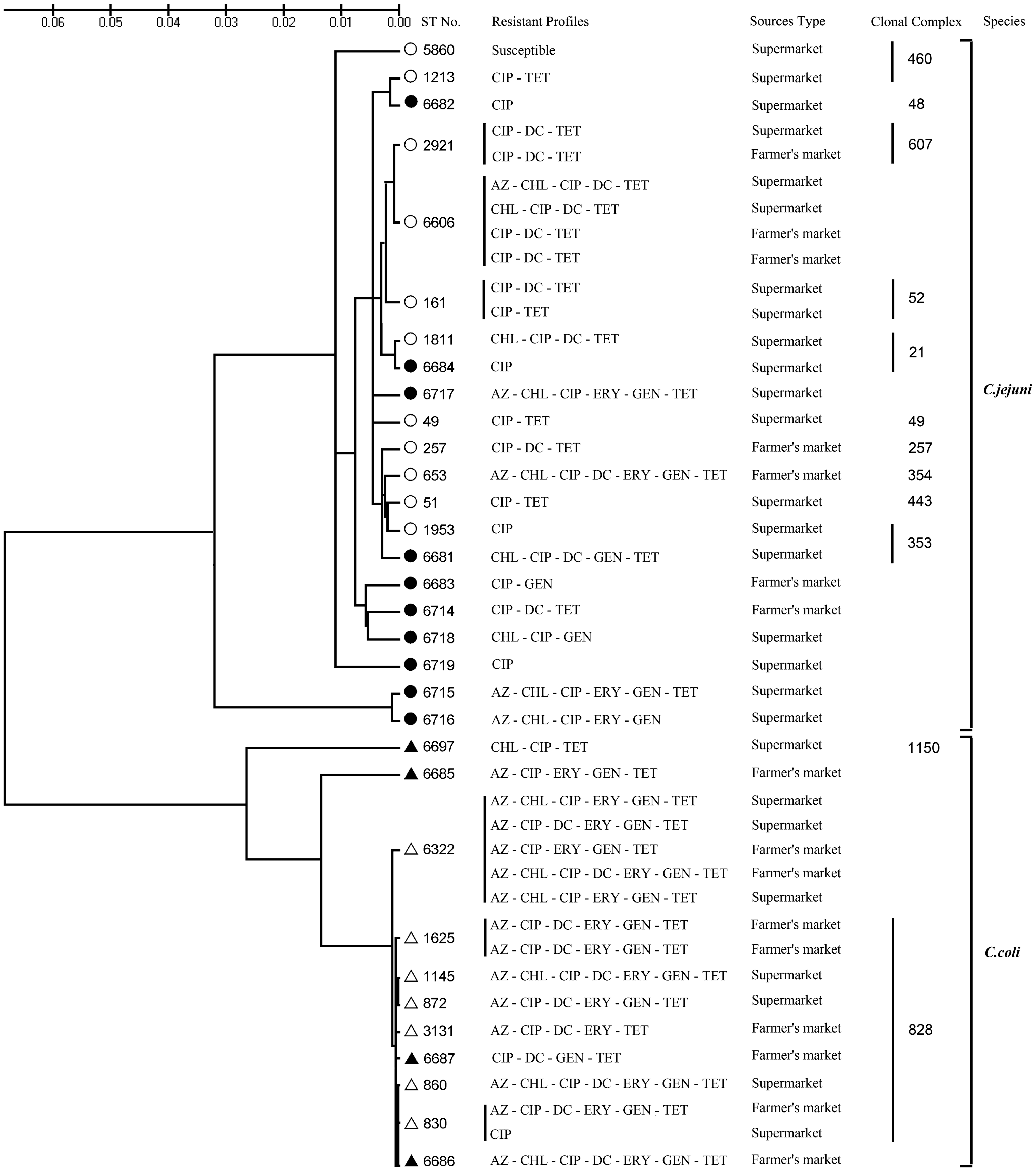
Multilocus sequence typing of Campylobacter jejuni and C. coli isolates. Circles indicate strains of C. jejuni; triangles indicate strains of C. coli. All of the solid shapes were submitted in this study. AZ, azithromycin; CHL, chloramphenicol; CIP, ciprofloxacin; DC, doxycycline; ERY, erythromycin; GEN, gentamicin; TET, tetracycline.
Discussion
In this study, approximately one quarter of the retail whole chicken carcasses collected from 43 retail markets of Beijing were found to be contaminated by Campylobacter, and the loads ranged from 2.5 to 7050 CFU/g. Furthermore, Campylobacter isolates with the multidrug resistance profiles were observed, and >95% of the isolates showed resistance to ciprofloxacin and >80% of C. coli isolates were co-resistant to azithromycin and erythromycin. Ma et al. reported there was a high prevalence of resistance to ciprofloxacin (99.6%) and tetracycline (99.2%) among the C. jejuni and C. coli isolates in Shanghai, and the vast majority of C. coli were resistant to gentamicin (95.4%) and erythromycin (94.1%) (Ma et al., 2014). Our data are similar to those reported previously. The genetic variance of C. jejuni and C. coli was highly diverse, and no dominant STs were identified in C. jejuni isolates. To the best of our knowledge, this is the first surveillance report of Campylobacter enumeration from retail chicken carcasses in China. Our study provides baseline enumeration data for the food safety risk assessment of Campylobacter contamination and antimicrobial-resistant isolates from retail chicken carcasses.
The data showed that retail chicken carcasses were important vehicles of Campylobacter transmission. Campylobacter isolates were recovered from approximately one quarter of chicken carcass samples, which was lower than other countries (Cook et al., 2012; Chokboonmongkol et al., 2013), but was higher than recent studies in China (Huang et al., 2009; Wang et al., 2013). On average, 57.4 CFU/g of Campylobacter were detected in the chicken carcasses, which was similar to previous studies (Habib et al., 2008). In our study, chicken rinses were directly plated onto two selective agars instead of including an enrichment step as the most probable number (MPN) method in other enumeration studies (Chenu et al., 2013). In theory, the enrichment step may improve the recovery rate of Campylobacter if the appropriate enrichment broth was used. Conventional Campylobacter enrichment broth relies on supplement of antibiotics, such as cefoperazone (Gharst et al., 2013); however, the widespread prevalence of multidrug-resistant isolates in retail chicken in China (Xu et al., 2014) may affect the enrichment broth efficiency for Campylobacter recovery. In our preliminary study, we found Campylobacter isolates could be outcompeted by antimicrobial resistant isolates, such as Escherichia coli (data not shown), and a lower Campylobacter recovery rate was found after enrichment because of the slow growth of Campylobacter as in a previous study (Kiess et al., 2010). If an appropriate enrichment broth could be developed to inhibit the growth of antimicrobial resistant non-Campylobacter, MPN method might be used to detect low-level Campylobacter contamination. Campylobacter load of the on-site slaughtered chicken carcasses showed significantly higher Campylobacter loads, which further indicated the necessity of good manufacturing process application on the slaughtering chain.
The data showed that selective media were important factors affecting Campylobacter enumeration results. Because of the high prevalence of antimicrobial-resistant isolates in retail chicken from China (Xu et al., 2014), antimicrobial resistant non-Campylobacter isolates would overgrow on regular Karmali agar, Preston agar, or Cefex agar as in our preliminary study (data not shown). To inhibit these multidrug resistant non-Campylobacter bacteria, additional 100 IU/mL polymyxin B and 6.25 μg/mL rifampicin were added in Karmali agar as recommended (Chon et al., 2013), and additional 32 μg/mL cefoperazone was added in modified Preston agar since Campylobacter isolates were naturally resistant to cefoperazone (Ahonkhai et al., 1981). The growth of non-Campylobacter bacteria was inhibited on these modified agars, and more Campylobacter isolates were recovered from chicken carcasses. In addition, the data showed the Campylobacter recovery rate using both modified Karmali agar and modified Preston agar was significantly higher than using single media (p<0.05) (Table 2). Another advantage of using both media was that modified Preston agar could inhibit the growth of Proteus that could grow on the whole modified Karmali agar because of its high motility (data not shown).
The contribution of retail chicken–associated Campylobacter in the community infections has been established (Baker et al., 2006; Stafford et al., 2007). In this study, >50% of C. jejuni and 80% of C. coli isolates were multidrug resistant, and these results are in line with those reported previously in China (Chen et al., 2010; Zhang et al., 2010; Qin et al., 2011). Besides these, almost all Campylobacter isolates were resistant to ciprofloxacin, and >80% of C. coli isolates were resistant to azithromycin and erythromycin. Two C. jejuni isolates (ST653) from 1 sample and 23 C. coli isolates (ST860, ST1145, ST6322, and ST6686) from 11 samples exhibited resistance to all tested antimicrobials except meropenem. The surveillance agencies should stay alert for the spreading of these multidrug-resistant isolates and the resistance mechanisms, because their transmission directly endangered the optimal treatment alternatives of campylobacteriosis in the community. Widespread fluoroquinolone and macrolide resistance in Campylobacter has also been documented as a unique characteristic in other studies of China and some Asian countries without strict antimicrobial application control (Chokboonmongkol et al., 2013; Serichantalergs et al., 2007). However, in countries with strict antimicrobial controls, such as the United States, <20% of Campylobacter isolates were resistant to ciprofloxacin, <3% of Campylobacter isolates were resistant to macrolide (Zhao et al., 2010), and similar resistance profiles were also reported in Canada (Agunos et al., 2013). These data further emphasized the necessity of strict antimicrobial application control in food production animals.
Rich genetic diversity of C. jejuni and C. coli isolates from chicken samples demonstrated extensive genetic heterogeneity and diverse origins of these isolates. Several isolates from the same sampling region exhibiting similar or identical STs indicated the clonal spread of these isolates. Several STs (ST353 CC, ST607 CC, ST 52 CC, and ST257 CC) identified in this study have also been detected from human samples (Cody et al., 2012; Shin et al., 2013). A dominant ST of C. coli (ST6322) was identified that consisted of multidrug-resistant isolates (Fig. 1) and have not been reported in other countries. The high resistance ratio of these isolates to fluoroquinolones and macrolides that were the common antimicrobials used in clinics should provide them a selective advantage over other isolates. Fluoroquinolones and macrolides are the primary choices of drug for treating campylobacteriosis, and in recent years less so with fluoroquinolone because it is so resistant. Since these isolates might be transmitted through the food chain via improper handling and inadequate cooking of food (CDC, 2013), the contribution of retail chicken in the transmission of Campylobacter isolates in hospital and community infections should be extensively studied.
In conclusion, our study provides baseline enumeration data for the food safety risk assessment of Campylobacter contamination in China and highlights the fact that retail chicken carcasses are a reservoir of potentially pathogenic and antimicrobial-resistant Campylobacter strains for consumers, which may pose a public health risk.
Footnotes
Acknowledgment
This study was financially supported by the Ministry of Health of the People's Republic of China.
Disclosure Statement
All authors listed in the manuscript contributed to the conception, acquisition, analysis, and interpretation of data, design, and critical revision of the manuscript, and approval of the final submitted version. The authors have no conflict of interest to declare.