




Abstract
The aim of this study was to investigate the role of white stork Ciconia ciconia as a potential reservoir of Campylobacter spp. Antimicrobial resistance and the presence of putative virulence genes of the isolates were also examined. A total of 398 white stork chicks sampled in Western Poland in habitats with high density of breeding were examined. Rectal swabs were collected during breeding season 2009–2012 from storks developing in a relatively pure environment (Odra meadows), in polluted areas (a copper mining–smelting complex), and in suburbs. Of the anal swabs collected, 7.6% were positive for Campylobacter among chicks (5.3% samples positive for C. jejuni and 2.3% samples positive for C. coli). Samples from polluted areas had the highest prevalence of Campylobacter (12.2%). The prevalence of resistance among C. jejuni and C. coli isolates from young storks was as follows: to ciprofloxacin (52.4%, 44.4%), and to tetracycline (19%, 77.8%). All of the analyzed isolates were susceptible to macrolides. The resistance to both classes of antibiotics was found in the 23.3% of Campylobacter spp. All Campylobacter spp. isolates had cadF gene and flaA gene responsible for adherence and motility. CdtB gene associated with toxin production was present in 88.9% of C. coli isolates and 57.1% of C. jejuni isolates. The iam marker was found more often in C. coli strains (55.6%) compared to C. jejuni isolates (42.9%). Our results confirm the prevalence of Campylobacter spp. in the white stork in natural conditions and, because it lives in open farmlands with access to marshy wetlands, the environmental sources such as water reservoirs and soil–water can be contaminated from white stork feces and the pathogens can be widely disseminated. We can thus conclude that Campylobacter spp. may easily be transmitted to waterfowl, other birds, and humans via its environmental sources and/or by immediate contact.
Introduction
C
Thermotolerant bacteria Campylobacter spp. is widespread in the nature. The principal reservoirs are the alimentary tract of wild and domesticated birds and mammals (Humphrey et al., 2007; Waldenström et al., 2007). Based on a temperature optimum similar to the temperatures found naturally in avian intestines (42°C), wild birds have been suggested as a reservoir for Campylobacter spp. Campylobacter spp. are prevalent in food animals, such as poultry, cattle, pigs, and sheep (Humphrey et al., 2007), in pets, including cats and dogs (Andrzejewska et al., 2013; Acke et al., 2011), and wild birds (Waldenström et al., 2007; Rutledge et al., 2013) and in the environmental water sources (Jones, 2001).
Wild birds have been associated worldwide with outbreaks of waterborne and foodborne disease (Sacks et al., 1986; Rutledge et al., 2013). Two outbreaks of campylobacteriosis in Norway were attributed to water supplies contaminated by feces of the pink-footed goose Anser brachyrhynchus (Varslot et al., 1996). Similarly, there is evidence that waterfowl such as mallard ducks (Anas platyrhynchos) and Canada goose (Branta canadensis) are an important source of contamination for water (Obiri-Danso et al., 1999; Jokinen et al., 2011). In 2008, an outbreak of human campylobacteriosis in Alaska was attributed to peas contaminated with C. jejuni from feces of sandhill cranes (Grus canadensis) (Gardner et al., 2011). There is also strong evidence that wild birds such as magpie Pica pica and jackdaw Corvus monedula can be a source of milk contamination with Campylobacter spp. by pecking through the aluminium-foil tops of bottles on doorsteps in England and Wales (Palmer et al., 1995).
Free-living birds, including migratory species, can become long-distance vectors for a wide range of Campylobacter spp., including antibiotic-resistant strains that can be transmissible to humans and farm animals (Waldenström et al., 2005; Tsiodras et al., 2008). Due to their great mobility, wild-living birds may function as effective spreaders of disease through fecal contamination of pastures, forage, and surface waters (Kapperud et al., 1983).
The white stork breeds in open farmland with access to marshy wetlands and often makes use of human habitations, nesting on the roofs of buildings, telegraph poles, in trees, or on purpose-built man-made platforms. The white stork Ciconia ciconia feeds in nearby pastures and ploughed fields (Berthold et al., 2000; Tryjanowski et al., 2006), so it can be a potential source of Campylobacter infection for both humans and farm animals, and as a migratory species (migrates from Central and Southern Europe and Asia to Southern Africa), can transfer genotypes and antibiotic resistance over large distances (Keller et al., 2011). The current scientific knowledge on this subject is limited. To address this lack of information, the present study was undertaken to evaluate the prevalence of C. jejuni and C. coli in the white stork, and to determine susceptibility to drugs, as well as to evaluate occurrence of pathogenic genes: cadF, flaA, cdtB, and iam. Epidemiological aspects and possible significance of the examined birds as a source of infections for domestic animals and humans are discussed.
Materials and Methods
Sample collection
Investigations were carried out in the white stork C. ciconia breeding season 2009–2012. A total of 398 (91 in 2009; 97 in 2010; 98 in 2011, and 112 in 2012) white stork chicks that originated from Western Poland were examined during the ringing of young birds from 138 nests (31 in 2009; 37 in 2010; 36 in 2011, and 34 in 2012) (Table 1). All newborn white storks were examined. One hundred sixty-eight rectal swabs were collected during June–July from young storks (aged 19–54 d) developing in a relatively pure environment near Odra meadows in the neighborhood of Kłopot village (52°07′56.3''N, 14°42'10.4''E) with no industry within a radius of 150 km (Tryjanowski et al., 2005) (Fig. 1). One hundred forty samples were also collected in Czarna (51°54'43,9''N, 15°42'01,1''E) and Czarnowo (52°02'03,7''N, 14°57'24,7''E), which are located 20 km away from Zielona Góra (51°56'26,1'' N, 15°30'38,9''E), and treated as suburban areas, and 90 samples near Głogów (51°39'32,6''N, 16°04'49,9''E), where a copper mining–smelting complex is situated (polluted areas). Samples were collected by insertion of a sterile swab 1–2 cm into the cloacae of the birds (Waldeström et al., 2002).
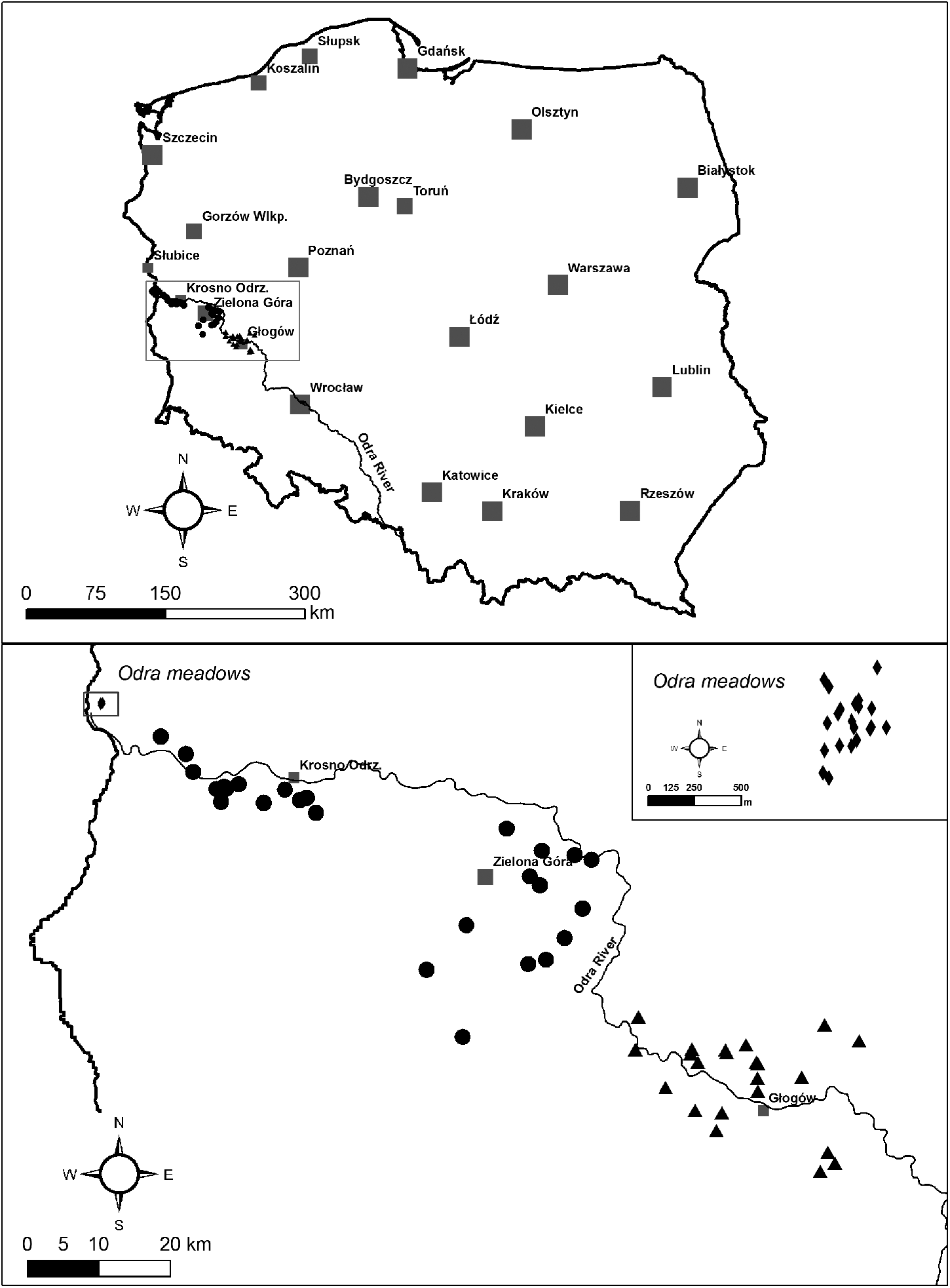
Study area; nesting sites of white stork Ciconia ciconia in polluted (Głogów), suburban (Zielona Góra), and control (Kłopot) environments in the seasons of 2009–2012 (Western Poland). Vertical diamonds, jacks in Odra meadows; circles, jacks in suburban area; triangles, jacks in polluted area.
C.j., Campylobacter jejuni; C.c., Campylobacter coli.
Bacterial strains
Rectal swabs were stored at a temperature of≈4°C in Amies (Copan) transport medium, transmitted into 3 mL of Bolton broth (Oxoid, Basingstoke, UK), and incubated at 42°C for 48 h in a microaerobic atmosphere (French et al., 2009). Cultures were streaked on the modified charcoal cefoperazone desoxycholate agar plates (Oxoid) and incubated at 42°C under microaerobic conditions for 48 h. Colonies suspected of being Campylobacter spp. were examined for cell morphology by Gram staining method, motility, catalase, oxidase, and hippurate hydrolysis reactions (Hendriksen et al., 2003). Bacterial chromosomal DNA was isolated from 24-h culture on Columbia agar with 5% sheep blood by a conventional boiling method (de Lamballerie et al., 1992). A bacterial suspension (100 μL) in phosphate-buffered saline with 45 μL of chelating resin (Chelex 100, BioRad) was boiled for 10 min before centrifuging at 13,000×g for 10 min. The isolates were identified as C. jejuni or C. coli using the polymerase chain reaction (PCR) method with species-specific primers, as described by On and Jordan (2003) (Table 2). Amplicons were analyzed by electrophoresis in 1.5% agarose gel (Merck). DNA bands were visualized by staining with Midori Green Stain (Nippon Genetics, Duren, Germany).
Amplification of virulence genes
The presence of the cadF, flaA, cdtB, and iam genes was determined with the PCR method with primers and cycling conditions as described previously (Nachamkin et al., 1993; Konkel et al., 1999; Bang et al., 2001; Carvalho et al., 2001) (Table 2). All PCRs were performed in 25-μL volumes containing 2.5 μL of 10×PCR buffer (Fermentas, Vilnius, Lithuania), 2.5 μL of MgCl2 (25 mM, Fermentas) 1.0 μL of each PCR primer (10 μM, Oligo, Warsaw, Poland), 0.5 μL of deoxynucleoside triphosphate mix (10 mM, Fermentas), 0.5 μL of Dream Taq DNA Polymerase (0.5 U/μL, Fermentas), 2.0 μL of template, and 15.0 μL of DNA-free purified water (Fermentas).
The PCR products were analyzed by electrophoresis in 1.5% agarose gel. The DNA bands were visualized by staining with Midori Green Stain and photographed using the IG/L-E InGeniusL documentation system.
Antimicrobial susceptibility testing
The susceptibility of Campylobacter isolates to erythromycin, azithromycin, tetracycline, and ciprofloxacin was determined by E-test (AB Biodisk, Solna, Sweden) on Mueller-Hinton agar with 5% defibrinated horse blood (bioMerieux, Marcy l'Etoile, France). The plates were incubated at 37°C for 48 h under microaerophilic conditions. The following Clinical and Laboratory Standards Institute (CLSI, 2008) interpretative criteria for the Enterobacteriaceae family were used as breakpoints for Campylobacter resistance: erythromycin 32 μg/mL, tetracycline 16 μg/mL, azithromycin 8 μg/mL, and ciprofloxacin 4 μg/mL.
Reference strains
The following positive strains (C. jejuni ATCC 33291, C. jejuni ATCC 33560, and C. coli ATCC 33559) were included in the study.
Statistical analysis
Contingency analysis (Fisher's exact test at p<0.01) was used for establishing differences of prevalence, virulence, and antimicrobial resistance of Campylobacter isolated from white stork chicks. To study the influence of physiological and environmental variables on the incidences of Campylobacter infections, we used general linear modeling (orthogonal sums of squares) as implemented in Statistica 7.0. We determined differences in the infection rates of Campylobacter in storks by chi-square tests at p<0.01).
Results
During our 4-year study, a total of 398 samples from white stork were tested (Table 1). The number of anal swab samples positive for Campylobacter among chickens was 30/398 (7.5%), with 21/398 (5.3%) samples positive for C. jejuni and 9/398 (2.3%) samples positive for C. coli. In only two of the nests (1.4%) all of two and three chickens, respectively, were infected. The largest number of samples had been collected from young storks developing in the relatively unpolluted Odra meadow environment (168/398). However, there we found the lowest proportion of Campylobacter infections (3.6%). The samples from polluted areas had the highest prevalence of Campylobacter (total in 4 years: 12.2%). The proportion of Campylobacter-positive samples varied among the sites, from 0% (Odra meadows in 2009) to 20.8% (suburban areas in 2011). Contingency-table analysis and general linear modeling (Table 3) pointed to a weak tendency for polluted areas to have increased and for meadows to have decreased infection rates (chi-square=7.02, p=0.03). We did not find differences between males and females with respect to Campylobacter occurrences (Table 3).
SS, sums of squares; df, degrees of freedom; F, Fisher's F.
All analyzed isolates of C. jejuni and C. coli contained the flaA gene involved in strains motility, and the cadF gene responsible for adherence (Fig. 2). The CdtB gene associated with toxin production was present in 88.9% and 57.1% of C. coli and C. jejuni, respectively. The iam gene linked with invasiveness of Campylobacter was observed more often in C. coli (55.6%) strains than in C. jejuni (42.9%). We did not find annual and habitat differences in iam sequences. The weak tendency (p<0.01) towards the presence of cdtB genes in suburban regions vanished after Bonferroni correction for multiple testing (p>0.05).
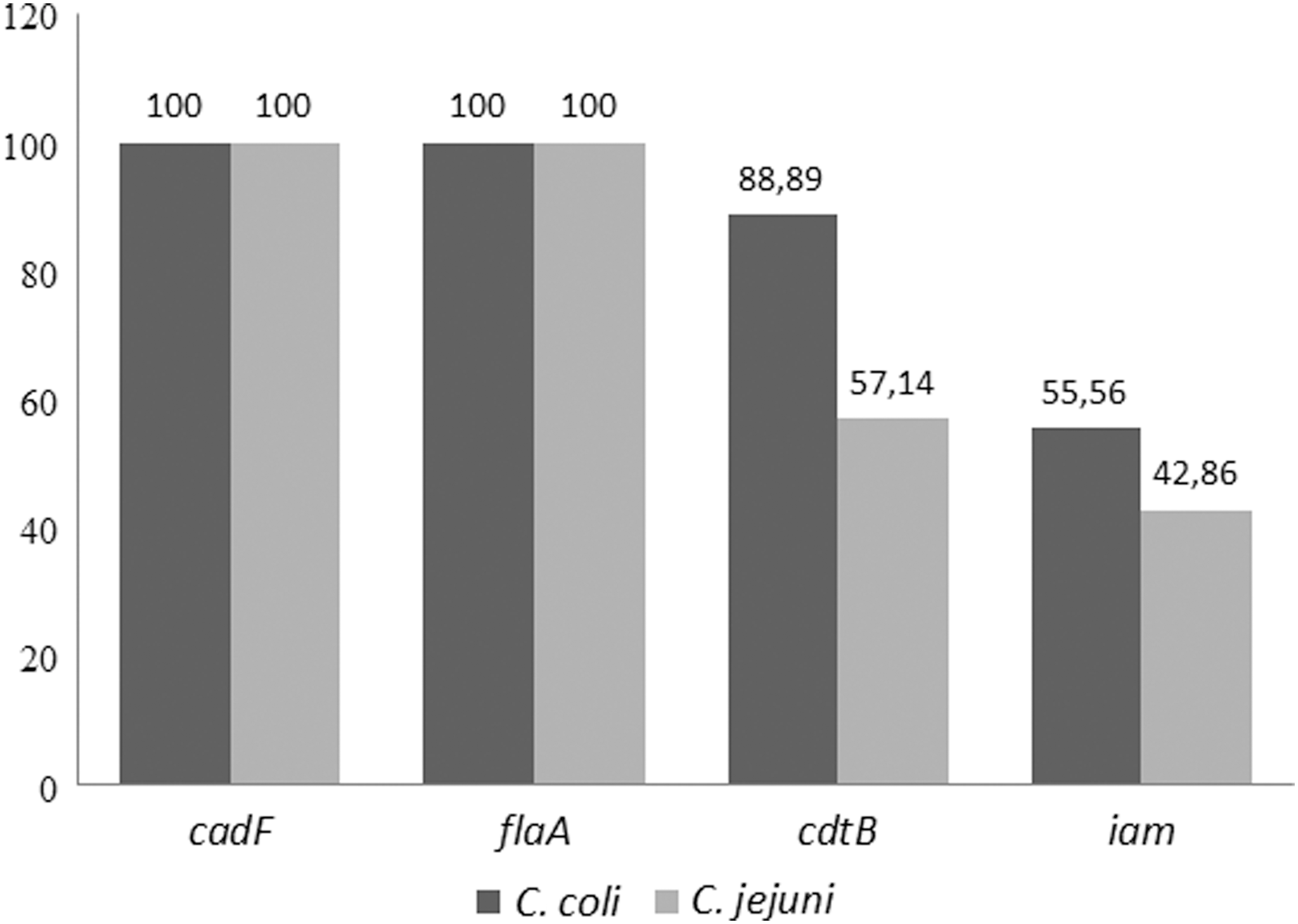
Prevalence (%) of virulence genes among Campylobacter jejuni and C. coli isolates from white stork Ciconia ciconia chicks (Western Poland).
All isolates from young storks were susceptible to macrolides (erythromycin and azithromycin) (Table 4). Some (36.7%) of the isolates were resistant to tetracycline, although the percentage of resistant C. coli (77.8%) was higher than that of C. jejuni (19%). We found the highest resistance rate to ciprofloxacin (>50% of the isolates) Furthermore, resistance to both classes of antibiotics was found in 23.3% of Campylobacter spp. (more often in C. coli (55.6%) strains than in C. jejuni (9.5%) We did not find annual and habitat differences in antibiotic resistance (tetracycline, ciprofloxacin).
Results expressed as the number of Campylobacter-positive samples vs. total number of strains analyzed.
Discussion
We evaluated the prevalence and characterization of Campylobacter within white storks in order to assess the probability of transfer of these bacteria to commercially reared poultry, domestic animals, and even humans. The abundant and migratory white stork has a high potential for interaction with free-range poultry. We focused on C. jejuni and C. coli as being primarily responsible for human disease (Humphrey et al., 2007).
The infection rates observed in the present study (7.5%) are low with respect to reports in other countries. Other studies on Campylobacter infections in wild-bird populations reported rates between 2% and 50% (Waldenström et al., 2005, 2007; Colles et al., 2008). Yogasundram et al. (1989) and Keller et al. (2011) found results similar to ours in the United States, with an overall Campylobacter prevalence of 10.1% and 7.2%, respectively, in wild birds. White stork infection rates are higher than those found in rooks (Corvus frugilegus) in Croatia (2.9%: Vlahović et al., 2010) and in samples of other free-living birds (1.9%: Vlahović et al., 2004). However, we note that prevalence estimates are likely to vary between studies due to the different sampling regimens and culture methods.
The prevalence of Campylobacter in wild birds also differs greatly among geographical regions. In Great Britain, Hughes et al. (2009) found infection rates less than 2%, whilst Heuvelink et al. (2008) reported near 14% prevalence in Dutch corvids. Finally, Waldenström et al. (2002) found highly variable infection rates (0 to 100%; average of 21.6%) among Swedish bird species. Among long-distance migrants (birds migrating to Africa, the Middle East, or Asia), only 3% of the individuals (representing four species) tested positive for Campylobacter spp. In contrast, 11% of the short-distance migrants (birds migrating to different parts of Europe) tested positive (Waldenström et al., 2002).
In our study, the samples from polluted areas had the highest prevalence of Campylobacter (12.2%), what can be caused by changes in physiological condition of storks (oxidative stress) due to environmental pollution. Further researches to improve this statement are necessary. The size of a bird, its condition, and its habitat might be related to the probability of its predispositions in carrying any infection originated from Campylobacter (Waldenström et al., 2002; Keller et al., 2011).
Results of the present study showed that all analyzed isolates of C. jejuni and C. coli derived from young storks possessed the flaA and cadF genes responsible for motility and adherence, which indicates their pathogenic potential (Nuijten et al., 2000). Other authors also confirmed the presence of flaA and cadF genes in all or almost all of the isolates tested that were derived from poultry carcass and feces, from cats and dogs, and from human clinical specimens (Bang et al., 2003; Datta et al., 2009; Ripabelli et al., 2010; Wieczorek et al., 2011). More than 55% of C. coli and nearly 43% of C. jejuni isolates from young storks harbored the iam gene that is connected with diarrhea. Rizal et al. (2010) detected and described this marker in 78% of the Campylobacter isolates from chickens and in 60% of human isolates. Carvalho et al. (2001) reported 85% of human isolates to contain the gene. However, some studies suggest that it is not a universal marker due to its low prevalence among Campylobacter isolates from humans (Rozynek et al., 2005; Rizal et al., 2010) and from domestic animals (Andrzejewska et al., 2013). Further studies must be done to clarify the specific role of this marker in the isolates from different sources. In our study, the cdtB gene associated with toxin production was present in 57% and 89% of C. jejuni and C. coli, respectively. These results are lower than in the studies by Gargiulo et al. (2011), who detected this gene in 100% of C. jejuni and of C. coli isolates from common teals in Italy. On the other hand, Rozynek et al. (2005) identified these virulence markers in 93.8% of isolates derived from children with diarrhea as well as in 94.6% of the isolates derived from poultry carcasses. In turn, Rizal et al. (2010) reported a low prevalence of cdtB genes (20% in chicken and 28% in human isolates). Our study also suggests that strains of Campylobacter isolated from young white storks may be effective colonizers of wild animals and birds, poultry, and people; thus, white storks may play a role in the epidemiology of Campylobacter in Poland.
Antibiotic resistance in Campylobacter is globally emerging and has already been described by several authors and recognized by The World Health Organization (WHO, 2000, 2013) as a public health problem (Silva et al., 2011). Antibiotics, generally macrolides, tetracycline, and (fluoro)quinolones, are necessary for the most severe cases. In recent years, several studies confirmed the increased number of Campylobacter isolates as resistant to macrolides and fluoroquinolones (Alfredson et al., 2007; Wieczorek et al., 2012).
All isolates of C. jejuni and C. coli derived from young storks were found to be susceptible to erythromycin and azithromycin. Similar results were described by Waldenström et al. (2005), who determined the antimicrobial resistance of Campylobacter isolates from wild birds in Sweden. Recent studies have reported on the emerging problem of macrolide-resistant strains isolated from poultry, where contaminated food can be the transmission vehicle for these strains to people. A relatively high level of resistance to erythromycin in Campylobacter strains from chicken meat was reported by the EFSA (2013a) (e.g., 7.7% and 11% in Belgium for C. jejuni and C. coli, respectively, and 50% of the Campylobacter isolates in Italy). The highest resistance rate was observed to tetracycline and fluoroquinolones (ciprofloxacin) (i.e., 36.7% and 50%, respectively). Overall, the incidence of resistance to these antimicrobial agents was lower for investigated wild-bird isolates in Sweden (0.7–3.6%) (Waldenström et al., 2005). According to the present study, 23.3% of Campylobacter strains were resistant to both classes of antibiotics, and this percentage was lower than that reported by other authors (Wieczorek et al., 2012; Rozynek et al., 2008).
The use of antimicrobial agents in the rearing of poultry and other food-producing animals is perceived by many as a strong threat to public health, as bacteria in these systems, including pathogenic ones, are under strong selection for acquiring resistance to antimicrobial compounds. Resistant genotypes could spread from farms into the environment by a number of ways, and further spread to some environmental reservoirs such as wild birds. Furthermore, a feedback loop from one farm through the environmental reservoir to the next is possible.
Conclusions
This is the first study to report the prevalence, antimicrobial resistance, and molecular characterization of Campylobacter jejuni and C. coli isolated from white storks in natural environments. Generally, our results confirm the prevalence of Campylobacter spp. in white storks in wild conditions, because this species lives in open farmlands with access to marshy wetlands, and the environmental sources such as water reservoirs and soil-water can be contaminated from white stork feces and thus the pathogens can be widely disseminated. We thus conclude that Campylobacter spp. may be transmitted to waterfowl, other birds, and humans via its environmental sources and/or by immediate and close contact, but hard evidence studies on the role of white storks in Campylobacter pathogenesis are necessary.
Footnotes
Disclosure Statement
No competing financial interests exist.