




Abstract
The consumption of fruit and vegetables continues to rise in the United States and European Union due to healthy lifestyle recommendations. Meanwhile, the rate of foodborne illness caused by the consumption of these products remains high in both regions, representing a significant public health and financial issue. This study addresses the occurrence of reported foodborne outbreaks associated with fresh fruits and vegetables consumption in the United States and European Union during the period 2004–2012, where data are available. Special attention is paid to those pathogens responsible for these outbreaks, the mechanisms of contamination, and the fresh produce vehicles involved. Norovirus is shown to be responsible for most of the produce-related outbreaks, followed by Salmonella. Norovirus is mainly linked with the consumption of salad in the United States and of berries in the European Union, as demonstrated by the Multiple Correspondence Analysis (MCA). Salmonella was the leading cause of multistate produce outbreaks in the United States and was the pathogen involved in the majority of sprouts-associated outbreaks. As is reflected in the MCA, the pattern of fresh produce outbreaks differed in the United States and European Union by the type of microorganism and the food vehicle involved.
Introduction
C
A large portion of this produce is consumed raw, and the number of foodborne outbreaks associated with these products has increased correspondingly (Buck et al., 2003; Lynch et al., 2009; Olaimat and Holley, 2012). In this context, unpasteurized fruit juices and raw sprouts are also considered high-risk foods. The 2011 Escherichia coli O104:H4 outbreak from sprouted seeds in Germany gives a clear indication of the emerging relevance of the consumption of these products within food safety issues (Soon et al., 2013).
Globalization and growing international trade can also increase the risk, especially if produce comes from countries with lower safety standards (Newell et al., 2010). Nevertheless, nutrition educators and healthcare professionals believe that the benefits of eating fresh fruits and vegetables outweigh the risk of contracting a foodborne illness by consuming fresh produce (Nyachuba, 2010).
The number of reported outbreaks (defined as the occurrence of two or more cases of similar illness resulting from the ingestion of a common food) reported both in the United States and European Union represents only a fraction of the actual number of outbreaks that occur (Arendt et al., 2013). Large outbreaks, outbreaks associated with food service and institutions, and outbreaks that have a longer duration or cause serious disease are more likely to be investigated and reported. Conversely, the data may not reflect what occurs in sporadic cases (O'Brien et al., 2002; EFSA, 2008). Moreover, there are differences in the sensitivity of the national or state systems in identifying and investigating foodborne outbreaks.
A wide spectrum of pathogens and food vehicles has been documented in produce-associated outbreaks (Berger et al., 2010). The occurrence of food-related infections due to fresh produce calls for better control interventions and the need for improved prevention strategies worldwide, since food can be contaminated at any point in the food chain, and interventions must be applied where appropriate at every step. Hence, the future success of global efforts to prevent produce-related outbreaks depends on the understanding of the key contributing factors and the maintenance of best practices to reduce and eliminate contamination (Kozak et al., 2013).
The purpose of this article is to review and analyze the factors that contribute to the occurrence of foodborne outbreaks due to the consumption of fruit and raw vegetables: the produce vehicles, the mechanisms of contamination, and the microorganisms responsible for these outbreaks across the United States and European Union over the last decade.
Materials and Methods
Literature search, data sources, and selection criteria
This study is focused on reported outbreaks associated with fresh fruits and vegetables, also described as “produce-associated outbreaks,” being defined as two or more cases of the same illness in which the epidemiologic investigation implicated the same uncooked produce item, such as fruit, vegetable, salad, or juice (Sivapalasingam et al., 2004). Raw sprouts have also been considered in this context.
Literature searches were performed using PubMed and Google Scholar as well as subject-specific (CAB Direct, AGRICOLA, Food Science, and Technology Abstracts) databases to identify potentially relevant publications, prioritizing peer-reviewed journals. The keywords included in the literature search were as follows: fruit, fresh vegetables, leafy greens, sprouts, berries, foodborne outbreaks, food-borne outbreaks, biological hazards, prevention and control, good hygiene practices, decontamination, food handlers, and the specific pathogens (Norovirus [NoV] and other viruses such as Hepatitis A virus, Adenovirus and Rotavirus, Salmonella, E. coli, Campylobacter, Shigella, Staphylococcus, Clostridium, Listeria, Cryptosporidium, Cyclospora, Giardia).
In the United States, the Centers for Disease Control and Prevention (CDC) collects data on outbreaks of foodborne disease (CDC's OutbreakNet Foodborne Outbreak Online Database,
In the European Union, the system for the monitoring and collection of information on zoonoses is based on Directive 2003/99/EC (2003), which obliges Member States to collect data on the occurrence of foodborne outbreaks and other zoonosis-related information. The European Food Safety Authority (EFSA) is assigned the tasks of examining these data and publishing annual European Union Summary Reports in cooperation with the European Centre for Disease Prevention and Control (ECDC). Annual data of each Member State are used as a basis for the EFSA and ECDC European Union Summary Reports on Trends and Sources of Zoonoses, zoonotic agents, antimicrobial resistance, and foodborne outbreaks in European Union. The National Zoonosis Country Reports include information regarding foodborne outbreaks for each country. These data are available through the EFSA webpage:
To have comparable data on foodborne outbreaks that occur in both regions (United States and European Union), the earliest year included in the present study was 2004, the first year for which European reports are available.
Only those outbreaks with laboratory detection of the suspected causative agent in a fresh vegetable or fruit were included.
Statistical data analysis
To further explore and visualize the relationships between regions (United States or European Union), microorganism, and food vehicle, a MCA of the outbreak data was carried out (with Statgraphics Centurion XVI 16.1.18 software). MCA is a technique for analyzing the relationships of several categorical variables (Greenacre, 1984), in our case, region, microorganism and food vehicle. Specifically, MCA is obtained by using a standard correspondence analysis on an indicator matrix. Thus, MCA computes the inertia (equivalent to the variance) for quantitative variables and breaks down the total inertia along axes that gradually explain less of the inertia (Greig and Ravel, 2009). In this way, MCA is able to represent a multidimensional dataset on a two-dimensional map that minimizes the deformation and underscores the relationship between categories. The interpretation of MCA is based upon proximities between the points, the two axes, and the distances between points (Greig and Ravel, 2009).
To facilitate and simplify the MCA, the food vehicles were grouped into categories (Table 1): Salad, leafy vegetables, tomato, other vegetables, sprouts, berries, melon-like, fruit juices, and other fruits.
Results and Discussion
Produce-associated outbreaks in the United States and European Union
Tables 2 and 3 summarize the reported outbreaks associated with fresh vegetables, sprouts, and fruits from 2004 to 2012 in the two regions (United States and European Union, respectively). In addition, specific information regarding year, country/state, pathogen, food vehicle involved, and location of exposure of each outbreak are available on CDC's database and EFSA Summary Reports. Based on the availability of these data, the location of exposure or consumption was known for 95% (318 of 337) and 76% (141 of 185) of those outbreaks occurring in the United States and European Union, respectively.
The United States and European Union have reported a total of 377 and 198 produce-associated outbreaks, respectively, for the period under study. This high number of outbreaks linked to fresh produce may be due to improved surveillance, but it might also be related to changes in consumer food preferences, food production and distribution practices, as well as the emergence of new foodborne pathogens (Harris et al., 2003; Sivapalasingam et al., 2004).
For the United States, the absolute number of outbreaks due to fresh produce ranged from 23 to 60 per year, not showing a clear trend along this period. In fact, there were substantial increases in 2006 (57 outbreaks), 2008 (51 outbreaks), and 2011 (60 outbreaks) (CDC's database). According to Purayidathil and Ibrahim (2012), the incidence of total foodborne outbreaks in the United States has decreased since 1990, although major outbreaks continue to occur, as in 2006. Nevertheless, the number of produce-associated outbreaks remains high and represents a significant health and financial issue (Lynch et al., 2009; Berger et al., 2010). In addition, 49 of all produce-associated outbreaks (13%) occurring during the period under study were multistate outbreaks. Multistate outbreaks are outbreaks that either spread to other states or originate from the same vector in multiple states at the same time (Purayidathil and Ibrahim, 2012).
For the European Union, the number of outbreaks oscillated between 10 and 42, highlighting increases in 2006 (29 outbreaks), 2009 (34 outbreaks), and 2010 (44 outbreaks). Hence, they also lack a clear tendency (EFSA Summary Reports).
Microorganisms, food vehicles, and locations of exposure
A wide spectrum of microorganisms and food vehicles are involved in produce-associated outbreaks (Tables 2 and 3). Among all microorganisms, NoV was the main pathogen responsible (59% in the United States and 53% in the European Union) followed by Salmonella (18% in the United States and 20% in European Union).
NoV is now widely viewed as the leading cause of foodborne illness and is likely to be a much larger contributor to produce-associated outbreaks than previously reported due to improvements in diagnostics (Butot et al., 2008; Tuan Zainazor et al., 2010; Radin et al., 2011). Specifically in the United States, NoV outbreaks were strongly correlated with the consumption of salads; in the European Union, this pathogen was mainly linked to berries (raspberries) (Tables 2 and 3).
These results can be visualized by applying the MCA (Fig. 1). Thus, dimension 1 clearly separates the United States from the European Union. NoV is located slightly to the left of the graph due to the higher number of produce outbreaks reported in the United States, and it appears close to berries and salad. In addition, according to dimension 1, berries are placed in the same quadrant as the European Union, and salad appears close to the United States.
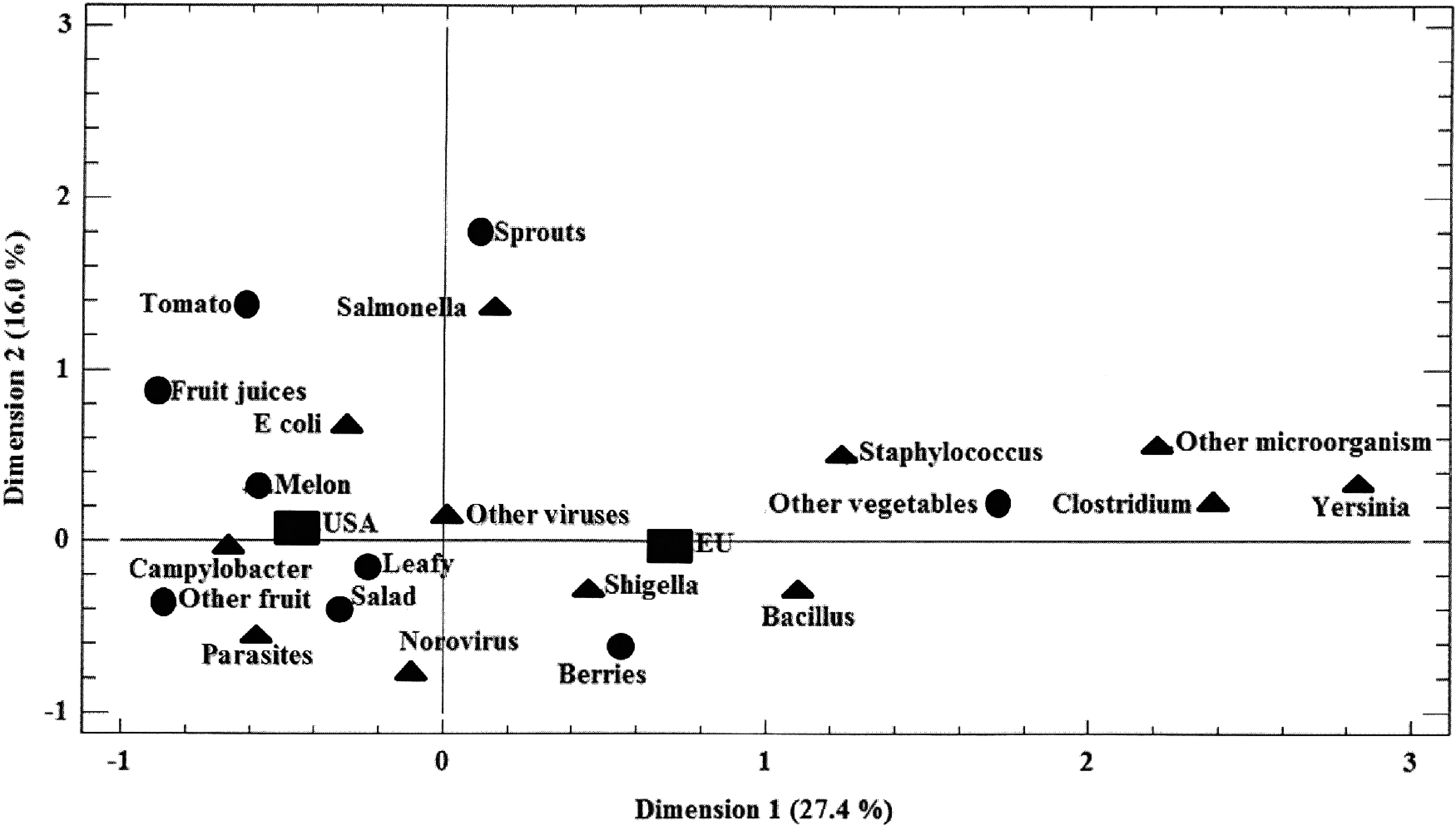
Map resulting from the Multiple Correspondence Analysis of the microorganisms and the food vehicles of foodborne outbreaks that occurred in the United States and in the European Union.
Table 3 shows the increase of foodborne outbreaks associated with NoV in the European Union. A significant example is the number of outbreaks linked to raspberries in the European Union, which may be due to an increased distribution and consumption of this fruit in that geographical area. The EFSA has reported that a significantly high number of foodborne outbreaks from 2007 to 2011 were caused by the combination of NoVs and fresh and frozen raspberries (27 outbreaks), followed by NoVs and leafy greens eaten raw as salads (24 outbreaks) in countries of Northern Europe (EFSA, 2013).
Other viruses such as hepatitis A, adenovirus, and rotavirus appear as causative agents to a lesser extent (CDC's database and EFSA Summary Reports), and they did not show a clear relationship between etiology and food vehicle (Fig. 1).
Salmonella was the most common bacterial pathogen responsible for produce outbreaks (Sivapalasingam et al., 2004), accounting for nearly half of the outbreaks due to bacteria (53% in the United States and 50% in the European Union). In addition, Salmonella was the main bacterium responsible for multistate produce-associated outbreaks in the United States (n=24). For the European Union, the number of Salmonella outbreaks has decreased since 2004, whereas it has increased in the United States (EFSA Summary Reports and CDC's database). A total of 26 different Salmonella serotypes have been identified so far (EFSA Summary Reports and CDC's database). Salmonella Typhimurium and Salmonella Newport were most involved in United States outbreaks, both linked mainly to the consumption of tomatoes (CDC's database). In contrast, Salmonella Enteritidis was the most common serotype in the European Union, associated primarily with salad, followed by Salmonella Newport, which is mostly related to the consumption of lettuce according to EFSA Summary Reports. Salmonella outbreaks stood out as the microorganism involved in the majority of sprouts-associated outbreaks (n=14 in the United States and n=11 in the European Union) (Tables 2 and 3). The types of sprouts included alfalfa, bean, and mung bean. These results are reflected in the MCA (Fig. 1). Much research has been performed to try to find an explanation for the increase in Salmonella outbreaks. Currently, the internalization theory is gaining strength since several studies have indicated that Salmonella spp. is capable of replicating to relatively high levels on or within the plant (Schikora et al., 2008; Deering et al., 2012). It is likely that bacteria can enter the plant and move through it passively, being transported via the mass flow of water entering the plant and moving within it (Deering et al., 2012). Salmonella internalization occurs in several leafy vegetables and fresh herbs and the level of internalization largely varies among plants and within the same crop. Since internalized bacteria may evade disinfection, it is of great interest to identify plants that are more susceptible to bacterial internalization, as well as plant and environmental factors that affect internalization (Golberg et al., 2011).
Regarding other microorganisms, E. coli and Campylobacter outbreaks were more prevalent in the United States (12.2% and 2.4%, respectively) than in the European Union (3.8% and 1.6%, respectively). In fact, both microorganisms appear in the same side of the graph quadrant as the United States (Fig. 1). As expected, E. coli O157 was the most prevalent strain (Sivapalasingam et al., 2004; Heaton and Jones, 2008; Berger et al., 2010). Furthermore, E. coli was the second most common pathogen identified as the cause of multistate outbreaks in the United States (n=15). Regarding food vehicle, E. coli was associated with the consumption of various fresh vegetables, fruits, and sprouts (Tables 2 and 3), but especially with lettuce and unpasteurized apple juices (Friesema et al., 2008; Berger et al., 2010; Buchholz et al., 2011; Althaus et al., 2012; Kase et al., 2012; Orue et al., 2013). As seen in Table 2, lettuce was the fresh produce most linked to E. coli infections in the United States, causing eight multistate outbreaks out of 22 total outbreaks in the period under consideration. Furthermore, the most important multistate outbreak occurring in the United States in 2006 was due to the consumption of fresh spinach, and it resulted in 238 infected cases and 5 deaths (CDC's database). In the European Union, sprouted fenugreek seeds were involved in the major food outbreak in 2011 (EFSA Summary Reports), resulting in 3000 cases with bloody diarrhea, 852 cases of hemolytic uremic syndrome, and 53 deaths (Mora et al., 2011; Borgatta et al., 2012). The causative agent was E. coli O104:H4, a new strain not previously reported in the European Union.
Campylobacter jejuni was involved in produce outbreaks linked to the consumption of salad, lettuce, tomato, and melon (Tables 2 and 3). On the other hand, certain bacteria such as Shigella, Bacillus, and Staphylococcus were associated with higher numbers of produce-associated outbreaks in the European Union than in the United States.
Additionally, produce outbreaks linked to Clostridium and Yersinia occurred exclusively in several European Union countries (EFSA Summary Reports). None of these microorganisms showed a clear relationship between etiology and food vehicle, as reflected in the MCA (Fig. 1). This relative lack of specificity in association between foods and pathogens suggests that cross-contamination, environmental contamination, and food-handler contamination may be common along the food chain (Greig and Ravel, 2009). In addition, these microorganisms did not show a clear trend, with the number of produce outbreaks associated with them ranging unpredictably between one and three from 2004 to 2012.
The potential for environmental Listeria, mainly L. monocytogenes, to contaminate fresh produce and lead to enteric infection has long been recognized (Blakeman, 1985). However, Listeria outbreaks linked to fresh produce are infrequent and tend to be limited to vulnerable groups (Heaton and Jones, 2008). In fact, Listeria was responsible for only three multistate outbreaks in the United States (Table 2).
Finally, parasites have rarely been involved in produce-related outbreaks (<4% in the United States), and most of those outbreaks have been due to Cyclospora.
According to the available data, produce-associated outbreaks were more likely to take place in food-service establishments (54% in the United States and 40% in the European Union), especially in restaurants during preparation by infected food workers (Hall et al., 2014), followed by private homes. Other common locations of consumption were workplaces and schools. Limited numbers of outbreaks were also described in hospitals, residential establishments, food retailers, and farm shops, among others (CDC's database and EFSA Summary Reports).
Most NoV outbreaks due to fresh produce occurred in food-service establishments (60% in the United States and 45% in European Union), especially at workplaces (CDC's database and EFSA Summary Reports). In the United States, Salmonella was most commonly implicated in outbreaks linked to food-service establishments (40%) while in the European Union, it was more prevalent in private homes (34%).
Recommendations to cope with trends include following the Good Agricultural Practices Guides (FDA, 2008) for the produce industry as well as protection from contamination by food handlers who are ill or infected by pathogens, especially for NoV. The most effective strategies for control of NoV in fresh vegetables and fruits focus on prevention measures for avoiding viral contamination. Specifically for NoV, CDC has published a list of precautions such as hand-washing with water and soap after contacting the toilet, and before eating or preparing or handling food, as well as washing fruits and vegetables carefully before eating them (CDC, 2013b).
Conclusions
Foodborne disease outbreaks associated with fresh fruits and vegetables remain prevalent in the European Union and United States as demonstrated by the number of outbreaks reported annually, lacking a clear trend to diminish. There is substantial evidence that contamination of fresh produce with pathogens is significant and may contribute to the foodborne illness burden. Within our study, NoV and Salmonella were the most common pathogens linked to the fresh produce outbreaks. NoVs were primarily linked with the consumption of salad in the United States and of berries in the European Union. Salmonella was the leading cause of multistate produce outbreaks in the United States and was the pathogen involved in the majority of sprouts-associated outbreaks.
Footnotes
Disclosure Statement
No competing financial interests exist.