




Abstract
The effectiveness of a two-step heat treatment for eliminating desiccation-adapted Salmonella spp. in aged chicken litter was evaluated. The aged chicken litter with 20, 30, 40, and 50% moisture contents was inoculated with a mixture of four Salmonella serotypes for a 24-h adaptation. Afterwards, the inoculated chicken litter was added into the chicken litter with the adjusted moisture content for a 1-h moist-heat treatment at 65°C and 100% relative humidity inside a water bath, followed by a dry-heat treatment in a convection oven at 85°C for 1 h to the desired moisture level (<10–12%). After moist-heat treatment, the populations of Salmonella in aged chicken litter at 20 and 30% moisture contents declined from ≈6.70 log colony-forming units (CFU)/g to 3.31 and 3.00 log CFU/g, respectively. After subsequent 1-h dry-heat treatment, the populations further decreased to 2.97 and 2.57 log CFU/g, respectively. Salmonella cells in chicken litter with 40% and 50% moisture contents were only detectable by enrichment after 40 and 20 min of moist-heat treatment, respectively. Moisture contents in all samples were reduced to <10% after a 1-h dry-heat process. Our results demonstrated that the two-step heat treatment was effective in reducing >5.5 logs of desiccation-adapted Salmonella in aged chicken litter with moisture content at or above 40%. Clearly, the findings from this study may provide the chicken litter processing industry with an effective heat treatment method for producing Salmonella-free chicken litter.
Introduction
C
Physical dry-heat treatment after composting or without composting is one of the most commonly used methods to destroy potential pathogens in chicken litter and to produce a stable organic fertilizer (Kim et al., 2012). However, some pathogenic cells may become acclimatized to sublethal conditions during mesophilic composting or stockpiling, cross-protecting them against subsequent exposure to lethal temperatures (Singh et al., 2010; Chen and Jiang, 2014). Our previous study has demonstrated that desiccation-adapted Salmonella in aged chicken litter showed extended survival during dry-heat treatment (Chen et al., 2013). Desiccation-adapted Salmonella cells in aged chicken litter with the moisture content of 50% could still be detected by enrichment after 40 min of dry-heat treatment even at 150°C. As a result, dry heat takes a long time to inactivate heat-resistant cells in chicken litter, suggesting that current thermal processing techniques may not rapidly eliminate pathogens from physically heat-treated chicken litter. Also, these surviving pathogenic cells could potentially contaminate produce and environment, when physically heat-treated chicken litter is applied to agricultural land as organic fertilizer or soil amendment. Furthermore, prolonged thermal exposure may utilize more energy and also negatively affect the quality of chicken litter, since mechanical drying can potentially cause nutrient loss, such as nitrogen (N) loss from ammonia volatilization (Moore et al., 1995).
To achieve a rapid destruction of pathogens in physically heat-treated chicken litter while minimizing quality loss, additional approaches should be explored as another hurdle for pathogen control. It is generally recognized that moist heat is a more efficient lethal treatment for microorganisms as compared to dry heat (Willey, 2008). When moist air is used to inactivate bacterial cells, much lower temperatures are required for bacterial inactivation, compared with heating with dry air. Moist heat kills microorganisms by employing water molecules to degrade nucleic acids, denature enzymes and other proteins, and disrupt cell membranes, as compared with dehydration and oxidation effects of dry heat. In animal feed industry, steam is used to condition the feed mash for rapid pathogen inactivation prior to the pelletizing process (Jones, 2011). However, the response of various pathogens in animal wastes to moist heat has not been thoroughly studied.
In order to completely eliminate pathogens in chicken litter, it would be plausible to design a two-step heat treatment, with the first step using moist heat to rapidly inactivate large populations of pathogens in chicken litter, and then to apply dry heat to eliminate the remaining cells and to reduce the moisture content to the desired level (<10–12%). Therefore, the objective of this study was to evaluate a two-step heat treatment for effectively eliminating Salmonella in aged chicken litter.
Materials and Methods
Aged chicken litter preparation
To prepare aged chicken litter, the litter inside the Cobb broiler chicken house (Organic Farms, Livingston, CA) was collected annually followed by a partial windrow composting for 7–10 d. After composting, the litter was screened out of rice hulls. In the lab, chicken litter samples were air-dried overnight under the fume hood to reduce the moisture content to <20%, screened to the particle size of <3 mm using a sieve, and then stored in sealed containers at 4°C until use.
Bacterial strains
Salmonella enterica serovars Enteritidis H2292 and Heidelberg 21380 (kindly provided by Dr. Michael Doyle, University of Georgia, Griffin, GA), Senftenberg ATCC 43845, and Typhimurium 8243 (derived from Salmonella Typhimurium LT2 by Dr. Russell Maurer, Case Western Reserve University, Cleveland, OH, and kindly provided by Dr. Roy Curtiss III, Washington University, St. Louis, MO) (Chen et al., 2013) were used for the two-step heat treatment. All the strains were induced to rifampin resistance (100 μg mL−1) using the gradient plate method (Smith et al., 1982).
Inoculum preparation
Each Salmonella strain was grown overnight at 37°C in 1 L of tryptic soy broth (Dickinson and Company, Sparks, MD) supplemented with rifampin 100 μg mL−1. The overnight cultures were centrifuged and washed three times with sterile 0.85% saline. The final pelleted cells were resuspended in saline to desired cell concentrations (≈109 CFU mL−1) through adjusting the optical density at 600 nm to ≈0.7. Afterwards, these resuspended cultures were further concentrated 100 times (≈1011 CFU mL−1) by centrifuging. Equal volumes of four cultures were mixed as inoculum for the subsequent two-step heat treatment.
Preparation of desiccation-adapted Salmonella cells
Aged chicken litter used for desiccation adaptation with the initial ammonia content of 853.55±72.64 μg g−1 was exposed to greenhouse conditions for 15 d to lower the ammonia content to 78.32±6.21 μg g−1 in order to minimize the population reduction during desiccation adaptation. The chicken litter with lower ammonia content was adjusted to the desired moisture contents of 20, 30, 40, and 50% with sterile tap water. Salmonella cultures were added (1:100, vol/wt) into 300 g of aged chicken litter with lower ammonia content at a final concentration of ≈109 CFU g−1 for a 24-h adaptation at room temperature. Afterwards, the aged chicken litter inoculated with desiccation-adapted cells was mixed (1:100, wt/wt) in a mixer (KitchenAid Professional HD, KitchenAid Inc., St. Joseph, MI) with the aged chicken litter with the adjusted moisture content. Controls were washed Salmonella cells (≈109 CFU mL−1), suspended in saline, and kept at room temperature (22°C) for 24 h that were then added to the aged chicken litter with 20% moisture content in a ratio of 1:100 (vol/wt).
Two-step heat treatment
About 20 g of inoculated aged chicken litter was distributed evenly in an aluminum pan (I.D. 10 cm) in a thin layer (≈0.5 cm in depth), placed into a metal tray (13×9×2 inches) immersed in a water bath with water temperature set at 70°C (Precision Scientific Inc., Chicago, IL), and treated by moist heat for 1 h. The temperature inside the litter samples reached 65°C during the moist-heat treatment. The relative humidity (RH) in the water bath chamber was constantly monitored with a USB data logger (EL-USB-2-LCD, Lascar Electronics Inc., Erie, PA). Then, litter samples were immediately dry-heated in a convection oven (Binder Inc., Bohemia, NY) set at 85°C for 1 h to the desired moisture content of <12%. Temperature was initially set at a higher set point of 100°C to minimize the come-up time for dry-heat treatment. Temperature was determined with T-type thermocouples (DCC Corporation, Pennsauken, NJ), with one cord inserted into litter samples throughout two-step treatment and another cord exposed to the air inside the water bath or the oven. During dry-heat treatment, duplicate samples were taken out at 30 and 60 min, and placed immediately in an ice water bath. Samples were then homogenized in sterile 0.85% saline with a ratio of 1:10 (vol/wt) using a Stomacher 400 Circulator (Seward Ltd., West Sussex, UK) at medium speed (230 rpm) for 1 min. Homogenates were then diluted serially with saline.
Enumeration of Salmonella cells
The surviving Salmonella cells were enumerated using a modified two-step overlay method with Xylose-Lysine-Tergitol 4 agar (XLT-4, Dickinson and Company) supplemented with rifampin 100 μg mL−1 as the selective media to allow heat-injured cells to resuscitate (Chen et al., 2013). Litter samples collected at the beginning (0 h) were used to determine the initial counts of Salmonella. Samples that were negative for Salmonella by direct plating recovery method (detection limit: 1.30 log CFU g−1) were pre-enriched in universal pre-enrichment broth (Neogen Corp., Lansing, MI) followed by a secondary enrichment in Rappaport-Vassiliadis broth (Dickinson and Company) supplemented with rifampin 100 μg mL−1. After 24-h incubation at 42°C, enriched cultures were then plated onto XLT-4 supplemented with rifampin 100 μg mL−1.
Moisture content, aw, ammonia, and microbiological analysis
Moisture content was determined using a moisture analyzer (Model IR-35, Denver Instrument, Denver, CO), whereas water activity (aw) was measured with a dew-point water activity meter (Aqualab series 3TE, Decagon Devices, Pullman, WA). Ammonia content was measured according to the method as described by Weatherburn (1967). The aged chicken litter used in this study was free of Salmonella by following the procedures for microbiological analyses recommended by U.S. Food and Drug Administration's (FDA's) Bacteriological Analytical Manual (USFDA, 2014). Each sample was analyzed in duplicate.
Statistical analysis
Each experiment was performed in two separate trials. Plate count data were converted to log CFU g−1 in dry weight. Differences among samples were determined by least significant differences using SigmaPlot 12.3 (Systat Software Inc., San Jose, CA), and were considered to be significant when p<0.05.
Results
The aw of aged chicken litter increased as moisture content increased from 20% to 50% (Table 1). During two-step heat treatment, the temperature in aged chicken litter increased more rapidly in samples with lower moisture contents (Fig. 1). During moist-heat treatment of chicken litter with 20, 30, 40, and 50% moisture contents, RH in the water bath increased from 52% to 100% within 15 min. During moist-heat treatment, the come-up times for heating aged chicken litter with 20, 30, 40, and 50% moisture contents to reach the target temperature of 65°C were 13, 15, 18, and 37 min. During dry-heat treatment, the come-up times for heating aged chicken litter with 20, 30, 40, and 50% moisture contents to reach the target temperature of 85°C were 30, 45, 60, and 78 min, respectively. Obviously, the higher initial moisture content of chicken litter required the longer come-up time. Moisture levels in all samples decreased slightly during moist-heat treatment, but after 1-h drying process, dropped dramatically from the initial moisture contents of 20, 30, 40, and 50% to 4.1, 4.6, 6.2, and 8.3%, respectively, which were lower than the desired level of 12% (Fig. 2).
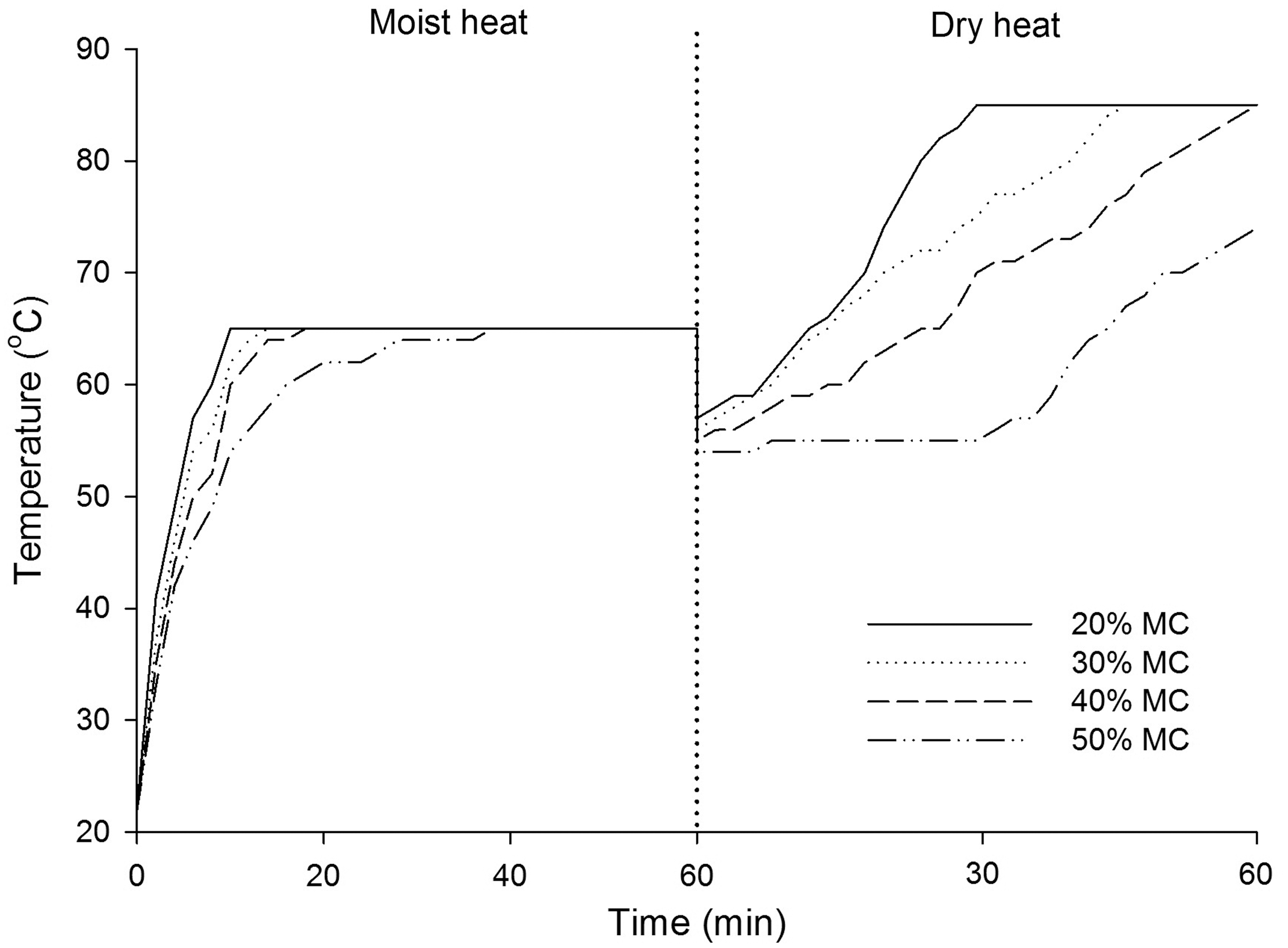
Change of temperature in aged chicken litter during two-step heat treatment, i.e., moist heat (on the left of dotted vertical line) and dry heat (on the right of dotted vertical line). MC, moisture content.
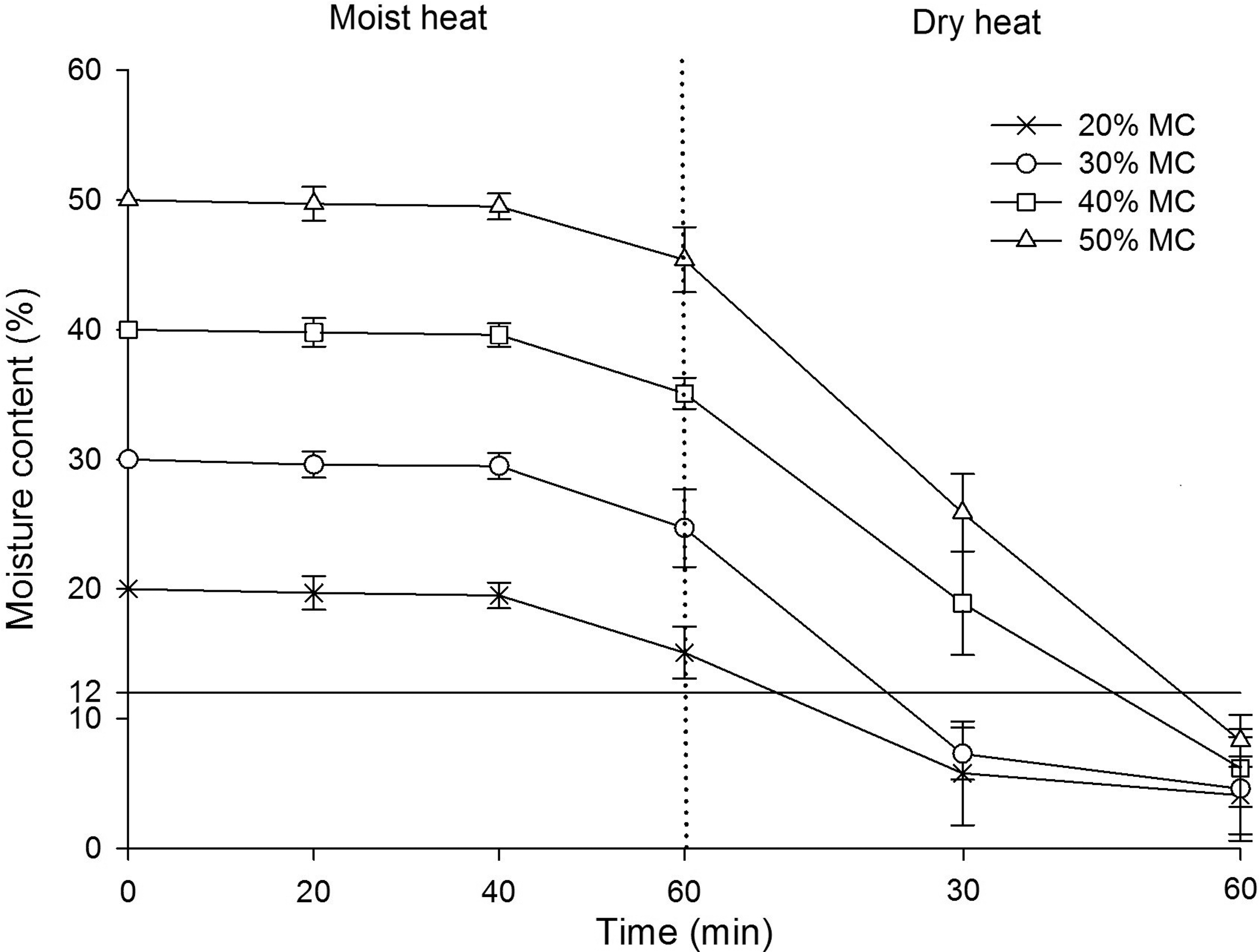
Change of moisture content in aged chicken litter during two-step heat treatment, i.e., moist heat (on the left of dotted vertical line) and dry heat (on the right of dotted vertical line). MC, moisture content. The horizontal solid line represents the target moisture content (<12%) to reach after two-step heat treatment.
Data are expressed as means±SD of two trials. Means with different letters in the same column are significantly different (p<0.05).
+, detectable by enrichment.
—, not detectable by enrichment.
CFU, colony-forming units; aw, water activity.
Desiccation-adapted and nonadapted Salmonella cells in aged chicken litter were subject to two-step heat treatment. Due to the impact of heat exposure during the extended come-up times on microbial inactivation, the thermal inactivation data were collected during this period of time as well. Salmonella counts in aged chicken litter decreased in all samples during two-step heat treatment; however, desiccation-adapted Salmonella displayed extended survival as compared to the nonadapted control in chicken litter with 20% moisture content (Table 1). Control cells in aged chicken litter were not detectable by enrichment after 20 min of moist-heat treatment. In contrast, desiccation-adapted Salmonella cells exhibited a much longer duration of survival and the population of viable desiccation-adapted cells was 2.97 log CFU g−1 after two-step heat treatment.
Although Salmonella counts in aged chicken litter decreased in all treatments during two-step heat treatment, the reductions in desiccation-adapted Salmonella populations in aged chicken litter with different moisture contents varied (Table 1). Based on our results, the desiccation-adapted cells were more quickly inactivated in aged chicken litter samples at higher moisture contents. For aged chicken litter with 40% and 50% moisture contents, moist-heat treatment for 1 h was sufficient to achieve a >5.5-log reductions of Salmonella.
To investigate the possibility that desiccation adaptation of Salmonella in aged chicken litter with low moisture content could result in increased thermal resistance, our research expanded on the above studies by comparing the survival profiles of Salmonella cells adapted in aged chicken litter at 20% moisture content with at 40% and 50% moisture contents during two-step heat treatment (Table 1). Our results showed that Salmonella cells desiccation-adapted in aged chicken litter at 20% moisture content were inactivated much more slowly as compared to adaptation at 40% and 50% moisture contents.
Discussion
The raw or partially composted chicken litter is currently processed by dry heat in the commercial settings. Although various organizations and federal agencies provide some guidelines to ensure effective heat treatment for animal manure, there are still no defined heating sources (dry versus moist heat) or scientifically validated temperature–time requirements (Chen and Jiang, 2014). It is generally recognized that moist heat is a more efficient lethal treatment for microorganisms as compared to dry heat. For example, Wilkinson et al. (2011) reported that Salmonella Typhimurium in fresh chicken litter containing rice hulls with 30–65% moisture levels was completely eliminated within 1 h at both 55°C and 65°C in a water bath. In another study, a >5-log reduction of Salmonella Typhimurium population in chicken litter containing pine shavings was achieved when exposed to steam for 30 or 100 min (Cox et al., 1986). Therefore, in this study, we evaluated a two-step heat treatment, consisting of a moist-heat treatment for 1 h at 65°C and a sequential dry-heat treatment for 1 h at 85°C, for rapidly eliminating Salmonella in aged chicken litter.
As far as we are aware, there are no published reports studying the effect of moist-heat treatment on desiccation-adapted pathogens in compost or animal manure. Therefore, in the present study, survival profiles of desiccation-adapted and nonadapted Salmonella cells during two-step heat treatment were compared. Our results showed that desiccation-adapted cells survived much longer in comparison to the nonadapted control (p<0.05) (Table 1). In order to provide temperature–time recommendations for processing physically heat-treated chicken litter, the heat-resistant form of Salmonella (i.e., desiccation-adapted cells) was used to simulate the worst-case scenario. This high level of thermal tolerance of desiccation-adapted Salmonella cells could be attributed to the fact that some bacterial cells were sufficiently adapted to the hostile dry condition, which induced cross-protection to subsequent thermal inactivation by moist- and dry-heat treatments (Potts, 1994).
Our results clearly demonstrated the impact of moisture content of chicken litter on the thermal inactivation of Salmonella (Table 1). It has been postulated that water molecules that are in close contact with proteins inside a cell could be a factor influencing the microbial inactivation (Doesburg et al., 1970). As expected, surviving populations of Salmonella observed in the present study became lower with the increase in moisture content (consistent with the increase in aw in this study) of chicken litter during moist-heat treatment, indicating that increased moisture content enhanced the lethal effect. Similar results have been reported earlier by Riemann (1968), who found that a drastic reduction in viable Salmonella population could be obtained by heating meat and bone meal at 90°C for a relatively short time after the meal was conditioned from the “natural” aw of 0.6–0.7 to an aw of about 0.9. Also, in the work of Archer et al. (1998), for any temperature of 57–70°C, the heat resistance of inoculated Salmonella Weltevreden increased, as the initial aw of flour prior to heating decreased from 0.6 to 0.2. Therefore, the amount of available water in chicken litter can considerably influence the effectiveness of thermal processing and, in addition to temperature and time, aw or moisture content in chicken litter prior to heating should be considered as another critical controlling factor during two-step heat treatment. Additionally, it is critical for the moisture to penetrate among particles of chicken litter during moist-heat treatment. Therefore, it is of great significance for fertilizer processors to reduce the heterogeneity of chicken litter to ensure that a thorough processing can be achieved to eliminate all pathogenic cells.
Pelletization with the heating and dehydration process involved has been widely used in poultry waste processing (Cox et al., 1986; López-Mosquera et al., 2008). Pelletization may increase the bulk density and the uniformity of particle size in chicken litter, allowing a higher level of nutrient density for land application (McMullen et al., 2005). In the pelletizing industry, regardless of heating source, temperature, and equipment, pellets should leave the die at a temperature of 60–95°C and moisture content of 12–18% (Kaddour and Alavi, 2010). In general, for long-term storage, the final moisture content of the pellets should be <12–13% (Robinson, 1984; Maier et al., 1992). For biosolids, the U.S. Environmental Protection Agency (USEPA) suggests that biosolids should be dried by direct or indirect contact with hot gas to reduce the moisture content to 10% or lower (USEPA, 2003). In this study, there was no dramatic decrease in the Salmonella population during dry-heat treatment. Therefore, the dry-heat treatment is mainly utilized to reduce the moisture content of chicken litter to <12%, since moisture contents of all litter samples were reduced to <10% after the drying process, which guarantees the stability of physically heat-treated chicken litter products for long-term storage.
In conclusion, our results demonstrated that the two-step heat treatment was effective in reducing heat-resistant desiccation-adapted Salmonella in aged chicken litter. The higher initial moisture contents in chicken litter contributed to rapid killing of Salmonella during moist-heat treatment. Based on our results, a two-step heating process consisting of a moist-heat treatment for 1 h at 65°C and a sequential dry-heat treatment for 1 h at 85°C can be sufficient for achieving >5.5-log reductions of Salmonella in chicken litter with moisture content of ≥40%. In order for these findings to be used by the chicken litter processing industry, an additional pilot study of this two-step heat processing is needed. Furthermore, the effect of moist-heat treatment on the product quality of chicken litter should also be investigated.
Footnotes
Acknowledgment
We would like to thank Mr. Bob Myers at Organic Farms, CA for providing aged chicken litter. This research was funded by a grant from the Center for Produce Safety, University of California at Davis.
Disclosure Statement
No competing financial interests exist.