




Abstract
The frequent use of antimicrobials in commercial poultry production has raised concerns regarding the potential impact of antimicrobials on human health due to selection for resistant bacteria. Several studies have reported similarities between extraintestinal pathogenic Escherichia coli (ExPEC) strains isolated from birds and humans, indicating that these contaminant bacteria in poultry may be linked to human disease. The aim of our study was to analyze the frequency of antimicrobial resistance and virulence factors among E. coli strains isolated from commercial chicken carcasses in Paraná, Brazil, in 2007 and 2013. A total of 84 E. coli strains were isolated from chicken carcasses in 2007, and 121 E. coli strains were isolated in 2013. Polymerase chain reaction was used to detect virulence genes (hlyF, iss, ompT, iron, and iutA) and to determine phylogenetic classification. Antimicrobial susceptibility testing was performed using 15 antimicrobials. The strains were also confirmed as extended-spectrum β-lactamase (ESBL)–producing E. coli with phenotypic and genotypic tests. The results indicated that our strains harbored virulence genes characteristic of ExPEC, with the iutA gene being the most prevalent. The phylogenetic groups D and B1 were the most prevalent among the strains isolated in 2007 and 2013, respectively. There was an increase in the frequency of resistance to a majority of antimicrobials tested. An important finding in this study was the large number of ESBL-producing E. coli strains isolated from chicken carcasses in 2013, primarily for the group 2 cefotaximase (CTX-M) enzyme. ESBL production confers broad-spectrum resistance and is a health risk because ESBL genes are transferable from food-producing animals to humans via poultry meat. These findings suggest that our strains harbored virulence and resistance genes, which are often associated with plasmids that can facilitate their transmission between bacteria derived from different hosts, suggesting zoonotic risks.
Introduction
A
Currently, chicken products are suspected to be sources of foodborne pathogens and/or antimicrobial-resistant bacteria for humans (Marshall and Levy, 2011; Johnson et al., 2012; Mellata, 2013; Asai et al., 2014). Multiresistant bacteria are frequently found in poultry (Jiang et al., 2011; Dierikx et al., 2012; Johnson et al., 2012). Their presence can be caused by selection pressure on bacteria due to the indiscriminate use of antimicrobials in aviculture as feed additives or as therapy (Marshall and Levy, 2011; Asai et al., 2014).
Escherichia coli is commonly found in the gastrointestinal tracts of animals and can be used as a bioindicator of antimicrobial resistance (Jiang et al., 2011). A small percentage of E. coli strains are capable of causing diseases and can be subdivided into the following groups: (1) intestinal nonpathogenic (commensal isolates), (2) diarrheagenic E. coli, and (3) extraintestinal pathogenic E. coli (ExPEC) (Pitout, 2012). ExPECs strains are characterized by the possession of many virulence factors that are distinct from commensal and diarrheagenic E. coli, and according to phylogenetic classification, these bacteria can belong to group B2 or less commonly to group D, whereas commensal intestinal strains belong to group A or B1 (Clermont et al., 2000; Johnson et al., 2008).
Avian and human ExPEC strains demonstrate similar characteristics in terms of virulence genes, phylogenetic groups, and common behavior in response to body temperature when establishing infections in extraintestinal locations. This leads to the hypothesis that avian E. coli might serve as a reservoir for resistance genes or that it can colonize the human intestinal tract (Bauchart et al., 2010; Johnson et al., 2012).
The emergence of plasmid-mediated antimicrobial resistance genes among bacteria can aid pathogenic bacteria in surviving host defenses. An important finding in the last several years is the increase of extended-spectrum β-lactamase (ESBL)–producing bacteria in chicken meat in some places. ESBL production confers broad-spectrum resistance and is a health risk given that ESBL genes are easily transferable between bacteria; therefore, there may be a transfer risk from food-producing animals to humans via poultry meat (Warren et al., 2008; Dierikx et al., 2012).
Paraná, located in the south of Brazil, is the largest producer of poultry meat in Brazil (UBABEF, 2013). However, there have been few studies examining the frequency of antimicrobial resistance and virulence factors in isolates from chicken carcasses in this region. In the present study, we analyzed the profile of antimicrobial resistance and virulence factors in strains of E. coli isolated from poultry carcasses in 2007 and 2013. Changes in resistance and virulence were verified, since the antimicrobials tested have been banned for use as growth promoters in aviculture in Brazil (Brasil, 2003, 2009).
Materials and Methods
Bacterial isolates
A total of 205 E. coli strains were isolated from commercial refrigerated chicken carcasses, intended only for local consumption, that were sold in the city of Londrina (northern region in Paraná, Brazil). Of the 205 strains, 84 E. coli strains were isolated in 2007 from 40 poultry carcasses (Kobayashi et al., 2011), and 121 E. coli strains were isolated in 2013 from 26 poultry carcasses. Six main chicken brands consumed in the region were analyzed in the corresponding periods. Each chicken carcass was placed in sterile packaging with 100 mL of brain-heart infusion broth (Himedia Laboratories Pvt. Ltd., Mumbai, India). After homogenization, 0.1 mL was smeared on MacConkey agar (Neogen Corporation, Lansing, Michigan) and into crystal violet neutral red bile agar (Neogen Corporation) in poured plates, and the plates were incubated at 37°C for 18–24 h. Suspected colonies were confirmed to be E. coli via biochemical tests such as EPM, MILi (Toledo et al., 1982a, b) and Simon's citrate agar (Merck, KGaA, Darmstadt, Germany). One to eight strains were collected from each chicken carcass. Only strains that exhibited different genotypic characteristics of virulence factors and phenotypic resistance were selected.
Phylogenetic classification
E. coli strains were assigned to one of four phylogenetic groups (A, B1, B2, or D). Phylogenetic classification was based on the analysis of the presence of the chuA and yjaA genes and a DNA fragment (TSPE4.C2), as described by Clermont and colleagues (2000). This polymerase chain reaction (PCR) reaction contained 1.25U Taq DNA polymerase (Invitrogen®, Carlsbad, CA) in 1X PCR buffer (Invitrogen®), 0.2 mM of each dNTP, 2.5 mM MgCl2, and 1 μM of each primer. The PCR program consisted of 94°C for 5 min, followed by 30 cycles of 94°C for 30 s, 55°C for 30 s, and 72°C for 30 s, and a final extension step at 72°C for 7 min (Clermont et al., 2000). PCR amplicons were visualized on 2.0% agarose gels stained with GelRed (Biotium, Hayward, CA). After gel electrophoresis, the images were captured using an Image Capture system (LPixImageHE, Loccus Biotecnologia, SP, Brazil).
Virulence factor genes
Five genes encoding virulence factors were investigated. The selected genes were iutA (aerobactin siderophore receptor gene), hlyF (putative avian hemolysin), iss (episomal increased serum survival gene), iroN (salmochelin siderophore receptor gene), and ompT (episomal outer membrane protease gene). The PCR reaction contained 1.25U Taq DNA polymerase (Invitrogen®) in 1X PCR buffer (Invitrogen®), 0.2 mM of each dNTP, 2.5 mM MgCl2, and 1 μM of each primer. The PCR program consisted of 94°C for 2 min, followed by 25 cycles of 94°C for 30 s, 63°C for 30 s, and 68°C for 3 min, and a final extension step at 72°C for 10 min (Johnson et al., 2008). PCR amplicons were visualized on 2.0% agarose gels stained with GelRed (Biotium). After gel electrophoresis, the images were captured using an Image Capture system (LPixImageHE).
Antimicrobial susceptibility testing
Antimicrobial susceptibility testing of E. coli isolates was performed using the standard disk-diffusion method recommended by the Clinical and Laboratory Standards Institute (CLSI, 2008, 2013). Antimicrobials used included the following: 5 μg of ciprofloxacin; 10 μg each of ampicillin, gentamicin, norfloxacin, and enrofloxacin; 30 μg each of cefazolin, cefotaxime, cefoxitin, ceftazidime, tetracycline, nalidixic acid, and chloramphenicol; 300 μg of nitrofurantoin; 1.25/23.75 μg of trimethoprim-sulfamethoxazole; and 20/10 μg of amoxicillin-clavulanic acid (Oxoid Ltd., Basingstoke, Hants, UK). Strains resistant to third-generation cephalosporins were tested in an ESBL test. ESBL production was confirmed via double-disk diffusion testing for amoxicillin/clavulanate and cefotaxime or ceftazidime, or by using a combination disk test with cefotaxime, cefotaxime+clavulanic acid (Becton Dickinson, Sparks, MD), ceftazidime and ceftazidime+clavulanic acid (Becton Dickinson), according to CLSI recommendations. The E. coli isolate ATCC 25922 was used as a negative control and Klebsiella pneumoniae ATCC 700603 as positive control. ESBL-producing E. coli were characterized in terms of ESBL gene groups (1, 2, 8, 9, and 25 groups) by PCR as described by Woodford and colleagues (2006).
Statistical analysis
All frequencies comparisons among different groups were performed with Fisher exact test and the chi-square test. Findings were considered significant for p<0.05. The tests were performed with the statistical program R version 3.1.0 (R Foundation for Statistical Computing, Vienna, Austria).
Results
Virulence factors and phylogenetic classification
In both 2007 and 2013, the iutA gene was the most prevalent and was present in 66.7% and 54.5% of isolates, respectively. We noted few changes in the frequencies of the hlyF, iutA, ompT, and iroN genes when comparing both years analyzed. However, the iss gene was significantly different (p<0.05) (Table 1). We found that among the strains isolated in 2013, 19.8% were positive for all 5 genes surveyed versus 8.3% in 2007 (p<0.05 using chi-square test).
p<0.05 chi-square test. 2007 vs. 2013 E. coli isolates.
In terms of phylogenetic classification, the most prevalent group in 2007 was group D (34.5%), whereas in 2013, the most prevalent group was group B1 (37.2%). All four phylogenetic groups were found in both years. We also noticed that there was a reduction in the percentage of strains in groups B2 and D; 50% of strains were B2 or D in 2007, whereas in 2013, only 33.8% were B2 or D (p<0.05). We also noted that group B1 greatly increased (p<0.05) (Table 1).
Resistance
In 2007, we found a high frequency of resistance to tetracycline (70.24%), nalidixic acid (61.9%), and trimethoprim–sulfamethoxazole (58.33%) (Fig. 1). In addition, 62 (73.8%) of the strains were resistant to 3 or more antimicrobials (Table 2).
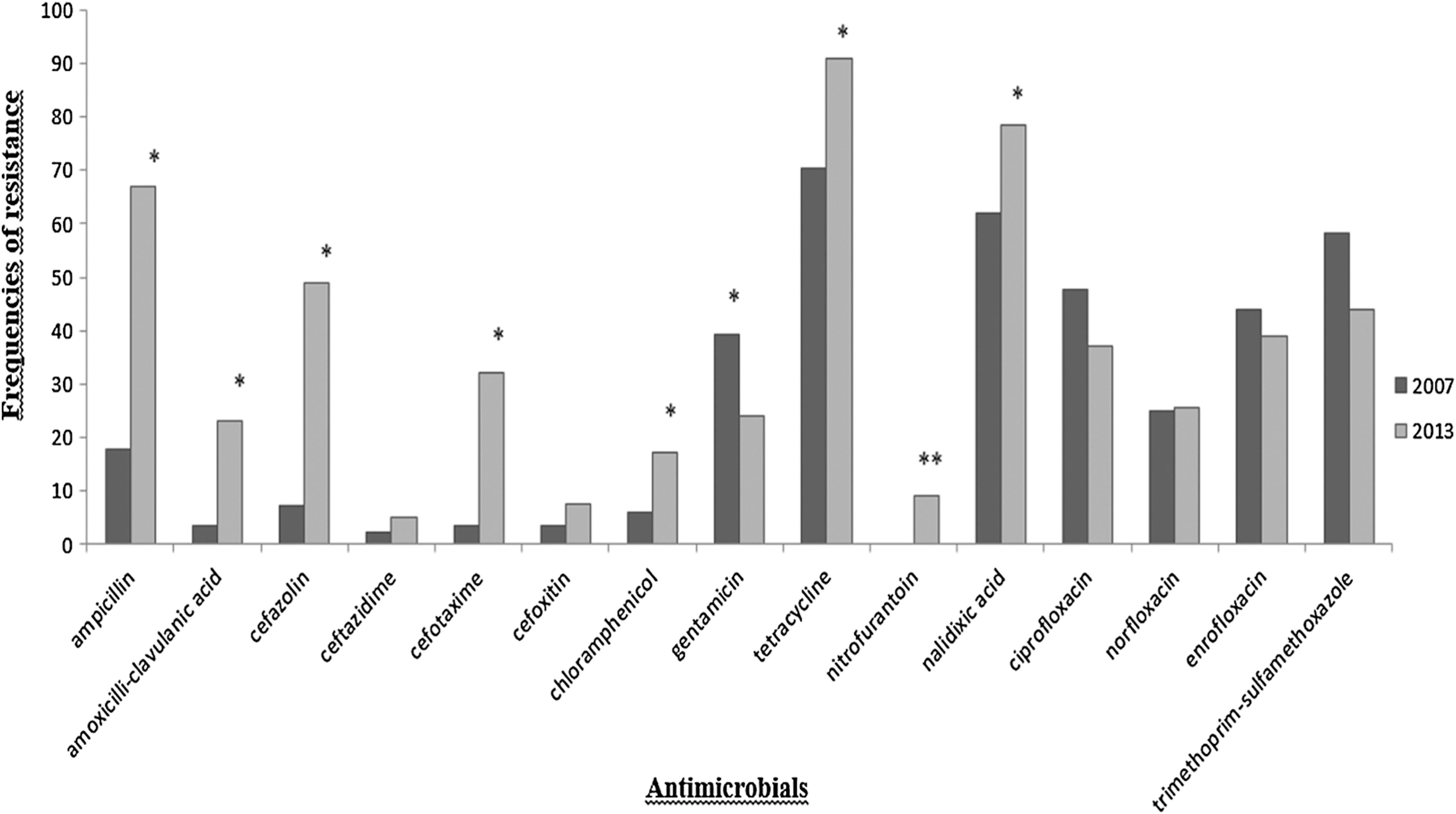
Frequencies of resistance exhibited by Escherichia coli strains isolated from chicken carcasses in 2007 and 2013. *p<0.05, χ2 test; **p<0.05, Fisher exact test.
In 2013, we found an increase in the frequency of resistance to the majority of antimicrobials tested, with the exception of gentamicin, ciprofloxacin, enrofloxacin, and trimethoprim–sulfamethoxazole (Fig. 1). Resistance to tetracycline was most frequently observed in 2013 as well, with 90.91% of strains, followed by nalidixic acid (78.51%) and ampicillin (66.94%) (Fig. 1). We observed that 79.3% of strains were resistant to 3 or more antimicrobials (Table 2), and all strains were resistant to at least 1 antimicrobial tested.
An interesting observation was that 39 strains present in 17 chicken carcasses (65.4% of carcasses analyzed in 2013) were positive in the ESBL test in 2013 for all brands except 1; we did not observe these results in 2007. Alleles encoding group 2 cefotaximase (CTX-M) enzymes were the most commonly found (64.1%). Among the strains that produced ESBL, the majority were associated with non-β-lactam antibiotics, primarily tetracycline (97.4%) and nalidixic acid (79.5%) (Table 3).
Amp, ampicillin; amc, amoxicillin-clavulanic acid; kz, cefazolin; caz, ceftazidime; ctx, cefotaxime; clo, chloramphenicol; cn, gentamicin; tet, tetracycline; nit, nitrofurantoin; nal, nalidixic acid; cip, ciprofloxacin; nor, norfloxacin; enr, enrofloxacin; sut, trimethoprim-sulfamethoxazole. NF, Not found.
Discussion
Currently, chicken meat is one of the most consumed meats in the world, and Brazil is the world's largest exporter of chicken meat and the third largest producer (UBABEF, 2013). Recently, many authors have demonstrated that E. coli from poultry is the food animal source most closely linked to human ExPEC, suggesting a zoonotic risk (Manges and Johnson, 2012; Mellata, 2013).
Avian pathogenic E. coli (APEC) is responsible for avian colibacillosis, which promotes significant economic losses in the poultry industry worldwide (Kobayashi et al., 2011). Johnson and colleagues (2008) showed that APEC isolates can be distinguished from avian fecal E. coli isolates by their possession of five genes carried by plasmids (iutA, hlyF, iss, iron, and ompT). Our results show that these genes are present in E. coli isolates from chicken carcasses.
The most prevalent virulence gene was iutA in both years surveyed; this gene encodes a siderophore system that is highly prevalent in ExPEC isolates (Bélanger et al., 2011). In 2013, 19.8% of the strains were positive for all 5 genes surveyed, versus 8.3% in 2007. These virulence genes are generally present on typical APEC plasmids in a conserved virulence plasmidic region (Lemaître et al., 2013), and the presence of the five genes in our strains indicated that they may carry this region, but we cannot confirm this because plasmids were not examined by our group.
These genes were also found in human E. coli isolates, such as those isolated from urinary tract infections and sepsis (Luo et al., 2012; Koga et al., 2014). Koga and colleagues (2014) showed that 3 of 14 strains that possessed plasmids had conjugative plasmids, and some of these carried the iss, iroN, ompT, and hlyF genes, which are the genes that were identified in our strains isolated from chicken carcasses. This indicates that E. coli strains isolated from commercial chicken carcasses have potential zoonotic risks and additionally serve as reservoirs for virulence genes for ExPEC strains.
Studies have demonstrated that the majority of ExPEC strains belong to phylogenetic group B2 (Clermont et al., 2000). The most prevalent phylogenetic group in our results was group D in 2007 and group B1 in 2013. Group B2 was infrequently found, and its frequency decreased from 2007 to 2013 (15.48% to 4.13%, p<0.05). The low presence of group B2 among strains indicates that the main contamination of chicken carcasses occurs with commensal bacteria.
The use of antimicrobial agents to increase poultry production can be linked to the emergence of drug-resistant bacteria, including antimicrobials for human use (Marshall and Levy, 2011). In the present study, we analyzed the frequency of antimicrobial resistance for strains isolated in 2007 and 2013. Despite the fact that many antimicrobials, such as tetracyclines, β-lactams, and quinolones, are prohibited as growth promoters in Brazil (BRASIL, 2003, 2009), the frequency of antimicrobial resistance among our strains isolated in 2013 was higher than the strains isolated in 2007 for the majority of the antimicrobials tested.
Resistance to tetracycline was most frequently observed in strains from both 2007 and 2013, and there was a significant increase (p<0.05) over the 6-year gap. Rossa and colleagues (2013) demonstrated high resistance to tetracycline in Brazil in enterobacteria from conventional poultry, including E. coli. Similar data were also provided for other countries (Kang et al., 2005; Jiang et al., 2011; Hasan et al., 2012). This antimicrobial was one of the first to be used as a growth promoter in the 1940s and was widely used until recently. The high frequency of resistance to tetracycline may be related to the ease of access to and the low price of this antimicrobial in veterinary medicine in Brazil (Phillips et al., 2004).
Quinolones are broad-spectrum agents that are often used for enteric infections and human urinary tract therapy (Pitout, 2012). However, the presence of quinolone-resistant E. coli in animals has increased (Lai et al., 2014). Our results indicate a high frequency of resistance to nalidixic acid in strains isolated from chickens, with an increase from 61.9% in 2007 to 78.5% in 2013 (p<0.05). This can indicate that there has been an increase in the use of quinolones in poultry.
β-Lactams are among the most clinically relevant antibiotics, particularly against pathogenic Gram-negative bacteria, and β-lactam resistance has frequently been linked to bacteria associated with food-producing animals (Dierikx et al., 2012; Pitout, 2012). One of the mechanisms of resistance to β-lactams is the production of ESBL enzyme. The emergence and dissemination of ESBL-producing bacteria among Enterobacteriaceae has been reported as a major public health issue, mainly in nosocomial infections. However, ESBL-producing bacteria from outpatient and environmental samples have been identified as well (Dierikx et al., 2012; Korzeniewska and Harnisz, 2013). In 2007, our strains did not exhibit ESBL, but interestingly, 39 strains positives for ESBL production, isolated from 17 chicken carcasses, were found in 2013, and group 2 CTX-M enzymes were the most prevalent (64.1%). In 2009, the production of CTX-M2 by Salmonella enterica in chickens in southern Brazil was reported (Fernandes et al., 2009). Other countries have also reported a high prevalence of ESBL-producing bacteria isolated from birds (Dierikx et al., 2012; Ewers et al., 2012; Reich et al., 2013). Our results suggest that broad-spectrum cephalosporins may be used in aviculture. In Canada, the emergence of ESBL genes in poultry carcasses was associated with the use of third-generation cephalosporins, particularly ceftiofur, in aviculture; these drugs are injected into eggs to control E. coli omphalitis in broiler chickens (Dutil et al., 2010; Mellata, 2013).
Our results demonstrated that, in 2013, 79.3% of strains were resistant to 3 or more antimicrobials. ESBL-producing E. coli strains can harbor genes for resistance to other families of antimicrobials such as fluoroquinolones, aminoglycosides, and sulfonamides, among others. This can occur because the genes that encode for resistance for both bla ESBL and other antimicrobial classes are often located in the same mobile genetic elements, such as plasmids or transposons (Cantón and Coque, 2006). In our study, the majority of ESBL-producing strains were associated with resistance to non-β-lactam antibiotics, primarily tetracycline (97.4%) and nalidixic acid (79.5%). Another possibility for the presence of ESBL-producing bacteria in poultry is co-selection via the use of other antimicrobials.
In our study, there was a high frequency of resistance to antimicrobials, despite the banning of several groups of antibiotics as growth promoters in poultry in Brazil. This suggests that the long-term use of antimicrobials in aviculture has caused selection pressure among bacteria.
Considering the importance of chicken meat exportation to Brazilian agribusiness, monitoring the frequency of antimicrobial resistance in animal products can assure quality for the consumption of chicken meat. These findings led us to believe that the presence of isolates harboring virulence and resistance genes in chicken carcasses and the use of antimicrobials in food animal production can facilitate the transmission of these bacteria between different hosts, suggesting a zoonotic risk.
Footnotes
Acknowledgments
This study was supported by Conselho Nacional Desenvolvimento Científico e Tecnológico (CNPq) (Chamada MCTI/CNPq/ANVISA n°23/2012). Thanks are also given to CAPES for the use of financial facilities.
Disclosure Statement
No competing financial interests exist.