




Abstract
Exclusion of broiler batches, highly colonized with Campylobacter (>7.5 log10 colony-forming units/g), from the fresh poultry meat market might decrease the risk of human campylobacteriosis. The objective of this study was to compare different sample types (both at the farm and the slaughterhouse) and methods (direct culture, quantitative real-time polymerase chain reaction [qPCR], propidium monoazide [PMA]-qPCR) applied for the quantification of the Campylobacter colonization level. In addition, the applicability of the lateral flow–based immunoassay, Singlepath® Direct Campy Poultry test (Singlepath® test), was evaluated as a rapid method for the qualitative detection of Campylobacter in highly colonized broiler batches. Campylobacter counts differed significantly between sample types collected at farm level (cecal droppings, feces, boot swabs) and at slaughterhouse level (cecal content, fecal material from crates). Furthermore, comparison of Campylobacter counts obtained by different methods (direct culture, qPCR, PMA-qPCR) in cecal droppings revealed significant differences, although this was not observed for cecal-content samples. Evaluation of the Singlepath® test on cecal droppings and cecal-content samples revealed an acceptable level of sensitivity and specificity. In conclusion, cecal droppings and cecal content are proposed as the most representative sample types for quantification of Campylobacter colonization level of broilers at farm and slaughterhouse, respectively. Direct culture and qPCR are equally sensitive for quantification of Campylobacter in fresh cecal-content samples. PMA treatment before qPCR inhibits the signal from dead Campylobacter cells. Consequently, when samples are extensively stored and/or transported, qPCR is preferred to direct culture and PMA-qPCR. Furthermore, the Singlepath® test offers a convenient alternative method for rapid detection of Campylobacter in highly colonized broiler batches.
Introduction
C
Contamination of poultry carcasses with Campylobacter occurs during slaughtering of Campylobacter-positive flocks (Sampers et al., 2010; Seliwiorstow et al., 2015). However, it has been suggested that the slaughter of birds with low Campylobacter colonization level results in lower carcass contamination and consequently in a lower public health risk (Rosenquist et al., 2006). Since highly colonized flocks account for high consumers' health risk, quantification of the Campylobacter colonization level is a more efficient risk indicator than presence–absence testing (Nauta et al., 2009). Nevertheless, the identification of highly colonized Campylobacter batches requires representative sampling strategies and also reliable methods for quantification of the Campylobacter colonization level of birds before slaughter.
Several sample types, such as cecal droppings (Herman et al., 2003), fecal material (Stern et al., 2003), boot swabs (Chowdhury et al., 2012) at the farm level, and cecal content (Rasschaert et al., 2007) and fecal material from crates (Nauta et al., 2009) at the slaughterhouse level have been used to determine the Campylobacter status of slaughter birds. However, the type of sample can influence Campylobacter counts, providing unreliable information on the flock colonization level. Therefore, at first, a comparative analysis of sample types for Campylobacter quantification by direct culture method at farm and slaughterhouse level was performed.
The most commonly used method for quantification of Campylobacter colonization level is the direct culture on selective agar, although it is a time-consuming procedure that is not applicable for testing all broiler flocks shortly before slaughter. A quicker alternative might be quantitative real-time PCR (qPCR) or a qPCR combined with propidium monoazide (PMA), which quantify only viable Campylobacter cells (Josefsen et al., 2010; Duarte et al., 2015). Thus, secondly, direct culture, qPCR, and PMA-qPCR were evaluated for their usefulness for Campylobacter enumeration on both cecal droppings and cecal-content samples.
Nevertheless, culture and molecular methods require either time or advanced laboratory equipment. Therefore, a rapid, simple, and reliable test identifying highly colonized broiler flocks might allow testing of all poultry broiler batches shortly before the slaughter. For this reason, the utility of a recently developed lateral-flow test, namely, the Singlepath® Direct Campy Poultry (Singlepath® test), was evaluated.
Materials and Methods
Sample collection
At the farm level, from each of 10 broiler flocks (i.e., a group of chickens reared in the same broiler house) at the age of 39–41 days, at least 10 fresh cecal droppings (i.e., watery and light brown; Fig. 1) and 10 fresh fecal material samples (i.e., firm and brown droppings with a white part from urates) were collected and pooled in sample cups with a cover to minimize sample exposure to the air. For each of these flocks, two boot swabs (Article: H01038A, KOLMI, France) were also analyzed. At the slaughterhouse level, 10 batches (i.e., birds from 1 flock slaughtered on the same day), which were not related to previously examined flocks at the farm level, were sampled by collecting 6 intestinal packages in plastic bags. Additionally, for each batch the correspondent fecal material (≈10 g) from the transport crates was collected in plastic sample cups with covers.
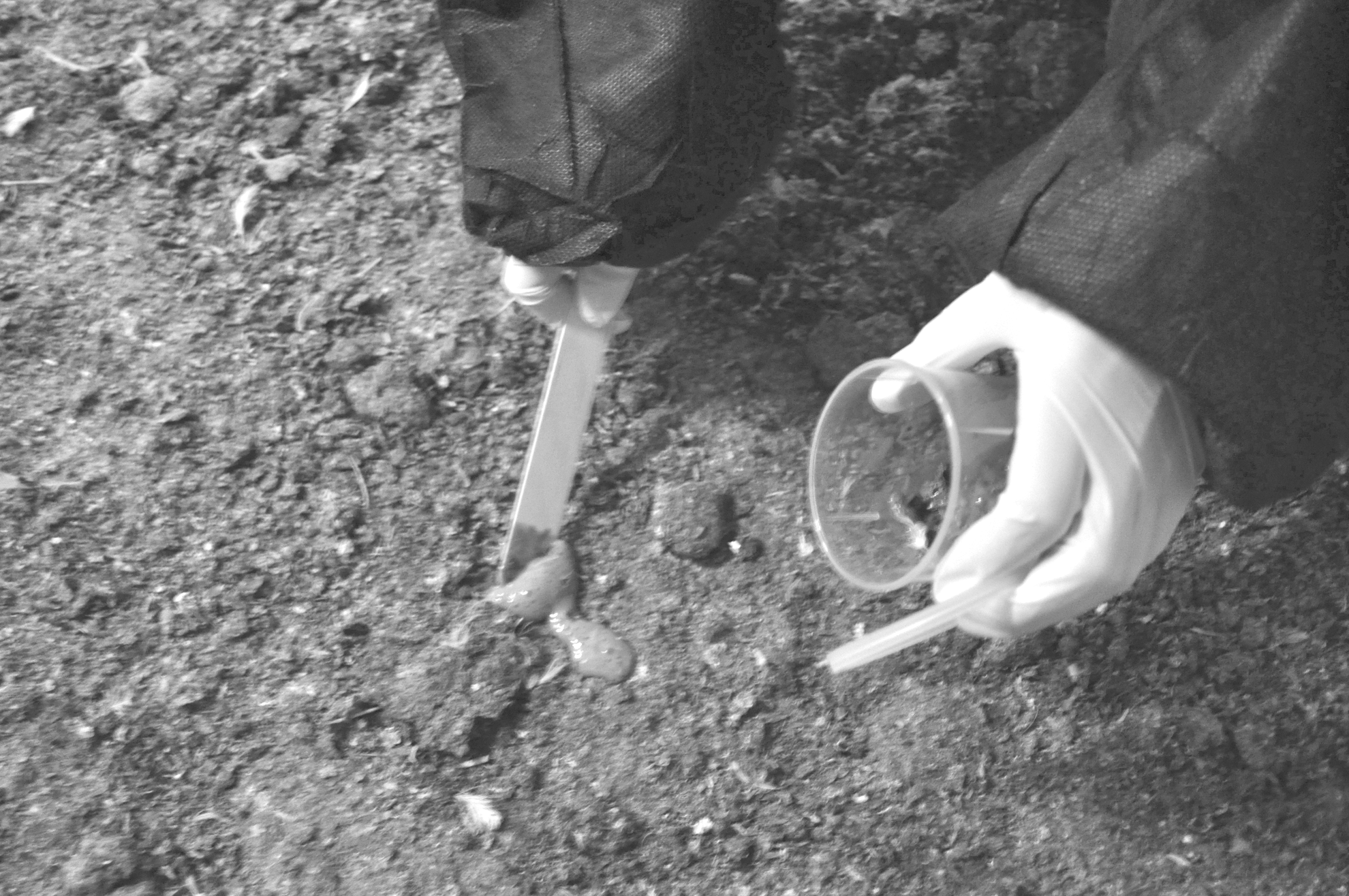
Sampling of cecal droppings at a broiler farm.
Additional cecal droppings and cecal-content samples from 50 flocks and 50 batches were collected for comparison of analytical methods to detect high levels of Campylobacter colonization. This resulted in a total amount of 60 cecal droppings and 60 cecal-content samples analyzed.
All samples were collected aseptically, transported to the laboratory under cooled conditions, and analyzed the same day.
Samples preparation
At the laboratory, the content of each sampling cup (cecal droppings, fecal material, and fecal material from crates) was mixed with a wooden spatula. Intestinal packages were removed from plastic bags to collect one cecum, which was immersed in ethanol to remove the external contamination. After ethanol evaporation, approximately 1 g of cecal content was collected and pooled per batch.
Enumeration of Campylobacter by direct culture method
One gram of all pooled cecal and fecal samples were homogenized with 0.1% peptone water (Bio-Rad Laboratories, USA) at a ratio of 1:10, plated on Campyfood Agar (bioMérieux, France) and incubated under microaerobic conditions at 41.5°C for 48 h. The homogenates of cecal droppings and cecal-content samples were further used for enumeration of Campylobacter by qPCR and by PMA-qPCR (see section “Enumeration of Campylobacter by qPCR and by PMA-qPCR”).
Material collected on boot swabs was weighed by comparing the weight of clean and used swabs. Next, 0.1% peptone water was added to the plastic bag with the boot swabs at a ratio of 1:5. The homogenate was plated and incubated as described above.
Presumptive Campylobacter colonies were enumerated and confirmed (at least four per sample) by microscopic observation and by Campylobacter species PCR assays (Linton et al., 1996; Vandamme et al., 1997).
Enumeration of Campylobacter by qPCR and by PMA-qPCR
From each homogenate of cecal droppings and cecal-content samples, two aliquots of 0.5 mL were prepared. One aliquot was treated with PMA as described by Duarte et al. (2015) and the second aliquot was left PMA-untreated. Afterward, both PMA-treated and -untreated aliquots were submitted to DNA extraction as described previously (Duarte et al., 2015) and DNA was stored at −20°C. Next, Campylobacter quantification by duplex TaqMan qPCR was performed in both PMA-treated and -untreated aliquots, but only for samples with countable results by the direct culture method (Duarte et al., 2015).
Lateral-flow test
Singlepath® Direct Campy Poultry test (Singlepath® test; Merck Millipore, Germany) is a gold-labeled immunosorbent assay for the detection of Campylobacter-positive flocks, colonized with>7.5 log10 colony-forming units (CFU)/g. The Singlepath® test was applied to all collected cecal droppings (n=60) and cecal-content samples (n=60). To perform the Singlepath® test, approximately 1 g of sample (prepared as described in “Samples preparation”) was analyzed as specified by the manufacturer. Briefly, 9 mL of sample diluent, provided by the manufacturer, was added to the sample, mixed, and after sedimentation (10 min) at room temperature, 1 mL of supernatant was heat-inactivated (95°C) for 15 min, and allowed to cool to room temperature. Next, 2 drops of sample buffer, provided by the manufacturer, were added to the sample, which was subsequently mixed and allowed to settle for 10 min. Afterwards, five drops of the supernatant was applied to the test. Results were visible for qualitative interpretation after 20 min at room temperature.
Data analysis
All Campylobacter counts were converted to log10 values. To test for differences in Campylobacter counts between sample types collected at farm level, a Friedman test was used followed by the Wilcoxon signed-rank test with a Bonferroni adjustment. At slaughterhouse level, differences in Campylobacter counts between sample types were calculated using the Wilcoxon signed-rank test. Results below the quantification limit (100 CFU/g) were excluded from the analysis.
A linear mixed model, with the method type as a fixed and repeated effect and the batch/flock as the random effect, was used to determine differences in Campylobacter counts between quantification methods. Additionally, to define a relation between Campylobacter counts obtained by different methods, linear regression analysis was performed.
Since the Singlepath® test is based on immune-chromatographic principles, it produces positive results in the presence of targeted antigen. Therefore, when Campylobacter counts measured by direct culture method decreased during samples storage (up to 72 h at 4°C), the Singlepath® test still presented positive results (John et al., 2013). This finding allows using the combination of results from the direct culture and qPCR as proxy gold standard for evaluation of the Singlepath® test. Results obtained by the proxy gold standard and by Singlepath® test were compared using McNemar's tests. Additionally, kappa statistics were calculated to measure the agreement between methods.
Described statistical analyses were performed using SPSS software version 22 (IBM Corporation, USA), and a significance level of 5% was used.
Results
Comparison of Campylobacter counts between sampling types at farm and slaughterhouse level
At the farm level, in two flocks Campylobacter was not detected in any sample type (Table 1). The type of sample collected at the farm level had a significant effect on the Campylobacter counts (p<0.001), measured by direct plating, with significantly the highest numbers for cecal droppings (p<0.05) and significantly the lowest for boot swabs (p<0.05) in comparison to other sample types.
For each flock and each batch, one sample from every sample type was analyzed.
Mean was calculated based on samples above the quantification limit. Different letters indicate significant differences (p<0.05) between samples types. As flocks and batches were not related, Campylobacter counts in samples collected at the farm level were not compared with those collected at the slaughterhouse level.
CFU, colony-forming units.
At the slaughterhouse level, in both cecal content and fecal material samples from six batches, Campylobacter was not detected (Table 1). Campylobacter counts in the four remaining batches were significantly higher in cecal content than in fecal material collected from crates (p<0.05).
As cecal droppings and cecal-content samples showed the highest Campylobacter counts among the tested sample types collected at the farm and slaughterhouse level, respectively, those types were selected for the evaluation of the analytical methods including the Singlepath® test.
Comparison of Campylobacter counts obtained by direct culture, qPCR, and PMA-qPCR
The result of the study revealed that Campylobacter was recovered by direct culture method in 65% (39/60) of flocks (cecal droppings) and in 50% (30/60) of batches (cecal content).
The most commonly recovered species was Campylobacter jejuni (63.3%), followed by C. coli (32.4%). Furthermore, two flocks were colonized by both C. jejuni and C. coli and one with C. lari.
When comparing Campylobacter counts in cecal-dropping samples, significantly higher mean counts were recovered by qPCR (7.88±1.18 log10 CFU/g) in comparison to PMA-qPCR (7.60±1.40 log10 CFU/g; p<0.05) and direct culture (7.22±1.36 log10 CFU/g; p<0.01; Fig. 2A). Also, mean Campylobacter counts obtained by PMA-qPCR were significantly higher than those recovered by direct culture (p<0.05; Fig. 2A). However, when cecal-content samples were analyzed, mean Campylobacter counts obtained by direct culture, qPCR, and PMA-qPCR accounted for 8.36±0.91, 8.24±1.41, and 8.36±1.21 log10 CFU/g, respectively, and no significant differences were revealed between methods (p>0.05, Fig. 2B).
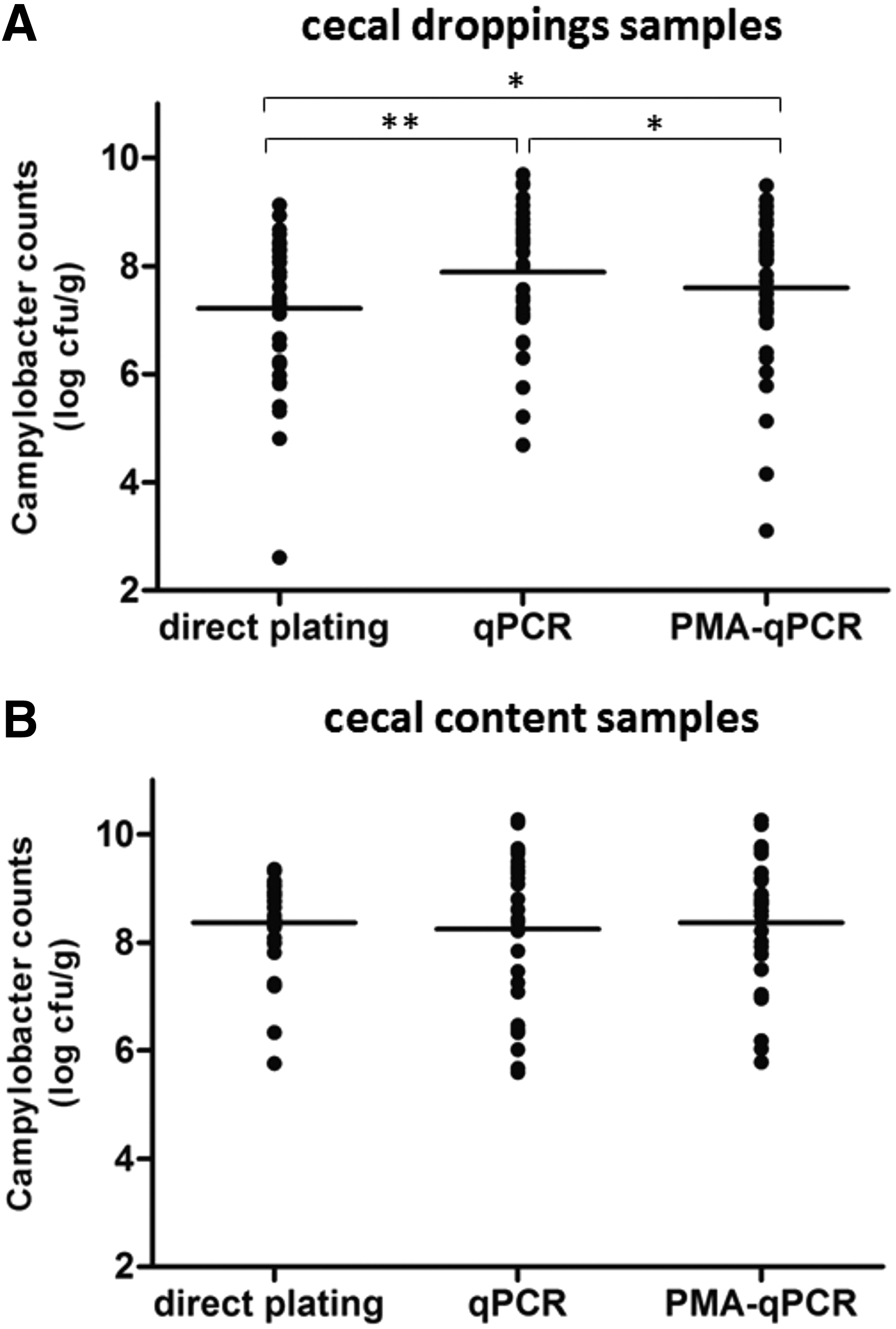
Campylobacter counts in cecal droppings
When Campylobacter counts obtained by qPCR and PMA-qPCR were plotted against the results of the direct-culture method (Fig. 3), a higher correlation was revealed for sample types treated with PMA (Fig. 3C and D) in comparison to non-PMA-treated samples (Fig. 3A and B).
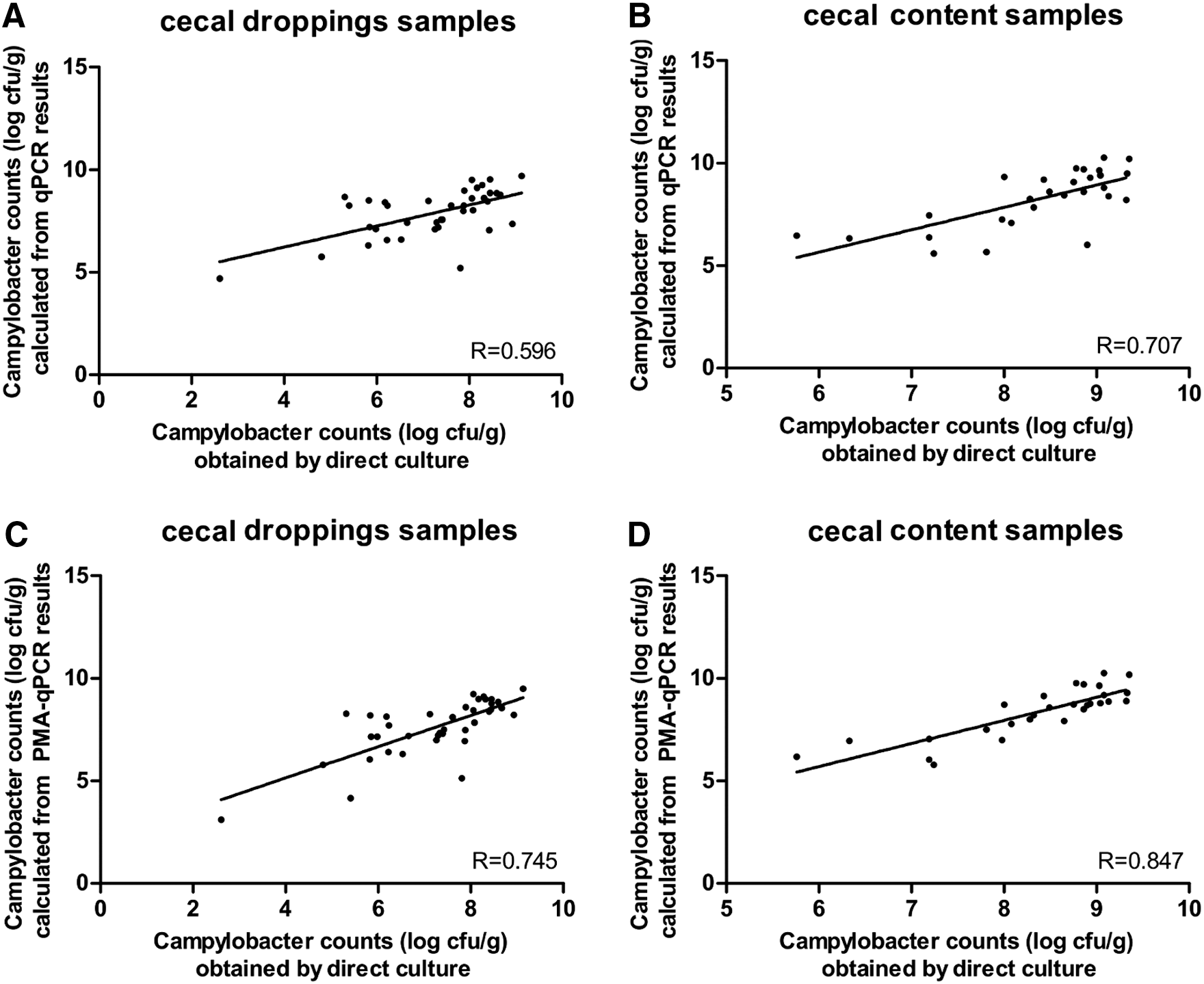
Scatter plots demonstrating the correlation between Campylobacter counts obtained by direct culture and quantitative real-time polymerase chain reaction (qPCR) in cecal-dropping samples
Performance of the Singlepath® Direct Campy Poultry test for detection of highly colonized broiler batches
Of 60 tested flocks (cecal-dropping samples), 27 and 26 were identified as colonized with >7.5 log10 CFU/g by the Singlepath® test and the proxy gold standard (i.e., combined results of direct culture method and qPCR), respectively. At the slaughterhouse level (cecal-content samples), 60 batches were examined. Twenty-five tested positive by the Singlepath® test and 24 were colonized with at least 7.5 log10 CFU/g based on direct culture or the qPCR method.
The McNemar's test could not detect significant differences in performance of the Singlepath® test and proxy gold standard for detection Campylobacter colonization levels of at least 7.5 log10 CFU/g (p>0.05). Additionally, the kappa value for cecal droppings and cecal-content samples was 0.899 (p<0.001) and 0.966 (p<0.001), respectively, and as such shows high agreement between the Singlepath® test and the proxy gold standard method.
The sensitivity and specificity of the Singlepath® test was calculated using a 2×2 table approach (Table 2). Of all examined samples, two cecal droppings and one cecal-content sample tested positive by Singlepath® test even though Campylobacter counts in these samples were <7.5 log10 CFU/g. Only one false-negative outcome of the Singlepath® test was recorded for all tested samples. Based on these results, the sensitivity and specificity of Singlepath® test accounted for 96.15% (95% CI 80.30–99.36) and 94.12% (95% CI 80.29–99.11), respectively, when cecal-dropping samples were analyzed. Higher values were obtained for cecal-content samples, namely, 100.00% sensitivity (95% CI 85.62–100.00) and 97.22% specificity (95% CI 85.42–99.54).
Singlepath® Direct Campy Poultry test.
Combined results of direct culture and quantitative real-time polymerase chain reaction (qPCR) were treated as the proxy gold standard.
Campylobacter counts obtained by at least one method (direct culture or qPCR) were ≥7.5 log10 CFU/g.
Discussion
First, in the present study different sample types collected at farm and slaughterhouse level were analyzed for Campylobacter counts. At farm level, the fact that the highest numbers were recovered in cecal droppings may not be surprising, as ceca are the highest colonized parts of the intestinal tract of birds (Cason et al., 2007). Additionally, cecal droppings may allow better Campylobacter survival than fecal material due to possible antimicrobial activities of urate crystals in feces (Rudi et al., 2004). However, the practical disadvantage of cecal droppings is that they are more difficult to collect in broiler houses than fecal material, as they are less frequently present and harder to be properly recognized (EFSA, 2012).
The most applicable sample type, already in use for detection of Salmonella in broiler flocks, would be boot swab samples. While the sensitivity of boot swabs for Campylobacter detection is reported as not being significantly different from the sensitivity of cecal droppings and fecal material (Vidal et al., 2013), in the present study, this sample type delivered lower Campylobacter counts. This might be explained by the fact that when individuals are walking through the broiler house, not only fresh cecal droppings are collected on boot swabs but also bedding materials in which Campylobacter is exposed to long-lasting dry and oxidative stresses. Similarly, at the slaughterhouse level, higher Campylobacter counts found in cecal-content samples than in fecal material collected from transporting crates can be explained by factors discussed above.
Second, an evaluation of a direct culture method—qPCR and PMA-qPCR for enumeration of Campylobacter on cecal droppings and cecal-content samples—was performed. No significant differences in Campylobacter counts between the analytical methods were observed when working with fresh cecal-content samples. In contrast, when cecal-dropping samples were analyzed, significantly higher Campylobacter counts were recovered by qPCR in comparison to PMA-qPCR or direct plating. This observation suggests that cecal-dropping samples contained a fraction of dead campylobacters that is quantified together with viable cells by qPCR but not by direct plating and by PMA-qPCR (Josefsen et al., 2010). Presence of dead Campylobacter cells in cecal droppings can be caused by length of the transportation and/or storage time of samples (Rodgers et al., 2012). In contrast, cecal content was retained inside the cecum until the laboratory analyses, which excludes dry and oxidative stress impairing Campylobacter survival.
The application of PMA treatment improved the correlation between the direct culture and the qPCR-based method (Fig. 3), which was in agreement with a previous report using PMA-qPCR for quantification of Campylobacter in artificially and naturally contaminated poultry meat (Seinige et al., 2014). However, a significant difference in Campylobacter counts on cecal-dropping samples was still observed when comparing the direct culture method and the PMA-qPCR. Optimization experiments confirmed the effectiveness of PMA treatment at a concentration of 25 μg/mL for reduction of signals from membrane-damaged Campylobacter cells in carcass rinses (Duarte et al., 2015). However, it was also reported that the use of PMA at a concentration of 25.55 μg/mL is ineffective for complete inhibition of signals from membrane-damaged Campylobacter cells in carcass rinses (Pacholewicz et al., 2013; Seinige et al., 2014) and that a concentration of 51.1 μg/mL is more optimal (Seinige et al., 2014). Apart from the PMA concentration, other factors might also influence the qPCR signal reduction when analyzing cecal samples. Therefore, further optimization of the PMA treatment is needed for reliable quantification of Campylobacter membrane-intact cells in samples from cecal origin.
Investigation of the birds' Campylobacter colonization level is demanding in terms of equipment, personnel, and time. Since a Campylobacter colonization can quickly spread throughout a broiler flock (Van Gerwe et al., 2009), testing for Campylobacter should be performed as closely as possible to the slaughter day to provide precise information. Therefore, a rapid and reliable test that can be executed by non-laboratory-skilled personnel for discrimination between flocks colonized below and above 7.5 log10 CFU/g is needed. In the present study, the Singlepath® test was evaluated on cecal droppings and cecal-content samples. In three samples (two cecal droppings and one cecal content), Campylobacter counts for both culture method and qPCR were below the detection limit of the test proposed by the manufacturer (7.5 log10 CFU/g), although a positive outcome of the Singlepath® test was recorded. It implies that in some cases, the Singlepath® test is also able to detect lower Campylobacter concentrations than 7.5 log10 CFU/g. The only false-negative result was obtained when the flock was colonized by C. lari, which might be detected by the Singlepath® test probably at higher concentrations because the test was designed primarily to detect C. jeuni and C. coli as the most prevalent Campylobacter species in poultry (EFSA, 2010).
Conclusions
In conclusion, the sample type and the analytical method used influence quantitative results on Campylobacter colonization level.
Cecal droppings or cecal content are the most appropriate sample types for quantification of broilers' Campylobacter colonization level.
The direct culture method and qPCR-based methods are equally sensitive for Campylobacter enumeration in cecal-content samples. Application of the PMA treatment before qPCR analyses reduces the detection of dead cells by qPCR. However, qPCR is an attractive alternative for the culture-based method for quantification of stressed and nonculturable Campylobacter in samples that are extensively stored and transported before further analyses.
The Singlepath® test could be considered an alternative, qualitative method, which can be performed under nonlaboratory conditions and allows rapid detection of flocks/batches colonized with at least 7.5 log10 CFU of Campylobacter per gram of cecal content or cecal-dropping sample.
Footnotes
Acknowledgments
The authors would like to thank Lisa John and Charlotte Lindhardt from Merck Millipore for their kind cooperation. We also thank Tommy Van Limbergen, Elke Wattijn, Bavo Verhaegen, Ignacio Gisbert Algaba, Jeroen Vandenheuvel, and Carine Van Lancker for their assistance in the present study. The study was financially supported by Merck Millipore.
Disclosure Statement
No competing financial interests exist.