




Abstract
In South Korea, few reports have indicated the occurrence and characteristics of extended-spectrum β-lactamase (ESBL)–producing Escherichia coli in food-producing animals, particularly in poultry slaughterhouses. In this study, we investigated the occurrence and antibiotic resistance of ESBL-producing E. coli from whole chicken carcasses (n=156) and fecal samples (n=39) of chickens obtained from 2 slaughterhouses. Each sample enriched in buffered peptone water was cultured on MacConkey agar with 2 mg/L cefotaxime and ESBL agar. ESBL production and antibiotic susceptibility were determined using the Trek Diagnostics system. The ESBL genotypes were determined by polymerase chain reaction (PCR) using the bla SHV, bla TEM, and bla CTX-M gene sequences. Subtyping using a repetitive sequence-based PCR system (DiversiLab™) and multilocus sequence typing (MLST) were used to assess the interspecific biodiversity of isolates. Sixty-two ESBL-producing E. coli isolates were obtained from 156 samples (39.7%). No bla SHV genes were detected in any of the isolates, whereas all contained the bla TEM gene. Twenty-five strains (40.3%) harbored the CTX-M group 1 gene. The most prevalent MLST sequence type (ST) was ST 93 (14.5%), followed by ST 117 (9.7%) and ST 2303 (8.1%). This study reveals a high occurrence and β-lactams resistance rate of E. coli in fecal samples and whole chickens collected from slaughterhouses in South Korea.
Introduction
G
Analysis of genotypic patterns has contributed to research on the dissemination mechanisms of ESBL-producing E. coli (Suzuki et al., 2009; Ewers et al., 2010). Pulsed-field gel electrophoresis (PFGE) is the most widely used typing method worldwide. In recent years, advanced sequencing facilities and the availability of genome sequences have led to the development of new typing methods such as repetitive sequence-based polymerase chain reaction (rep-PCR) and multilocus sequence typing (MLST). PCR-based genotyping methods are rapid, simple, easy to perform, and more cost effective than other subtyping methods (Hyeon et al., 2011, 2013). The semiautomated rep-PCR system (DiversiLab™, bioMérieux, Marcy I'Etoile, France) has been used to trace sources of food poisoning outbreaks and cross-contamination in food-processing industries with short analysis times (within 4 h) and reduced labor costs (Healy et al., 2008; Hyeon et al., 2011). Compared with PFGE, MLST allows for characterization of international outbreaks by comparison of sequence types (STs), tracking, and epidemiological analysis (Vandenesch et al., 2003; Hyeon et al., 2013).
The recent discovery of ESBL-producing E. coli in healthy food-producing animals in several countries in Europe and the United States reveals that assessing infections in livestock is also important (Geser et al., 2012; Clemente et al., 2013). In Korea, research on ESBL-producing E. coli has primarily focused only on hospitals and community-related environments, with studies on livestock and farm environments being undertaken only recently (Lee et al., 2004; Kim and Lee, 2010; Kang et al., 2013; Tamang et al., 2013a, 2013b). In addition, while studies detecting ESBL-producing E. coli in food-producing animals and slaughterhouses have been conducted in Europe and North America, few studies have been conducted in South Korea (Lee et al., 2004; Hwang et al., 2007; Costa et al., 2009; Doi et al., 2010; Kolar et al., 2010; O'Keefe et al., 2010; Leverstein-van Hall et al., 2011; Shaheen et al., 2011). Furthermore, several studies have examined the presence of Salmonella spp. in Korean slaughterhouses; however, the presence of ESBL-producing E. coli has been unexamined (Bae et al., 2013).
In this study, carcass and fecal samples collected from two chicken slaughterhouses in Korea were analyzed for the occurrence of ESBL-producing E. coli. Because ESBL-positive strains may also carry the genetic determinants for the resistance to other antibiotics such as aminoglycosides, fluoroquinolones, chloramphenicol, and tetracycline, the antimicrobial resistance profiles of the isolates were also determined. In addition, genotype analysis of the isolated organisms was conducted to assess the interspecific biodiversity of the isolates.
Materials and Methods
Sample collection
Samples of chicken carcasses (n=117) and feces (n=39) were obtained from two poultry slaughterhouses in Iksan, Jeollabuk-do (slaughterhouse A) and Chungju, Chungcheongbuk-do (slaughterhouse B), South Korea, in May and June 2012. Slaughterhouse A is a large-scale slaughterhouse capable of processing 500,000 birds per day, while slaughterhouse B is medium-sized, capable of processing 50,000 birds per day. The two slaughterhouses were visited twice at a 1-week interval. On each visit, about 10 fecal samples and carcasses were collected from individual chickens. The fecal samples were collected by swabbing the rectal area on individual live birds queued up for slaughter. Fecal swabs were placed into transport medium (Hanil Comed, Seongnam, South Korea). All carcasses were collected at the sorting step. In all, 42 carcasses and 14 fecal samples were collected from slaughterhouse A, and 75 carcasses and 25 fecal samples were collected from slaughterhouse B. We used sterile plastic bags and gloves to prevent contamination.
Isolation of ESBL-producing E. coli from chicken carcasses and fecal samples
Chicken carcasses were placed in 400-mL buffered peptone water (BPW; Difco, Detroit, MI) and rinsed. A 50-mL test portion from the 400 mL rinsate was enriched at 37°C for 24 h. One milliliter of transport medium (Hanil Comed) for feces was inoculated into 9 mL BPW followed by incubation at 37°C for 24 h. Enriched broth (0.1 mL) was plated onto MacConkey agar (Difco) supplemented with the third generation cephalosporin cefotaxime (2 mg/L; Sigma, St. Louis, MO) (Kim et al., 2010), and was incubated at 37°C for 24 h. Colonies of typical morphology and suspected of being ESBL producers were subcultured on CHROMagar Orientation with CHROMagar ESBL supplement (0.57 g/L; CHROMagar, Paris, France), and presumptive ESBL-producing colonies were obtained (Reist et al., 2013). Colonies from the CHROMagar were subcultured on blood agar (Asan Pharmaceutical, Seoul, Korea) and brain-heart infusion (BHI) agar (Difco), and finally confirmed with a Vitek 2 system (bioMérieux).
Antibiotic susceptibility test and determination of ESBL production
Antibiotic resistance and ESBL production were determined using an automatic diagnostic system, Trek (Thermo Scientific, Oakwood Village, OH). Antibiotic susceptibility was tested using broth microdilution with the following drugs: ampicillin, cefazolin, cefepime, cefotaxime, cefoxitin, cefpodoxime, ceftazidime, ceftriaxone, cephalothin, ciprofloxacin, gentamicin, imipenem, and meropenem. Isolates were scored positive for ESBL production when there was an eightfold difference between the minimum inhibitory concentrations (MICs) of cefotaxime and cefotaxime-clavulanic acid, and between the MICs of ceftazidime and ceftazidime-clavulanic acid. The MICs of cefotaxime and ceftazidime, alone and in combination with clavulanic acid, were determined by broth microdilution according to the Clinical and Laboratory Standards Institute guidelines using Trek microbroth dilution panels (ESB1F/Sensititre Extended Spectrum Beta-lactamase Plate, Thermo Scientific) (Khalaf et al., 2009).
ESBL gene test using multiplex PCR
To test for the presence of the ESBL genes, isolates that were scored as positive for ESBL production (see above) were selected for the PCR assay. A single colony on BHI agar was suspended in sterile distilled water, boiled for 10 min, and clarified by centrifugation at 15,000×g for 10 min. The supernatants were collected in new tubes for use as DNA templates. The primers used in the assay are shown in Table 1. Multiplex PCR was conducted for the bla TEM, bla SHV, bla CTX-M, and bla CTX-M gene groups (CTX-M-1, CTX-M-2, CTX-M-8, CTX-M-9) with C1000 thermal cyclers (Bio-Rad, Hercules, CA). One microliter of DNA template solution was transferred to a Hotstart PCR premix (SNC; Hanam, Korea) with 1 μL of each primer (at 10 pmol) to make up a 20-μL total volume. The reaction was carried out as follows: initial denaturation at 94°C for 5 min; followed by 30 cycles of 94°C for 5 s, 60°C for the times shown in Table 1, and 72°C for 1 min; and final extension at 72°C for 7 min. The PCR products were resolved by electrophoresis on 1.5% (wt/vol) agarose gels and visualized with the Gel Doc XR+ system (Bio-Rad) after ethidium bromide staining.
TEM, Temoniere; CTX, cefotaxime; SHV, sulfhydryl variable.
MLST of ESBL-producing E. coli
The seven housekeeping genes used for MLST were fumC, gyrB, icd, mdh, purA, recA, and adk as described by Wirth et al. (2006). The PCR sequencing and cycling conditions also followed the method described in Wirth et al. (2006). Amino acid sequences in the PCR product were analyzed at
Rep-PCR DNA fingerprinting with DiversiLab™
ESBL-producing E. coli isolates were cultured on BHI agar at 37°C for 24 h. DNA from each isolate was extracted using an UltraClean Microbial DNA Isolation Kit (MO BIO Laboratories, Carlsbad, CA) in accordance with the manufacturer's instructions. Genomic DNA samples were quantified with a NanoDrop 2000 ultraviolet spectrophotometer (Thermo Scientific), and the final DNA concentrations for each sample were set at 25–50 ng/μL. The extracted DNA was amplified using a DiversiLab™ E. coli fingerprinting kit (BioMerieux) and the data are shown as a dendrogram (Healy et al., 2005). Dendrograms and subtyping patterns were created by determining the distance matrices and using an unweighted-pair group method with arithmetic mean. Subtyping patterns were analyzed using the Pearson correlation statistical methods in the DiversiLab™ software. We scored isolates as indistinguishable if they had a high percentage of similarity (>97%), as described elsewhere (Healy et al., 2008; Chon et al., 2012).
Statistical analysis
The occurrence of the genotype patterns of ESBL-producing E. coli isolated from fecal samples and chicken carcasses were compared with Fisher exact test using GraphPad InStat software (GraphPad Software, Inc., San Diego, CA). P-values <0.05 were considered statistically significant.
Results
Isolation of ESBL-producing E. coli
Using the VITEK 2 system, we confirmed that all pink colonies derived from 58 carcasses and 18 fecal samples and grown on CHROMagar ESBL agar were E. coli. When the MICs of cefotaxime and ceftazidime were compared alone and in combination with clavulanic acid, 49 strains isolated from carcasses (41.9%) and 13 strains from fecal samples (33.3%) (i.e., total, 62 strains; 39.7%) showed an eightfold difference (Table 2) and were classified as ESBL-producing E. coli. These strains were further used for genotyping analysis. The occurrence of ESBL-producing E. coli isolates in slaughterhouses A and B was 48.2% and 35%, respectively, with an overall occurrence of 39.7%. In particular, slaughterhouse A showed a higher occurrence of these isolates (52.4%) in carcasses than in fecal samples (35.7%; Table 2).
Samples collected from two slaughterhouses between May and June 2012. Two slaughterhouses were visited twice in a 1-week interval. About 10 fecal samples and carcasses were collected in each visit.
ESBL genotyping patterns
PCR products from 62 strains of ESBL-producing E. coli isolated from carcasses and fecal samples were detected with primers targeting bla TEM, bla SHV, and bla CTX-M (Table 3). bla CTX-M was identified in 21 of 49 isolates from carcasses (42.9%) and 4 of 13 fecal isolates (30.8%), for a total of 25 among the 62 strains (40.3%). All 25 bla CTX-M-positive strains belonged to the CTX-M-1 group, according to the results of the PCR assay. All 62 isolates harbored the bla TEM gene and none were positive for bla SHV gene. Considering all groups, strains producing blaTEM gene were significantly (p<0.05) more prevalent than those producing all other genes (Table 3).
Different uppercase letters (A, B, and C) within a row indicate a statistically significant difference (p<0.05).
All tested strains harboring bla CTX-M genes were identified as belonging to CTX-M group 1.
Antibiotic susceptibility of ESBL-producing E. coli
The antibiotic susceptibility patterns of ESBL-producing E. coli isolates from fecal and carcass samples are shown in Table 4. All ESBL-producing E. coli isolates from fecal samples were resistant to ampicillin, cefazolin, cefpodoxime, ceftriaxone, cephalothin, and cefotaxime (100%), while rates of resistance to the fluoroquinolone group (ciprofloxacin) and aminoglycoside group (gentamicin) were 76.9% and 46.2%, respectively. Rates of resistance to cefepime, cefoxitin, and ceftazidime were 7.7%, 7.7%, and 46.2%, respectively. ESBL-producing E. coli isolates were 100% susceptible to antibiotics of the carbapenem group, including imipenem and meropenem.
Break point of each antibiotic is presented in bold type.
All ESBL-producing E. coli isolates from carcasses were resistant to ampicillin, cefazolin, cefpodoxime, cefotaxime, and cephalothin (100%), which is similar to the results obtained for the fecal samples, except for ceftriaxone, which had a resistance rate of 89.8% in carcass samples. Resistance rates for ciprofloxacin and gentamicin were 71.4% and 38.8%, respectively, and resistance rates were 14.3% for cefepime, 100% for cefazolin, 10.2% for cefoxitin, and 32.7% for ceftazidime. Similar to the strains isolated from the fecal samples, ESBL-producing E. coli isolates from carcasses were also 100% susceptible to imipenem and meropenem.
Molecular characterization by MLST
STs were determined, and the results are displayed under class 2 in Figure 1. Among the 49 ESBL-producing E. coli strains isolated from carcasses, 18 different STs were identified. The most prevalent STs were ST 93 (nine isolates), ST 117 (six isolates), ST 2309 (five isolates), ST 95 (four isolates), and ST 2847 (four isolates). Relatively less prevalent STs were ST 101 (three isolates); ST 57, ST 162, ST 38, ST 354, ST 457, and ST 208 (two isolates each); and ST 3189, ST 1056, ST 1431, ST 1403, ST 1286, and ST 2667 (one isolate each; Fig. 1). The 13 fecal isolates also had a diverse group of STs: ST 2847 and ST 57 (two isolates each); and ST 457, ST 1463, ST 155, ST 95, ST 602, ST 117, ST 449, ST 10, and ST 354 (one isolate each).
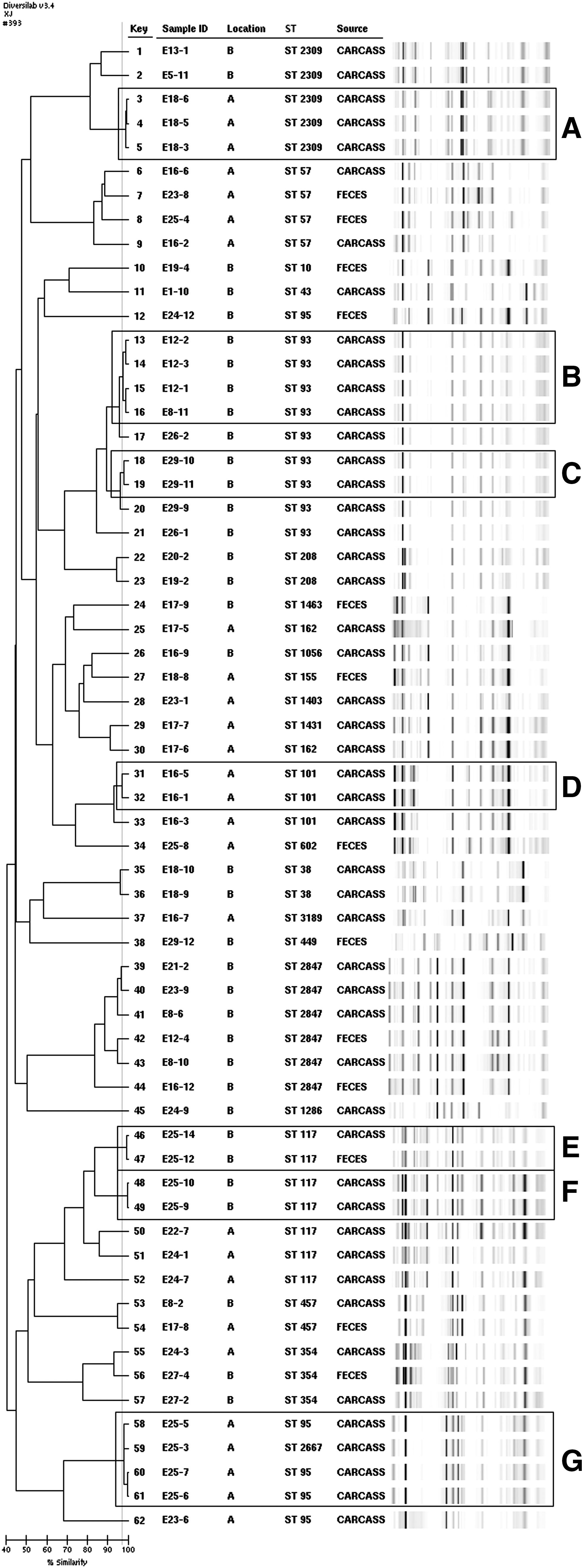
The DiversiLab™ system results (dendrogram and gel-like image) for extended-spectrum β-lactamase–producing Escherichia coli from chicken carcasses and fecal samples (class 1: source of the isolates; class 2: sequence type [ST]; class 3: slaughterhouse). A–G represent groups.
Molecular characterization by rep-PCR fingerprinting
The dendrogram generated from rep-PCR patterns and computer-generated virtual gel images is summarized in Figure 1. Strains displaying more than 97% similarity were divided into 7 diverse groups. Strains in groups A, C, D, F, and G were isolated on the same day from the same source and slaughterhouse, while strains in group B were isolated on different dates, but from the same source and slaughterhouse. Strains in group E were isolated from different sources, both feces and carcass.
Discussion
In this study, we found a higher occurrence of ESBL-producing E. coli in samples collected at slaughterhouse A (48.2%) than in those from slaughterhouse B (35%). Furthermore, we found a greater occurrence of ESBL-producing E. coli in chicken carcasses than in fecal samples. This result is consistent with that of a previous report from Portugal that detected ESBL-producing E. coli in 55.6% of chicken carcasses and 11.1% of fecal samples (Machado et al., 2008). A similar pattern of distribution was found in a Korean study on ESBL-producing Salmonella spp. in chicken farms, which reported 4% prevalence in carcasses and 1.8% in fecal samples (Tamang et al., 2011). Although these studies have found a higher prevalence of E. coli than Salmonella spp. in chicken farms and slaughterhouses, a consistent pattern of ESBL-producing bacteria found more frequently in carcass samples than in intestinal contents has emerged. A recent study of bacteria isolated from bioaerosols and surface swabs in a Slovakian slaughterhouse failed to detect the CTX-M gene, and found that the isolate has relatively low (14%) resistance to gentamicin (Gregova et al., 2012). By contrast, we found 40.3% of our isolates harbored the CTX-M gene, and reported a higher rate of resistance to gentamicin (38.3% and 46.2% in carcasses and fecal samples, respectively). Relative to our findings, the prevalence of ESBL-producing E. coli on retail chicken meat was lower in the United States (5%), higher in Spain (93.3%), and similar in Germany (43.9%). The antibiotic resistance to ciprofloxacin in Spanish and German studies was 32.2% and 7.6%, respectively (Egea et al., 2012; Kola et al., 2012), while strains found on Korean chicken in the present study were highly resistant (76.9%). The high rate of resistance to the fluoroquinolone group, ciprofloxacin, is due to the frequent use of fluoroquinolone antibiotics for poultry farming in South Korea (Jung et al., 2009).
In the rep-PCR results, each group (A–G) consists of genetically indistinguishable strains showing similarity >97% (Fig. 1). The rep-PCR distinguished strains from each slaughterhouse because strains in each group were from the same slaughterhouse. Also, all strains in each group, except some strains such as key number 46, 47, and 59, showed identical location, ST, and source of strain. These similar strains from same location and source might be originated either from a farm exclusively supplying broiler to slaughterhouse or from cross-contamination from environment of a byproduct processing plant. The rep-PCR assay demonstrated that strain 46 from a chicken carcass and strain 47 from a chicken fecal sample in slaughterhouse B appeared to have a similar origin. It indicates the possibility of cross-contamination between chicken carcass and the rectal area at the slaughterhouse (Fig. 1).
Kang et al. reported that ST131, ST405, and ST648 are the most prevalent STs in community-onset bacteremia caused by ESBL-producing E. coli in South Korea (Kang et al., 2013). We identified these three STs, as well as ST10, ST38, ST95, and ST354, all of which have also been previously isolated from clinical samples. Recently, Maluta et al. (2014) reported that avian pathogenic E. coli and extraintestinal pathogenic E. coli strains from clinical isolates shared nine serogroups (O2, O6, O7, O8, O11, O19, O25, O73, and O153) and nine STs (ST 10, ST 88, ST 93, ST 117, ST 131, ST 155, ST 359, ST 648, and ST 1011). Interestingly, we identified ST 93 and ST 117 as the most prevalent STs in our findings, suggesting a potential route of transmission. Based on their prominence, the serotypes and virulence of these strains should be characterized in future research.
To our knowledge, this is the first report of ESBL-producing E. coli isolated from a chicken slaughterhouse. However, because of the small number of sampling places and partial characterization of the isolates, we cannot generalize our results to characterize all poultry slaughterhouses in South Korea. Thus, more research on slaughterhouse environments and epidemiological studies on ESBL-producing E. coli contamination are needed. However, the rise of antibiotic-resistant bacterial strains is worrisome. Lim et al. (2014) investigated the trends in sales of antimicrobials for livestock and fisheries in South Korea, and found that the use of cephalosporin had increased fourfold between 2003 and 2012. Significant care and caution are required in using cephalosporins, and reduction and eradication efforts for ESBL-producing E. coli are necessary.
Footnotes
Acknowledgments
This work was supported by Animal, Plant and Fisheries Quarantine and Inspection Agency (No. B-FS03-2011-12-01). This research was also supported by the Bio-industry Technology Development Program of iPET (no. 112137-3) funded by the Ministry for Food, Agriculture, Forestry, and Fisheries.
Disclosure Statement
No competing financial interests exist.