




Abstract
Food handlers carrying enterotoxin-producing Staphylococcus are a potential source of food poisoning. The aim of this study was to analyze genes encoding enterotoxins in coagulase-positive Staphylococcus (CoPS) and coagulase-negative Staphylococcus (CoNS) isolated from the anterior nostrils and hands of food handlers at a university restaurant in the city of Natal, Northeast Brazil. Thirty food handlers were screened for the study. The isolates were subjected to Gram staining, a bacitracin sensitivity test, mannitol fermentation, and catalase and coagulase tests. CoNS and CoPS strains were subsequently identified by a Vitek 2 System (BioMerieux, France) and various biochemical tests. Polymerase chain reaction was used to detect genes for enterotoxins A, B, C, D, E, G, H, and I (sea, seb, sec, sed, see, seg, seh, and sei) and a disc-diffusion method was used to determine susceptibility to several classes of antimicrobials. All food handlers presented staphylococci on their hands and/or noses. The study found 58 Staphylococcus spp., of which 20.7% were CoPS and 79.3% were CoNS. S. epidermidis was the most prevalent species. Twenty-nine staphylococci (50%) were positive for one or more enterotoxin genes, and the most prevalent genes were seg and sei, each with a frequency of 29.3%. Indeed, CoNS encoded a high percentage of enterotoxin genes (43.5%). However, S. aureus encoded even more enterotoxin genes (75%). Most isolates showed sensitivity to the antibiotics used for testing, except for penicillin (only 35% sensitive). The results from this study reinforce that coagulase-negative as well as coagulase-positive staphylococci isolated from food handlers are capable of genotypic enterotoxigenicity.
Introduction
U
Materials and Methods
Sample collection and Staphylococcus identification
This study was conducted by collecting specimens from 30 food handlers working in a university restaurant between November 2012 and June 2013, after permission from the Ethics Committee on Research at the Federal University of Rio Grande do Norte and participant consent. The restaurant where the handlers worked serves approximately 4200 meals a day, providing for all individuals in the university community. A collection of biological samples from the anterior nostrils and hands (interdigital, subungual, and palm regions) of every food handler was made using a sterile swab moistened in sterile normal saline. The swabs were immediately placed in Brain Heart Infusion media (HiMedia, India) with 6.5% NaCl and incubated at 35°C for 24 to 48 h. Samples were then streaked on nutrient agar (HiMedia). Colonies were screened for Staphylococcus spp. by Gram staining, bacitracin sensitivity test (0.04 U; Newprov, Brazil), and catalase and coagulase tube tests. The CoNS and coagulase-positive Staphylococcus (CoPS) strains were identified by a Vitek 2 System (BioMerieux, France) and biochemical tests such as carbohydrate fermentation, urea degradation, Voges–Proskauer test, pyrrolidonyl arylamidase test, and novobiocin resistance (Murray et al., 2007). The strains were stored at −22°C in skim milk (BD Diagnostics, USA).
Antimicrobial susceptibility testing
Antimicrobial susceptibility testing was performed using a disk-diffusion method to penicillin G (10 U), cefoxitin (30 μg), erythromycin (15 μg), clindamycin (02 μg), linezolid (30 μg), trimethoprim–sulfamethoxazole (1.25/23.75 μg), chloramphenicol (30 μg), ciprofloxacin (05 μg), gentamicin (10 μg), rifampin (05 μg), and tetracycline (30 μg), according to the Clinical and Laboratory Standards Institute (CLSI, 2013). All isolates were further distinguished by a double-disk diffusion test (D-test) for the presence of inducible clindamycin resistance. The antibiotic discs were purchased from Newprov.
Detection of enterotoxin-encoding genes
DNA extraction was performed as described by Pacheco et al. (1997). Polymerase chain reaction (PCR) was used to analyze the following genes: sea, seb, sec, sed, see, seg, seh, and sei (Johnson et al., 1991; Mehrotra et al., 2000; Jarraud et al., 2002). Reactions were performed in a total volume of 25 μL containing 0.4 mM of each primer (Invitrogen, USA), 12.5 μL of 1X Master Mix (dNTP, MgCl2, and Taq DNA polymerase; Promega, USA), nuclease-free water (Promega), and 100 ng genomic DNA. Primer details are shown in Table 1. PCR amplification was performed using a Bio-Rad thermocycler (Bio-Rad, USA) with the following cycles: initial denaturation for 5 min at 94°C and then 30 cycles at 94°C for 2 min (denaturation) and 72°C for 1 min (extension). The various temperatures used in the annealing step are shown in Table 1. Final extension was performed at 72°C for 5 min (Rall et al., 2010). The PCR-amplified samples were analyzed by electrophoresis for 50 min at 110 V through a 1.5% agarose gel (Invitrogen) in 0.5X Tris/Borate/EDTA (0.09 M Tris-HCl, 0.09 M boric acid, 2 mM EDTA, pH 8.3; Bio-Rad, USA). A 100-bp ladder (New England Biolabs, USA) was used for reference. The gel was stained in a solution of Gel Red 3X (Biotium, USA) for 30 min and visualized by a Gel Doc™ EZ System (Bio-Rad). Positive controls used for comparison included S. aureus FRI 996 (sea, seb, and sed), S. aureus ATCC 19095 (sec, seh, and sei), S. aureus ATCC 27664 (see), and S. aureus ATCC 23235 (seg) (Fig. 1).
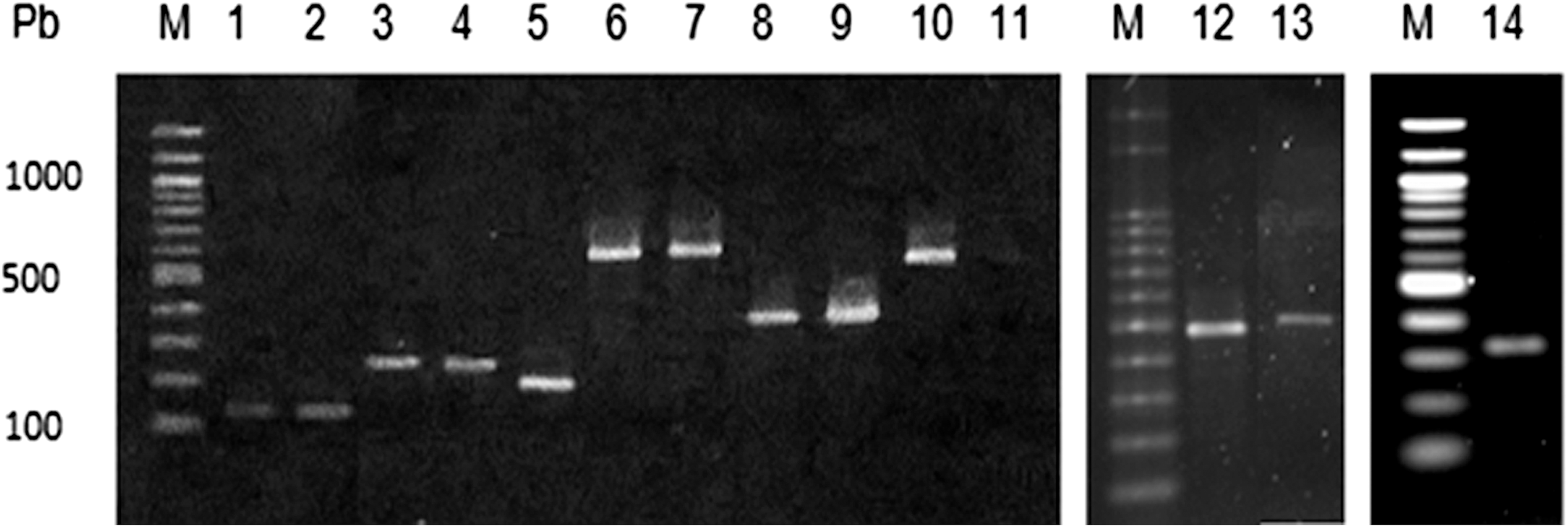
Agarose gel containing polymerase chain reaction–amplified products of enterotoxin-encoding genes in Staphylococcus spp. M, 100-pb DNA ladder; 1, positive control to sea (120 pb); 2, positive sample to sea (120 pb); 3, positive control to sec (257 pb); 4, positive sample to sec (257 pb); 5, positive control to see (209 pb); 6, positive control to seg (642 pb); 7, positive sample to seg (642 pb); 8, positive control to seh (376 pb); 9, positive sample to seh (376 pb); 10, positive control to sei (577 pb); 11, positive sample to sei (577 pb); 12, positive control to seb (478 pb); 13, positive sample to seb (478 pb); 14, positive control to sed (317 pb).
Results and Discussion
Food handlers carrying enterotoxin-producing bacteria in their noses or on their hands are regarded as the main source of food contamination, either via manual contact or respiratory secretions. Out of a total of 60 samples (hand and nasal samples combined), 58 Staphylococcus species were isolated, 46 (79.3%) being CoNS and 12 (20.7%) being S. aureus. All food handlers tested positive for Staphylococcus, but only two had the bacteria only on their hands. The high colonization rate by Staphylococcus spp. detected in this research represents a foodborne disease risk for consumers at the studied restaurant due to inadequate personal hygiene or cross-contamination. In the study, the presence of S. aureus on food handlers was similar to data reported previously (Figueroa et al., 2002; Bresolin et al., 2005; Grando et al., 2008). Several researchers have reported the presence of S. aureus in nasal mucosa of food handlers where the rate of nasal colonization varied between 20% and 30% (Simsek et al., 2009; Dagnew et al., 2012; El-Shenawy et al., 2013; Ho et al., 2014). However, in this study, the prevalence of S. aureus in nasal mucosa was higher (40%) than in the studies cited above. The CoNS species S. epidermidis, S. hominis, S. caprae, S. warneri, S. lugdunensis, S. saprophyticus, S. capitis, S. cohnii, S. chromogenes, and S. simulans were isolated from the handlers.
The most prevalent species was S. epidermidis (45.6%), followed by S. hominis (21.7%). Previous studies have found different CoNS species colonizing food handlers, reflecting differences in the distribution of microbiota among populations of people (Udo et al., 1999; Rall et al., 2010). The presence of species not commonly isolated in humans can be explained by the food handlers' contact with various types of food, which could transfer staphylococcal species during handling (Fontes et al., 2013; Lyra et al., 2013). Most isolates showed a sensitivity profile to antimicrobials, although 65% were resistant to penicillin, 37.9% to erythromycin, 29.3% to tetracycline, and 25.9% to trimethoprim–sulfamethoxazole. Importantly, two S. aureus species were D-test positive, demonstrating a resistance to clindamycin, an antibiotic frequently used to treat S. aureus infections. Although no methicillin-resistant Staphylococcus aureus (MRSA) was found, it is important to monitor the presence of this lineage in healthy individuals because, according to a 2011 CDC report, the rate of community-associated Staphylococcus aureus (CA-MRSA) has increased in past years. In this study, 29 (50%) of staphylococci encoded genes for enterotoxins. Among the isolates positive for enterotoxins, 20 were positive for only one gene, 8 harbored two genes, and 2 were positive for three genes.
The most prevalent genes were seg and sei (29.3% each), which highlights the importance of nonclassical enterotoxins. The distribution of enterotoxin genes by species found in this study is shown in Table 2. There is much ongoing research into the occurrence of Staphylococcus aureus on food handlers and its relationship to food-poisoning outbreaks, but the CoNS species are often neglected, as they are not considered human pathogens. In this study, the frequency of enterotoxin-encoding CoNS was significant (43.5%). However, S. aureus showed a higher frequency of enterotoxin-encoding genes (75%). There are few studies evaluating the enterotoxins in CoNS isolated from food handlers, but some authors have detected genes for enterotoxins as well as enterotoxins at the protein level in this group (Udo et al., 1999; Veras et al., 2008; Rall et al., 2010; Lyra et al., 2013). The colonization of enterotoxin-encoding Staphylococcus on the hands and noses of food handlers is troublesome because of its link to outbreaks of foodborne illness and suggestion of poor hygiene among these workers. Considering the classic enterotoxin-encoding genes found in this study, the gene sec had a high frequency (26.8%). Lyra et al. (2013) and Loncarevic et al. (2005) also observed a similarly high frequency, a stark contrast to other studies where the gene sec was present at a low frequency and sea was the most prevalent (Figueroa et al., 2002; Holecková et al., 2002; Cha et al., 2006).
H, hands; n, nostrils; SE, staphylococcal enterotoxin.
Likewise, in a study conducted in Brazil with food handlers, researchers found a low percentage of the sec gene in CoNS (Rall et al., 2010). The results from this study demonstrate that coagulase-negative as well as coagulase-positive staphylococci isolated from food handlers harbor enterotoxin-encoding genes. Although enterotoxin production has not been investigated here, the ability of these strains to produce enterotoxins cannot be excluded.
Footnotes
Acknowledgments
The authors would like to acknowledge the financial support received from the FAPERN (Fundação de apoio à Pesquisa do Estado Rio Grande do Norte)/CNPq (Conselho Nacional de Desenvolvimento Científico e Tecnológico) and Dr. Celso José Bruno de Oliveira from the Federal University of Paraiba (UFPB) for providing the standard bacterial strain used as a positive control (S. aureus ATCC 23235).
Disclosure Statement
No competing financial interests exist.