




Abstract
Several real-time polymerase chain reaction (PCR) assays have been developed to detect and quantify Shiga toxin–producing Escherichia coli (STEC) O157:H7, but none have targeted the O-antigen specific gene (rfbEO157) in combination with the three major virulence genes, stx1, stx2, and eae. Our objectives were to develop and validate a four-plex, quantitative PCR (mqPCR) assay targeting rfbEO157, stx1, stx2, and eae for the detection and quantification of STEC O157 in cattle feces, and compare the applicability of the assay to detect STEC O157 to a culture method and conventional PCR (cPCR) targeting the same four genes. Specificity of the mqPCR assay to differentially detect the four genes was confirmed with strains of O157 and non-O157 STEC with different profiles of target genes. In cattle feces spiked with pure cultures, detection limits were 2.8×10⁴ and 2.8×100 colony-forming units/g before and after enrichment, respectively. Detection of STEC O157 in feedlot cattle fecal samples (n=278) was compared between mqPCR, cPCR, and a culture method. The mqPCR detected 48.9% (136/278) of samples as positive for E. coli O157. Of the 100 samples that were randomly picked from 136 mqPCR-positive samples, 35 and 48 tested positive by cPCR and culture method, respectively. Of the 100 samples randomly chosen from 142 mqPCR-negative samples, all were negative by cPCR, but 21 samples tested positive by the culture method. McNemar's chi-square tests indicated significant disagreement between the proportions of positive samples detected by the three methods. In conclusion, the mqPCR assay that targets four genes is a novel and more sensitive method than the cPCR or culture method to detect STEC O157 in cattle feces. However, the use of real-time PCR as a screening method to identify positive samples and then subjecting only positive samples to a culture method may underestimate the presence of STEC O157 in fecal samples.
Introduction
S
Although culture-based procedures (direct plating, spiral plating, most-probable number method) have been developed to quantify STEC O157 in feces, they are time consuming and labor intensive, and therefore not practical in studies that require testing a large number of samples (Omisakin et al., 2003; Fegan et al., 2004; Robinson et al., 2004; LeJeune et al., 2006; Brichta‐Harhay et al., 2007; Fox et al., 2007; Stephens et al., 2007). Real-time quantitative PCR (qPCR) to detect and quantify STEC O157 is a sensitive and rapid method, with the added advantages of high-throughput capability and potential for automation. Several multiplex qPCR assays targeting different combinations of major genes of STEC O157, including rfbE (O157 antigen), per (O157 antigen), ecf1 (attaching and effacing gene conserved fragment 1), uidA (b-glucuronidase), stx1 (Shiga toxin 1), stx2 (Shiga toxin 2), eae (intimin), and ehxA (enterohemolysin) have been developed (Fortin et al., 2001; Reischl et al., 2002; Ibekwe and Grieve, 2003; Sharma and Dean-Nystrom, 2003; Fitzmaurice et al., 2004; Hsu et al., 2005; Wang et al., 2007; Jacob et al., 2012; Guy et al., 2014; Luedtke et al., 2014). However, these assays have targeted only up to three genes concurrently, and none have included antigen-specific O157 gene (rfbE) in combination with the three major virulence genes (stx1, stx2, and eae). Our group has developed a multiplex real-time PCR assay that targeted rfbE, stx1, and stx2 to quantify STEC O157 in cattle feces (Jacob et al., 2012). Because eae is critical for bacterial attachment and a certain proportion of STEC O157 contain stx1 alone or in association with stx2, all four genes (rfbE, stx1, stx2 and eae) are better targets to detect and quantify STEC O157 in cattle feces. Optimization of a four-plex PCR reaction is challenging because of potential interactions among primers and probes in the reaction. Multiple primer pairs and probes can often result in the formation of secondary structures, which can then be amplified in lieu of target DNA. Dimer interactions become increasingly problematic for optimization of multiplex (four-plex) qPCR (mqPCR), especially when more than three genes are targeted (Elnifro et al., 2000; Mackay et al., 2004); therefore, very few mqPCR assays have been developed that target four genes simultaneously (Pavlovic et al., 2010; Anklam et al., 2012; Luedtke et al., 2014). The objectives of this study were to develop a mqPCR assay that targeted rfbEO157, stx1, stx2, and eae genes for quantification of STEC O157 and validate the assay with pure cultures and cattle feces spiked with pure cultures. In addition, the applicability of the assay to detect STEC O157 in feedlot cattle feces was determined and compared with conventional PCR (cPCR) targeting the same four genes and a culture method of detection.
Materials and Methods
STEC strains
A strain of STEC O157 (CDC EDL932; ATCC 43894; American Type Culture Collection, Manassas, VA) that is positive for the four target genes (rfbE, stx1, stx2 and eae) was used in the initial development and optimization of the assay conditions. The strain was grown overnight at 37°C on a blood agar plate (Remel, Lenexa, KS). DNA extraction from colonies was performed with Qiagen DNeasy blood and tissue kit (Qiagen, Valencia, CA). Ten-fold serial dilutions of the extracted DNA were performed in ddH2O for the mqPCR assay. Subsequent validation of the assay included additional strains of STEC O157 with different combinations of the target genes, and strains of non-O157 STEC (Table 1). Analytical specificity of the mqPCR assay was tested with 25 strains of STEC O157, 26 strains of non-O157 STEC that included O26, O45, O103, O111, O121, and O145 serogroups, and 4 strains of non-E. coli bacteria (Klebsiella pneumoniae, Morganella morganii, Salmonella enterica [serogroup C1], and Serratia marcescens).
Primers and probes
The primers and probes for rfbEO157, stx1, and stx2 were from a previous study (Jacob et al., 2012). Primers and probe for eae were designed based on evaluations of 315 sequences from the GenBank database available at the time. Sequences from the database were aligned using ClustalX version 2.1 (
mqPCR running conditions
The working concentrations of all primers in a primer mix were 10 pM/μL. The working concentrations of probes were as follows: rfbE (2.5 pM/μL), stx1 (1.0 pM/μL), stx2 (10.0 pM/μL), and eae (10.0 pM/μL). The reaction consisted of 1 μL of primer mix and each probe, 10 μL of BioRad iQ multiplex powermix, 4 μL of sterile PCR grade water, and 1 μL of DNA template (total reaction volume=20 μL). The assay running conditions consisted of 95°C for 10 min, followed by 45 cycles of 95°C for 15 s, 56°C for 20 s, and 72°C for 40 s. Probe concentrations were optimized by comparing different dilutions of each probe for each target gene. All samples used to generate standard curve data, PCR efficiency, and R2 values were run in triplicate. Assays were performed with the BioRad (Hercules, CA) CFX96 Real-Time System.
Analytical sensitivity of the mqPCR assay
The analytical sensitivity of the assay was assessed with five strains of E. coli O157 with variable target genes (four STEC and one non-STEC) and six strains of non-O157 STEC belonging to O26, O45, O103, O111, O121, and O145 serogroups (Table 1). Single colonies of E. coli strains grown on blood agar plates were inoculated into 10 mL Luria-Bertani (LB; Becton Dickinson Co., Sparks, MD) broth and incubated at 37°C for 16 h. Then, 100 μL was inoculated into 10 mL LB and incubated at 37°C until an absorbance of 0.4 (600 nm) was achieved (approximately 3 h and 108 CFU/mL). Serial 10-fold dilutions in LB broth were prepared and 1 mL from each of 10–1 to 10–7 dilutions was boiled for 10 min and centrifuged at 9000 RCF for 5 min to obtain a crude DNA preparation. Extracted DNA (1 μL) was then subjected to the mqPCR assay. To determine viable cell counts (CFU/mL), 100 μL of the serially diluted LB broth (dilutions 10–5, 10–6, and 10–7) were spread-plated on blood agar plates and incubated overnight at 37°C, then colonies were counted. Two replications of the assay with pure cultures of STEC/non-STEC O157 and non-O157 STEC strains were performed.
Cattle feces that were spiked with pure cultures of STEC O157 ATCC 43894 and ATCC 43889 strains with variable target genes were also tested to determine the analytical sensitivity of the assay. Fecal samples were obtained from pen-floor fecal pats from the university dairy farm. Fecal samples confirmed as negative for the four target genes by the mqPCR assay were used. Serial 10-fold dilutions of STEC ATCC 43894 and 43889 were prepared in LB broth as previously described and DNA was extracted from each dilution. One milliliter from each serial dilution of LB was added to 10 g of feces and mixed thoroughly. Then, 1 g of spiked fecal mix was added to 9 mL of Gram-negative broth (Becton Dickinson Co.) amended with cefixime (0.05 mg/L), cefsulodin (10 mg/L), and vancomycin (8 mg/L; GNccv) and vortexed. One milliliter of spiked fecal sample suspended in GNccv broth was removed before and after a 6-h enrichment at 37°C, boiled for 10 min, and centrifuged at 9000 RCF for 5 min to obtain a crude DNA template. Extracted DNA was purified with a GeneClean® Turbo Kit (MP Biomedicals LLC, Solon, OH) and subjected to the mqPCR assay. Two replications of the spiked fecal sample experiment were performed for each strain of STEC O157 (ATCC 43894 and 43889). Minimum detection limits, based on cycle threshold (Ct) values from the mqPCR assay, were determined for pure cultures, as well as for spiked fecal samples before and after 6-h enrichment.
Application of mqPCR assay to detect STEC O157 in fecal samples from naturally shedding feedlot cattle
DNA, extracted from cattle fecal samples after a 6-h enrichment, was utilized from a prior study (Cull et al., 2012) on fecal shedding of STEC O157:H7. Extracted DNA was from a subset of fecal samples (n=278), randomly selected from a total of 1200 samples from the control group. Of the samples that were positive (136/278) and negative by mqPCR (142/278) for STEC O157, 100 randomly selected (using the RAND and SORT functions in Microsoft Excel [Microsoft Corporation, Redmond, WA]) samples of each were tested by a conventional PCR assay (Bai et al., 2010) that targeted the same 4 genes, rfbEO157 , stx1, stx2, and eae. Multiplex qPCR and cPCR results were compared with a culture-based method of detection, which was based on immunomagnetic bead separation, plating on a selective medium, and PCR confirmation of the putative isolates. The culture data were obtained from the previous study (Cull et al., 2012).
Statistical analysis
Cohen's κ statistic and 95% CI were computed to determine the agreement beyond that due to chance between mqPCR, cPCR, and culture methods for detection of STEC O157 in fecal samples using STATA MP 12.0 (StataCorp., College Station, TX). Interpretations of the κ statistic were based on the scale proposed by Landis and Koch (Landis and Koch, 1977). In addition, the McNemar's chi-square test (McNemar, 1947) was used to compare the proportion of positives identified by the three detection methods. When McNemar's tests were significant, κ statistics were provided for reference only.
Receiver operating characteristic (ROC) curve analysis was used to analyze average Ct values of 100 mqPCR positive samples against positive or negative detection values of cPCR. Given that Ct values are negatively correlated with a positive outcome (e.g., lower Ct values indicate a positive reaction, thus a sample is more likely to be classified as positive), a reciprocal transformation of the Ct values was performed. Reciprocal Ct values were used as discrimination thresholds to determine diagnostic sensitivity and specificity of the cPCR assay as it relates to the mqPCR.
Results
The optimization of the mqPCR assay was achieved with DNA from the STEC O157 ATCC 43894 strain, which was positive for all four target genes. The end-point threshold cycle (Ct) values for each of the 4 genes were determined and standard curve data were generated from serially diluted (10-fold dilutions) DNA. An average end-point Ct value of 38.5 was obtained for the 4 genes. Correlation coefficients were >0.99, and PCR efficiencies were 90–110%. Based on colony count data, the average minimum detection limit was 3.1×10³ CFU/mL for STEC ATCC 43894 (Table 3).
Data are shown as means from two independent experiments.
Analytical specificity
Specificity of the mqPCR assay was tested with strains of STEC O157 (n=25), non-O157 STEC (n=26) and non-E. coli bacterial species (n=4) and results indicated that the assay correctly detected the presence or absence of the 4 genes, rfbEO157, stx1, stx2, and eae (data not shown) in all strains (n=55). In the non-O157 STEC serogroups, the assay detected only the virulence genes and not the rfbE gene (Table 3).
Analytical sensitivity with pure cultures
Two replications of the pure culture assay were performed on STEC/non-STEC O157 and non-O157 STEC strains with variable target genes (Table 3). Initial concentrations of all STEC/non-STEC O157 subjected to 10-fold serial dilutions were from 3.1 to 3.5×10⁸ CFU/mL. The average minimum detection limits of the assay for all STEC/non-STEC O157 strains used in the study were from 3.1 to 3.5×10³ CFU/mL with average Ct values of 37.6 to 38.8. Correlation coefficients were >0.99 for all pure cultures of STEC/non-STEC O157 and PCR efficiencies were 90–110%. Initial concentrations of pure cultures of non-O157 STEC strains subjected to 10-fold serial dilutions were from 2.2 to 2.7×10⁸ CFU/mL with average Ct values of 37.6–38.8. As expected, none of the six non-O157 STEC showed amplification of the rfbEO157 gene. For non-O157 STEC with variable stx1, stx2, and eae genes, the average minimum detection limit of the assay was from 2.2 to 2.7×10³ CFU/mL. Correlation coefficients for all non-O157 STEC pure cultures, determined from the standard curve data, were >0.99 and PCR efficiencies were 91–112% (Table 3).
Analytical sensitivity with cattle feces spiked with STEC O157
Before enrichment, the minimum detection limits of the assay with feces spiked with serially diluted cultures (10-fold) of E. coli ATCC 43894 (positive for all 4 genes) or ATCC 43889 (positive for rfbEO157, stx2, and eae) were 2.8×10⁴ and 2.9×10⁴ CFU/g, respectively. After 6 h of enrichment, the detection limit was improved to 2.8×100 and 2.9×100 CFU/g for E. coli ATCC 43894 and ATCC 43889, respectively (Table 4).
Data are shown as means from two independent experiments.
CFU, colony-forming units.
Application of mqPCR assay and comparison with cPCR and a culture method for detection of STEC O157 in fecal samples from feedlot cattle
In the assay of fecal samples (n=278) by mqPCR assay, a sample positive for rfbE, eae, and at least 1 stx gene was considered as positive and a sample negative for rfbE was considered negative for STEC O157. Of the 278 fecal samples subjected to mqPCR, 136 were positive and had Ct values that were below the designated maximum threshold for rfbE (38.1), eae (37.9), and either or both stx1 (37.8) and stx2 (37.9) genes. Of the 100 samples that were randomly picked from the 136 positive samples, 35 tested positive by cPCR and 48 were positive by culture-based detection (Table 5). Of the 100 samples randomly chosen from the 142 that were negative by mqPCR, none were positive by cPCR, but 21 samples tested positive by the culture method (Table 5). The Cohen's κ statistics indicated a slight agreement beyond that due to chance between the mqPCR and cPCR tests (κ=0.35) and between mqPCR and the culture method (κ=0.27). The McNemar's chi-square tests for these comparisons were statistically significant (p<0.05), indicating a disagreement between the proportions of positive samples detected by these methods (Table 5).
Based on the detection of the genes that code for O157 antigen, rfbE, and the three virulence genes, stx1, stx2, and eae in feces enriched in Gram-negative broth amended with cefixime (0.05 mg/L), cefsulodin (10 mg/L), and vancomycin (8 mg/L) at 37°C for 6 h (Bai et al., 2012).
Based on immunomagnetic separation, plating on selective medium, and confirmation of the isolate by a multiplex PCR that targeted rfbE, stx1, stx2, and eae genes (Cull et al., 2012).
Analysis of the Ct values of the 35 samples that tested positive by the cPCR assay indicated that 30 samples (86%) had average Ct values <31.0 for all 4 target genes (Fig. 1A). For the Ct values of the 65 samples that tested negative by the cPCR assay, 63 samples (97%) had average Ct values >31.0 (Fig. 1B). The ROC curve analysis determined that a Ct value of 31.0 (reciprocal value=0.0322) yielded optimum sensitivity (85.7%) and specificity (96.9%) as well as the highest number of samples correctly classified (93%) by the cPCR assay. Diagnostic sensitivity, false-positive rate (1-specificity), and area under the curve for all observations are depicted in the ROC curve in Figure 2.

Percentages of cycle threshold (Ct) values of the 100 multiplex quantitative polymerase chain reaction (PCR)–positive fecal samples from feedlot cattle that were greater (dark gray) or lower (light gray) than Ct 31 in positive (n=35;
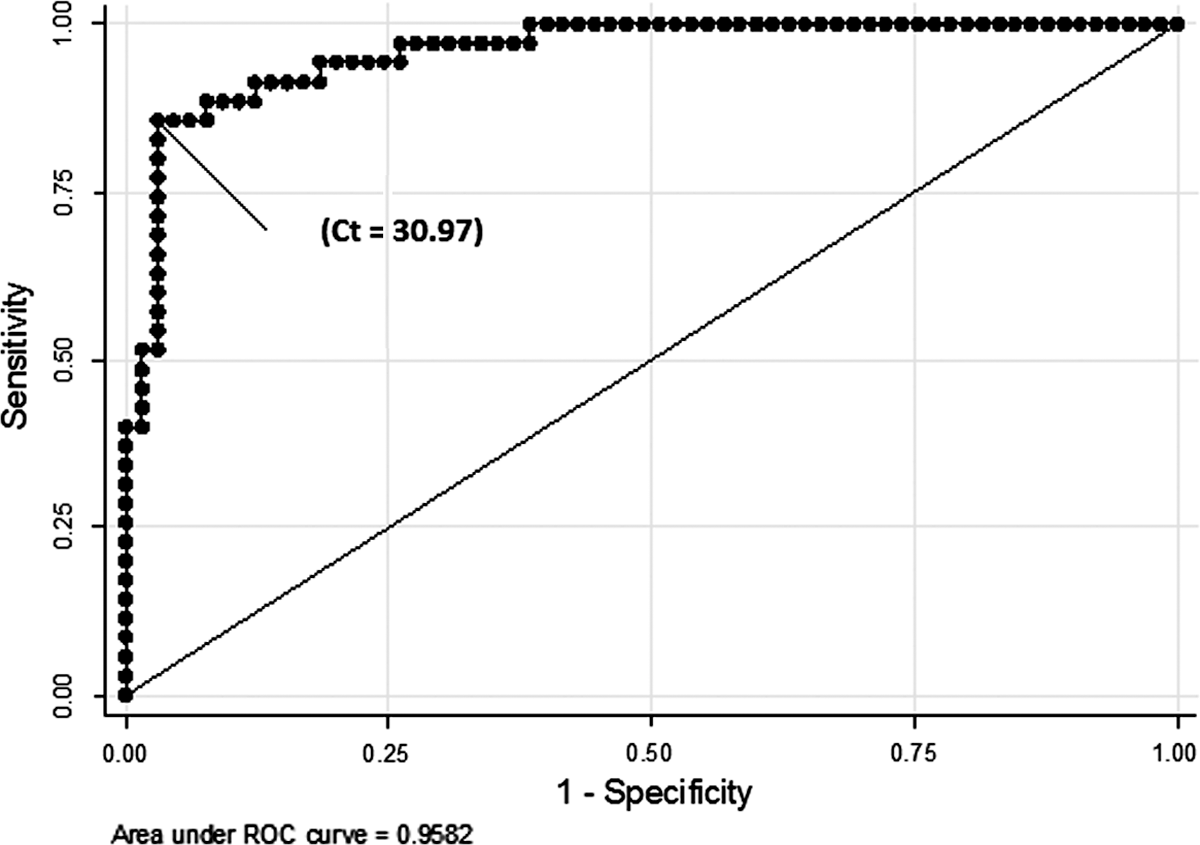
Receiver Operating Characteristic (ROC) graph of conventional polymerase chain reaction (PCR) for 100 feedlot cattle fecal samples positive for Shiga toxin–producing Escherichia coli O157 by multiplex quantitative PCR. (95% CI 0.90074–0.98900; SE=0.0184). Ct, cycle threshold.
Discussion
Our multiplex, real-time PCR assay is novel in that it targets the O157-specific gene and the three major virulence genes concurrently. Many multiplex qPCR assays that target different combinations of major genes of STEC O157, generally rfbEO157, per, ecf1, uidA, fliC H7 , stx1, stx2, eae, and ehxA have been developed (Fortin et al., 2001; Ibekwe and Grieve, 2003; Sharma and Dean-Nystrom, 2003; Fitzmaurice et al., 2004; Hsu et al., 2005; Bertrand and Roig, 2007; Wang et al., 2007; Madic et al., 2011; Anklam et al., 2012; Jacob et al., 2012; Leudtke et al., 2014; Mancusi and Trevisani, 2014; Russo et al., 2014). In addition, a number of real-time PCR-based commercial detection systems with undisclosed gene targets have been used to detect and quantify STEC O157 (Burns et al., 2011; Fratamico et al., 2014; Wasilenko et al., 2014). These assays have been used to characterize isolates, and to detect and/or quantify STEC O157 in a variety of sample matrices, including feces, ground beef, dairy products, produce, and wastewater. However, only a few of the assays have been applied for the detection and quantification of STEC O157 in fecal samples (Ibekwe and Grieve, 2003; Sharma and Dean-Nystrom, 2003; Fitzmaurice et al., 2004; Hsu et al., 2005; Wang et al., 2007; Anklam et al., 2012; Jacob et al., 2012; Leudtke et al., 2014). Only the assay developed by Jacob et al. (2012) targeted the combination of the serogroup-specific rfbE gene with the stx1 and stx2 genes, but the assay did not include eae. Although stx1 and stx2 genes share nucleotide (58%) and amino acid (56%) sequence homologies (Jackson et al., 1987), there is no consensus region (65–200 bp) that can be used to design a single primer pair for both genes. Because intimin is a critical virulence factor for attachment to enterocytes, we chose to include eae gene to make it a four-plex assay. Anklam et al. (2012) developed two sets of multiplex qPCR assays: one targeting rfbE with uidA as an internal E. coli control and the other targeting the four virulence genes (stx1, stx2, eae, and ehxA). Leudtke et al. (2014) targeted the enterohemorrhagic E. coli (EHEC)–specific target gene, ecf1, in combination with the three virulence genes (stx1, stx2, and eae). The advantage of targeting the ecf1 gene is that it identifies all EHEC (O157 and other serogroups). Our assay is designed to detect and quantify only E. coli O157 serogroup and the three virulence genes. None of the previous studies with the exception of Jacob et al. (2014) have compared the real-time assay with conventional PCR and culture method of detection of STEC O157 in the feces of naturally shedding cattle.
The results obtained in this study indicate that the mqPCR assay is a sensitive method to detect and quantify STEC O157 in cattle feces. The validation of the quantification was done with pure cultures or feces spiked with pure cultures of STEC O157. The assay also may be useful in identifying cattle that shed very high concentrations of STEC O157 (≥104 CFU/g). However, the application of mqPCR in determining fecal concentration of STEC O157 in naturally shedding cattle and a comparison with the culture-based method (direct plating, spiral plating, MPN method, etc.) needs to be evaluated. Based on the assay with pure cultures of strains of STEC O157, the minimum detection limit was 103 CFU/mL, which is in agreement with a previous study (Jacob et al., 2012). A positive fluorescence signal for rfbE was absent for all non-O157 STEC, indicating the serogroup specificity of the mqPCR assay for STEC O157. Average minimum detection limits for remaining target genes with non-O157 STEC, subjected to 10-fold serial dilutions, were slightly higher compared to STEC O157 strains.
DNA extracted directly from cattle feces spiked with two strains of STEC O157 (ATCC 43894 and ATCC 43889) generated a minimum detection limit of ≈104 CFU/g for the mqPCR assay, which is also in agreement with the previous study (Jacob et al., 2012). However, detection limits slightly improved when an enrichment step was included. Minimum detection limits of the mqPCR assay for both pre-enriched and enriched samples were similar between the strains tested, indicating precise detection of STEC O157 strains variable for the target genes. Although the assay can accurately detect the presence of E. coli O157 serogroup and the three virulence genes, it is possible that virulence genes amplified in a sample could be from non-O157 STEC present in the feces.
When comparing agreement among tests, McNemar's chi-square tests (p<0.05) indicated disagreement between the proportion of positive samples detected by mqPCR, cPCR, and the culture method, indicating possible differences in sensitivity among the three methods. Based on ROC curve analysis of Ct values, the cPCR was less sensitive than mqPCR in detecting rfbE, stx1, stx2, and eae genes. Overall, the mqPCR assay detected a higher proportion of positive samples than the cPCR assay or culture method. However, 21% of samples that were positive by culture method were negative by the mqPCR, which indicates that the use of real-time PCR to screen samples before subjecting positive samples to a culture method may underestimate the presence of STEC O157 in fecal samples. The reason for the misidentification of culture-positive samples by mqPCR is not known but is likely reflective of the difference in detection limit between the two methods. The mqPCR requires a concentration approaching 104 CFU/g for detection, whereas the immunomagnetic bead-based culture method may be able to capture E. coli O157 cells at lower concentrations. As with any PCR assay, there is also a possibility for false positives because of amplification of DNA from nonviable cells in the feces.
In conclusion, the validated mqPCR assay is novel in that it targets four major genes (rfbE, stx1, stx2, and eae) of STEC O157. Although mqPCR is a more sensitive method of detection, the use of real-time PCR as a screening method to identify positive samples and then subjecting only positive samples to a culture method may underestimate the presence of STEC O157 in fecal samples. Therefore, subjecting fecal samples to culture-based methods may remain necessary, in addition to real-time PCR, to obtain a more accurate estimate of the presence of STEC O157 in cattle feces.
Footnotes
Acknowledgments
The authors wish to thank Neil Wallace for his assistance in this project. This publication is contribution no. 15-254-J from the Kansas Agricultural Experiment Station, Manhattan, KS. This research was supported by the Agriculture and Food Research Initiative Competitive Grant no. 2012-68003-30155 from the USDA National Institute of Food and Agriculture.
Disclosure Statement
No competing financial interests exist.