




Abstract
Salmonella is commonly found in a variety of food products and is a major cause of bacterial foodborne illness throughout the world. In this study, we investigated the prevalence and diversity of Salmonella in eight different food types: sheep ground meat, cow ground meat, chicken meat, cow offal, traditional Sanliurfa cheese, unripened feta cheese, pistachios, and isot (a spice blend of dried red peppers specific to Sanliurfa), traditionally and commonly consumed in Turkey. Among 192 food samples, Salmonella was detected in 59 samples, with the highest prevalence in raw poultry parts (58%) and offal (58%) samples, while Salmonella was not detected in pistachios and dried red pepper. Resultant Salmonella isolates were characterized by serotyping, multilocus sequence typing (MLST), and pulsed-field gel electrophoresis (PFGE). Ten different serotypes represented 10 MLST sequence types (STs) with 1 novel ST and 17 PFGE types. Antimicrobial resistance profiling revealed that 30.5% of the isolates were resistant to two or more antimicrobials. Salmonella enterica subsp. enterica serotype Telaviv, which is rare throughout the world, was the second most common serotype isolated from food samples in this study, suggesting that this serotype might be one of the subtypes that is endemic to Turkey.
Introduction
S
Among many methods, serotyping represents the cornerstone for Salmonella classification and nomenclature (Wiedmann, 2002; Grimont and Weil, 2007; Wattiau et al., 2011), but it lacks the ability to reveal the phylogenic relation between different subtypes. DNA-based methods are commonly used to further subtyping of strains (Harbottle et al., 2006; Soyer et al., 2010). Among molecular subtyping tools, multilocus sequence typing (MLST), based on comparison of nucleotide sequences of the housekeeping genes, has the advantage of providing portable subtyping data, which are easier to interpret, exchange, and compare between different laboratories through the open-access internet-based databases (Wiedmann, 2002; Urwin and Maiden, 2003). Thus, the analysis displays true evolutionary relationship of the isolates (Alcaine et al., 2006; Achtman et al., 2012). However, MLST may not reach the discriminatory power of pulsed-field gel electrophoresis (PFGE), a valuable tool in epidemiological investigation and surveillance (Refsum et al., 2002; Wonderling et al., 2003).
Retrospective knowledge about the relationship between subtype and food source or geographical location of isolation can facilitate the outbreak investigation process. Hence, we aim to determine the spatial and temporal groups of different Salmonella subtypes from various food samples in a pilot region (i.e., Sanliurfa) in Turkey by using phenotypic (serotyping and antimicrobial susceptibility test by disk diffusion) and genotypic (MLST and PFGE) methods.
Materials and Methods
Food samples
Eight different types of samples (raw ground sheep meat, raw ground cow meat, chicken meat parts, cow offal, traditional Sanliurfa cheese, unripened feta cheese, pistachios, and isot [a spice blend of dried red peppers specific to Sanliurfa]) were collected from retail and street vendors in different districts in the south part of Turkey, the city Sanliurfa. Food samples were collected over four different sampling periods, representing the seasons of a year (i.e., spring, summer, fall, and winter), between April 2012 and December 2012. During each sample collection, two different districts in Sanliurfa city were designated as the sampling districts. For each food type, three food samples were collected from each district, resulting in the collection of six food samples for each food type in a sampling period. In total, 192 food samples were collected. Food samples were transferred overnight in cold-chain conditions to the Food Engineering Department at Middle East Technical University, Ankara, where all analysis was conducted.
Isolation of Salmonella
Food samples were microbiologically analyzed to detect and isolate Salmonella in compliance with the standard of ISO 6579:2002 (ISO, 2002). For Salmonella confirmation of presumptive positive colonies, polymerase chain reaction (PCR) was performed by the amplification of genus-specific 678-bp region of Salmonella, invA gene (Kim et al., 2007). Amplified DNA fragments were observed under ultraviolet light after gel electrophoresis procedure for 30 min at 110 V. Confirmed Salmonella isolates were stored at −80°C in a solution in 15% glycerol.
Serotyping
Serotyping of isolates was conducted according to the White-Kauffmann–Le Minor scheme (Grimont and Weil, 2007) at the laboratory of the Public Health Agency of Turkey in Ankara, where a second Salmonella confirmation was also performed by using biochemical tests.
Antimicrobial susceptibility test (AST)
The disk diffusion method was performed to characterize the antimicrobial resistance profile of the isolates. Eighteen different antimicrobials (Oxoid Ltd., Basingstoke, UK) were analyzed: amikacin 30 μg (AK), gentamicin 10 μg (GN), kanamycin 30 μg (K), streptomycin 10 μg (S), ciprofloxacin 5 μg (CIP), nalidixic acid 30 μg (N), ampicillin 10 μg (AMP), amoxicillin–clavulanic acid 20/10 μg (AMC), tetracycline 30 μg (TE), cefoxitin 30 μg (FOX), cephalothin 30 μg (KF), ertapenem 10 μg (ETP), ceftriaxone 30 μg (CRO), ceftiofur 30 μg (EFT), sulfisoxazole 300 μg (SF), sulfamethoxazole–trimethoprim 23.75/1.25 μg (SXT), chloramphenicol 30 μg (C), and imipenem 10 μg (IPM) (CLSI, 2002). The quality control strain was Escherichia coli ATCC 25922 (Favier et al., 2013; Rothrock et al., 2015). The susceptibility limits of antimicrobial agents except ceftiofur were determined by the Clinical Laboratory Standards Institute's (CLSI) latest report (CLSI, 2013), and the limits for ceftiofur were set according to the CLSI report in 2002 (CLSI, 2002). Isolates showing resistance to two or more antimicrobial agents were considered to be multidrug resistant (MDR).
MLST
PCR amplification and the subsequent DNA sequencing of seven housekeeping loci were performed according to S. enterica MLST at University of Warwick (UoW) (available on
PFGE
PFGE was performed using the PulseNet standardized protocol with additional 50 μM thiourea to the running buffer (Murase et al., 2004; Ribot et al., 2006). PFGE plugs were digested with XbaI (Roche Applied Science, Mannheim, Germany) and Salmonella Braenderup H9812 was used as a molecular size standard in all PFGE gels run on the CHEF-DR III system (Bio-Rad Laboratories, Hercules, CA). The gel pictures were analyzed using BioNumerics software (Applied Maths, Sint-Martens-Latem, Belgium). Similarity analysis was conducted using Dice coefficient and clustering was performed using the unweighted-pair group method by arithmetic mean. PFGE types were assigned unique numerical identifiers (i.e., PT 1).
Phylogenetic and statistical analyses
Phylogenetic analysis was performed, and phylogenetic trees were constructed using MegAlign software (DNAStar). Via the concatenation of seven genes for each isolate, an overall phylogenetic tree was formed. Neighbor-joining format was used for the display of the trees.
Due to the low values of many integers, 2 × 2 two-tailed Fischer exact test was used in order to examine the relationship between food types with STs and serotypes. P values of <0.05 were evaluated as statistically significant. Simpson's Index of Diversity (SID) was calculated for the comparison of the discriminatory power of serotyping, MLST, and PFGE.
All information for isolates, including isolate source, serotypes, STs, antimicrobial resistance profiles, and PFGE types, is publicly available at the Pathogen Detector website (
Results
The high prevalence of Salmonella among food samples
A total of 59 among 192 food samples were as positive for Salmonella (30.1%). The highest prevalence of Salmonella (39.6%) was observed in the food samples collected in the fall, which was followed by the prevalence of summer (N = 15, 31.3%), spring (N = 13, 27%), and winter (N = 12, 25%) periods, respectively. Among eight food categories, the highest prevalence of Salmonella was found in chicken meat and offal; 58.3% of samples were Salmonella-positive in chicken meat and offal groups. Meanwhile, prevalence in cattle and sheep ground meat was obtained in 13 samples (54.2%) and 12 samples (50%), respectively. Lower prevalence values were observed in cheese groups (i.e., four unripened feta cheese, 16.7%, and two Sanliurfa cheese, 8.3%). In dried food samples (i.e., pistachios and isot), Salmonella was not detected.
Serotyping and MLST
For three isolates, multiple serotyping attempts resulted in different serotypes that did not match with the genotyping analysis (i.e., MLST and PFGE). Therefore, three isolates were excluded from the isolate set that is reported from this point. A total of 56 S. enterica subsp. enterica isolates represented 10. Salmonella Infantis (n = 15), Salmonella Telaviv (n = 13), and Salmonella Anatum (n = 11) were the 3 dominant serotypes accounting for approximately 67.8% of 56 isolates, which were followed by Salmonella Montevideo (n = 7), Salmonella Reading (n = 3), and Salmonella Kentucky (n = 2), Salmonella Newport (n = 2). Furthermore, one isolate was classified as Salmonella Typhimurium, Salmonella Hadar, and Salmonella Othmarschen serotypes (Table 1). As a result, the SID calculated for serotyping of 56 isolates was 0.83.
One cattle ground meat isolate, one sheep ground meat isolate, and one offal isolate, all with ST 195 resulted in inaccurate serotyping.
Similarly, 10 STs were detected among the 56 Salmonella isolates characterized. Four of the sequence types represented 82.14% of 56 Salmonella isolates, including ST 32 (n = 15), ST 1068 (n = 13), ST 64 (n = 11), and ST 195 (n = 7). Other sequence types detected were ST 93 (n = 3), ST 166 (n = 2), ST 314 (n = 2), ST 33 (n = 1), ST 81 (n = 1), and ST 19 (n = 1). Therefore, for MLST, SID was calculated as 0.83, which is the same with the result concerning serotyping (0.83). Results of serotyping and MLST were concordant, where each ST corresponds to one serotype and the SID for MLST and serotyping was 0.83 (Table 1). Among 10 STs, only 1 novel sequence (ST 1832, Salmonella Othmarschen) was detected. It is noteworthy that novel ST 1832 was closely related to ST 195 (Montevideo), sharing the same allelic types for four of the seven alleles (Fig. 1).
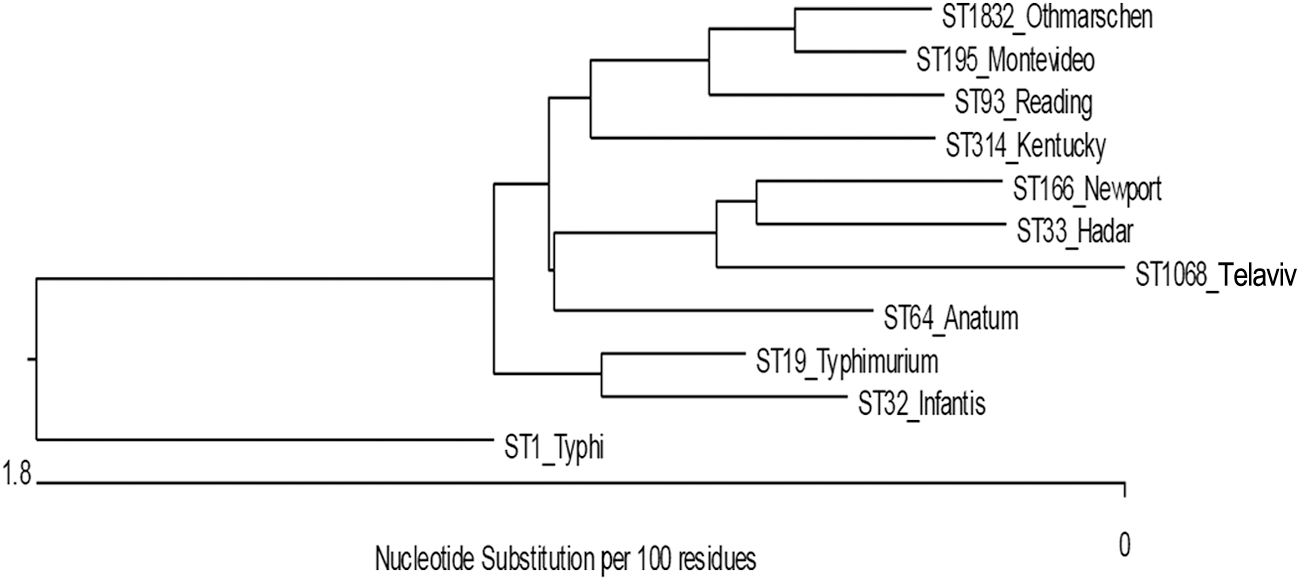
Phylogenetic tree of detected 10 subtypes according to their concatenated sequences of seven housekeeping genes in Salmonella enterica multilocus sequence typing scheme. Sequences of seven genes from one representative of each serovar-sequence typing subtype group were concatenated, and a 3336-base-pair sequence was formed for each subtype. Concatenation was conducted with following order: aroc (501 nt), dnan (501 nt), hemd (432 nt), hisd (501 nt), pure (399 nt), suca (501 nt), thra (501 nt). In order to avoid negative branch lengths in the figure, a cladogramic view of neighbor-joining tree was selected. Phylogenetic tree of the detected sequence types (STs) were rooted by ST 1 of serovar Typhi as the outgroup.
AST
Almost half of Salmonella isolates (45.8%) showed resistance to at least one antimicrobial agent. Antimicrobial-resistant Salmonella isolates showed resistance to aminoglycosides (66.7%), tetracyclines (63.0%), quinolones (59.3%), and sulfonamides (85.2%). Among aminoglycosides, streptomycin and kanamycin were dominant (Table 2). The MDR isolates were the 30.5% of Salmonella isolates and made up 66.7% of resistant isolates. Antimicrobial susceptibility test by disc diffusion method resulted in 11 different antimicrobial resistance profiles among 56 Salmonella isolates.
ST, sequence type; PT, pulsed-field electrophoresis type.
K, kanamycin; S, streptomycin; N, nalidixic acid; AMP, ampicillin; T, tetracycline; KF, cephalothin; SF, sulfisoxazole; SXT, sulfamethoxazole–trimethoprim; C, chloramphenicol.
Of note, all Salmonella Infantis isolates were resistant to at least to two antimicrobial agents and thus were classified as MDR (Table 3). All Salmonella Infantis isolates were resistant to nalidixic acid and tetracycline, and nearly all of them were resistant to streptomycin and sulfisoxazole. It was observed that 51.9% and 83.3% of the resistant and MDR isolates, respectively, belonged to Salmonella Infantis. The other MDR profiles were observed in serotypes Salmonella Hadar (5.6%), Salmonella Anatum (5.6%), and Salmonella Newport (5.6%) isolates. In contrast, 85.7% of Salmonella Montevideo isolates, and 84.6% of Salmonella Telaviv serotypes were susceptible to all antimicrobial agents (Table 3). None of the isolates showed resistance to amikacin, gentamicin, ciprofloxacin, amoxicillin–clavulanic acid, cefoxitin, ceftriaxone, ceftiofur, imipenem, and ertapenem.
K, kanamycin; S, streptomycin; N, nalidixic acid; AMP, ampicillin; T, tetracycline; KF, cephalothin; SF, sulfisoxazole; SXT, sulfamethoxazole–trimethoprim; C, chloramphenicol.
Three isolates belonging to ST 195 were excluded due to their inaccurate serotyping results.
ST, sequence type; PT, pulsed–field electrophoresis type.
PFGE
The 56 Salmonella isolates characterized in the current study represented unique 17 PFGE types (PTs) (Fig. 2). All the serotypes and STs were further diversified by PFGE typing as each serotype and ST included more than one PFGE pattern. The SID value calculated for PFGE (0.89) was higher than serotype and MLST (0.83). PFGE provided discrimination beyond the serotype and ST level for isolates belonging to Salmonella Infantis (ST 32, n = 15), Telaviv (ST 1068, n = 13) (Fig. 3), and Salmonella Montevideo (ST 195). The most frequently detected PFGE pattern was PT 8, which was observed in 12 of 15 Salmonella Infantis (ST 32) isolates. Since 93% of subtype Infantis (ST 32) isolates were recovered from chicken meat, PFGE typing revealed a potentially common and highly clonal Salmonella Infantis strain present in retail poultry samples in Turkey. PT 8 was further differentiated into five different MDR profiles. Similarly, PT64, represented by 11 Salmonella Anatum isolates (ST 64), was categorized into three groups of antimicrobial resistance profiles including susceptible (n = 6), resistant to sulfisoxazole (n = 4), and resistant to sulfisoxazole and streptomycin (n = 1). PFGE type 33 representing nine Salmonella Telaviv (ST 1068) isolates (Fig. 3), was the third most common PT and PT 33 isolates were susceptible to all antimicrobial agents, except one isolate, which was resistant to sulfisoxazole (Table 3).
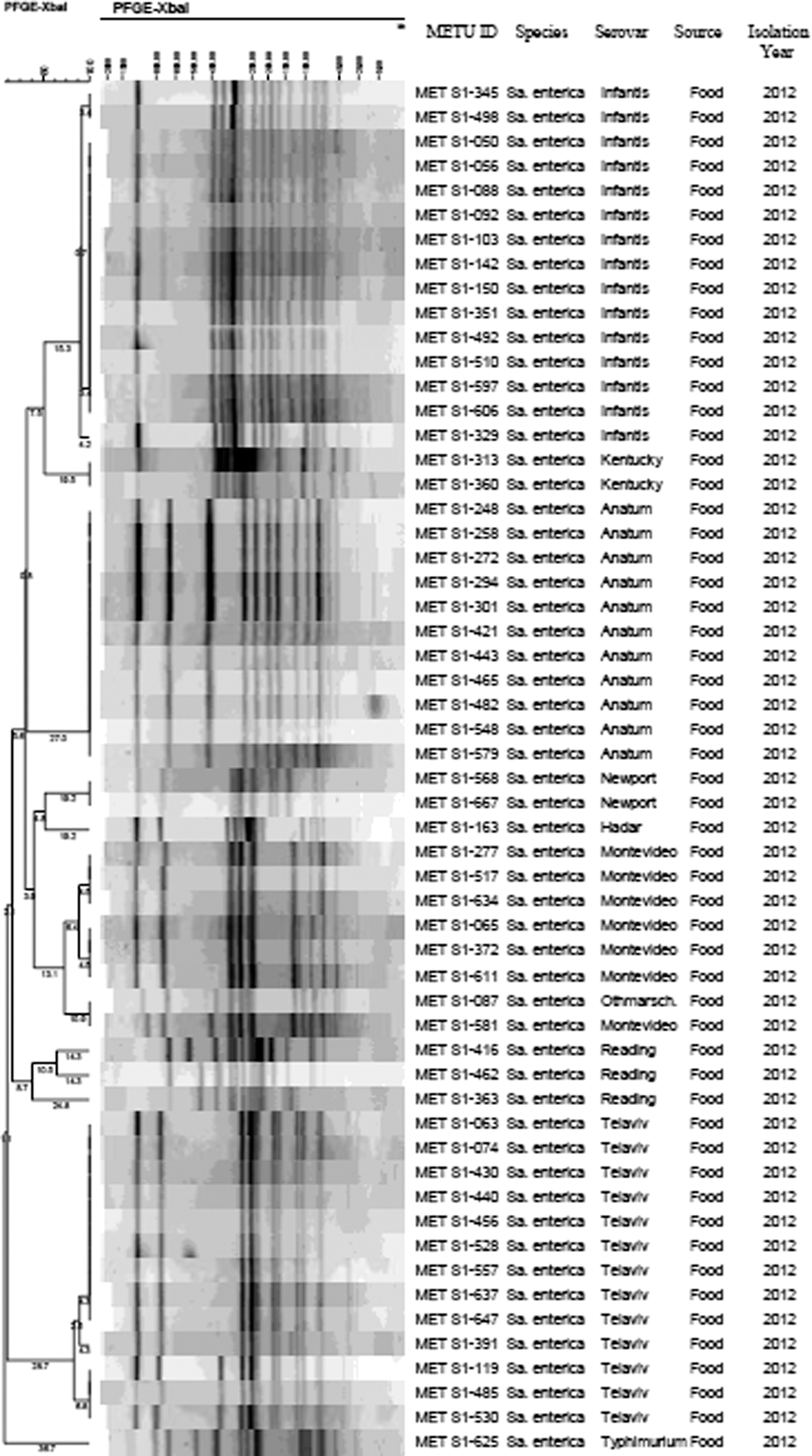
Dendrogram for 56 isolates were determined by the restriction fragments created by XbaI enzyme. Bionumerics software was used to build the dendrogram. Similarities were determined by Dice coefficient and the patterns were compared by unweighted-pair group method with arithmetic mean. 2.5% band position tolerance and 1.5% optimization was used. PFGE, pulsed-field gel electrophoresis.
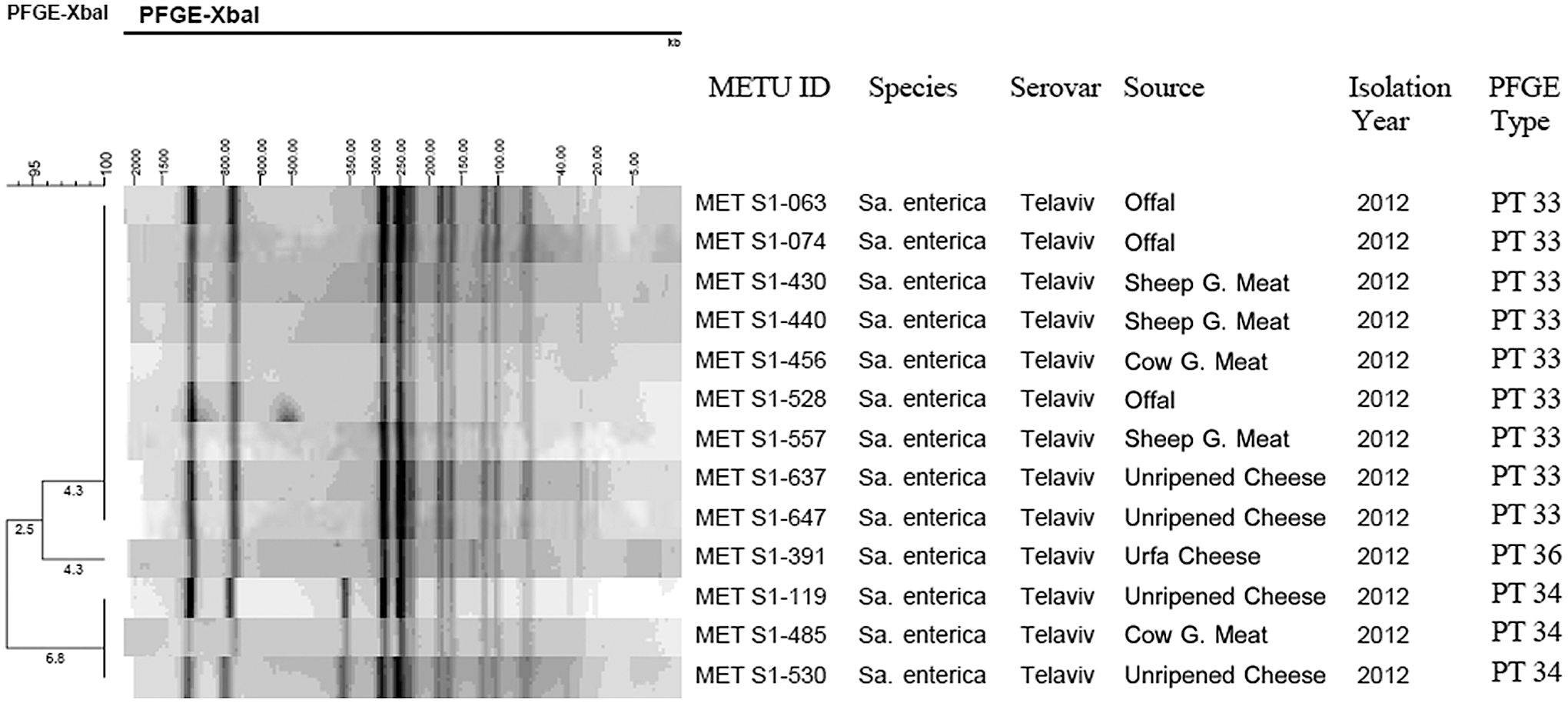
Dendrogram for serovar Telaviv showed three clusters of approximately 92.1% similarity. Having the most number of isolates, PT 33 was found in nine isolates. The isolates showed clonal dissemination through various food isolates by presenting only a three-band difference among 13 isolates. PFGE, pulsed-field gel electrophoresis; Sa. enterica, Salmonella enterica; G. Meat, ground meat.
Discussion
Distribution of serotyping and MLST results in different food types indicates a possible affiliation between some subtypes and food types
Salmonella Infantis isolates (ST 32), the most common serotype in our study, were all from chicken meat samples (p < 0.05). In addition, 6 of 11 Salmonella Anatum isolates were acquired from raw ground beef (p < 0.01), while the remaining 5 isolates were from ground mutton (p < 0.05). In addition, five out of seven Salmonella Montevideo (ST 195) isolates were isolated from cow offal samples (p < 0.01). However, serotype Salmonella Telaviv (ST 1068) was collected in a wider range food samples (i.e., cattle ground meat, sheep ground meat, offal, unripened cheese, and Urfa cheese) and was not over-represented within a given food type. It is also notable that all of the four isolates isolated from unripened feta cheese represented Salmonella Telaviv (p < 0.01) (Table 1). These analyses support that specific Salmonella serotypes may be over-represented among certain types of food samples collected in Turkey.
Despite the fact that there is a lack of data to assess the source and geographical clustering of Salmonella subtypes in Turkey, Salmonella Infantis was previously isolated from chicken products in different areas of Turkey (Sarımehmetoğlu et al., 1996; Cetinkaya et al., 2008). Reports by the European Food Safety Authority (EFSA) also indicated that the prevalence of serotype Salmonella Infantis in European Union (EU) countries at broiler facilities has increased in recent years. Along with Salmonella Enteritidis and Salmonella Typhimurium, Salmonella Infantis was the most commonly reported serotype isolated from chicken, broiler meat, and eggs in the EU (EFSA, 2013). Another study by EFSA also showed that Salmonella Infantis, isolated in 15 different EU member states, was the most widely distributed serotype across the EU as well as the most dominant serotype in several countries, accounting for 97.8%, 57.1%, and 40% of Salmonella isolates in Hungary, Slovenia, and Switzerland, respectively (EFSA, 2011). Apart from the EU, Salmonella Infantis persistence in broiler flocks had been described as an emerging problem worldwide, including countries such as Japan, Saudi Arabia, Algeria, and the United States on different continents (Miller et al., 2010).
Consistent with previous studies, the Salmonella Infantis in our study showed MDR. The most prevalent MDR profiles were K-S-N-T-SF (6/27) and S-N-T-SF (5/27), and they were characteristic of nearly all Salmonella Infantis isolates in the current study (Table 3). Researchers from Germany showed that Salmonella isolates from food were commonly resistant to streptomycin (93.7%), sulfamethoxazole (92.5%), and tetracycline (80.9%) (Miko et al., 2005). In another study, tetracycline (80.0%), streptomycin (73.0%), and sulfamethoxazole (60.0%) resistance was demonstrated by Salmonella isolated from retail meat samples such as chicken, beef, pork, and turkey in the United States (White et al., 2001). These three antimicrobials were also shown to inhibit growth of food-origin Salmonella isolated from Turkey in our study.
Comparison of international references with our findings and other studies in Turkey indicating that subtype Telaviv representing ST 1068 and PTs 33, 34, and 36 might be a characteristic serotype to Sanliurfa, as well as Turkey
In the current study, Salmonella Telaviv was the second most common serotype, where Salmonella Telaviv was isolated from 13 food samples, including 5 different food types. It was also noteworthy that all of the isolates collected from unripened cheese samples (n = 4) were classified as Salmonella Telaviv (ST 1068), as well as one of the two isolates collected from Urfa cheese samples. The isolate from Urfa cheese (MET S1-391) was the only isolate representing PT 36. MET S1-391 had a single band difference (approx. 120 kb) when compared to PT 33, which might be attributed to an insertion or a deletion mutation or plasmid acquisition (Tenover et al., 1995). PT 33 was represented by Salmonella Telaviv isolates collected from cow offal (MET S1-63, MET S1-74, MET S1-528) and ground sheep samples (MET S1-430, MET S1-440, MET S1-557), while PT 34 was represented by Salmonella isolates collected from one ground beef sample (MET S1-485) and two unripened cheese (MET S1-119, MET S1-530) samples (Fig. 3). All Salmonella Telaviv isolates were susceptible to antimicrobial agents. Although Salmonella Telaviv seems to be a rare serotype in the United States (CDC, 2009) and other countries, a Turkish study, mentioned above (Erol, 1999) reported one Salmonella Telaviv isolate isolated from a ground beef sample from Ankara. In addition, there were three notifications in 2003 and one notification in 2011 regarding detection of Salmonella Telaviv in EU by the Rapid Alert System for the Food and Feed (RASFF) annual reports. Products exported to EU that were reported to be contaminated with Salmonella Telaviv included pet food in 2011 and meal of lamb tripe, cumin, and peppermint in 2003; all products originated from Turkey (RASFF, 2011). To our knowledge, a sole previous surveillance study described the presence of Salmonella Telaviv among 300 fecal samples from adult cattle in Europe (Vella and Cuschieri, 1995). In another study, our research team observed that Salmonella Telaviv was also significantly present in cattle feces and sheep feces collected from slaughterhouses and pastures, but had not obtained clinical human cases in the last 5 years in the Sanliurfa region in Turkey (Acar et al., 2015, unpublished data). In the UoW S. enterica MLST Database, there was a single record of Salmonella serotype Telaviv (out of 6174 records). This single Salmonella Telaviv isolate was originated from a chicken in Israel in 1940 and shared the identical sequence type with Telaviv isolates in the current study, ST 1068.
Conclusions
As one of the important exporters of fresh fruits, fresh vegetables, and also processed foodstuff to EU and many other countries, Turkey lacks the retrospective literature data focusing on relations of subtype-source and subtype-geographical region through the use of conventional and molecular characterization methods. This study suggested a possible geographic clustering of serotype Telaviv in Turkey. To confirm this result, studies with a larger sample size from different regions of Turkey should be conducted in future.
Footnotes
Acknowledgments
The authors thank Dr. Huseyin Avni Kirmaci in Department of Food Engineering at Harran University for sending food samples, Dr. Martin Wiedmann for providing access to BioNumerics in Food Science Department at Cornell University, and Dr. Kendra K. Nightingale for reviewing the manuscript. The authors are very grateful for the financial research support and technical support provided by The Scientific and Technological Research Council of Turkey (TUBITAK) under project number of TUBITAK 111O192, and Middle East Technical University BAP.
Disclosure Statement
No competing financial interests exist.