




Abstract
During the summer of 2013, an increase of Salmonella enterica ssp. enterica serovar Szentes isolates from human clinical cases was registered by the Swiss National Centre for Enteropathogenic Bacteria and Listeria. In the course of the ensuing 9 months, 18 isolates originating from 13 patients and from one food sample were collected. Of the 13 human cases, 10 (77%) were female. The patients' ages ranged from 27 to 83 years (median age 49 years). Pulsed-field gel electrophoresis (PFGE) performed with XbaI, and multilocus sequence typing (MLST) were used to type the strains. PFGE as well as MLST showed the strains as indistinguishable. The PFGE pattern and MLST sequence type (ST427) were identical to those of Salmonella enterica serovar Szentes isolated in previous years (2002–2013) from sporadic cases in Switzerland and Germany. The increased isolation frequency continued for 6 months after the detection of Salmonella Szentes in sprouts. No common food exposure could be established. Due to lack of information on the potential food source, further investigations were not possible. The outbreak of this unusual serotype was detected because of its temporal clustering.
Introduction
N
The Swiss National Centre for Enteropathogenic Bacteria (NENT) is the reference laboratory for typing and molecular analysis of Salmonella spp. isolates in Switzerland and reports all cases to the Swiss Federal Office of Public Health. Between June 2013 and March 2014, the NENT detected Salmonella enterica ssp. enterica serovar Szentes in samples from 13 human cases of infection. In September 2013, the food control authority of the Canton Basel-Landschaft, Switzerland, performed a screening of raw vegetables for the prevalence of microbiological contamination. Salmonella Szentes was detected in a sprout sample. Subsequently, the product was withdrawn from the market. The NENT continued to register cases of infection due to Salmonella Szentes until March 2014, when the outbreak subsided.
Salmonella Szentes (antigenic formula 16:k:1,2 [Grimont et al., 2008]), is a rarely occurring serotype. Previous to the increase of Salmonella Szentes isolates from human clinical cases described in this study, the NENT registered a mere three cases of sporadic human salmonellosis caused by Salmonella Szentes, one each in the years 2000, 2002, and 2009, respectively. Additionally, in 2007, a pig meat sample tested positive for Salmonella Szentes in the course of a baseline study on the prevalence of salmonellae in slaughter pigs in Switzerland (Bruhn et al., 2009). In other countries, food-related findings of Salmonella Szentes involved coriander from Turkey (2003), ready-to-eat salad detected in Sweden in 2012, and rucola salad from Spain (2013), as notified by the Rapid Alert System for Food and Feed (RASFF) (
Apart from Bulgaria, where two cases of human salmonellosis caused by Salmonella Szentes were registered in 2011 (Asseva et al., 2011), this serovar has to our knowledge not been reported recently in human infections in other European countries.
This report describes the genotypic characterization of the outbreak-related Salmonella Szentes strains in comparison to sporadic isolates from Switzerland and Germany. The strains were subtyped by pulsed-field gel electrophoresis (PFGE) and multilocus sequence typing (MLST).
Materials and Methods
Salmonella isolates
Between June 2013 and March 2014, 17 Salmonella isolates that were sent to the NENT, Switzerland, for final serological identification according to the Kauffmann–White–LeMinor scheme (Grimont et al., 2008), were identified as Salmonella Szentes. The samples originated from 13 diseased individuals and had been submitted by primary diagnostic laboratories located throughout Switzerland.
In addition, one Salmonella Szentes strain originating from a sprout sample was detected in September 2013 by the horizontal method (ISO 6579:2002). The isolate was detected by the food control authority of the Canton Basel-Land, Switzerland and subsequently submitted to the NENT.
Further isolates were included in the study for genotypic comparison: Salmonella Szentes SZ04 isolated from pig meat in 2007 (Bruhn et al., 2009), strain Salmonella Szentes SZ06, isolated from a diseased person in 2009 in Switzerland, and six Salmonella Szentes isolates obtained from the strain collection of the Robert Koch-Institute, Germany. These included four clinical isolates (SZ02, SZ05, SZ07, and SZ08) from the years 2002, 2008, 2010, and 2013, respectively, and two strains (SZ01 and SZ03) isolated from foodstuffs in 2002 and 2003, respectively. Table 1 provides an overview of the 26 isolates that were further characterized in this study.
f, female; m, male; nd, not defined; na, not applicable.
PFGE
PFGE was performed by following the CDC PulseNet protocol (
MLST
For MLST, internal fragments of the seven housekeeping genes (thrA, purE, sucA, hisD, aroC, hemD, and dnaN) were amplified by polymerase chain reaction, as described previously (Kidgell et al., 2002). Typing was performed according to the Achtman scheme (Achtman et al., 2012). Sequencing of the amplification products was performed by Microsynth (Balgach, Switzerland). Sequence types were assigned in accordance with the Salmonella enterica MLST Database
Results and Discussion
This study reports the involvement of Salmonella Szentes in an outbreak in Switzerland. In total, 18 Salmonella enterica serovar Szentes strains were collected between June 2013 and March 2014. Seventeen strains were isolated from a total of 13 patients, all of whom lived in Switzerland. Ten (77%) were female. The patients' ages ranged from 27 to 83 years (median age 49 years); hence, the demographic characteristics of this outbreak can be described as predominantly adult females. From one patient, Salmonella Szentes was isolated repeatedly over 5 months (Table 1).
One isolate (SZ13) originated from sprouts. Sprouts are a well-known source of salmonella infections and have been reported as the source of a number of outbreaks (EFSA, 2014). However, this particular food sample could not be established as the origin of the outbreak, as the brand and the producer of the sprouts were not disclosed by the respective food-control authority. Therefore, there existed no possibility to further trace the produce or to perform further epidemiological studies. Prolonged exposition of consumers to the sprouts originating from the same batch or from the same seeds cannot be excluded.
Figure 1 shows the indistinguishable PFGE patterns of four isolates originating from two individual patients. This indistinguishable pattern is representative for the isolates analyzed during the outbreak period. It was shared by 16 of the 17 human strains. Exceptionally, one single isolate (SZ12) deviated by a single additional band of approximately 200 kb within the same pattern (data not shown), and one human strain was not analyzed by PFGE. The Salmonella Szentes strain detected in a sprout sample (isolate SZ13) exhibited a PFGE pattern identical with the cluster (data not shown).
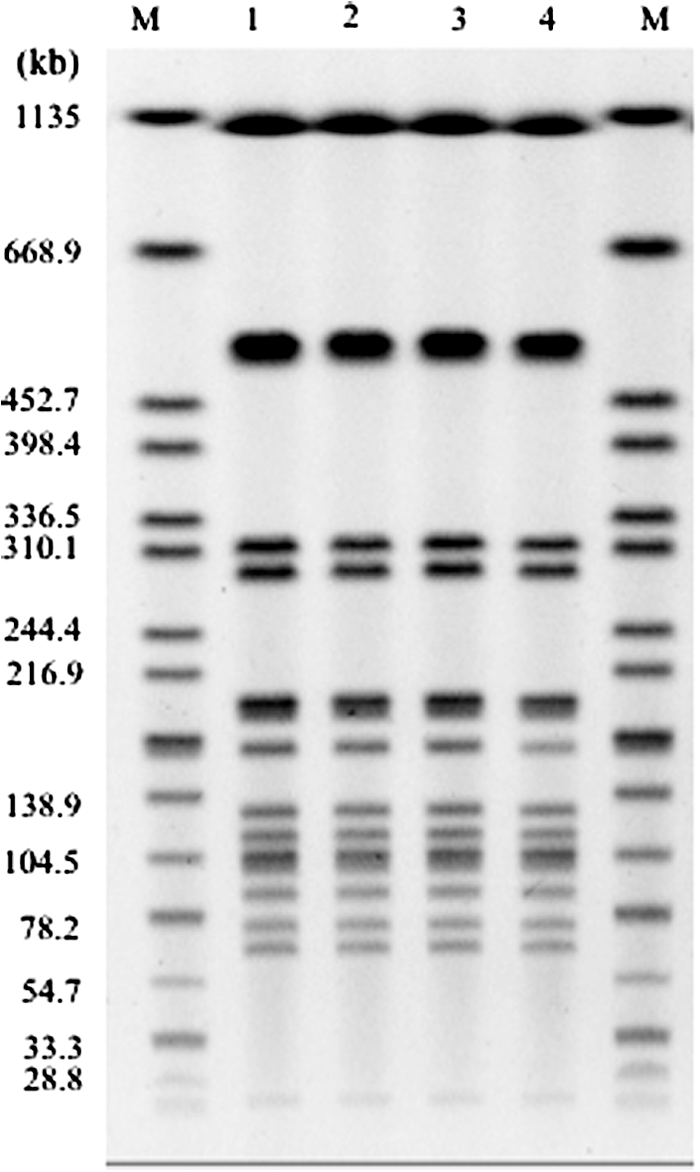
Representative XbaI pulsed-field gel electrophoresis patterns of Salmonella Szentes isolates from the Swiss cluster 2013/2014. Lane 1: isolate SZ17; lane 2: isolate SZ19; lane 3: SZ20; lane 4: SZSZ18. M: XbaI pattern of Salmonella Braenderup H9812 as molecular size marker.
PFGE patterns were generated from earlier sporadic isolates, and were included in this study for comparison. The isolate from pig meat from 2007 (SZ04) and the clinical isolate from 2009 (SZ06) were both from Switzerland. Six Salmonella Szentes strains isolated from humans and from food were from Germany (Table 1). All the PFGE patterns of these isolates were identical and indistinguishable from the pattern shown in Figure 1.
Seven isolates were selected for MLST: three of the outbreaks strains (SZ17, SZ21, and SZ26), a clinical isolate from 2009 (SZ06), and three of the sporadic strains from Germany (SZ01, SZ05, and SZ08). All seven isolates uniformly showed sequence type ST427.
Conclusions
Considering the identical PFGE profiles and the identical sequence type, it is obvious that the Salmonella Szentes isolates analyzed in this study are highly clonal. For the outbreak in 2013/2014, the acquisition of this clonal strain from a common source could not be established, not least because confidentiality requirements protecting the food producer prevented further epidemiological investigations. The outbreak situation resolved in March 2014 when the last case of infection was reported, and the origin remains unexplained. Because older strains were indistinguishable, this clone appears to be highly persistent and genetically stable. An important epidemiological feature of this outbreak is the absence of a cluster of cases associated with households or with food service establishments. Only the temporal clustering of this unusual serotype made it possible to detect this outbreak. Improved typing methods with higher discriminatory power such as whole genome sequencing would be needed in order to further differentiate this clone.
Footnotes
Acknowledgments
The authors wish to thank Dr. Wolfgang Rabsch, Robert Koch Institute, Wernigerode, Germany, for providing part of the strains characterized in this study. This work was financially supported in part by the Swiss Federal Office of Public Health.
Disclosure Statement
No competing financial interests exist.