




Abstract
Salmonella enterica serovar Stanley is an important serovar that has been increasingly identified in human salmonellosis. The present study aimed to investigate the antimicrobial resistance and molecular typing of 88 Salmonella Stanley strains isolated from humans (diarrhea patients, n = 64; and healthy carrier, n = 1), foods (aquatic products, n = 16; vegetable, n = 1; and pork, n = 1), and environment (waste water, n = 2; and river water, n = 3) in Shanghai, China from 2006 to 2012. Nearly half of the strains were resistant to sulfafurazole (43/88, 48.9%), and many were resistant to streptomycin (35/88, 39.8%), tetracycline (22/88, 25%), and nalidixic acid (19/88, 21.6%). Approximately a quarter of the strains (24/88, 27.3%) were resistant to more than three antimicrobials, and five had ACSSuT resistance type. Six clusters (A–F) were identified by pulsed-field gel electrophoresis (PFGE) with 80% similarity. Interestingly, strains in the same cluster identified by PFGE possessed similar antibiotic resistance patterns. PFGE typing also indicated that aquatic products might serve as a transmission reservoir for Salmonella Stanley infections in humans.
Introduction
N
Materials and Methods
Bacteria strains
A total of 88 Salmonella Stanley isolates were identified among 3152 Salmonella strains that were collected from hospitals, supermarkets, farmers market, and Huangpu River in Shanghai, China from 2006 to 2012 (Zhang et al., 2014, 2015). Among them, 65 strains were from human stool samples and 23 strains were from other sources (1 vegetable, 1 pork, 16 aquatic products, 2 wastewater and 3 river samples). The isolation of Salmonella was done according to United States Food and Drug Administration Bacteriological Analytical Manual (FDA, 1998) and standardized procedure recommended by the World Health Organization (WHO, 2010). Typical Salmonella isolates were further identified with API identification kits (BioMerieux, Marcy, France) and serovars with commercial antiserum (SSI Diagnostica, Copenhagen, Denmark). Serovars were assigned according to the White–Kauffmann–Le Minor scheme (Popoff et al., 2004).
Antimicrobial susceptibility testing
Antimicrobial susceptibility was evaluated using the Kirby–Bauer disk-diffusion method (CLSI, 2003) against 16 antimicrobial agents, including amoxicillin/clavulanic acid (AMC, 20/10 μg), ampicillin (AMP, 10 μg), ceftazidime (CAZ, 30 μg), cefotaxime (CTX, 30 μg), ceftiofur (EFT, 30 μg), cefepime (CEP, 30 μg), chloramphenicol (CHL, 30 μg), tetracycline (TET, 30 μg), ciprofloxacin (CIP, 5 μg), nalidixic acid (NAL, 30 μg), ofloxacin (OFX, 5 μg), gentamicin (GEN, 10 μg), streptomycin (STR, 10 μg), sulfafurazole (SIZ, 300μg), trimethoprim/sulfamethoxazole (SXT, 1.25/23.75 μg), and trimethoprim (TMP, 5 μg). The quality-control strains used were Escherichia coli ATCC 25922 and ATCC 35218. Results were interpreted according to Clinical and Laboratory Standards Institute guidelines (CLSI, 2012).
Pulsed-field gel electrophoresis (PFGE)
PFGE was performed according to a standardized protocol by the Centers for Disease Control and Prevention (Ribot et al., 2006). The genomic DNA of Salmonella Stanley isolates and standard marker Salmonella enterica serovar Braenderup H9812 were extracted and digested with 50 U of restriction enzyme XbaI (TaKaRa, Dalian, China) for 1.5–2 h. The samples of digested genomic DNA were run on CHEEF Mapper system (Bio-Rad, Hercules, CA) for 18 h at 14°C. Comparative analysis of the PFGE profiles was performed using Bionumerics software version 6.5 (Applied Maths, Kortrijk, Belgium). With 80% similarity, the bands were grouped together as one cluster.
Results
Antimicrobial resistance
Most of the Salmonella isolates (65/88, 73.9%) were resistant to at least one of the tested antibiotics. Resistance to sulfafurazole was most common (43/88, 48.9%), whereas only one strain showed resistance to ofloxacin (Table 1). Many strains were also resistant to streptomycin (34/88, 38.6%), tetracycline (22/88, 25%), nalidixic acid (19/88, 21.6%), ampicillin (16/88, 18.2%), trimethoprim–sulfamethoxazole (15/88, 17%), trimethoprim (14/88, 15.9%), and amoxicillin/clavulanic acid (14/88, 15.9%). A total of 27.3% (24/88) strains were resistant to three or more antibiotic agents (Fig. 1). Moreover, five strains had ACSSuT (AMP-CHL-STR-SIZ-TET) resistance type, and were isolated from river water (n = 2), aquatic products (n = 1), retail meat (n = 1), and a diarrhea patient (n = 1). Most multidrug-resistant strains (resistant to more than three antimicrobials) were from aquatic products (n = 9) and water samples (n = 3).
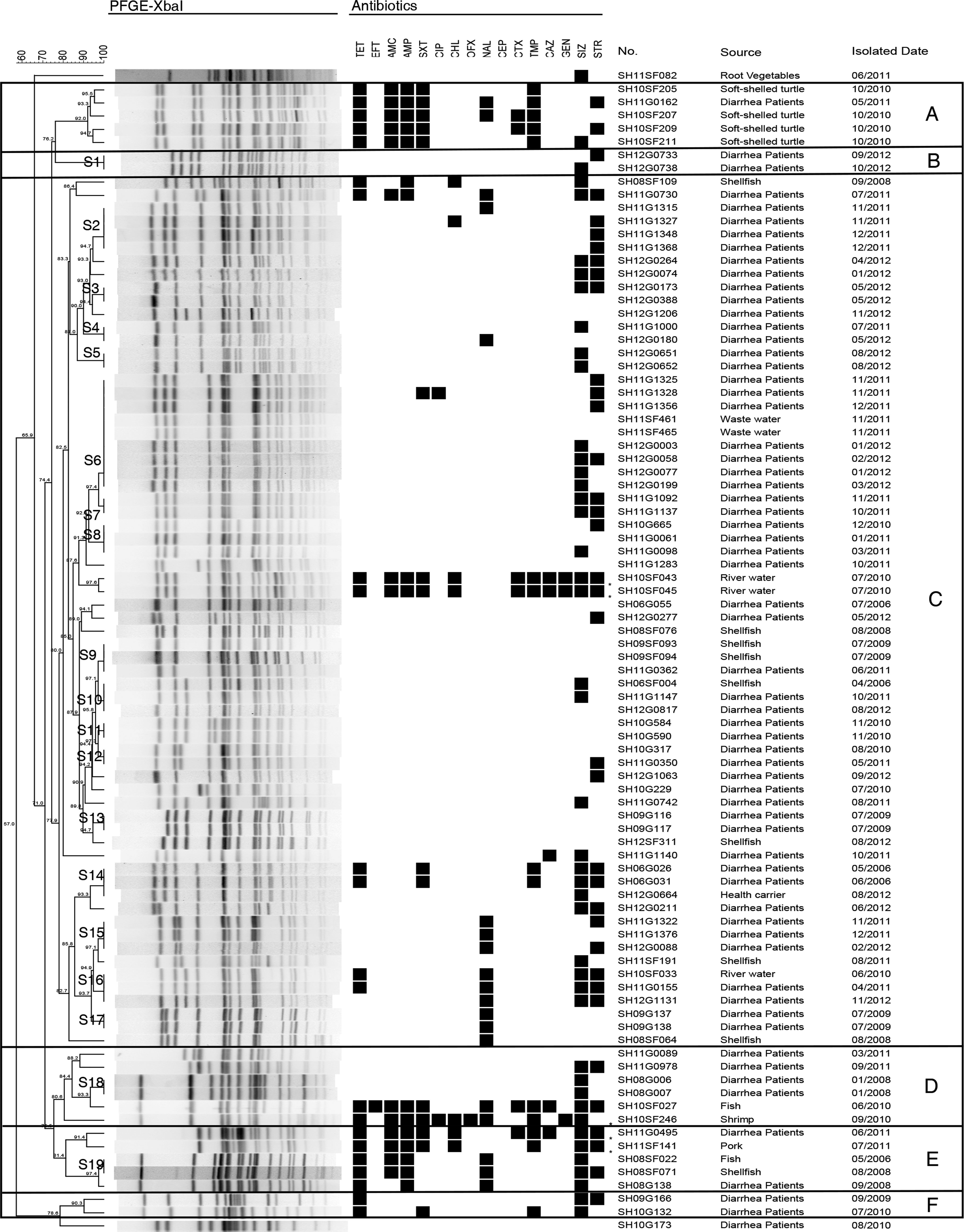
Pulsed-field gel electrophoresis (PFGE) patterns with XbaI analysis and antimicrobial resistance profiles of Salmonella Stanley strains. A black box indicates resistance to a particular antimicrobial. *Resistance to ampicillin, chloramphenicol, streptomycin, sulfamethoxazole, and tetracycline.
Resistance to at least ampicillin, chloramphenicol, streptomycin, sulfamethoxazole, and tetracycline.
Molecular subtyping by PFGE
With 80% pattern similarity, 88 Salmonella Stanley strains were mainly grouped into 6 distinct PFGE clusters (A–F) (Fig. 1). The majority of the strains (66/88, 75%) were grouped into Cluster C, of which 53 were from humans, 6 from aquatic products, and 5 from water samples. A total of 16 patterns (S2–S17) that contained more than two isolates were defined in cluster C. Pattern S6 strains were isolated from diarrheal patients (n = 7) and water (n = 2) in November 2011 to January 2012. Pattern S9 consisted of strains from aquatic products (n = 2) in 2009 and diarrheal patients (n = 1) in 2011. Pattern S10 contained three isolates, one of which was from an aquatic product in 2006 and two from diarrheal patients in 2011 and 2012. Pattern S16 contained one strain from water in 2010, and two strains from diarrheal patients in 2011 and 2012.
Most multidrug-resistant strains belonged to clusters A, C, and E. Strains in clusters B and F were solely isolated from humans. For example, four strains from aquatic products and one from diarrheal patients in Cluster A shared 92% pattern similarity and showed a similar multidrug resistance pattern. Cluster E showed a 97.4% pattern similarity that consisted of multidrug-resistant strains. Cluster D contained six strains from diarrheal patients and two strains from aquatic product with one strain showing ACSSuT type.
Discussion
Foodborne salmonellosis has been a significant public health issue worldwide. Salmonella Stanley is considered a zoonotic bacterium, which has been associated with various infections in humans and animals. Outbreaks of Salmonella Stanley infections in humans have been reported in the United States and the European Union (Werner et al., 2007; CDC, 2014; Kinross et al., 2014). Although no Salmonella Stanley outbreak was officially documented in China, Salmonella Stanley was identified from diarrheal patients or foods in several provinces (Deng et al., 2012; Zhang et al., 2014; Ke et al., 2014; Li et al., 2014). Previous studies confirmed that the majority of Salmonella Stanley strains were isolated from domestic animals or poultry (Chai et al., 2012). The antimicrobial resistance data in our study showed that approximately a quarter of the strains were multidrug resistant, and the resistance rate of nalidixic acid was also relatively high (21.6%) compared to data reported by others (Deng et al., 2012; Hendriksen et al., 2012). In contrast, less than 10% of strains were confirmed to be resistant to cephalosporin, which was lower than in a previous study (Hendriksen et al., 2012). In addition, Salmonella Stanley strains from aquatic products and water were more likely to be resistant to multiple drugs, and most Salmonella Stanley strains that represented ACSSuT pattern were isolated from aquatic products and water samples.
Molecular characterization analysis revealed six related PFGE clusters of multidrug-resistant Salmonella Stanley strains that might play a role in the dissemination of resistance between food or water and humans. Most strains belonged to cluster C, including two of the strains with ACSSuT resistance pattern from water samples. The identical PFGE patterns among Salmonella Stanley strains from humans, aquatic products, and river indicated that water or aquatic products might serve as a vehicle in transmitting human salmonellosis, which have been reported previously (Besser et al., 2000; Gorman and Adley, 2004; Oloya et al., 2009). In cluster A, there were four strains from aquatic products that shared PFGE patterns with human strains, also indicating aquatic products as a reservoir of Salmonella. Similar antimicrobial resistance patterns were also found among the strains belonging to the same cluster. Thus, multidrug-resistant Salmonella can be transmitted to humans via contaminated food or water and potential risk factors for human salmonellosis include consumption of contaminated food, animal contact, and environmental contamination.
In conclusion, this study revealed that aquatic products and water can serve as a reservoir of Salmonella Stanley and may play a role in transmitting salmonellosis in humans. Multidrug resistance was also common among Salmonella strains from these sources. An active surveillance of Salmonella in humans, food, and the environment provides important data to public health agencies and should help control and prevent salmonellosis in humans from its source.
Footnotes
Acknowledgments
This work was funded by the National Natural Science Foundation of China (31402193), National High Technology Research and Development Program of China (863 Program) (No. 2012AA101601), Special Fund for Agro-scientific Research in the Public Interest (No. 201403054), The Mega-projects of Science and Technology Research of China (No.2012ZX10004215-003); the Projects Baoshan District of Committee of Science and Technology (13E46), and the Projects of Hongkou District of Health and Family Planning Committee (1104-42) in Shanghai.
Disclosure Statement
No competing financial interests exist.