




Abstract
Enteropathogenic Escherichia coli (EPEC) is an important foodborne pathogen that potentially causes infant and adult diarrhea. The occurrence and characteristics of EPEC in retail ready-to-eat (RTE) foods have not been thoroughly investigated in China. This study aimed to investigate EPEC occurrence in retail RTE foods sold in the markets of China and to characterize the isolated EPEC by serotyping, virulence gene analyses, antibiotic susceptibility test, and molecular typing based on enterobacterial repetitive intergenic consensus–polymerase chain reaction (ERIC-PCR). From May 2012 to April 2013, 459 RTE food samples were collected from retail markets in 24 cities of China. E. coli in general, and EPEC specifically, were detected in 144 (31.4%) and 39 (8.5%) samples, respectively. Cold vegetable in sauce was the food type most frequently contaminated with EPEC (18.6%). Of 39 EPEC isolates, 38 were atypical EPEC (eae+) and 1 was typical EPEC (eae+bfpA+) by multiplex PCR assays. The virulence genes espA, espB, tir, and iha were detected in 12, 9, 2, and 1 of 39 isolates, respectively, while genes toxB, etpD, katP, and saa were not detected. O-antigen serotyping results showed that among 28 typeable isolates, the most common serotype was O119, followed by O26, O111, and O128. Many isolates were resistant to tetracycline (64.1%; 25/39), ampicillin (48.7%; 19/39), and trimethoprim/sulfamethoxazole (48.7%; 19/39). ERIC-PCR indicated high genetic diversity in EPEC strains, which classified 42 strains (39 isolates and 3 reference strains) into 32 different profiles with a discrimination index of 0.981. The findings of this study highlight the need for close surveillance of the RTE foods at the level of production, packaging, and storage to minimize risks of foodborne disease.
Introduction
E
The pathogenicity of EPEC is associated with several virulence factors. These virulence factors may be located either chromosomally or on plasmids. A number of genes have been identified as being of particular importance for the pathogenicity of EPEC including eae gene, espA-B, encoding type III secretion system proteins; tir, encoding the translocated intimin receptor (Tir); katP, encoding a bifunctional catalase peroxidase; etpD, associated with a type III secretion system; toxB, the adherence-associated gene; iha, encoding the IrgA homologue adhesin (Iha); bfpA, encoding bundle-forming pili; and saa, encoding an autoagglutinating adhesin (Toma et al., 2004; Wani et al., 2007; Monaghan et al., 2012). The virulence genes are also used to divide EPEC strains into two subtypes: typical, which carries both the eae and bfpA genes, and atypical, which carries eae but not bfpA. The detection of virulence genes may aid the study of the pathogenic characteristics of EPEC isolates.
Antibiotic-resistant E. coli strains have been isolated from different sources in many countries (Cortés et al., 2010; Yang et al., 2011). Since antibiotic-resistant strains in foods can be transmitted to humans through their consumption and handling, surveillance and monitoring drug-resistant bacteria in food is very important to implement targeted control strategies.
Enterobacterial repetitive intergenic consensus–polymerase chain reaction (ERIC-PCR) is a simple and cost-effective molecular genotyping method, which has been widely used for determining the genetic relationships of foodborne bacteria and tracking the bacterial source of contaminated food such as E. coli, Salmonella spp., and Listeria monocytogenes (Dalla-Costa et al., 1998; Ye et al., 2009; Sahilah et al., 2010; Chen et al., 2014).
In China, the consumption of ready-to-eat (RTE) foods has increased markedly in recent years. However, limited information is available on pathogenic E. coli contamination in RTE foods sold in Chinese supermarkets. The occurrence and characteristics of EPEC strains found in retail RTE foods have not been thoroughly investigated. The aim of this study was to investigate the prevalence of EPEC strains in retail RTE foods, and to determine the serotypes, virulence genes, antimicrobial resistance, and genetic diversity of the isolates.
Materials and Methods
Sample collection
From May 2012 to April 2013, 459 RTE foods, including 144 cooked meats, 38 fried rice/sushi, 59 cold vegetables in sauce, 48 cold noodles in sauce, and 170 roast poultry, were purchased randomly from supermarkets and farmer's markets in 19 provinces (24 cities) of China. The sampling sites covered most of the provincial capitals of China (Supplementary Fig. S1; Supplementary Data are available online at
Isolation and enumeration of E. coli
All bacteriological media, unless otherwise indicated, were purchased from Guangdong Huankai Co. Ltd. (Guangzhou, China). E. coli was isolated from food samples according to the National Food Safety Standards of China (GB/T 4789.6 − 2003), with some modifications. Briefly, 25 g of food sample was placed into a sterile bag containing 225 mL Butterfield's phosphate-buffered water and homogenized at 230 rpm for 2 min using a stomacher (Huankai Ltd., Guangzhou, China). Serial 10-fold dilutions were prepared up to 1:103, and three aliquots of each dilution were inoculated into lactose broth and fermentation tubes. After enrichment at 37°C for 24–48 h, a loopful of suspension from positive cultures (lactose fermentation positive and gas production) was streaked onto Chromagar E. coli agar (Huankai Ltd.) and incubated at 37°C for 18–24 h. Two to three presumptive E. coli colonies were selected from each plate and confirmed to be E. coli by the API 20E test (bioMerieux, Beijing, China). The number of positive Chromagar E. coli plates and positive tubes were used to calculate the most probable number (MPN) of E coli.
PCR confirmation of EPEC
All confirmed E. coli strains were grown overnight in lactose broth at 37°C. Genomic DNA was extracted using a commercial Universal DNA Extraction Kit (Sangon Biotech, Shanghai, China) according to the manufacturer's instructions. EPEC were identified by amplifying eae, bfpA, stx1, and stx2 as described previously (Paton and Paton, 1998; Mohammed, 2012). The primer sequences used in this study are shown in Table 1. All oligonucleotide primers were synthesized by Sangon Biotech. The PCR mixture (25 μL in total) contained 1× DreamTaq™ Green PCR Master Mix (Fermentas, Waltham, MA, USA), 4-μL primers mixtures, and 2 μL of DNA template. The PCR was conducted in a Bio-Rad PTC-200 Thermal Cycler (Bio-Rad, Hercules, CA, USA). Genomic DNA from the clinical strains EPEC O44:K74 (eae+ bfpA+) and
Virulence genes of EPEC
Eight individual PCRs were performed to detect the presence of virulence genes (espA, espB, tir, katP, etpD, toxB, saa, iha) in EPEC isolates as in previous studies (Brunder et al., 1996; Schmidt et al., 1997; Kobayashi et al., 2001; McNally et al., 2001; Schmidt et al., 2001; Paton and Paton, 2002; Tarr et al., 2002). The primers used are shown in Table 1. Three clinical strains O157:H7 (espA, espB, tir, katP, etpD), O26:K60 (eae, tir, iha), and O103:H8 (eae, saa, toxB), kindly provided by Guangdong Provincial Center for Disease Control and Prevention, were used as the positive control.
Serogrouping
The EPEC isolates were serotyped by slide agglutination using commercial O antisera (Tianrun Bio-Pharmaceutical, Ningbo, China), according to the manufacturer's instructions.
Antibiotic susceptibility test
The EPEC isolates were tested for antimicrobial susceptibility to 13 antibiotics using the agar disc diffusion method on Mueller–Hinton agar (Oxoid, Hampshire, UK) following Clinical and Laboratory Standards Institute (CLSI) guidelines (CLSI, 2011). The 13 antibiotics (Oxoid) tested were as follows: ampicillin (10 μg), amoxicillin/clavulanic acid (30 μg), ceftazidime (10 μg), cefotaxime (30 μg), chloramphenicol (30 μg), ciprofloxacin (5 μg), nalidixic acid (30 μg), norfloxacin (10 μg), amikacin (30 μg), gentamicin (10 μg), kanamycin (30 μg), trimethoprim/sulfamethoxazole (25 μg), and tetracycline (30 μg). The isolates were classified as susceptible, intermediately resistant, and resistant using the breakpoints specified by the CLSI standards, and E. coli ATCC 25922 was used as the reference strain.
ERIC-PCR
For ERIC-PCR, the primers ERIC1 (5′-ATGTAAGCTCCTGGGGATTCAC-3′) and ERIC2 (5′-AAGTAAGTGACTGGGGTGAGCG-3′) were used (Versalovic et al., 1991). The PCR was performed in a 25-μL solution containing 1.0 U of Taq DNA polymerase (Dongsheng Biotech, Guangzhou, China), 1.0 μM of each primer, 2.5 mM MgCl2, 0.2 mM of each dNTP, and 40 ng of template genomic DNA. Amplifications were performed with a Bio-Rad PTC-200 Thermal Cycler (Bio-Rad) under the following conditions: an initial denaturation at 94°C for 3 min; 35 cycles each consisting of 1 min at 94°C, 1 min at 52°C, and 3.5 min at 72°C; and a final extension at 72°C for 10 min. The ERIC-PCR products were separated by electrophoresis using a 2.0% (wt/vol) agarose gel with GoldView stain (0.005% vol/vol), and the gel was photographed using a UV Imaging System (GE Healthcare Waukesha, WI, USA). The fingerprinting patterns were analyzed on a Gel-Pro analyzer 4.0 (Media Cybernetics, Rockville, MD, USA). The observed bands in the gels were evaluated based on the presence (coded 1) or absence (coded 0) of polymorphic fragments for the ERIC primers. Cluster analysis was performed with NTSYS-pc (Version 2.10; Exeter Software, Setauket, NY, USA), based on simple matching co-efficient and unweighted pair-group arithmetic average clustering. The discrimination index was calculated as described by Hunter and Gaston (1988).
Results
Prevalence of E. coli and EPEC in retail RTE foods
The prevalence and concentration of E. coli and EPEC in the 459 retail RTE foods is shown in Table 2. E. coli was detected in 144 (31.4%) of these samples. The estimated quantity of E. coli in the positive samples ranged from 3 to >1100 MPN/g. Of the positive samples, 62 (43.1%) showed >110 MPN/g of E. coli. EPEC was isolated from 39 (8.5%) of the 459 samples, including 19 (13.2%) from cooked meats, 11 (18.6%) from cold vegetables in sauce, 7 (14.6%) from cold noodles in sauce, and 2 (1.2%) from roast poultry.
MPN, most probable number.
Virulence genes and serotypes of EPEC
A total of 332 isolates were identified as E. coli by API 20E. Of these, 39 isolates were identified as EPEC by 2 multiplex PCR assays. One isolate was typical EPEC (eae+, bfpA+) and 38 were atypical EPEC (eae+, bfpA–). The genes espA, espB, tir, and iha were detected in 30.8% (12/39), 23.1% (9/39), 5.1% (2/39), and 2.6% (1/39) respectively, of the isolates, while toxB, etpD, katP, and saa were not detected in any isolates (Fig. 1).
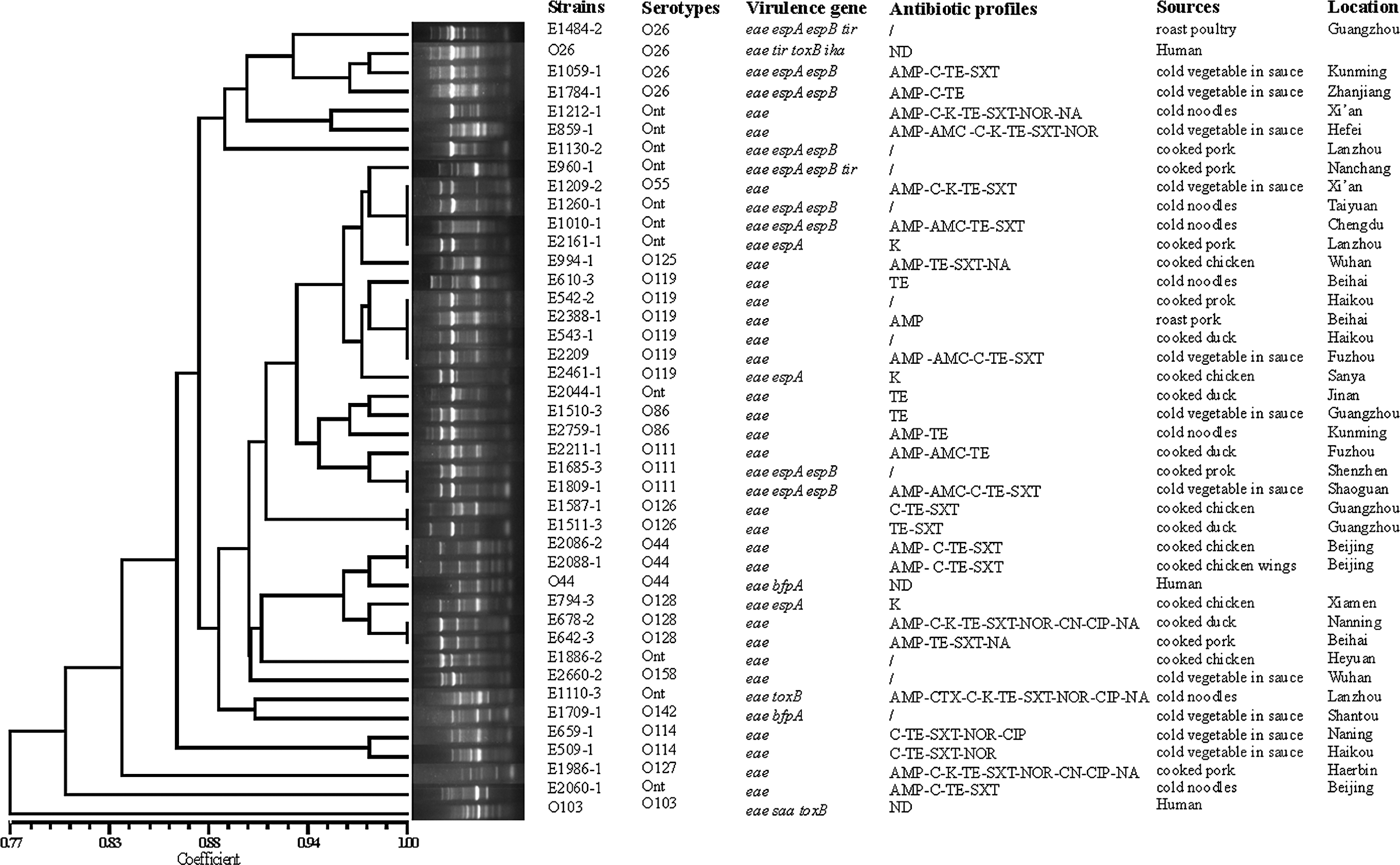
Enterobacterial repetitive intergenic consensus–polymerase chain reaction DNA fingerprinting analyses of enteropathogenic Escherichia coli from retail ready-to-eat foods in China.
For O serotyping, 28 of the 39 E. coli isolates were typeable and 11 were nontypeable. The 28 typeable isolates belonged to 13 different serogroups. The most common serotype was O119 (six isolates), followed by O26 (three isolates), O111 (three isolates), and O128 (three isolates).
Antibiotic resistance of EPEC
Antibiotic susceptibility results showed that all 39 isolates were susceptible to ceftazidime and amikacin, 38 (97.4%) to cefotaxime, and 37 (94.9%) to gentamicin. Most isolates were also susceptible to ciprofloxacin (89.7%), nalidixic acid (84.6%), norfloxacin (82.1%), amoxicillin/clavulanic acid (89.7%), and kanamycin (76.9%). Conversely, 25 (64.1%) isolates were resistant to tetracycline, 19 (48.7%) resistant to ampicillin, 19 (48.7%) resistant to trimethoprim/sulfamethoxazole, and 16 (41.0%) resistant to chloramphenicol. Some isolates exhibited intermediate resistance to kanamycin (Fig. 1 and Table 3). With regard to multidrug resistance, 56.4% (22 of 39) isolates were resistant to two or more of the tested agents. Some of the multidrug resistant isolates were resistant to seven to nine of these antibiotics.
ERIC-PCR molecular typing of EPEC
ERIC-PCR yielded three to eight bands with sizes ranging from approximately 180 to 4444 bp (Supplementary Figs. S2 and S3), which was sufficient to classify the 42 strains (39 isolates and 3 reference strains) into 32 different patterns, with a discrimination index of 0.981. The isolates with the same serotypes yielded identical or similar ERIC patterns (Fig. 1). Two isolates (E542-2, E543-1) obtained from cooked meat in Haikou were indistinguishable. Likewise, two isolates (2086-2, 2088-1) from cooked meat in Beijing had the same ERIC profiles, virulence genes, and antimicrobial resistances.
Discussion
Human infections caused by EPEC remain a global problem, and are most frequently attributed to the consumption of contaminated foods. RTE foods are often eaten directly, which increases the potential infection risk associated with the consumption of these foods. This study is the first comprehensive report on the prevalence of E. coli and EPEC in retail RTE foods in China. Our results showed that 31.4% of retail RTE foods were contaminated with E. coli. The contamination levels were more than 110 MPN/g in 43.1% (62/144) of the E. coli–-positive samples. The prevalence of EPEC in RTE foods was 8.9%, which is higher than that reported in Guangdong province in China (1.1%, Yang et al., 2011) and Mexico (1.4%, Bautista-De et al., 2013). These results indicated poor microbiological quality of retail RTE foods in China.
As cold vegetable in sauce and cold noodles are not intended to undergo a heating treatment step prior to consumption, they are susceptible to the presence of high E. coli and EPEC contamination. For cooked foods (cooked meats and roast poultry), the heat treatment can destroy most bacteria present in these foods. Thus, the contamination of E. coli in these food products may be caused by postprocessing contamination during slicing, weighing, and packaging.
When classified by subtype, all the isolates, except one, in this study were atypical EPEC. The presence of a higher number of atypical EPEC than typical EPEC in food samples is consistent with a previous study (Canizalez-Roman et al., 2013). In recent years, typical EPEC infections have decreased and atypical E. coli infections have increased (Hernandes et al., 2009). Atypical EPEC is an emerging diarrheagenic pathogen, not only in developing countries, but also in industrialized countries (Estrada-Garcia et al., 2009; Contreras et al., 2010). In China, a foodborne outbreak caused by atypical EPEC has also been reported (Chen et al., 2012). Previous studies indicated that atypical EPEC is more closely related to STEC and can also cause hemorrhagic colitis or hemolytic uremic syndrome in humans (Trabulsi et al., 2002; Kozub-Witkowski et al., 2008). Thus, the presence of this pathotype in food poses a potential risk to consumers.
The formation of A/E lesion is the key feature of EPEC pathogenesis. The genetic determinants for production of A/E lesions are located on a large chromosomal pathogenicity island known as the locus of enterocyte effacement (LEE). The genes associated with LEE include eae, espA, espB, and tir. In this study, the genes espA and espB were commonly detected in these isolates, while tir was detected in a small number of isolates. Non-LEE genes iha, toxB, saa, etpD, and katP were usually absent in these isolates. These results are different from those reported by Monaghan et al. (2012). In their study, tir and iha were frequently detected, while saa, espA, espB, and toxB were also present but to a lesser extent. These differences in EPEC characteristics might be associated with sample types or the geographical area.
Serotyping results showed that 28.2% of EPEC isolates were serologically O nontypeable. A similar finding has been reported by Monaghan et al. (2012). Although the detection of EPEC by serological screening is still the method of choice in most food and clinical diagnostic laboratories worldwide, serotyping alone is insufficient for differentiation of EPEC because of the diversity of serotypes. A combination of phenotypic and genotypic methods is necessary for better characterization of EPEC.
The increasing prevalence of antimicrobial-resistant bacteria is a major concern in human and veterinary medicine worldwide. In the present study, 29 (74.4%) isolates were resistant to at least 1 antibiotic. The highest prevalence of resistance was observed for tetracycline (64.1%), followed by ampicillin (48.7%) and trimethoprim/sulfamethoxazole (48.7%). These results are consistent with previous studies (Yang et al., 2011; Ahmadi et al., 2012; Campos et al., 2013). The high prevalence of resistance to these antibiotics could be related to their common use in animal husbandry and humans in China. Additionally, poor hygienic practice may contribute to the spread of resistant strains. Chloramphenicol is a strictly controlled antibiotic in farming and humans in many countries. EPEC was previously reported to be 100% susceptible or intermediately resistant to this antibiotic (Campos et al., 2013). However, in our study, 41.0% of EPEC isolates were resistant to this antibiotic. The high prevalence of resistance to this antibiotic suggests that unauthorized use may have occurred in China. Notably, some EPEC isolates were resistant to seven to nine antibiotics, which is worrisome. Continuous surveillance of antibiotic resistance of EPEC in these foods is needed since resistant strains may enter the human population through the RTE foods.
A relationship was observed between ERIC-PCR profiles and serotypes. Most of the isolates with the same serotypes were clustered together. The different ERIC-PCR patterns were observed in the same serotypes, suggesting that these EPEC isolates are highly genetically heterogeneous. No significant correlation was observed between ERIC-PCR profiles and origin of strains.
Conclusions
Our results revealed relatively high isolation rates of E. coli and EPEC in retail RTE foods in China, which may reflect poor hygienic practices during product preparation and retail marketing. Many EPEC isolates were resistant to a wide range of commonly used antibiotics and carried different virulent genes associated with human disease. Multiresistant EPEC strains are of great public health concern as they may further complicate the treatment of infection caused by EPEC. The high genetic diversity suggests diverse sources of contamination and highlights the need for close surveillance of the food at the level of production, packaging, and storage. Chinese regulatory authorities should consider formulating a regulatory framework for controlling EPEC to improve the microbiological safety of RTE foods.
Footnotes
Acknowledgments
We thank Dr. Moutong Chen for his technical assistance in analyzing the ERIC profiles. This work was supported by International Science and Technology Cooperation Projects (No. 2013DFH30070) and Guangzhou Science and Technology Projects (No. 201100000074).
Disclosure Statement
No competing financial interests exist.
References
Supplementary Material
Please find the following supplemental material available below.
For Open Access articles published under a Creative Commons License, all supplemental material carries the same license as the article it is associated with.
For non-Open Access articles published, all supplemental material carries a non-exclusive license, and permission requests for re-use of supplemental material or any part of supplemental material shall be sent directly to the copyright owner as specified in the copyright notice associated with the article.
