




Abstract
Background and Objective:
Stable flies (Stomoxys calcitrans L.) are very common around confined and pastured cattle, and due to their painful bites they are very important animal pests. Cattle are asymptomatic reservoirs of foodborne pathogens, Escherichia coli O157:H7 and other Shiga-toxigenic E. coli serotypes (STEC). In the present study, the potential of stable flies to carry STEC in a beef cattle feedlot was assessed.
Methods:
Stable flies (n = 180) were collected over 3 summer months and processed individually for STEC-8 that included the serotype O157 and seven non-O157 serotypes (O26, O45, O103, O104, O111, O121, and O145). Isolation and detection of STEC was based on direct plating as well as the enrichment/immunomagnetic separation approach. Modified Posse agar (mP) was used for culturing non-O157 serotypes and sorbitol MacConkey agar with cefixime and potassium tellurite (CT-SMAC) for E. coli O157. Multiplex polymerase chain reactions were used for differentiation of individual serotypes and detection of virulence genes (stx1, stx2, eae, and ehxA).
Results and Conclusions:
Of 180 stable flies, 67 (37.2%) carried enterics on mP (mean: 3.6 ± 1.05 × 10⁶ colony-forming units [CFU]/fly) and 55/180 (30.5%) were positive for bacteria on CT-SMAC (mean: 1.2 ± 1.08 × 10⁴ CFU/fly). However, stable flies positive for E. coli serotypes of interest were very rare (prevalence: 1.1%). The three serotype-positive isolates, two E. coli O26 and one E. coli O45, were recovered from two flies and neither of them harbored the virulence genes. We conclude that stable flies likely do not play a role as a biological vector and/or reservoir of STEC-8 in cattle feedlots.
Introduction
B
Materials and Methods
Stable flies (n = 50) were collected on a weekly basis from June 9 to August 25 from a commercial feedlot in central Nebraska using a sweep net and processed using two approaches for isolation of STEC. In the parallel study, the fecal samples from the same feedlot were collected on a weekly basis and processed for detection of STEC (Dewsbury et al., 2015).
Direct plating involved surface sterilization (Zurek et al., 2000) to eliminate cross-contamination during collection followed by homogenization of individual flies in 1.0 mL phosphate-buffered saline (pH 7.2) and dilution plating of the homogenate on sorbitol MacConkey agar supplemented with cefixime and potassium tellurite (CT-SMAC) and on modified Posse agar (mP) as described by Dewsbury et al. (2015). Colony-forming units (CFU) were counted on each medium and the means were expressed as mean ± standard error of the mean throughout the study. Non-sorbitol fermenting (colorless) colonies from CT-SMAC were screened by the latex agglutination test (Oxoid, Basingstoke, England) for detection of E. coli O157:H7.
Enrichment: The fly homogenate (700 μL) was added to 10 mL of EC broth and incubated at 40°C for 6 h at 50 rpm and were subjected to immunomagnetic separation (IMS) following the manufacturer's instructions (Dynal Biotech, New Hyde Park, NY). Enriched samples were pooled into group A (O103+O104+O26) and group B (O145+O45+O121+O111) and dilution plated on mP.
For non-O157 serogroups, 6 colonies from direct plating and 12 (2 × 6) colonies from enrichment/IMS were tested per fly for STEC-8 as described by Dewsbury et al. (2015) using multiplex polymerase chain reaction (PCR) with STEC-7 (Bai et al. 2012) and O104 (Paddock et al. 2013) specific primers. Individual isolates from positive samples were further confirmed for serotype by single PCR and also screened for virulence genes (stx1, stx2, eae, ehxA) using 4-plex PCR (Bai et al., 2012).
Correlation between prevalence of enteric-positive flies and bacterial concentration on mP was assessed by the multiple regression analysis (p < 0.05). One-way analysis of variance was performed to compare the enteric concentrations over the 12-week period on each of mP and CT-SMAC (p < 0.05) in Origin 7 (OriginLab, Northampton, MA).
Results and Discussion
Of 180 stable flies, 67 (37.2%) and 55 (30.5%) were positive for bacteria on mP and CT-SMAC, respectively. The concentration of enterics ranged from 1.0 × 101 to 3.2 × 10⁷ (mean: 3.6 ± 1.05 × 10⁶) CFU/fly on mP and 1.0 × 101 to 6.0 × 10⁵ (mean: 1.2 ± 1.08 × 10⁴) CFU/fly on CT-SMAC (Fig. 1). Interestingly, the weekly prevalence of positive flies peaked (86.6%) in week 12 and corresponded to the highest enteric concentration (mean: 1.7 ± 0.32 × 10⁷ CFU/fly). A moderate correlation was found between the prevalence of enteric positive flies and the bacterial concentration (R 2 = 0.509). There was no significant difference in enteric concentrations on CT-SMAC over the 12-week period (p = 0.856); however, a significant difference (p = 0.001) was observed in enteric concentrations on mP between week 12 and all other weeks with exception of week 4 and week 10 (Fig. 1).
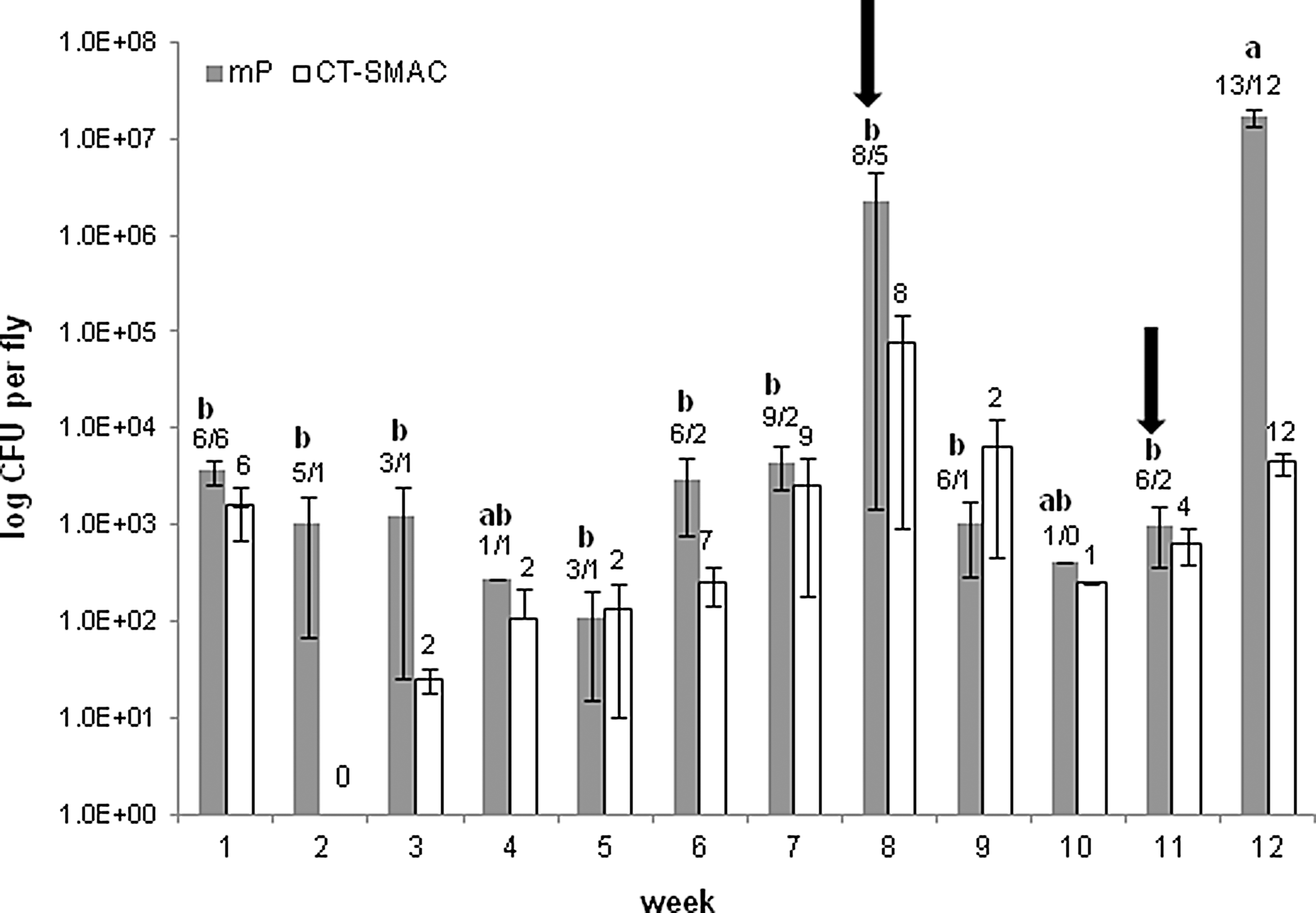
Prevalence and concentration of enterics associated with stable flies on a beef cattle farm. The 12-week sampling period (June 9–August 25) and a total of 15 stable flies were processed each week. Log colony-forming unit (CFU) per fly is presented as mean ± standard error of the mean. Detection limit for enterics was 10 CFU/fly on both modified Posse agar (mP) and MacConkey agar with cefixime and tellurite (CT-SMAC). Numbers above the gray bars represent total number of flies with detectable colony count on mP following direct plating technique/total number of flies processed each week by enrichment and immunomagnetic separation. The numbers above the white bars represent number of flies with detectable colony count on CT-SMAC. Black down arrows above the bars indicate flies positive for Escherichia coli O26 (week 8) and O45 (week 11). Different letters above gray bars indicate significant differences (p < 0.05) among CFU counts over 12 weeks.
Our previous studies reported 44.3% (411/982) stable flies from the pastured and confined cattle environment carried enterics with a mean concentration of 6.4 × 10⁴ CFU/fly. We also found 12.9% (120/928) of stable flies carried fecal coliforms with a mean concentration of 8.7 × 10³ CFU/fly (Mramba et al., 2006). In contrast to stable flies, the majority (95.4%) of house flies collected from a beef cattle feedlot carried fecal coliforms with a mean concentration 2.1 × 10⁵ CFU/fly (Alam and Zurek, 2004).
All sorbitol-negative colonies on CT-SMAC tested negative for the O157 antigen. Of 180 stable flies, only 2 flies were positive for the serotypes of interest: O45 (1 isolate) and O26 (2 isolates), all from the enrichment/IMS approach and neither of them carried the virulence genes tested. In a parallel study, cattle feces were collected from the same feedlot during the same collection period and screened for the presence of STEC following a similar approach. They showed that 0.8–41.4% of fecal samples in summer were positive for one or more of the STEC serotypes O157, O103, O26, and O145 (Dewsbury et al., 2015). Overall, our current data indicate that adult stable flies do not carry STEC-8 despite the presence of STEC in cattle feces on the same farm. These data are in agreement with the previous reports of Rochon et al. (2004, 2005) where they suggested based on laboratory bioassays that stable fly larvae and pupae retain and accumulate E. coli in the gut; however, most teneral adults were bacteria free. Their bioassays also showed that survival and retention of E. coli throughout various life stages of stable flies were significantly lower compared to that of house flies (Rochon et al., 2004, 2005).
Adult blood-feeding flies secrete salivary compounds such as complex mixtures of serine proteases, endonucleases, antithrombins, and antimicrobial peptides to evade host defense response (Wang et al., 2009) and may help in digestion of microbes during their passage through the crop and intestinal tract of the fly. Based on our study, we conclude that stable flies do not play a major role as a biological vector of STEC.
Footnotes
Acknowledgments
We thank Drs. Cernicchiaro and Nagaraja, Ms. Spencer, and Mr. Erram for their help in this study. Funding source: USDA-NIFA-CAP grant #2012-68003-30155 and contribution no. 16-100-J from the Kansas Agricultural Experiment Station.
Disclosure Statement
No competing financial interests exist.