




Abstract
Food illegally brought into the European Union, mainly in the personal luggage of travelers, represents a potential threat to consumers' health. The aim of this study was to investigate the presence of five pathogens in food brought into the European Union by Moldavian citizens as personal goods and illegally sold in Romania in the vicinity of the border. The occurrence of Staphylococcus aureus and Listeria monocytogenes was 7.5% and 8%, while Campylobacter spp., Escherichia coli O157:H7, and Salmonella spp. were absent in all samples. L. monocytogenes sequence type 2, 9, 121, and 155, highly prevalent among foodstuffs worldwide, was also present among isolates from ready-to-eat food illegally sold in Romania, even at the same date of sampling, indicating cross-contamination during food handling. S. aureus spa types t449, t304, and t524 were most often isolated from raw-milk cheeses contaminated with 103–105 colony-forming units per gram, evidencing a contamination at herd level or unhygienic conditions during processing. S. aureus t011 and t3625, both included in the livestock-associated CC398, were isolated from pork lard and poultry meat. This study shows that cross-border trade from nonmember states represents a neglected route of transmission of foodborne pathogens into the European Union that could lead to sporadic or family-associated cases of disease.
Introduction
I
As neither raw material origin and quality, nor technological process and hygienic conditions during food processing are known, smuggled food poses a potential health risk. Furthermore, the conditions during transportation and sale might violate the safety rules since refrigeration and adequate packaging are missing. Usually little information is available regarding associated risks and prevalence of pathogens in these foods. A better situation exists in the United States, where some of such foods are microbiologically examined. For example, it is known that cheese smuggled into the country by Mexican citizens harbors Salmonella (13%), Listeria spp. (4%), and Mycobacterium spp. (Kinde et al., 2007).
To fill this gap, one objective of the EU research project “Protection of consumers by microbial risk mitigation through combating segregation of expertise” (PROMISE) was to assess five significant foodborne pathogens for being introduced into EU via uncontrolled imports (
Besides investigating one of the neglected routes of pathogen transmission to the European Union, this study aims to analyze the routes of pathogenic genotypes involved in the illegally sold food.
Materials and Methods
Sample collection and pretreatment
A total of 200 samples were taken from July 2012 to February 2013 from a market in Galati, Romania. Samples were randomly collected in 15 different sampling occasions to ensure a representative coverage was taken each time of all food categories available in the market from a qualitative and quantitative point of view. Solid food samples were aseptically cut into pieces, if necessary, and ground in a laboratory mill. Subsamples, 10 g each (tests for Staphylococcus aureus) or 25 g each (tests for other pathogens), were transferred to sterile filter bags (Stomacher® Bags; Seward Ltd., Worthing West Sussex, UK), diluted 1:10 in sterile Ringer's solution (Scharlau; Scharlab, Barcelona, Spain) or the respective selective enrichment, and homogenized in a Stomacher lab blender for 180 s.
Aerobic mesophilic count
Enumeration of aerobic mesophilic count (AMC) was conducted according to ISO 4833 (2003) on Plate Count Agar (Fluka Analytical; Sigma-Aldrich, St. Louis, MO) after 24–48-h incubation at 30°C. All agar plates yielding 10–300 colony-forming units (CFU) were included in the calculation and AMC was expressed as mean CFU/mL or g.
Detection, isolation, and confirmation of foodborne pathogenic bacteria
Detection and isolation of Salmonella spp. were performed following ISO 6579 (2002). After primary enrichment in Buffered Peptone Water (Biolife Italiana srl., Milano, Italy) at 37°C for 24 h, 0.1 and 1 mL were transferred to the secondary enrichments Rappaport Vassiliadis Broth and Müller Kauffmann Tetrathionate Broth with novobiocin (both Biolife Italiana srl.) and incubated for 24 h at 41.5°C and 37°C, respectively. Both secondary enrichments were streaked onto selective agar media for Salmonella spp. detection: Xylose Lysine Desoxycholate Agar (Scharlau) and Salmonella Chromogenic Agar (Biolife Italiana srl.), both incubated at 37°C for 24 h. Up to five presumptive colonies from each agar plate were tested using Salmonella rapid latex test kit (Biolife Italiana srl.).
Detection of Campylobacter spp. was performed in Bolton Broth supplemented with Laked Horse Blood (Biolife Italiana srl.) under microaerobic conditions (5% O2, 10% CO2) (ISO 10272-1, 2006). After incubation for 48 h at 41.5°C, 10 μL of Bolton Broth was streaked onto Charcoal Cefoperazone Deoxycholate modified Agar (Scharlau) and Karmali Campylobacter Agar (LiofilChem, Roseto degli Abruzzi, Italy). Selective agar plates were incubated under microaerobic conditions for 24–48 h at 41.5°C. Thereafter, up to five suspicious colonies were confirmed by phenotypical tests (motility reaction, oxidase test, hippurate hydrolysis test, and biochemical profile).
Detection and isolation of Escherichia coli O157 was performed in Modified Tryptic Soy Broth plus novobiocin (Biolife Italiana srl.) incubated at 41°C for 24 h. Subsequently, Cefixime Tellurite MacConkey Sorbitol Agar (Scharlau) and Chromogenic E. coli O157 Agar plates (Biolife Italiana srl.) were loop inoculated and incubated for 24 h at 37°C. Presumptive E. coli O157 colonies were serologically confirmed (antisera for E. coli O157; Plasmatec, Bridport, UK).
The standard method ISO 11290-1 (1996) was used for detection and isolation of L. monocytogenes. The two-step enrichment protocol included Half Fraser Broth (Merck, KGaA, Darmstadt, Germany) incubated for 24 h at 30°C. The primary enrichment (0.1 mL) was transferred to Fraser Broth and incubated for 48 h at 37°C. Listeria Agar according to Ottaviani and Agosti and Palcam Agar (all Merck, KGaA) were each inoculated with Half Fraser and Fraser Broth and incubated for 24–48 h at 37°C. Up to five colonies were submitted to polymerase chain reaction (PCR) confirmation targeting the 16S rRNA and hly genes (Border et al., 1990).
The total number of coagulase-positive staphylococci (CPS) was enumerated on Baird Parker Agar with Rabbit Plasma Fibrinogen (Biolife Italiana srl.) following ISO 6888-2 (1999). After 24–48 h of incubation at 37°C, agar plates yielding 10–300 colonies were included in the calculation of CPS (mean CFU/mL or g). Then, up to five colonies from each plate were analyzed by PCR targeting the nuc gene (Trnčíková et al., 2013) to confirm S. aureus isolates.
Molecular epidemiological analysis of L. monocytogenes and S. aureus isolates
Multilocus sequence typing (MLST) of the seven housekeeping loci, abcZ (ABC transporter), bglA (beta glycosidase), cat (catalase), dapE (succinyl diaminopimelate desuccinylase), dat (
The S. aureus spa typing using the sequence of a polymorphic VNTR in the 3' coding region of the S. aureus–specific staphylococcal protein A (spa) was determined as described by Harmsen et al. (2003) (
Statistical analysis
SPSS.20 software (SPSS Inc., Chicago, IL) was used for statistical analysis. Analysis of variance analysis (Dunnett T3 post-hoc test) was performed with p-values <0.05 considered to be significant.
Results and Discussion
Sample characteristics and enumeration of AMC
In total, 200 food samples, illegally vended in a Romanian market, were investigated for the presence/absence of five foodborne pathogens. The food samples consisted of 36% dairy products (n = 73; raw milk; cheeses made of cow, sheep, or goat raw or pasteurized milk, cream, and butter), 31% fish and fish products (n = 61; smoked or canned fish), 20% meat and meat products (n = 41, chicken carcasses, sausages, pork rind, and lard) and 13% other food products (spices, dried fruits, jellies, gingerbread, and candies). Overall, 73% of the samples were homemade and sold in plastic bags or cartoon boxes, while 27% were produced at industrial level in which they were packed and labeled. In total, 80% of the foods originated from the Republic of Moldova, 17% from Ukraine, and 3% from Bulgaria.
The AMC, which is an important hygiene indicator, revealed a high variation even in food samples of the same category with an average of (1.89 ± 7.52) × 107 CFU/g in meat samples, (1.15 ± 2.78) × 107 in dairy products CFU/g, (5.01 ± 29.3) × 105 CFU/g in fish products, and (2.20 ± 5.56) × 105 CFU/g in other food samples (Supplementary Figure S1; Supplementary Data are available online at
Enumeration was calculated in colony-forming units (CFU/g or mL).
Listeria monocytogenes–positive after the secondary enrichment in Fraser Broth.
L. monocytogenes–positive after pre-enrichment in Half Fraser Broth.
AMC, aerobic mesophilic counts; RM, Republic of Modova; BUL, Bulgaria.
Raw meat and products thereof are easily perishable products, being exposed to both spoilage and pathogenic microorganisms during the slaughter and cutting procedures. The spoilage of raw meat is mainly due to undesired microbial development during storage (Doulgeraki et al., 2012). Effective carcass decontamination, proper evisceration, and rapid chilling procedures greatly reduce the initial microbiota of raw meat (Cerveny et al., 2010). However, these processes are only partially present or completely missing if products are made at home.
Since refrigeration is not performed and hygiene standards are not met at the selling point, multiplication of pathogens to levels sufficient to cause illnesses in vulnerable populations can occur and isolates with increased virulence potential and antibiotic resistance can be transmitted. For example, Gwida et al. (2012) correlated the re-emergence of brucellosis in nonendemic regions of the European Union with Turkish migrants, while Costard et al. (2013) estimated the risk of African swine fever introduced to the European Union by illegally imported pork products.
Occurrence of foodborne pathogens
All food samples were negative for Salmonella spp., Campylobacter spp., and E. coli O157:H7. It is known that the prevalence of these pathogens varies considerably: from 0 to 61% for Salmonella spp. (Vindigni et al., 2007), from 15% to 97% for Campylobacter (Garin et al., 2012), and from low prevalence to absence for E. coli O157:H7 (Çadırcı et al., 2010). Dan et al. (2015) reported prevalence of 9.72%, 4.17%, 15.28%, and 16.67% for C. jejuni, S. enterica serotype Enteritidis, L. monocytogenes, and E. coli, respectively, in poultry carcasses from Romania in 2012–2013. The type of food and the sampling period, which included the winter season with low temperatures, could affect the viability of pathogens. However, European Food Safety Authority (EFSA) reports showed low occurrence of these pathogens in Romania (EFSA, 2013), and other studies reported low prevalence or absence of the mentioned pathogens in illegally imported foods into other European countries (Rodríguez-Lázaro et al., 2015; Schoder et al., 2015).
The average occurrence of L. monocytogenes and S. aureus was 7.5% and 8%, respectively, with all contaminated samples originating from Republic of Moldova, with one exception produced in Bulgaria and contaminated with Listeria. Only one sample (Table 1) yielded both pathogens. L. monocytogenes had a high occurrence in raw and processed fish (16%), followed by meat and meat products (9%), and only 3% for dairy products. Several studies revealed a similar prevalence of L. monocytogenes: 17.5% for fish (range 4–60%), 10% for raw meat products (range 1.6–24%), and 0–9.3% in milk and dairy products (Oliver et al., 2005; Rhoades et al., 2009; Uyttendaele et al., 2009; Lambertz et al., 2012; EFSA and ECDC, 2014). A number of listeriosis outbreaks have been linked to contaminated cheese, including those made from pasteurized milk (e.g., acid curd cheese in Austria, Germany, and the Czech Republic in 2009/2010) (Fretz et al., 2010) and ricotta salata cheese in the United States in 2012 (CDC, 2012). Improper storage and hygienic conditions at the examined Romanian market support cross-contamination. Bacterial transfer rates of 0.0005–100% have been reported, depending on the nature of the surfaces and the individual participants during food handling (Chen et al., 2001). In addition, food samples contaminated with a low number of L. monocytogenes have also been associated with listeriosis outbreaks, emphasizing that not only the contamination level, but also the virulence potential of food isolates are important for the infection process and outcomes (Graves et al., 2005). The virulent potential of L. monocytogenes strains isolated in this study was reported by Ciolacu et al. (2015).
S. aureus had a similar occurrence in dairy (11%), fish (8%), and meat products (7%). These results are consistent with other studies where isolation rates of S. aureus from food samples ranged from 10% to 40% (Normanno et al., 2007; Pu et al., 2009; Crago et al., 2012). Storage time/temperature abuses, and inadequate chilling or heat treatment of foodstuffs at restaurants, canteens, or private households were responsible for S. aureus outbreaks (EFSA and ECDC, 2014; Hennekinne et al., 2012). A recent study reported a 27% S. aureus prevalence at a RTE food-processing facility, where S. aureus has been isolated from pre- and postcooked foods, surfaces, gloves of workers, and air (Syne et al., 2013). S. aureus could also be shed by ruminants affected by subclinical mastitis as an undetected stock problem (Völk et al., 2014; Walcher et al., 2014). Especially homemade raw milk cheeses produced in small batches as investigated in this study are often affected (Rosengren et al., 2010). Studies on the prevalence of S. aureus in fish products are rare, although 7% of all staphylococcal foodborne diseases are due to contaminated fish and fish products. Two recent studies reported an occurrence of S. aureus in 5–43% of fish and fish samples (Vázquez-Sanchez et al., 2012; Zarei et al., 2012). S. aureus contamination levels from 104 to 105 CFU/g are sufficient to produce enterotoxin at a level that poses a risk to consumers' health (EC2073/2005). In our study, only 13% of the S. aureus–positive samples harbored >105 CFU/g, while the majority was yielding between 102 and 104 CFU/g (Table 1). A further particular livestock-associated problem is the increasing number of methicillin-resistant S. aureus (MRSA) (Haran et al., 2012). Apart from dairy herds as a reservoir for MRSA, raw meat could also harbor higher loads of S. aureus (15–65%), among them 1–11% MRSA (Bhargava et al., 2011; Jackson et al., 2013). The antimicrobial susceptibility and genetic fingerprinting of the S. aureus isolates have been assessed by Oniciuc et al. (2015).
Molecular typing of L. monocytogenes and S. aureus isolates
The MLST of 15 L. monocytogenes isolates resulted in six ST. One L. monocytogenes fish isolate was assigned to ST2 (genetic lineages I). All other L. monocytogenes isolates (n = 14) were overrepresented among genetic lineage II (ST8, ST9, ST20, ST121, and ST155) and heterogeneously distributed in the MST (Fig. 1). The most common allelic profiles were ST20 and ST155 (n = 9; 60%). Interestingly, four samples harbored the latter STs on the same date of sampling, suggesting cross-contamination during handling of RTE food taken out of their original package. Furthermore, ST121 was prevalent in butter and poultry meat and ST20 in smoked herring and sprat on the same day. Widely prevalent ST2, ST9, ST121, ST8, and ST155 were also present in meat and fish samples and could have contaminated other open sold foodstuffs (Stessl et al., 2014; Rodriguez-Lazaro et al., 2015; Schoder et al., 2015).
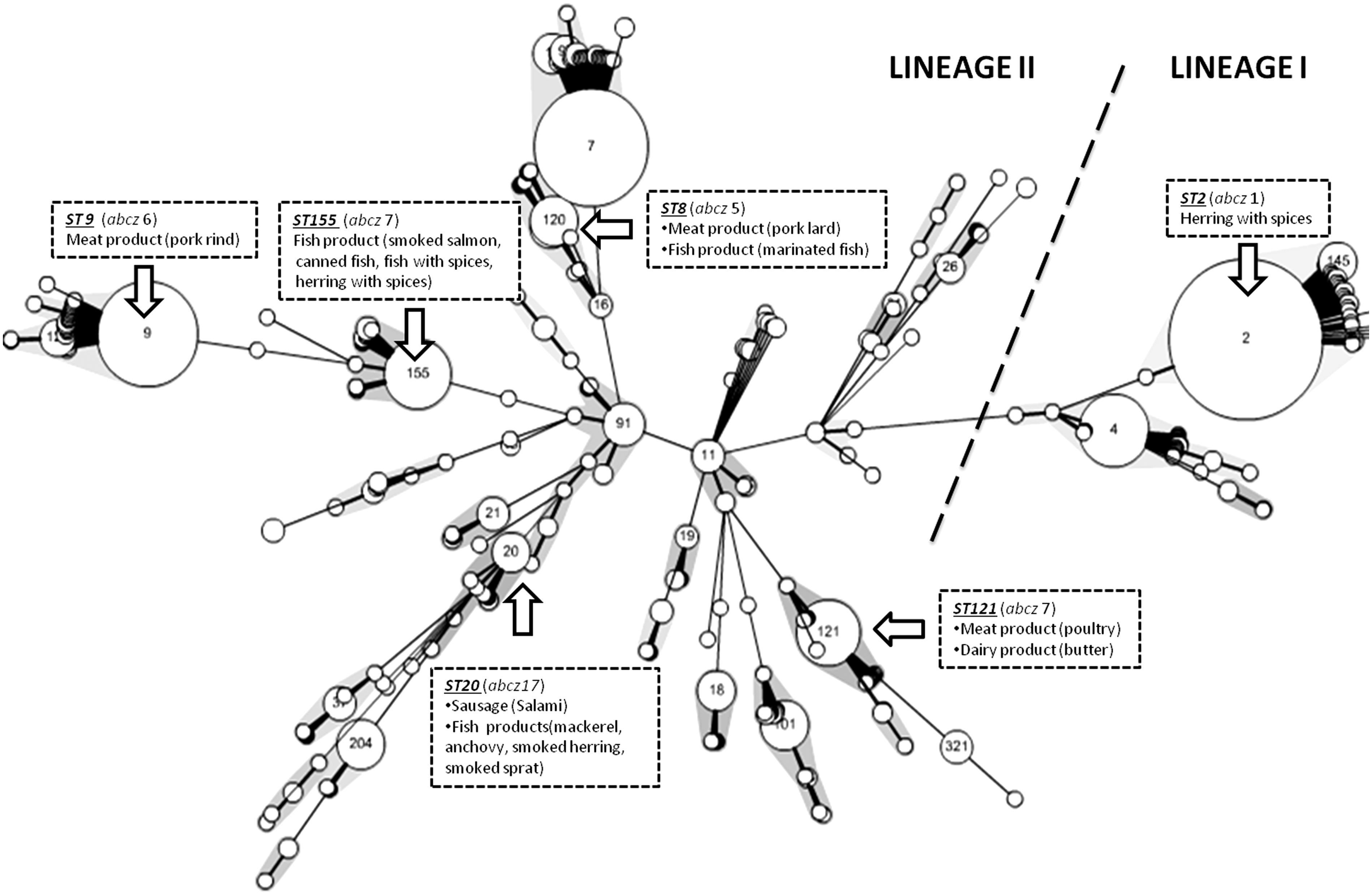
Multilocus sequence typing of 15 Listeria monocytogenes isolated from ready-to-eat food illegally sold in a Romanian market. The sequence types (ST) were clustered according to the abcz housekeeping gene using a minimum spanning tree (MST) tool available from the Institute Pasteur MLST database. Clonal complexes (CC) are shaded, defined as groups of profiles differing by no more than one gene from at least one other profile of the group. Strains with no CC designation correspond to genotypes that are not closely related to any other genotype (singletons). The ST, abcz allelic number, and sources of current L. monocytogenes isolates are included in each MST and surrounded by dotted boxes.
Spa typing of 16 S. aureus isolates resulted in the following profiles presented in decreasing order according to the isolation frequency in this study: t449, t304, t1606, t524, t011, t91, t3625, and t803 (Table 2). Of these, t449, t304, and t524 were most often isolated from cow, sheep, and goat-milk cheeses contaminated with 103–105 CFU/g, indicating a contamination at herd level or unhygienic conditions during food processing and handling. A strong indication of improper food handling at the market could be linked to the coincided isolation of S. aureus t449 at the same date of sampling from red caviar and different kinds of cheeses. The same observation could be made for S. aureus t1606 isolated from fish samples on the same day. S. aureus t011 and t3625, both related to the livestock-associated CC398, were isolated from pork lard and poultry meat. Another very frequently isolated spa type, t011, is often found to be methicillin resistant (
This information is based on the Ridom Spa Database (
MSSA, methicillin-sensitive Staphylococcus aureus; MRSA, methicillin-resistant S. aureus.
Conclusions
This study investigated for the first time the pathogens' presence in food legally brought by Moldavian citizens into the European Union as personal goods, but illegally sold in Romania, and revealed that contamination occurs at levels similar to those usually reported by EFSA (2013) for foods produced and sold with official control. L. monocytogenes is one of the main detected hazards, while poor hygiene conditions were emphasized by the presence of S. aureus. Food distribution to a certain limited number of consumers can most likely lead to sporadic or family-associated cases of diseases.
Footnotes
Acknowledgments
We would like to thank the Institute Pasteur for providing the MLST database of L. monocytogenes in the Genotyping of Pathogens and Public Health Platform and Sonja Klinger, BSc, for technical assistance. This work was supported by the 7th Framework Programme projects PROMISE (project number 265877) and FOODSEG (project number 266061). This publication made use of the spa typing website (
Disclosure Statement
No competing financial interests exist.
References
Supplementary Material
Please find the following supplemental material available below.
For Open Access articles published under a Creative Commons License, all supplemental material carries the same license as the article it is associated with.
For non-Open Access articles published, all supplemental material carries a non-exclusive license, and permission requests for re-use of supplemental material or any part of supplemental material shall be sent directly to the copyright owner as specified in the copyright notice associated with the article.
