




Abstract
Cronobacter sakazakii (formerly Enterobacter sakazakii) is an opportunistic pathogen that causes meningitis, sepsis, and necrotizing enterocolitis in neonates and infants through consumption of contaminated milk-based foods. In this study, the prevalence of C. sakazakii in 705 retail milk-based infant and baby food samples was investigated in 12 cities in Shaanxi, China, in 2010 and 2012. One hundred and nineteen samples (16.9%) were C. sakazakii positive. The isolates were further characterized for antimicrobial susceptibility to 14 antibiotics, pulsed-field gel electrophoresis profiles, and presence of the virulence genes. Samples of brand W, Y, A, and G in 2010 and 2012 were C. sakazakii positive. All isolates recovered in 2010 and 2012 were susceptible to levofloxacin and cefoperazone. In 2012, no isolate was resistant to gentamicin, cefoxitin, chloramphenicol, gatifloxacin, ciprofloxacin, and ceftriaxone. Antibiotic resistance of the isolates was most commonly found to rifampicin, amoxicillin-clavulanic acid, streptomycin, tetracycline, and ampicillin in both 2010 and 2012, except to trimethoprim/sulfamethoxazole in 2012. Pulsed-field gel electrophoresis profiles indicated that C. sakazakii isolates were genotypically diverse, although these isolates were prevalent in infant and baby foods with the same brand. A total of 34 virulence gene profiles of the C. sakazakii isolates in 2010 and 2012 were detected. Isolates that co-carried hly-ompX-eitCBAD-iucABCD/iutA genes in 2012 were significantly (p < 0.05) more prevalent than those in 2010. The results added new epidemiological evidence for the widespread occurrence of C. sakazakii in retail milk-based infant and baby foods and this should be an indicator of potential health risk for consumers.
Introduction
C
In this study, we examined 705 samples from 12 cities in Shaanxi Province, China, in 2010 and 2012 for prevalence of C. sakazakii. The susceptibility of the isolated strains to 14 antibiotics was tested, and PFGE was utilized for the molecular typing.
Materials and Methods
Sample collection, isolation and identification of C. sakazakii
In 2010, a total of 366 food samples were purchased from 60 retail stores and 20 supermarkets in 12 cities in Shaanxi, China. These products comprised 215 baby rice cereal (BRC), 137 powdered infant and baby formula (PIBF) and 14 other infant foods. In 2012, another batch of 339 samples including 230 BRC and 109 PIBF were collected in the corresponding cities as those in 2010. Two batches of food samples including domestically produced foods as well as some imported ones. The samples in 2010 comprised 48 different brands, while in 2012 they comprised 71 brands. Of all the brands, 24 were same in 2010 and 2012.
The isolation and identification of C. sakazakii were carried out according to the National Standards of the People's Republic of China (GB/T 4789.40-2010;
PCR identification and virulence genes amplification
Genomic DNA of the isolates was extracted as previously described (Sambrook and Russell, 2001). PCR was used to amplify ompA and rpoB and potential C. sakazakii virulence genes including ompX, cpa, hly, sip, eitCBAD, and iucABCD/iutA; C. sakazakii ATCC BAA-894 was used as positive control strain (Cruz et al., 2011; Franco et al., 2011). Primers, annealing temperatures, and products sizes for above-mentioned genes were presented in Table 1. All primers were synthesized by Beijing AuGCT Co, Ltd. (
A 25-μL PCR mixture contained 0.5 μM of each primer, 250 μM of dNTP (TaKaRa, Dalian, China) and 1× PCR buffer (TaKaRa), 1.5 mM of MgCl2 (TaKaRa), 0.5 U of Taq DNA polymerase (TaKaRa), and 5 μL of template DNA (approximate concentration was 10 ng/μL). The PCRs were performed in a Mycircle PCR system (Bio-Rad, Hercules, CA) with incubation at 94°C for 10 min followed by 35 cycles of 94°C for 30 s, annealing for 30 s, 72°C for 30 s, and a final extension of 72°C for 7 min. The PCR products were electrophoresised in 1% agarose gels with 0.5× Tris-borate-EDTA buffer and photographed under an ultraviolet light. PCR products of rpoB were stored in an ice box and sent to Shanghai Sunny Biotechnology Co., Ltd. (
Pulsed-field gel electrophoresis
Isolates recovered from the samples with same brand in 2010 and 2012 were subtyped by PFGE as previously described (Hunter et al., 2005; Ribot et al., 2006; Caubilla-Barron et al., 2007). Dendrograms were constructed using Bionumerics software (Version 2.0; Applied-Maths, Kortrijk, Belgium), and the cluster analysis was conducted using the DICE coefficient and unweighted pair group method with arithmetic means. Salmonella Braenderup H9812 was used as the DNA band size standard.
Antibiotic susceptibility tests
All isolates were tested for susceptibility to 14 antimicrobial agents (Li et al., 2014; Xu et al., 2015) using the agar dilution method described by the Clinical and Laboratory Standards Institute (CLSI, 2011) (Table 3). Enterococcus faecalis ATCC29212 and Escherichia coli ATCC25922 were used as quality control strains. The breakpoints for the interpretation of resistance and susceptibility were referenced to the standards provided by the CLSI (2011) except for streptomycin, which was determined by the U.S. National Antimicrobial Resistance Monitoring System provisional breakpoints for streptomycin (
Statistical analysis
Statistical comparisons of the prevalence of C. sakazakii in milk-based infant and baby foods in 2010 and 2012, percentages of antibiotic resistant isolates, and virulent genes carried in the isolates in 2010 and 2012 were analyzed using SPSS statistical software (Version 16.0; SPSS Inc., Chicago, IL). The chi-square test was used to compare discrete variables; threshold for significant difference was p < 0.05 and extreme significant difference was p < 0.01.
Results
Isolation and prevalence of C. sakazakii
Eighty-four (23.0%) of 366 milk-based infant and baby food samples were C. sakazakii–positive in 2010, while 35 (10.3%) of 339 samples were C. sakazakii–positive in 2012. In 2010, among the 84 C. sakazakii–positive samples, 58 (27.0%) were BRC and 24 (17.5%) were PIBF. In 2012, of the 35 C. sakazakii–positive samples, 32 (13.9%) were BRC and 3 (2.8%) were PIBF. One hundred and sixty six C. sakazakii isolates were recovered in 2010 and 70 were recovered in 2012 (Table 2). The most commonly C. sakazakii–positive brands in 2010 and 2012 were W, Y, A, G, JBS, and FG, among which brands W, Y, A, and G were C. sakazakii–positive in both 2010 and 2012.
Significant difference (p < 0.05) was found between the rates of C. sakazakii–positive samples collected in 2010 and 2012, respectively.
BRC, baby rice cereal; OIF, other infant food; PIBF, powdered infant and baby formula.
Antimicrobial susceptibility
All isolates recovered in 2010 were susceptible to levofloxacin and cefoperazone, and all isolates in 2012 were susceptible to levofloxacin, cefoperazone, ceftriaxone, cefoxitin, gentamicin, chloramphenicol, gatifloxacin, and ciprofloxacin. Antimicrobial resistance of the isolates was most commonly found to rifampicin, amoxicillin-clavulanic acid, streptomycin, tetracycline, and ampicillin both in 2010 and 2012, except to trimethoprim/sulfamethoxazole in 2012 (Table 3). No significant difference was found among resistance rates to rifampicin in 2010 and 2012, as well as to amoxicillin-clavulanic acid, ampicillin, chloramphenicol, nalidixic acid, gatifloxacin, ciprofloxacin, and ceftriaxone (Table 3). For streptomycin, tetracycline, and gentamycin, the resistance rates in 2010 were significantly (p < 0.05) higher than those in 2012 (Table 3).
Significant difference (p < 0.05) was found between the rates of C. sakazakii isolates that were resistant to streptomycin, tetracycline, gentamicin, and trimethoprim/sulfamethoxazole.
Pulsed-field gel electrophoresis (PFGE)
PFGE genotypes of the isolates recovered from the four C. sakazakii–positive brands (G, A, W, and Y) in both 2010 and 2012 were analyzed (cutoff value = 100%). Isolates 14-15(2) and 14-18(1) had the same DNA profiles but were recovered from different samples with different brands and districts. For foods with brand G, DNA profiles of the two isolates in 2010 and 2012 were totally different. For samples of brand A, isolates 1 and 2, 13 and 14 in 2012, isolates 11-1(1) and 11-1(2) in 2010 were assigned into three clusters, while the rest of the isolates in 2010 were assigned into other clusters. One isolate was detected from the sample of brand W in 2012, its DNA profiles were completely different from those in 2010. Similar results could be seen among the DNA profiles of isolates recovered from samples of brand Y in 2010 and 2012 (Fig. 1).
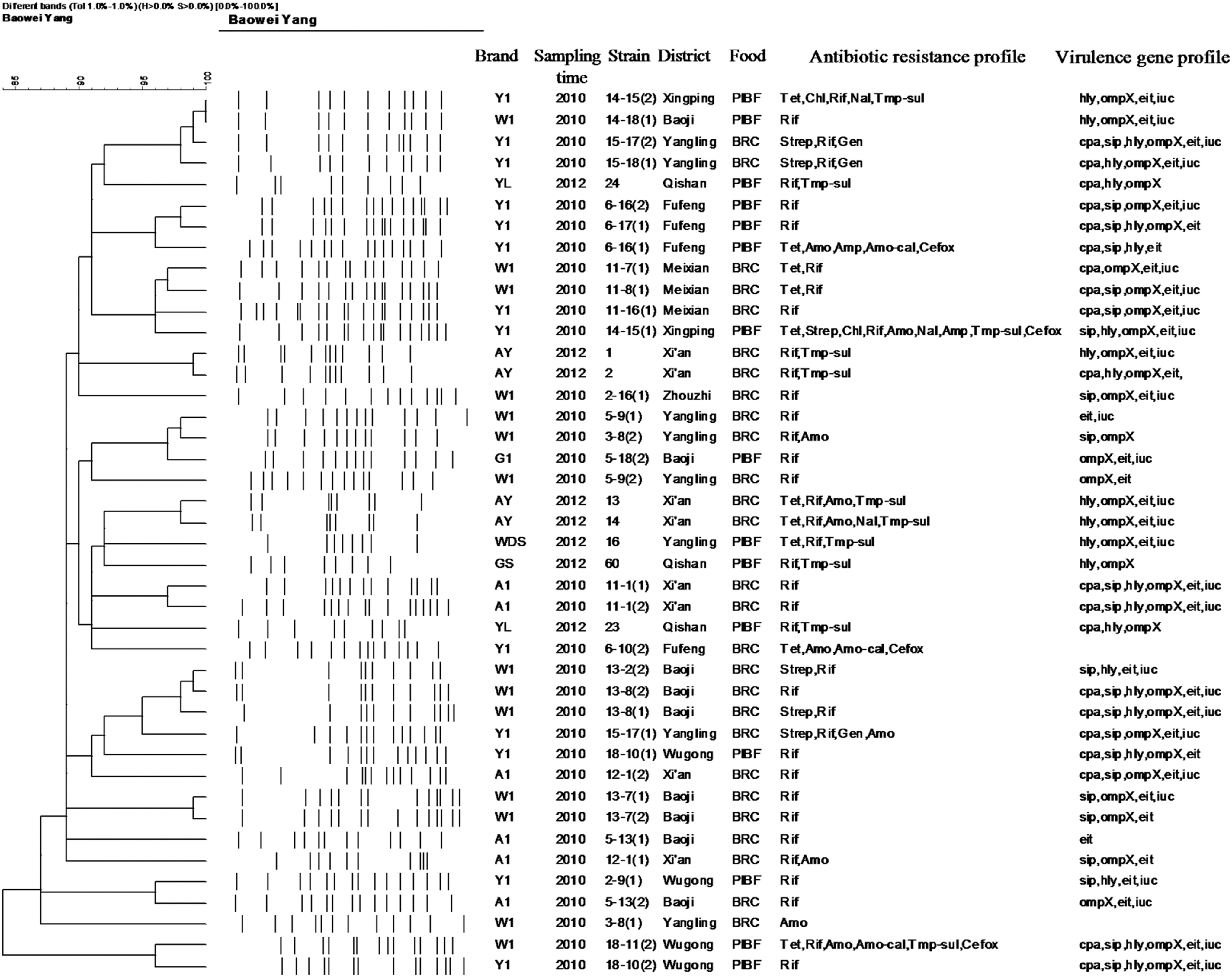
Pulsed-field gel electrophoresis dendrogram of Cronobacter sakazakii isolates recovered from brands A, G, W, and Y in 2010 and 2012. Brand designations: A1, sample of brand A that collected in 2010; AY, sample of brand A that collected in 2012; G1, sample of brand G that collected in 2010; GS, sample of brand G that collected in 2012; W1, sample of brand W that collected in 2010; WDS, sample of brand W that collected in 2012; Y1, sample of brand Y that collected in 2010; YL, sample of brand Y that collected in 2012; Food: PIBF, powdered infant and baby formula; BRC, baby rice cereal. Antibiotic resistence profiles: Amo, amoxicillin; Amo-cal, amoxicillin/clavulanic acid; Cefox, Cefoxitin; Chl, chloramphenicol; Gen, gentamicin; Nal, nalidixic acid; Rif, rifampicin; Strep, streptomycin; Tet, tetracycline; Tmp-sul, trimethoprim-sulfamethoxazole.
Virulence genes
A total of 34 virulence gene profiles were detected among C. sakazakii isolates in 2010 and 2012. Of the detected virulence gene profiles, hly-ompX-eitCBAD-iucABCD/iutA was the most commonly detected. It was simultaneously identified in 2 (1.2%) and 19 (27.1%) of the isolates in 2010 and 2012, respectively. And it was significantly (p < 0.05) more prevalent among isolates in 2012 than those in 2010. Virulence genes of hly (1.4%), cpa-hly-ompX (4.3%), cpa-hly-eitCBAD (1.4%), and cpa-hly-ompX-iucABCD/iutA (1.4%) could only be detected among the isolates in 2012. Eight virulence gene profiles including ompX, ompX-eitCBAD, cpa-ompX-eitCBAD, hly-ompX-eitCBAD, ompX-eitCBAD-iucABCD/iutA, cpa-hly-ompX-eitCBAD, hly-ompX-eitCBAD-iucABCD/iutA, and cpa-hly-ompX-eitCBAD-iucABCD/iutA were detected in both 2010 and 2012. Isolates cocarried virulence genes of hly-ompX-eitCBAD, cpa-hly-ompX-eitCBAD, hly-ompX-eitCBAD-iucABCD/iutA and cpa-hly-ompX-eitCBAD-iucABCD/iutA recovered in 2012 were significantly (p < 0.05) more prevalent than those in 2010.
Discussion
Much research has focused on the Cronobacter spp. contamination of dried milk–based infant foods including PIF (Simmons et al., 1989; Van Acker et al., 2001; FDA, 2002; Iversen and Forsythe, 2004; Shaker et al., 2007; Cawthorn et al., 2008). However, information concerning the prevalence of this pathogen in related foods in Shaanxi province, China was not well documented. In present study, 705 dried milk–based infant and baby foods that represented approximately 70 brands in Shaanxi, China, in 2010 and 2012 were investigated for the presence of C. sakazakii. The results indicated that 27.0% (58/215) of BRC and 17.5% (24/137) of PIBF samples in 2010 were detected to be C. sakazakii–positive; those were higher than C. sakazakii–positive sample rates of BRC (13.9%; 32/230) and PIBF (3.0%; 3/109) in 2012. Previous studies in other countries have reported that 2.4% of PIBF samples in the United Kingdom (Iversen and Forsythe, 2004), 25% of PIBF in Jordan (Shaker et al., 2007), and 14% of PIBF in South Africa (Cawthorn et al., 2008) were Cronobacter spp. positive. Based on the data extracted from scientific publications and reporting systems, more than 100 cases of neonatal Cronobacter spp. infections were reported between 2000 and 2008, the overall lethality of the 67 invasive cases was 26.9%. The lethalities of Cronobacter meningitis, bacteremia, and necrotizing enterocolitis were counted to be 41.9%, approximate 10%, and 19.0%, respectively (Friedemann, 2009). Although such data have not been reported in China, according to our current surveillance results, C. sakazakii contamination in dried milk–based infant and baby foods was revealed to be serious.
Previous studies revealed that C. sakazakii isolated from imported PIF samples in Argentina and Bangladesh, respectively, were susceptible to all the tested antibiotics (Terragno et al., 2009; Hoque et al., 2010); however, antimicrobial susceptibility results in present study revealed that C. sakazakii isolates in 2010 and 2012 were all resistant to rifampicin and agreed with previous findings that Cronobacter spp. was naturally resistant to this antibiotic (Stock and Wiedemann, 2002).
In this study, C. sakazakii isolates recovered from the samples of the four brands (A, G, W, and Y) that were detected as C. sakazakii–positive in both 2010 and 2012 were subtyped by PFGE using XbaI to elucidate the genetic diversity. The results indicated that majority of the isolates exhibited different DNA profiles, although they were recovered from the samples with same brand. According to PFGE results, 42 C. sakazakii strains of the four brands were subtyped to 41 different pulsotypes, which revealed that C. sakazakii isolates in the contaminated milk-based products were diverse and may originate from different sources. Previous studies indicated that there were two main sources of C. sakazakii contamination, one was contaminated machinery and equipment used during the manufacturing process. Another was the contaminated materials addition. Sterilization process cannot completely eliminate C. sakazakii for these additives like starchy substances, vitamins, and minerals (Pan et al., 2014). Therefore, the later stage of manufacturing process made the risk of C. sakazakii contamination increased (Mullane et al., 2007). Prevention of ingredient contamination was not enough for C. sakazakii control, or more importantly, elimination of C. sakazakii during manufacturing process.
Previous findings indicated that OmpA was one of the determinants that contributed to C. sakazakii invasion of brain microvascular endothelial cells in vitro, and potentially played a role in the pathogenesis of neonatal meningitis caused by this organism (Nair et al., 2009). Except for OmpA, products of other virulence genes, such as outer membrane gene X (ompX) (Kim et al., 2010), siderophore-interacting gene (sip), hemolysin gene (hly) (Baida and Kuzmin, 1996; Chen et al., 2004), and plasminogen activator gene (cpa), were all associated with invasiveness and potential hazards of Cronobacter spp. to its hosts (Cruz et al.,2011).
In Cronobacter spp., two iron acquisition systems (eitCBAD and iucABCD/iutA), which are known virulence factors, were carried by two plasmids of pESA3 (131 kb) and pCTU1 (138 kb) (Franco et al., 2011; Joseph et al., 2012). In this study, the detection rates of eitCBAD and iucABCD/iutA genes were consistent with previous studies (Franco et al., 2011). The most prevalent virulence gene detected among the six tested virulence genes was ompX (5.7%; 4/66), and this finding was in agreement with that of previous study (Kim et al., 2010). The detection rates of sip, hly and cpa were in low levels among the six tested virulence genes. In contrast, Cruz et al. (Cruz et al., 2011) reported the detection rates of sip, hly, and cpa were 60% (26/43), 37% (16/43), and 28% (12/43), respectively. Diverse and different clonal isolates, food samples, number of isolates, sampling districts, and gene detection methods might associate with the difference of our detection results and the previous ones. As the infants and young children are the dominant consumers of PIBF and BRC, and their immune systems are not well developed; thus, effective precautions and specific monitoring for C. sakazakii contamination in infant and baby foods production are especially important (
Conclusions
In 2010 and 2012, Cronobacter sakazakii was prevalent in dried milk–based infant and baby foods in Shaanxi Province, China. The antimicrobial resistance, PFGE patterns, and virulence genes of C. sakazakii were diverse. The milk-based foods continued to be potential threats for infant and baby health and greater attention should be paid.
Footnotes
Acknowledgments
This research was supported in part by Outstanding Doctoral Dissertation Program of Shaanxi Province, China (2010–2015), and the Chang Jiang Scholar Program of the Chinese Ministry of Education (2006–2013).
Disclosure Statement
No competing financial interests exist.