




Abstract
A total of 253 multiple-locus variable-number tandem-repeat analysis (MLVA) types among 634 isolates were discovered while studying the genetic diversity of porcine Yersinia enterocolitica 4/O:3 isolates from eight different European countries. Six variable-number tandem-repeat (VNTR) loci V2A, V4, V5, V6, V7, and V9 were used to study the isolates from 82 farms in Belgium (n = 93, 7 farms), England (n = 41, 8 farms), Estonia (n = 106, 12 farms), Finland (n = 70, 13 farms), Italy (n = 111, 20 farms), Latvia (n = 66, 3 farms), Russia (n = 60, 10 farms), and Spain (n = 87, 9 farms). Cluster analysis revealed mainly country-specific clusters, and only one MLVA type consisting of two isolates was found from two countries: Russia and Italy. Also, farm-specific clusters were discovered, but same MLVA types could also be found from different farms. Analysis of multiple isolates originating either from the same tonsils (n = 4) or from the same farm, but 6 months apart, revealed both identical and different MLVA types. MLVA showed a very good discriminatory ability with a Simpson's discriminatory index (DI) of 0.989. DIs for VNTR loci V2A, V4, V5, V6, V7, and V9 were 0.916, 0.791, 0.901, 0.877, 0.912, and 0.785, respectively, when studying all isolates together, but variation was evident between isolates originating from different countries. Locus V4 in the Spanish isolates and locus V9 in the Latvian isolates did not differentiate (DI 0.000), and locus V9 in the English isolates showed very low discriminatory power (DI 0.049). The porcine Y. enterocolitica 4/O:3 isolates were diverse, but the variation in DI demonstrates that the well discriminating loci V2A, V5, V6, and V7 should be included in MLVA protocol when maximal discriminatory power is needed.
Introduction
Y
Pigs are considered the most important reservoir for Y. enterocolitica. The bacteria are commonly found on the tonsils and during slaughter can be transmitted from there and the intestinal content to the carcass and offal (Fredriksson-Ahomaa et al., 2001; Laukkanen et al., 2009). The prevalence of porcine Y. enterocolitica is commonly studied from the tonsils or feces and the prevalence varies greatly. In Europe, the prevalence from tonsil samples has reportedly varied from 11% to 93% (Ortiz Martínez et al., 2009, 2010, 2011; Vanantwerpen et al., 2013; Fondrevez et al., 2014). In the United States, the prevalence from tonsil swabs has varied from 10% to 13% (Funk et al., 1998; Wesley et al., 2008) and from feces, from 4% to 13% (Bhaduri et al., 2005; Bhaduri and Wesley, 2006). In Canada, the prevalence from feces has ranged from 5% to 35% (Poljak et al., 2010), and in China, 15% for samples from tonsil swabs, 6% for those from intestinal content, and 3% for those from feces (Liang et al., 2012). The prevalence in feces depends on the pigs' age; the highest prevalence occurs in 2- to 3-month-old pigs and decreases as the pigs approach slaughtering age (Vilar et al., 2013).
Bioserotypes commonly associated with human yersiniosis are 4/O:3, 2/O:9, 2/O:5,27, and 1B/O:8 (Drummond et al., 2012). The variety of bioserotypes in one geographical region is limited and certain types predominate. Serotype O:3 is the most common in pigs in Europe (Fredriksson-Ahomaa et al., 2001; Laukkanen et al., 2009; Ortiz Martínez et al., 2009, 2011; EFSA and ECDC, 2015), the United States (Bhaduri and Wesley, 2006, 2012; Tadesse et al., 2013), Canada (Poljak et al., 2010), and China (Liang et al., 2012). However, bioserotype diversity is broader in England, where the most common bioserotypes are 2/O:9 and 2/O:5 (Ortiz Martínez et al., 2010).
To study the genetic diversity of Y. enterocolitica 4/O:3, researchers have used various methods, including pulsed-field gel electrophoresis (PFGE) (Fredriksson-Ahomaa et al., 2003, 2006) and multiple-locus variable-number tandem-repeat analysis (MLVA) (Gierczyński et al., 2007; Sihvonen et al., 2011; Virtanen et al., 2013). With PFGE, researchers have observed limited diversity and high clonality among bioserotype 4/O:3, even among strains of different geographical origin (Fredriksson-Ahomaa et al., 2003, 2006). MLVA has shown high discriminatory power (Sihvonen et al., 2011; Virtanen et al., 2013) and has served in a variety of Y. enterocolitica studies (Sihvonen et al., 2011; Virtanen et al., 2012, 2013; Wang et al., 2012; Virtanen et al., 2014). Researchers have used MLVA to distinguish between sporadic and outbreak-related strains (Sihvonen et al., 2011; Virtanen et al., 2013), to study transmission routes on and between pig farms (Virtanen et al., 2012, 2014) and to analyze the geographical relatedness of strains of serotypes O:3 and O:9 (Wang et al., 2012). To date, no published studies have explored the genetic diversity of numerous Y. enterocolitica 4/O:3 isolates from a wide range of countries.
We genotyped porcine tonsil Y. enterocolitica 4/O:3 isolates from eight European countries and discovered a large variety of MLVA types. MLVA proved to be highly discriminatory and the isolates within bioserotype 4/O:3 were diverse. The power to discriminate between the isolates varied between the countries and between the different Variable-number tandem-repeat (VNTR) loci. For this reason, an optimal and standardized MLVA method that uses only loci with large discriminatory power worldwide should be established for Y. enterocolitica. Based on the results of the present study, loci V2A, V5, V6, and V7 have the largest discriminatory power.
Materials and Methods
Y. enterocolitica isolates
A total of 634 porcine tonsil Y. enterocolitica 4/O:3 isolates from eight countries and 82 farms were studied (Table 1). From four English pigs, two to three isolates came from the tonsils of the same pigs (a total of nine isolates). All isolates were from the Culture Collections of the Department of Food Hygiene and Environmental Health, University of Helsinki, Helsinki, Finland (Laukkanen et al., 2009; Ortiz Martínez et al., 2009, 2010, 2011).
The mean value for each country was calculated from values of MLVA types discovered on a farm divided by the number of isolates studied from that farm. The farms, from which only one isolate was studied, were not included.
The value was calculated from number of MLVA types that occur on more than one farm divided by total number of MLVA types discovered from the country.
The same MLVA type occurred in Italy and Russia.
MLVA, multiple-locus variable-number tandem-repeat analysis.
MLVA
VNTR loci V2A, V4, V5, V6, V7, and V9 (Gierczyński et al., 2007) were used, and the forward fluorescent primers were labeled with ABI PRISM® dyes PET, NED, 6-FAM, and VIC (Applied Biosystems, Foster City, CA). Two multiplex PCRs were performed with V2A (6-FAM), V4 (NED), and V6 (PET), as well as V5 (NED), V7 (VIC), and V9 (6-FAM).
A colony of pure culture was transferred to a mixture of 100 μL of 1 × Buffer for DyNAzyme (Thermo Fisher Scientific, Inc., Vantaa, Finland) containing 0.6 U of Proteinase K (Thermo Fisher Scientific). The mixture was incubated at 37°C for 60 min and heated at 95°C for 10 min.
PCR took place in a 25-μL reaction mixture containing 5 μL of template, 5 nmol of dNTP mix (Thermo Fisher Scientific), 1 U of DyNAzyme II (Thermo Fisher Scientific), 1 × Buffer for DyNAzyme, 5 pmol of primers for loci V2A, V4, V5, and V6, 7 pmol of primer V7, and 3 pmol of primer V9. The PCR conditions were as follows: initial denaturation at 94°C for 1 min, 9 cycles of denaturation at 94°C for 30 s, annealing at 63°C–55°C (decreasing by 1°C with each cycle) for 30 s, extension at 72°C for 30 s, additional 25 cycles at a 58°C annealing temperature, and a final 5-min extension at 72°C.
For capillary electrophoresis, 2 μL of 1:100 diluted PCR end products was added to 13 μL of Hi-Di-Formamide (Applied Biosystems) and mixed with 0.3 μL of GeneScan-500 LIZ-Size Standard (Applied Biosystems). The samples were denatured at 95°C for 3 min and cooled at 4°C. Capillary electrophoresis was performed with an ABI PRISM 310 Genetic Analyzer (Applied Biosystems) with POP-4™ Performance Optimized Polymer (Applied Biosystems). The electrophoresis conditions were 15 kV at 60°C for 28 min.
Data analysis
The VNTR locus V2A was interpreted according to Virtanen et al. (2013). GeneScan (Applied Biosystems) was used to collect the data and BioNumerics 5.2 (Applied Maths NV, Sint-Martens-Latem, Belgium) to analyze them. Euclidean distances were used to calculate the cluster analysis. Discriminatory indexes (DIs) for the method and the different VNTR loci were compiled according to Hunter and Gaston (1988). Analysis of variance (One-Way ANOVA with Bonferroni comparison) served to analyze country-associated differences. The farms, from which only one isolate was studied, were omitted from the analysis of variance.
Results
Among the 634 Y. enterocolitica 4/O:3 isolates studied, a total of 253 MLVA types were discovered (Table 1). In the cluster analysis (Supplementary Fig. S1; Supplementary Data are available online at
The number of MLVA types discovered differed between the countries from 17 to 56 (Table 1). The number of MLVA types found per farm also varied, and taking into account the number of isolates studied per farm resulted in ratios showing that the isolates in Estonia and Spain were significantly less diverse than those in Italy and Russia (p < 0.05). In Belgium, all the MLVA types were farm specific. In all the other countries, some of the MLVA types were present on several farms. The proportion of MLVA types common to more than one farm varied between 0% and 21.4% in different countries (Table 1). The number of MLVA types found on one farm varied between 1 and 9 (Fig. 1 and Table 1). Most of the farms (85%) had more than one type. One to three isolates were studied from the farms that had only one MLVA type, with the exception of an Estonian farm (Es2 in Fig. 1).
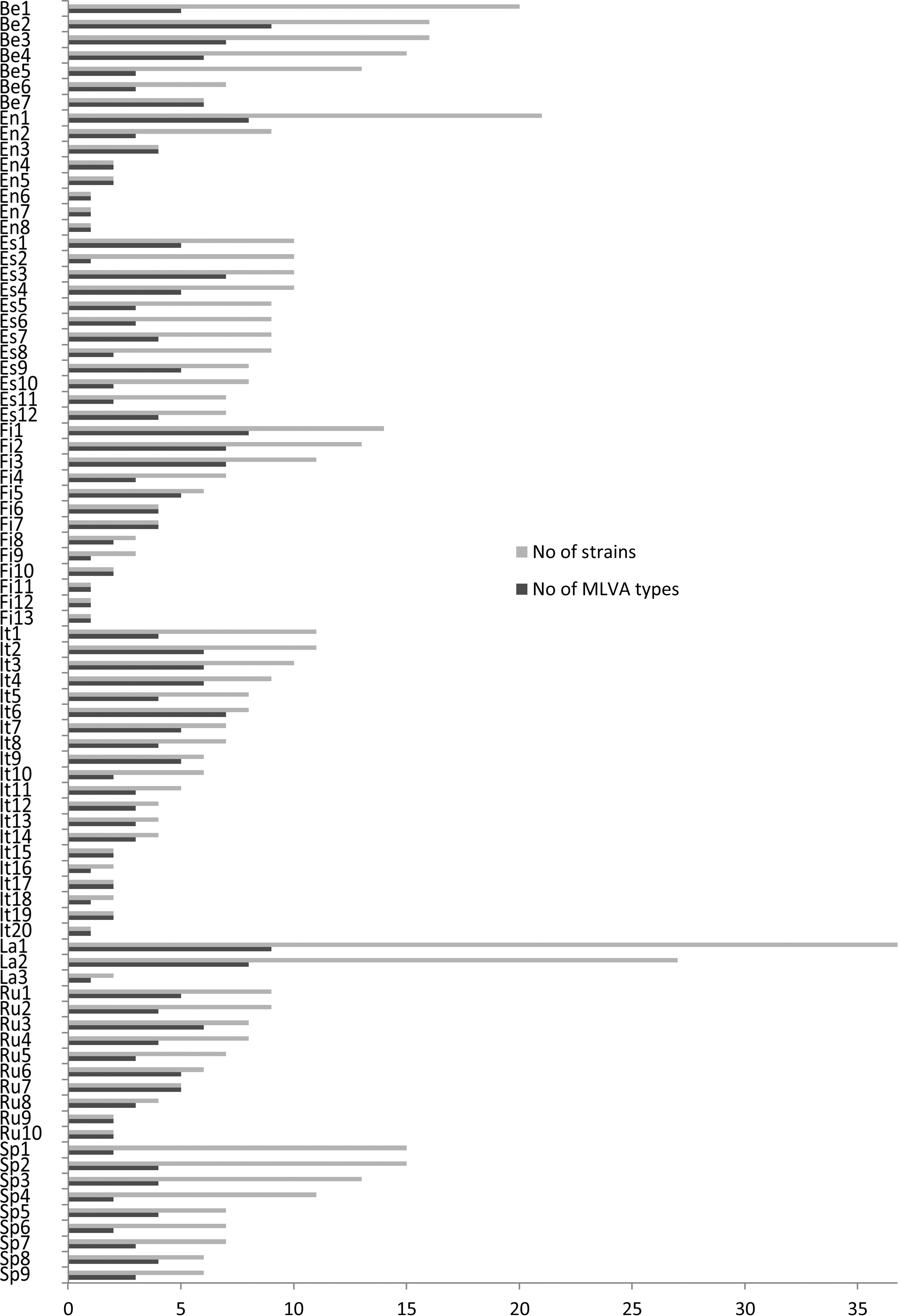
The number of Yersinia enterocolitica isolates studied and MLVA types found on each farm. Be, Belgium; En, England; Es, Estonia; Fi, Finland; It, Italy; La, Latvia; Ru, Russia; Sp, Spain. MLVA, multiple-locus variable-number tandem-repeat analysis.
The DI of the MLVA method was 0.989, but varied from 0.736 to 0.981 between countries (Table 2). The DIs of the different VNTR loci also varied (Table 2). Generally, loci V2A, V5, and V7 had the highest DIs, whereas loci V4 and V9 had the lowest. Comparing all isolates from all the countries revealed that locus V4 had relatively high discriminatory power, but examining the countries separately showed lower discriminatory power (Table 2). The highest DIs for V4 were 0.600 (Finland), 0.588 (Belgium), and 0.554 (Italy) and the lowest in Estonia (0.195) and Spain (0.000). Locus V9 had a relatively high DI in Belgium (0.823) and Italy (0.782), but a very low DI in England (0.049) and Latvia (0.000).
DI, discriminatory index; MLVA, multiple-locus variable-number tandem-repeat analysis; VNTR, variable-number tandem-repeat.
When two or three isolates were collected from the same tonsils of English pigs (Table 3) and analyzed with MLVA, identical or almost identical MLVA types were observed with some pigs, whereas others hosted two completely different MLVA types in their tonsils. English isolates collected from pigs of the same farm, but on two different occasions, revealed similar results (Table 4): one identical MLVA type was found in samples collected 6 months apart, but also completely different MLVA types were discovered. The almost identical MLVA types showed only one to two number variations in VNTR loci V5, V6, and V7.
The same MLVA type found in two isolates collected from the same pig.
MLVA, multiple-locus variable-number tandem-repeat analysis; VNTR, variable-number tandem-repeat.
The same MLVA type found at both occasions.
MLVA, multiple-locus variable-number tandem-repeat analysis; VNTR, variable-number tandem-repeat.
Discussion
MLVA demonstrated the broad genetic diversity of porcine Y. enterocolitica 4/O:3 isolates from eight European countries. Genotyping 634 isolates from 82 farms revealed 253 MLVA types. The number of MLVA types discovered was in line with that of previous studies. A recent study of Finnish porcine Y. enterocolitica isolates revealed 86 MLVA types among 359 isolates when 97% of the isolates were of bioserotype 4/O:3 (Virtanen et al., 2014). Researchers discovered 77 MLVA types among 82 Finnish human isolates that also included other bioserotypes (Sihvonen et al., 2011). A study of isolates from four European countries found 312 MLVA types among 379 isolates originating from human, porcine, and pork samples with majority of serotype O:3 (Virtanen et al., 2013). In China, isolates from humans and different animal species included five bioserotypes and revealed 104 MLVA types among 218 isolates (Wang et al., 2012). The study of porcine 4/O:3 isolates reveals less diversity compared to studies that include other bioserotypes or nonporcine isolates as well. All of these results demonstrate that MLVA is an effective genotyping method for Y. enterocolitica, even though the observed diversity is dependent on the study material.
Cluster analysis revealed mainly country-specific clusters. Only one MLVA type consisting of two isolates originated from two countries: Italy and Russia. Y. enterocolitica can be transmitted through live animals (Virtanen et al., 2012, 2014), which means the bacteria could also be transmitted from one country to another through transported animals. Observed country-specific MLVA types indicate only minor transportation of live animals between countries.
We noted differences in the number of MLVA types found across the countries in this study. When the number of MLVA types per farm was adjusted with the number of isolates studied per each farm, we discovered that the Estonian and Spanish isolates were significantly less diverse than Italian and Russian isolates (p < 0.05). Cluster analysis showed that in Finland, Italy, Spain, and Russia the isolates show a greater variety of VNTR numbers, thus demonstrating that Y. enterocolitica 4/O:3 isolates are more diverse in certain countries.
We found more than one MLVA type on most of the farms (Fig. 1). The number of MLVA types common to several farms varied. In Belgium, all the MLVA types were farm specific even though the farms were located across a 100-km range. In contrast, in Italy, Estonia, and Russia, where farms were located at a maximum of 300–600 km apart, many MLVA types were found on more than one farm (Table 1). The distance between farms does not seem to correspond to the number of shared MLVA types. This finding is in line with our previous findings showing that Y. enterocolitica travels through live animals between farms, and purchasing pigs from other farms, for example, increases the number of MLVA types (Virtanen et al., 2012, 2014). Furthermore, the different MLVA types on a farm could be the result of mutations of persistent strains (Virtanen et al., 2013).
The DI of the MLVA method was high (0.989), as other studies have previously showed (Sihvonen et al., 2011; Wang et al., 2012; Virtanen et al., 2013). To assess how well MLVA can be applied to isolates originating from different countries, we compared DIs and discovered clear differences (Table 2). In Spain, the DI of the method was only 0.736, so the method's discriminatory ability seems to depend on the origin of the samples. The Spanish isolates originated from farms located at a maximum of 70 km apart, so the isolates of this area could be more similar to Spanish isolates generally, but confirming this will require more studies.
We assessed how well the six VNTR loci can be applied to isolates originating from different countries and observed clear variation in the DIs (Table 2). Studying all the isolates together showed that the DIs for V4 and V9 were the lowest. This result is in agreement with previous results with Finnish isolates (Sihvonen et al., 2011; Virtanen et al., 2013). We observed surprisingly poor DIs for V4 and V9 in some of the countries. Locus V4 could not distinguish the isolates from Spain, or V9, the isolates from Latvia. In addition, with English isolates, V9 also had poor DI. The highest DIs occurred for V2A, V5, and V7, whereas previously, the highest DIs occurred with European isolates for V2A (Sihvonen et al., 2011; Virtanen et al., 2013). The length of the tandem-repeat sequence is 7 bp for V4 and 12 bp for V9, but 6 bp for all the other loci. Presumably, V4 and V9, with their longer sequences, vary less, a finding which our results support. In China, however, V2A and V4 had the lowest DIs, and V5, the highest (Wang et al., 2012). The discriminatory ability of the loci seems to depend partly on the isolates studied and not just on the length of the tandem-repeat sequences. Nevertheless, MLVA is a very useful tool for analyzing the diversity of porcine Y. enterocolitica 4/O:3 isolates.
Some researchers have suggested that MLVA could be too discriminating for long-term use and that the more discriminating loci V2A, V5, V6, and V7 can show hypervariability (Virtanen et al., 2013). In this study, the isolates had been collected over a short period of time, but to assess hypervariability, we compared English isolates collected from the same pigs and from one farm on two separate occasions. The results show that pigs can carry more than one MLVA type of Y. enterocolitica 4/O:3 in their tonsils. The results also show that loci V5, V6, and V7 contained one to two number differences in the VNTR numbers. The present study interpreted these as different MLVA types, but recent discussions have proposed that some of these almost similar isolates might be of a single epidemiological origin (Virtanen et al., 2013). In some cases, MLVA might be too discriminatory, which any interpretation of the results should take into account. The present study demonstrates that loci V2A, V5, V6, and V7 have the largest discriminatory power. We suggest these loci to be included in future studies where maximal discriminatory ability is needed and next to them new loci could be developed. In contrast, the less discriminating loci V4 and V9 could be useful in long-term sampling or in other situations where hypervariability could create problems.
Conclusions
MLVA is highly discriminatory, fast, and easy to perform, and the numerical data it produces are easy to compare reliably, making it an excellent genotyping method. This study shows that MLVA is an effective method for genotyping porcine Y. enterocolitica 4/O:3 isolates and that the isolates within 4/O:3 are diverse. The discriminatory power varies between countries and the different VNTR loci, which makes agreement on an optimal and standardized method for worldwide use challenging. MLVA for Y. enterocolitica should be developed further so as to use only loci with high discriminatory power. An agreement should also govern the interpretation of MLVA results from long-term sampling.
Footnotes
Acknowledgments
This research took place in the Finnish Centre of Excellence in Microbiological Food Safety Research and received funding from the Academy of Finland (grants 118602 and 141140).
Disclosure Statement
No competing financial interests exist.
References
Supplementary Material
Please find the following supplemental material available below.
For Open Access articles published under a Creative Commons License, all supplemental material carries the same license as the article it is associated with.
For non-Open Access articles published, all supplemental material carries a non-exclusive license, and permission requests for re-use of supplemental material or any part of supplemental material shall be sent directly to the copyright owner as specified in the copyright notice associated with the article.
