




Abstract
The current study was conducted to assess Salmonella spp. contamination in chicken carcasses produced at major poultry processing plants in South Korea. In total, 120 chicken carcasses were collected through 12 individual trials (10 chickens per trial) from six poultry processing plants in the summer of 2014 and the winter of 2015. Eighteen chicken samples (15%) were contaminated with Salmonella, with a higher rate of contamination observed during summer (14 isolates, 11.7%) than during winter (four isolates, 3.3%). Salmonella enterica serotype Typhimurium was the most prevalent, followed by Salmonella Hadar, Salmonella Rissen, Salmonella Bareilly, and Salmonella Virchow. Among five multidrug resistant isolates, a single strain was resistant to 10 antibiotics, including third-generation cephalosporins. This cephalosporin-resistant strain exhibited the extended-spectrum β-lactamase (ESBL) phenotype and harbored the gene encoding CTX-M-15, the most prevalent ESBL enzyme worldwide. Herein, repetitive-sequence-based polymerase chain reaction (rep-PCR) subtyping was conducted to discriminate the isolated Salmonella spp. and the ESBL-producing Salmonella isolate was distinguished by rep-PCR molecular subtyping, showing low genetic similarity in their rep-PCR-banding patterns. Given that poultry processing plants are the last stage in the chicken-production chain, the occurrence of Salmonella spp. including ESBL-producing strain in individually packaged chicken products highlights the necessity for regular monitoring for Salmonella in poultry processing plants.
Introduction
F
The emergence of antimicrobial-resistant Salmonella is another issue of concern. Generally, antibiotic treatment is not required in cases of Salmonella enterica gastroenteritis, but is essential in cases of invasive salmonellosis or in immunocompromised patients. Fluoroquinolones and extended-spectrum cephalosporins are commonly used to treat invasive infections or severe diarrhea, but an increasing number of Salmonella synthesizes extended-spectrum β-lactamases (ESBLs), complicating treatment of human salmonellosis (Gonzalez-Sanz et al., 2009; Clemente et al., 2013; Liebana et al., 2013; Seiffert et al., 2013). Therefore, ESBL phenotyping and genotyping data can be used to select therapeutic agents against human salmonellosis.
In the present study, we evaluated the serotype distribution and antimicrobial resistance of Salmonella isolated from chicken carcasses produced by different integrated broiler operations. The cephalosporin-resistant strain among multidrug resistant (MDR) strains was further characterized by ESBL phenotyping and genotyping. In addition, molecular subtyping of Salmonella isolates was performed using an automated repetitive-sequence-based polymerase chain reaction (rep-PCR) system (DiversiLab™, bioMérieux, Marcy l'Etoile, France).
Materials and Methods
Sample collection
The sampling of chickens was conducted from major six poultry processing plants (two in Jeonla, two in Gyeonggi, one in Chungcheong, and one Gyeongsang) listed among top 10 integrated broiler production system covering about half of the Korea chicken production. In total, 120 fresh chicken carcasses produced by different integrated broiler chicken operations were collected during the summer season (June-August) of 2014 and the winter season (December- February) of 2015. On each visit to one of the six poultry processing plants, 10 individually packaged chicken carcasses were randomly sampled from final packaging step. On each sampling day, collected samples were transported to the laboratory on ice and used for experiment.
Salmonella isolation and serotype identification
Samples were examined for the presence of Salmonella as recommended by the U.S. Department of Agriculture (USDA, 2014), with minor modifications. Briefly, each chicken carcass was transferred to a large sterile bag and rinsed with 400 mL of buffered peptone water (BPW; Oxoid, Hampshire, UK) with a rocking motion for 1 min. Then, 25 mL of the sample rinse fluid was combined with the same volume of sterile BPW and incubated at 37°C for 24 h. For selective enrichment, 0.1 mL of enrichment was transferred to 10 mL of Rappaport–Vassiliadis (RV) broth (bioMérieux, Marcy l'Etoile, France) and incubated at 42°C for 24 h. One loopful of RV broth culture was streaked onto xylose lysine deoxycholate agar (BD Difco, Detroit, MI) and incubated at 37°C for 24 h. Plates that contain suspicious colonies were selected and a maximum of three typical colonies were used for confirmation and further tests. The suspected colonies were screened by the urease test and confirmed by the VITEK 2 GN Kit (bioMérieux). Serotyping was performed by agglutination tests using antisera to somatic O antigen and flagella H antigens (BD Difco, Sparks, MD), according to the Kauffmann–White method.
Antimicrobial susceptibility testing
A standard disk diffusion method, as described by the Clinical and Laboratory Standards Institute (CLSI, 2013), was performed to determine antimicrobial susceptibilities against the following antimicrobials (mass/disk): ampicillin (AMP, 10 μg), amoxicillin/clavulanic acid (AMC, 30 μg), amikacin (AK, 30 μg), gentamicin (CN, 10 μg), streptomycin (S, 10 μg), tetracycline (TE, 30 μg), chloramphenicol (C, 30 μg), cefoxitin (FOX, 30 μg), cephalothin (KF, 30 μg), cefazolin (KZ, 30 μg), cefotaxime (CTX, 30 μg), ceftazidime (CAZ, 30 μg), trimethoprim/sulfamethoxazole (STX, 1.25/23.75 μg), nalidixic acid (NA, 30 μg), ciprofloxacin (CIP, 5 μg), norfloxacin (10 μg), enrofloxacin (ENR, 5 μg), and imipenem (IMP, 10 μg). Escherichia coli strain ATCC 25922 was used as quality reference strain for antimicrobial susceptibility testing, and the results were interpreted on the basis of the criteria provided by the CLSI. Nonsusceptible strains were subdivided into intermediate (I) and resistant (R) and Salmonella isolates not susceptible to three or more antimicrobials were defined as being MDR.
ESBL phenotype and β-lactamase genes
ESBL production was phenotypically tested by a double-disc diffusion method, according to the CLSI guidelines (CLSI, 2013). The following four antimicrobial discs (BD) were placed on the same Muller-Hinton Agar plate (Oxoid): cefotaxime (30 μg), cefotaxime-clavulanate (30 μg/10 μg), ceftazidime (30 μg), and ceftazidime-clavulanate (30 μg/10 μg). The isolates were considered positive for ESBL production if the diameters of the inhibition zones were increased by 5 mm or more on the discs with clavulanic acid than that observed on the corresponding disc without clavulanic acid. Isolates with positive test results for the ESBL phenotype were further evaluated by determining minimum inhibitory concentration (MIC) against 11 different β-lactam antibiotics: AMP, AMC, piperacillin/tazobactam (TZP), KZ, FOX, CTX, CAZ, cefepime (FEP), aztreonam (AZT), ertapenem (ETP), and IMP, using the VITEK AST-N224 Kit (bioMérieux). VITEK 2 MIC interpretation was based on CLSI guidelines (CLSI, 2013).
Detection of resistance genes
All isolates screened for ESBL production by phenotypic assays were further examined for the presence of resistance genes by PCR and sequencing. The genes encoding different types of β-lactamases (TEM, SHV, and CTX-M) were analyzed by PCR and confirmed by sequencing (Batchelor et al., 2005; Rayamajhi et al., 2008). The isolate positive for the blaCTX-M gene group was further tested by PCR using the ISEcp1 forward primers and the reverse primers specific for blaCTX-M-1 and blaCTX-M-9 to detect the flanking regions of blaCTX-M-1 group and blaCTX-M-9 group genes (Saladin et al., 2002; Branger et al., 2005), respectively. The amplified PCR products were sequenced (CosmoGenetech, Seoul, Korea) and then compared to the GenBank sequence database using BLAST (
Rep-PCR DNA fingerprinting
Genomic DNA was extracted using the NucliSENS easyMAG system (bioMérieux), and DNA concentrations were quantified using a NanoDrop 2000 UV spectrophotometer (Thermo Scientific, Wilmington, DE). The extracted genomic DNA was used as a template for rep-PCR amplification with the DiversiLab™ system (bioMérieux), and the amplified products were placed in a microfluidic chip and analyzed using a 2100 Bioanalyzer (Agilent Technologies, Palo Alto, CA). Dendrograms and subtyping patterns were created by determining phylogenetic distances using the unweighted-pair group method with arithmetic mean. Subtyping patterns were analyzed and statistically compared by determining Pearson's correlation coefficient, using the DiversiLab™ software. According to Healy et al. (2008), DNA patterns sharing more than 95% similarity were defined as genetically identical or similar.
Statistical analysis
The prevalence of Salmonella was compared between samples obtained during the summer and winter. Contingency tables were prepared to compare categorical variables and were analyzed by Fisher's exact test using InStat™ software, version 3.05 (GraphPad Software, San Diego, CA). P values were derived using Fisher's exact test, and p < 0.05 was considered statistically significant.
Results and Discussion
Salmonella distribution
Salmonella spp. was isolated from 18 (15%) of 120 chicken samples; 14 and 4 isolates were obtained during the summer and winter, respectively (Table 1). Isolates were assigned to five serovars of Salmonella enterica subsp. enterica, of which most isolates belonged to serogroups B (66.7%) and C (33.3%). The most prevalent serotype was Salmonella Typhimurium (12 isolates), followed by Salmonella Hadar (2 isolates), Salmonella Rissen (2 isolates), Salmonella Bareilly (1 isolates), and Salmonella Virchow (1 isolate). Interestingly, 86% of all isolates found during the summer were Salmonella Typhimurium, the most commonly reported serovar associated with human illnesses in South Korea (Kim, 2010). However, Salmonella Typhimurium was not isolated from carcasses during the winter in this study.
Values following different letters in the same column showed a statistically significant difference between summer and winter (P < 0.05).
R, resistant; I, intermediate.
AMP, ampicillin; CAZ, ceftazidime; CIP, ciprofloxacin; CTX, cefotaxime; FEP, cefepime; KF, cephalothin; KZ, cefazolin; NA, nalidixic acid; S, streptomycin; TE, tetracycline.
The overall prevalence of Salmonella (15%) in this study was relatively lower compared with the prevalence (36–63.3%) of studies conducted before 2011 in Korea (Chung et al., 2003; Woo, 2007; Hyeon et al., 2011; Bae et al., 2013). We speculate that the difference of Salmonella prevalence might be associated with the implementation of the packaging policy. With the introduction of individual packing system, cross-contamination inside the bulked packages appears to have decreased (Kim et al., 2012a).
The present study indicated that contamination of carcasses with Salmonella occurred at relatively higher rates in the summer, consistent with the higher incidence of human salmonellosis during the summer (Guerin et al., 2005; Cho et al., 2006; Kim et al., 2012b). Higher prevalence of Salmonella during summer seems to be attributed to cross-contamination in a processing plant or seasonal difference of processed carcass numbers (Kim et al., 2007; KCDC, 2013, 2014). The mean carcass numbers processed during the seasonal sampling period in the surveyed processing plants increased about 1.3 times higher during the summer than the winter (i.e., 35 million during summer vs. 26 million during winter) (MAFRA, 2014). Typically, the scalder and immersion chiller are identified as the major sources of cross-contamination among the processing procedures (Shackleford, 1988). Furthermore, the presence of high organic materials during processing often reduces the antimicrobial activity of certain chemicals (e.g., chlorine compounds), causing cross-contamination of foodborne pathogens along the poultry meat processing chain (Berrang et al., 2000; Cason and Hinton, 2006; Vo et al., 2006). Therefore, it may be necessary to further reduce the microbial loads in carcasses through additional control interventions (e.g., the application of higher chlorine concentrations in the immersion system or more frequent replacement of carcass immersion water) during the summer (Petrak et al., 1999; Allen et al., 2000; Northcutt et al., 2005). Previous study reported that antibacterial efficacy can be improved through multiple sequential interventions in the poultry slaughter process (Stopforth et al., 2007). It is recommended for each processing plant to continuously monitor the efficacy or chlorine concentration in case of chlorine use during carcass immersion chilling (FSIS/USDA, 2008, 2010).
Antimicrobial susceptibility profiles and ESBL-producing strain
Salmonella Typhimurium strains were susceptible to most of the tested antibiotics, whereas the other serotypes showed diverse resistance profiles (Fig. 1). The antimicrobial resistance of the isolates is shown in Table 2. Of the 18 isolates, 61.1% was resistant (or intermediate) to streptomycin (S), 38.9% to nalidixic acid (NA), 27.8% to tetracycline (TE), and 22.2% to ciprofloxacin (CIP). Overall, 5 out of 18 isolates exhibited MDR (5/18, 27.8%), of which a single Salmonella Virchow strain was resistant to 10 antimicrobials, including third-generation cephalosporins. Broad-spectrum resistance observed in Salmonella Virchow was in accordance with previous data generated in the study of Bertrand et al. (2006), where 90 Salmonella Virchow isolates from poultry and poultry products showed extended-spectrum resistance. In the study of Lee et al. (2016), 14 Salmonella Virchow strains isolated from duck carcasses were also resistant to broad-spectrum cephalosporins.
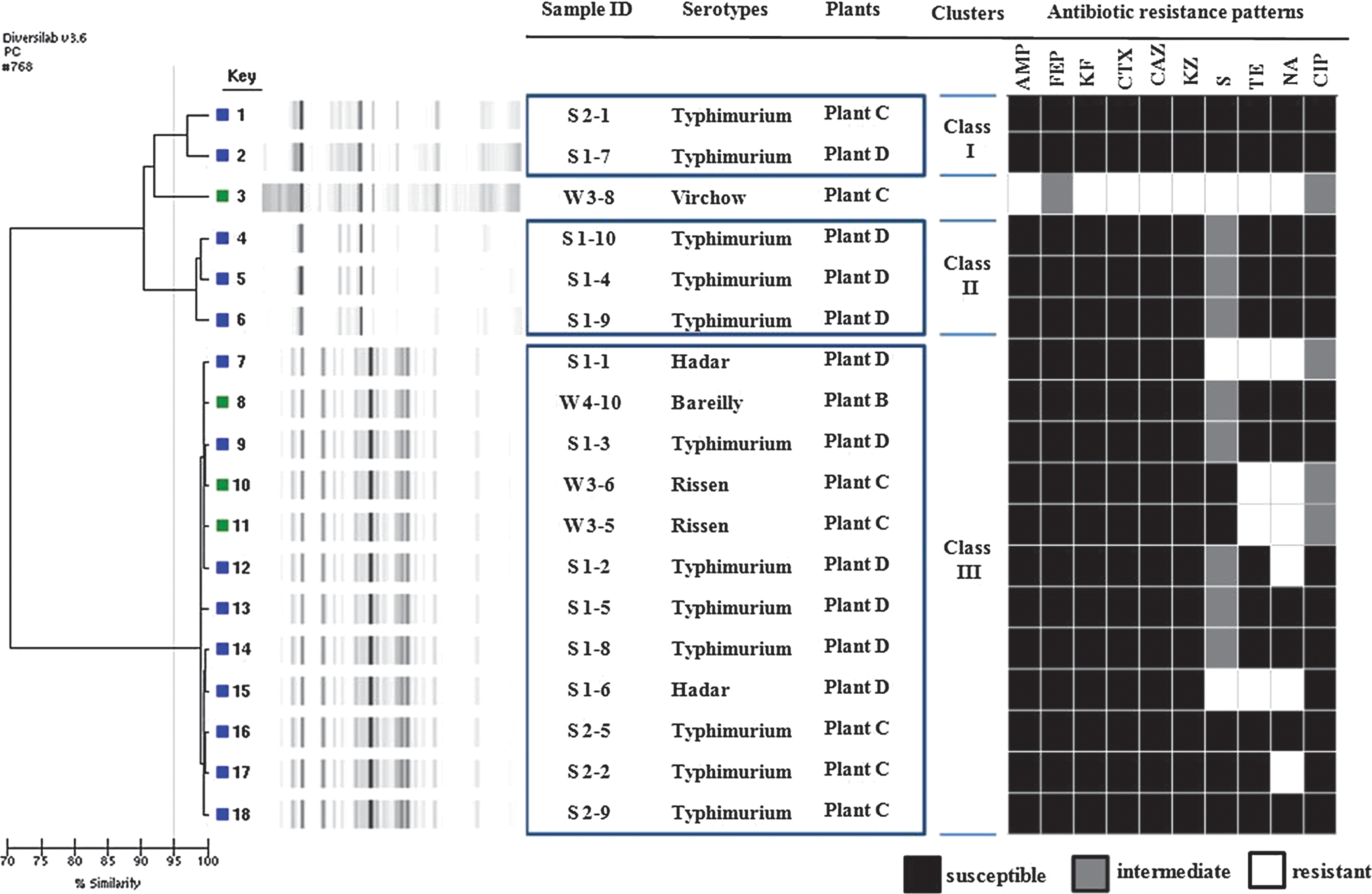
Dendrogram analysis and virtual gel image of DiversiLab™ repetitive-sequence-based polymerase chain reaction (rep-PCR) fingerprinting analysis of 18 Salmonella isolates from chicken carcasses at poultry processing plants. The isolates showing ≥95 similarity in their rep-PCR banding patterns were classified into three clusters (Class I to III). AMP, ampicillin; CAZ, ceftazidime; CIP, ciprofloxacin; CTX, cefotaxime; FEP, cefepime; KF, cephalothin; KZ, cefazolin; NA, nalidixic acid; S, streptomycin; TE, tetracycline. Sample ID; Season (S, summer; W, winter) and isolate number. The analysis included 18 Salmonella isolates identified in this study of which 14 were isolated during the summer and 4 were isolated during the winter. PCR, polymerase chain reaction.
The unique isolate showing resistance to broad-spectrum cephalosporins was positive for ESBL production in the double-disc diffusion test. PCR assay results showed that it was positive for blaCTX-M-15; however, genes encoding TEM and SHV enzymes were not detected. This is consistent with the results from a previous study conducted in South Korea by Tamang et al. (2011), where nontyphoid Salmonella strains from food animals harbored only blaCTX-M-15 without gene encoding TEM and SHV enzymes. Although ESBLs are less prevalent in Salmonella, ESBL-mediated resistance in Salmonella spp. is increasing across a wide geographical area, including Korea (Batchelor et al., 2005; Bertrand et al., 2006; Shahada et al., 2010). CTX-M-type β-lactamases, also known as cefotaximases, exhibit resistance by hydrolyzing CTX more effectively than CAZ (Jin and Ling, 2006). Consistent with this observation, W 3–8 exhibited higher MICs to CTX (MIC ≥64 μg/mL, R) in comparison with that toward CAZ (MIC = 16 μg/mL, I). The strain was also resistant to KZ, FEP, AZT (MIC ≥64 μg/mL, R), and AMP (MIC ≥32 μg/mL, R) and susceptible to FOX, AMC, TZP, IMP (MIC ≤0.25 μg/mL), and ETP (MIC ≤0.5 μg/mL) in VITEK 2 assays. In this study, the ESBL-producing strain showed resistance to NA with reduced susceptibility to CIP (MIC = 0.5 μg/mL), suggesting the possibility that plasmid-encoded quinolone/fluoroquinolone-resistance genes could be linked to gene encoding ESBLs, as previously reported by Robicsek et al.(2006).
Molecular subtyping
Chromosomal DNA was characterized using automated rep-PCR to evaluate the genetic similarity of the Salmonella isolates. The dendrogram and computer-generated virtual gel images generated using the DiversiLab™ system are presented in Figure 1. Salmonella isolates showing more than 95% similarity in rep-PCR-banding patterns, which indicated that they were genetically closely related, were classified into three clusters Class I–III (Fig. 1). The isolates in each class were genetically identical or closely related, independent of serotypes or processing plants. Twelve Salmonella Typhimurium isolates were included into three clusters (I, II, and III). The banding patterns of two Salmonella Hadar serovars (S 1–1 and S 1–6) and one Salmonella Bareilly serovar (S 4–10) isolated during summer and 2 Salmonella Rissen serovars (W 3–5 and W 3–6) isolated during winter were included in Cluster III. However, the Salmonella Virchow serovar W 3–8 was not included into any cluster on the basis of 95 % similarity, showing a lower degree of similarity with the other isolates.
Pulsed-field gel electrophoresis (PFGE) is generally considered the gold standard for molecular subtyping of Salmonella spp. However, the discriminatory power of subtyping Salmonella spp. using PFGE was not better than DiversiLab™ system (Foley et al., 2006; Hyeon et al., 2013). Furthermore, the automated rep-PCR system was technically simple and allowed completion of analysis of 12 samples in ∼4 h, compared with 3 days for PFGE (Healy et al., 2008). However, the DiversiLab™ system is needed to further evaluate the discriminatory power through more validation studies. Accordingly, the use of multiple subtyping methods is recommended; alternatively, subtyping along with antibiotic resistance profile analysis should be conducted to discriminate the isolated Salmonella spp. Herein, Salmonella Virchow strain harboring blaCTX-M-15 gene was distinguished by rep-PCR molecular subtyping along with antimicrobial resistance pattern analysis, which appears to be useful for discriminating ESBL-producing strains.
In conclusion, the present study indicated that contamination of carcasses with Salmonella occurred at relatively higher rates in the summer, consistent with the higher incidence of human salmonellosis during the summer. The emergence of multiresistant Salmonella from poultry in finished products represents a serious threat to public health, complicating future options for treating human infections. This study indicated that it is needed to reduce microbial contamination of broiler carcasses through proper interventions or hygienic rules considering seasonal difference or the quantity of processed carcasses. However, the information generated herein was limited compared with the size of the poultry production industry in Korea. Further nationwide research focusing on effective prevention of foodborne illness is essential for developing intervention and mitigation strategies in the poultry processing plants.
Footnotes
Acknowledgment
This paper was supported by Konkuk University in 2014.
Disclosure Statement
No competing financial interests exist.