




Abstract
Background:
Two outbreaks of gastroenteritis occurred in South Korea, affecting a middle school in the Jeollanam-do province in 2013 (Outbreak 1) and 10 schools in the Incheon province in 2014 (Outbreak 2). We investigated the outbreaks to identify the pathogen and mode of transmission.
Methods:
A retrospective cohort study was conducted in the Outbreak 1; and case–control studies were performed for the Outbreak 2. Samples from students, environments, and preserved food items were collected and pulsed-field gel electrophoresis (PFGE) was conducted to identify strains of pathogen.
Results:
We identified 167 and 1022 students who met the case definition (≥3 loose stools in any 24-h period) in the Outbreaks 1 and 2, respectively. The consumption of cabbage kimchi and young radish kimchi were significantly associated with the illness. Adjusted odds ratios of kimchi were 2.62–11.74. In the Outbreak 1, cabbage kimchi was made and consumed in the school restaurant and in the Outbreak 2, young radish kimchi was supplied by food company X and distributed to all the 10 schools in the Incheon province. Enterotoxigenic Escherichia coli (ETEC) O6 was isolated from fecal samples in 375 cases (33.9%) and from kimchi samples. PFGE patterns of the outbreak strains isolated from cases and food were indistinguishable in each outbreak.
Conclusion:
The suspected food vehicle in these two consecutive outbreaks was kimchi contaminated with ETEC O6. We recommend continued monitoring and stricter sanitation requirements for the food supply process in Korea, especially in relation to kimchi.
Introduction
S
In South Korea, outbreaks of foodborne and waterborne diseases affecting more than two people are investigated systemically by the local health authorities and Korea Centers for Disease Control and Prevention (KCDC). Among the causative agents identified in South Korea from 2007 to 2009, pathogenic E. coli (excluding EHEC) was the second most common (23.1%), following norovirus (27.5%), and the majority of outbreaks (85.8%) occurred between April and September (Gwack et al., 2010). Sixty-six outbreaks of E. coli occurred from 2009 to 2010; the most common subtype was EPEC (39.4%), followed by ETEC (30.3%), unspecified (12.1%), EHEC (10.6%), and EAEC (7.6%). Among the ETEC outbreaks, an ETEC O169 outbreak was reported in 2012 that affected seven schools and was caused by kimchi produced by a particular company (Cho et al., 2014).
Kimchi is a traditional Korean dish made from fermented vegetables and a spicy blend of chili peppers, garlic, and other ingredients. Although cabbage kimchi and watery kimchi are the two best-known versions of the food, there are literally hundreds of varieties as the main ingredient. During the preparation of traditional kimchi, the main ingredient, for example, cabbage or young radish, is salted overnight, rinsed well with water, and seasoned (Korea Tourism Organization,
From 2013 to 2014, two outbreaks of diarrheal illness were reported in South Korea that affected a middle school in the Jeollanam-Do province and 10 schools in the Incheon province. Epidemiological and laboratory investigations were performed to characterize the extent of the outbreak and to identify the causative pathogen and transmission route.
Materials and Methods
Escherichia coli outbreaks
Outbreak 1
On July 17, 2013, a school nurse employed at a middle school in town KJ, Jeollanam-Do reported to the local health authority that more than 15 students were affected by diarrhea. These outbreaks were subsequently reported to the KCDC, and an epidemiological investigation was initiated immediately by the local health authority and the KCDC.
Outbreak 2
On May 24, 2014, a local clinic in Incheon reported an outbreak of gastroenteritis affecting more than 10 students at a high school in Incheon to another local health authority. Between May 24 and 31, the local health authority was notified of gastroenteritis at nine other schools in Incheon. Upon recognition of the common features of these school outbreaks, the KCDC assumed responsibility for the epidemiological investigation.
Epidemiological investigation
A cohort study and a case–control study were conducted for the outbreaks in town KJ and in Incheon, respectively. A case of gastroenteritis was defined as illness with diarrhea (≥3 loose stools in any 24-h period). A case–control study was conducted using healthy controls consisting of two randomly selected students from the same class as the affected students. Self-administered questionnaires were used to collect information on demographics, clinical history, and potential exposure, including food, water, and snacks. Students who experienced loose stools were identified in cooperation with teachers at their respective schools. School cafeterias and kitchens were inspected to review food handling practices, sources of drinking water, and to interview food handlers. In South Korea, food service establishments are legally mandated to preserve samples of all food items that have been served in freezers for 6 days. As a result of this legal requirement, we were able to obtain preserved samples of food consumed in the school cafeteria.
Laboratory experiments
Bacteria from stool samples, preserved food items, drinking water, and the kitchen environment (i.e., kitchen knives and cutting boards) were cultivated on different selective agar plates to isolate relevant microorganisms. MacConkey agar was used for the detection of E. coli, Salmonella, and Shigella species. Thiosulfate–citrate–bile salts–sucrose (TCBS) agar was used for the detection of Vibrio species, Mannitol–Salt Agar (MSA) for Staphylococcus aureus, Tryptose–Sulfite–Cycloserine (TSC) for Clostridium perfringens, Campylobacter Blood-Free Selective Agar Base (CCDA) for Campylobacter jejuni, Listeria Selective Agar (LSA) for Listeria monocytogenes, Cefsulodin–Irgasan–Novobiocin (CIN) for Yersinia enterocolitica, and Mannitol–Egg Yolk–Polymyxin (MYP) for Bacillus cereus.
Multiplex polymerase chain reaction (MP-PCR) assays were conducted to detect pathogenic E. coli virulence genes using a kit (the Powercheck™ Diarrheal E. coli 8-plex Detection Kit; Kogene, Inc.) that we developed containing primers for the following highly conserved genes: stx1 and stx2 for EHEC; lt, sth, and stp for ETEC; eaeA and bfpA for EPEC; aggR for EAEC; and ipaH for EIEC. Other E. coli virulence genes were detected using MP-PCR assays with primers for 18 CF genes as described by Nada et al. (2010). Bacteria were directly inoculated into 3 mL Luria-Bertani broth for enrichment and incubated overnight at 37°C under shaking conditions. After incubation, the enriched broth culture was centrifuged at 13,000 rpm (Eppendorf) for 1 min, and the pellet was heated at 100°C for 10 min. After centrifugation of the lysate, 5 mL of the supernatant was sampled for PCR. PCR assays were carried out in volumes of 50 μL with 2U DNA Taq polymerase (TaKaRa Ex Taq) in a thermal cycler (PTC-100; MJ Research) under the following conditions: initial denaturation at 94°C for 5 min, 30 cycles of 94°C for 1 min, 55°C for 1 min, 72°C for 1 min, and final cycle 72°C for 5 min. Amplified PCR products were analyzed using gel electrophoresis in 2% agarose gels stained with ethidium bromide, visualized with ultraviolet illumination, and imaged using the Gel Doc 2000 documentation system (Bio-Rad).
O antigens of detected E. coli strains were determined by agglutination with the available O antisera (O1–O181; Universidad de Santiago de Compostela) (Guinéeet al., 1972). H antigens were tested for by PCR-restriction fragment length polymorphism analysis of the fliC gene that encodes flagellar proteins (Ramos Moreno et al., 2006). H antigen positivity was reconfirmed using the Denka E. coli Antisera Set2 (Denka Seiken Co., Ltd.).
For antibiotic resistance determination, the VITEK II system (bioMérieux, Inc.) was used. The Clinical and Laboratory Standards Institute breakpoints were used for the interpretation of susceptibility to all antimicrobial agents. The following antibiotics were tested: ampicillin, amoxicillin/clavulanic acid, ampicillin/sulbactam, cephalothin, cefotaxime, cefotetan, cefoxitin, cefazolin, ceftriaxone, imipenem, chloramphenicol, gentamicin, amikacin, nalidixic acid, ciprofloxacin, tetracycline, and trimethoprim/sulfamethoxazole. E. coli ATCC 25922 was tested as a quality control strain.
We performed pulsed-field gel electrophoresis (PFGE) according to the PulseNet standard protocol (
Statistical analysis
Odds ratios (ORs) with 95% confidence intervals (CIs) were calculated to assess the association between illness and food items. Fisher's exact test was used if ORs could not be calculated. p < 0.05 was considered to be statistically significant. All statistical analyses were conducted using SAS 9.2 (SAS Institute). This investigation did not require approval by an institutional review board due to the fact that it was a public health investigation instigated to control a disease outbreak.
Results
Epidemiological investigation
Outbreak 1
Of the 415 students attending the middle school of town KJ, 167 met the case definition (attack rate 40.2%). The patients experienced diarrhea (100.0%), abdominal pain (91.1%), nausea (24.0%), and chills (12.0%). Students began to show symptoms on the evening of July 14, 2013 and the peak number of cases occurred on the evening of July 16 (Fig. 1). The medium incubation period was 35.5 h (range 4–68 h) following consumption of lunch on July 14.
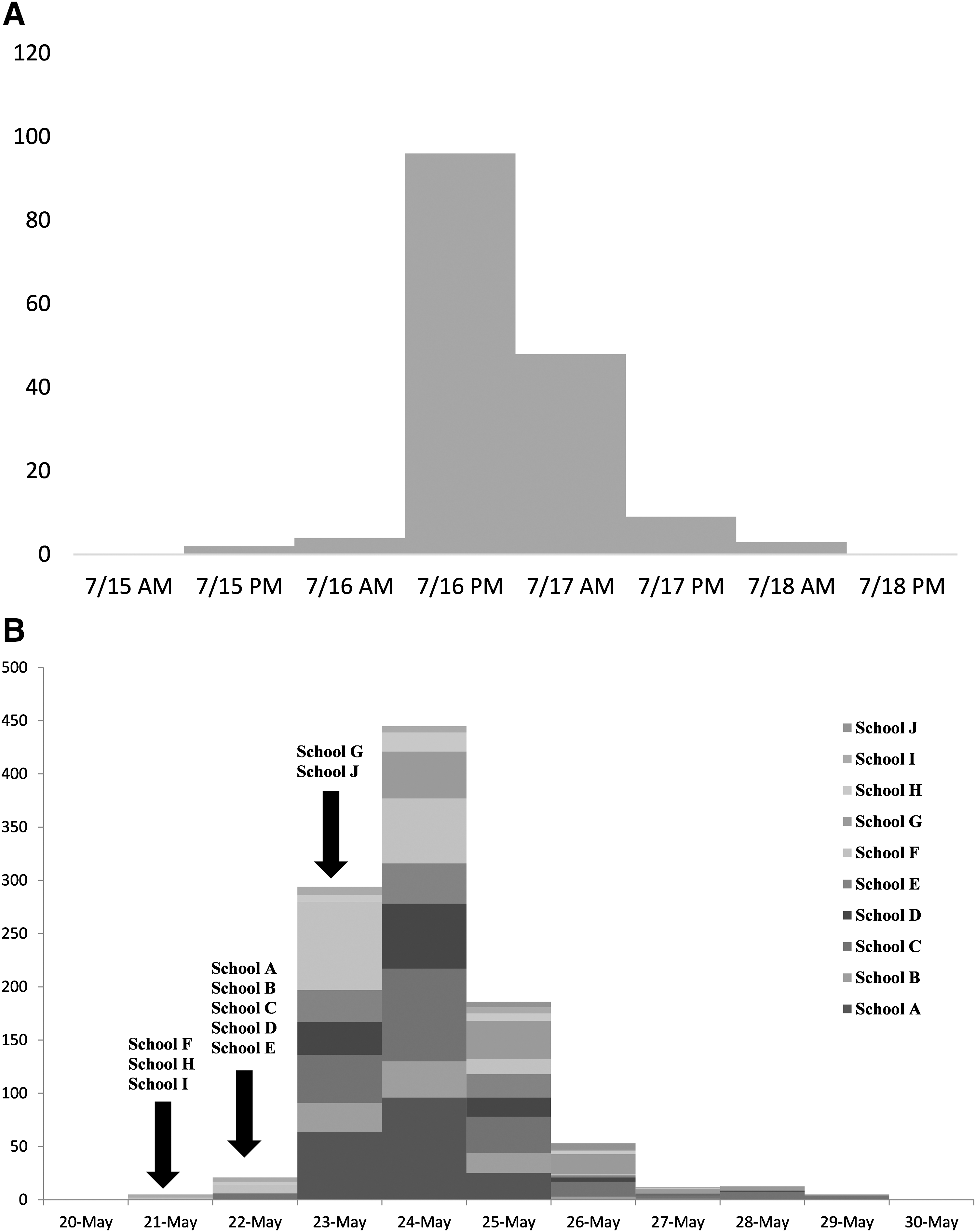
Epidemic curves of Escherichia coli enteritis associated with kimchi consumption
The school served lunch to students on weekdays, and there was no major event at the school around the time of the outbreak. All food items served for lunch on July 14 were significantly associated with illness, including cabbage kimchi (OR 1.70, 95% CI 1.36–2.13). Five food items had a p value <0.2 in the univariate analysis (Table 1), and were therefore included in the multivariate regression analysis (Table 1). Of the four food items that maintained a statistically significant association upon multivariate analysis, cabbage kimchi was the only significantly associated food (adjusted OR 2.62, 95% CI 1.58–4.34). The cases had not eaten the same snacks and purified water was served for drinking. During the investigation, proper food handling and hygiene practices were observed. All food handlers were asymptomatic and reportedly ate the same food items that were served to students. Potable tap water was used for cooking.
AR, attack rate; aOR, adjusted odds ratio; CI, confidence interval; RR, relative risk.
Outbreak 2
During the outbreak period, 1022 potential cases of ETEC gastroenteritis were identified. The dates of symptom onset were May 21–26, 2014. The attack rate ranged from 2.5% to 34.3%, corresponding to 12 cases in school J up to 210 in school C (Table 2). The main symptoms in affected subjects were diarrhea (100.0%), vomiting (8.3–36.1%), and fever (0.0–22.9%). No subjects experienced severe complications, such as hemolytic uremic syndrome or hospitalization. The mean incubation period at each school ranged from 38 to 84 h (Table 2). The 10 schools were located at different districts in the Incheon province and there was no common event that students with illness participated. On the result of food supply investigation, kimchi in all school cafeterias was supplied by a single food company X.
Total exposure: number of individuals who ate at the school cafeteria.
Isolated from affected individuals.
ETEC, enterotoxigenic E. coli; EPEC, enteropathogenic E. coli; lt, heat-labile toxin; st, heat-stable toxin.
Case–control studies were conducted at schools A, B, C, D, and E. In all schools, infection was significantly associated with eating young radish kimchi, supplied by the food company X, on multivariate analysis (Table 3). For schools A through E, the adjusted OR for young radish kimchi was 6.04 (95% CI 2.95–12.37), 3.71 (95% CI 1.41–9.75), 4.18 (95% CI 1.61–10.83), 8.34 (95% CI 3.27–21.27), and 17.74 (95% CI 5.45–57.76), respectively. No other food items were significantly associated with illness upon multivariate analysis.
Identification of the causative pathogen
At the Jeollanam-Do Research Institute of Public Health and Environment and the Incheon Research Institute of Public Health and Environment, 775 stool samples (125 from Outbreak 1 and 650 from Outbreak 2) from the cases, 30 (5 from Outbreak 1 and 25 from Outbreak 2) stool samples from food handlers, and samples from 45 preserved food items served during the outbreaks were tested for 10 species of bacteria (E. coli, Salmonella spp., Shigella spp., Vibrio spp., S. aureus, C. perfringens, C. jejuni, L. monocytogenes, Y. enterocolitica, and B. cereus) and 5 species of virus (Norovirus, Rotavirus, Adenovirus, Astrovirus, and Sapovirus). ETEC strains were cultivated on MacConkey agar for 375 stool samples from the cases (105 from Outbreak 1 [84.0%] and 270 from Outbreak 2 [41.5%]), 8 stool samples from food handlers (2 from Outbreak 1 [40.0%] and 6 from Outbreak 2 [24.0%]), and 2 food samples (1 from Outbreak 1 [20.0%] and 1 from Outbreak 2 [4.0%]). Among the food samples tested, kimchi served during the outbreaks was positive for ETEC. ETEC strains were isolated from cabbage kimchi in Outbreak 1 and from young radish kimchi in Outbreak 2. Three hundred eighty-five ETEC strains (383 from human feces and 2 from kimchi) contained the lt and st genes. No viral pathogens were found in stool or food samples. All environmental samples from the kitchens were negative for bacterial pathogens. Samples of drinking water from the school cafeterias were negative based on routine testing, including tests for general bacteria and E. coli. However, the total coliform was detected above standard in the Outbreak 1.
Characterization of ETEC isolates
PCR to detect CF genes, O-serotyping, and antibiotic resistance tests were performed to characterize the isolated ETEC strains from the outbreaks. PCR analysis with primers for 16 CF genes was positive for the CS21 gene in all ETEC strains tested. Serotyping of O antigens showed that all ETEC strains isolated, including the strain isolated from kimchi, were O6. However, the antibiotic resistance patterns of the strains were different between Outbreaks 1 and 2. The results indicated that the isolates from Outbreak 2 were resistant to ampicillin, amoxicillin/clavulanic acid, ampicillin/sulbactam, cephalothin, cefotaxime, cefoxitin, ceftriaxone, nalidixic acid, tetracycline, and trimethoprim/sulfamethoxazole, whereas the isolates from Outbreak 1 were resistant only to tetracycline and trimethoprim/sulfamethoxazole.
PFGE analysis of E. coli isolate lineage
To identify the lineage of the outbreak isolates, genomic similarities were investigated using PFGE. PFGE patterns using the restriction enzyme XbaI were highly similar for all isolates tested from each outbreak. There were four similar patterns in Outbreak 1 and the isolates of Outbreak 2 showed three patterns. Main PFGE patterns of ETEC O6 strains isolated from the cases and food handlers were ETCX01.072 (PFGE pattern number assigned by KNIH) in Outbreak 1 and ETCX01.103 in Outbreak 2. The PFGE pattern of the ETEC O6 strains isolated from kimchi matched that of the main strains isolated from human feces for each outbreak (Fig. 2). However, the PFGE patterns of the strains were distinguishable between the two outbreaks.
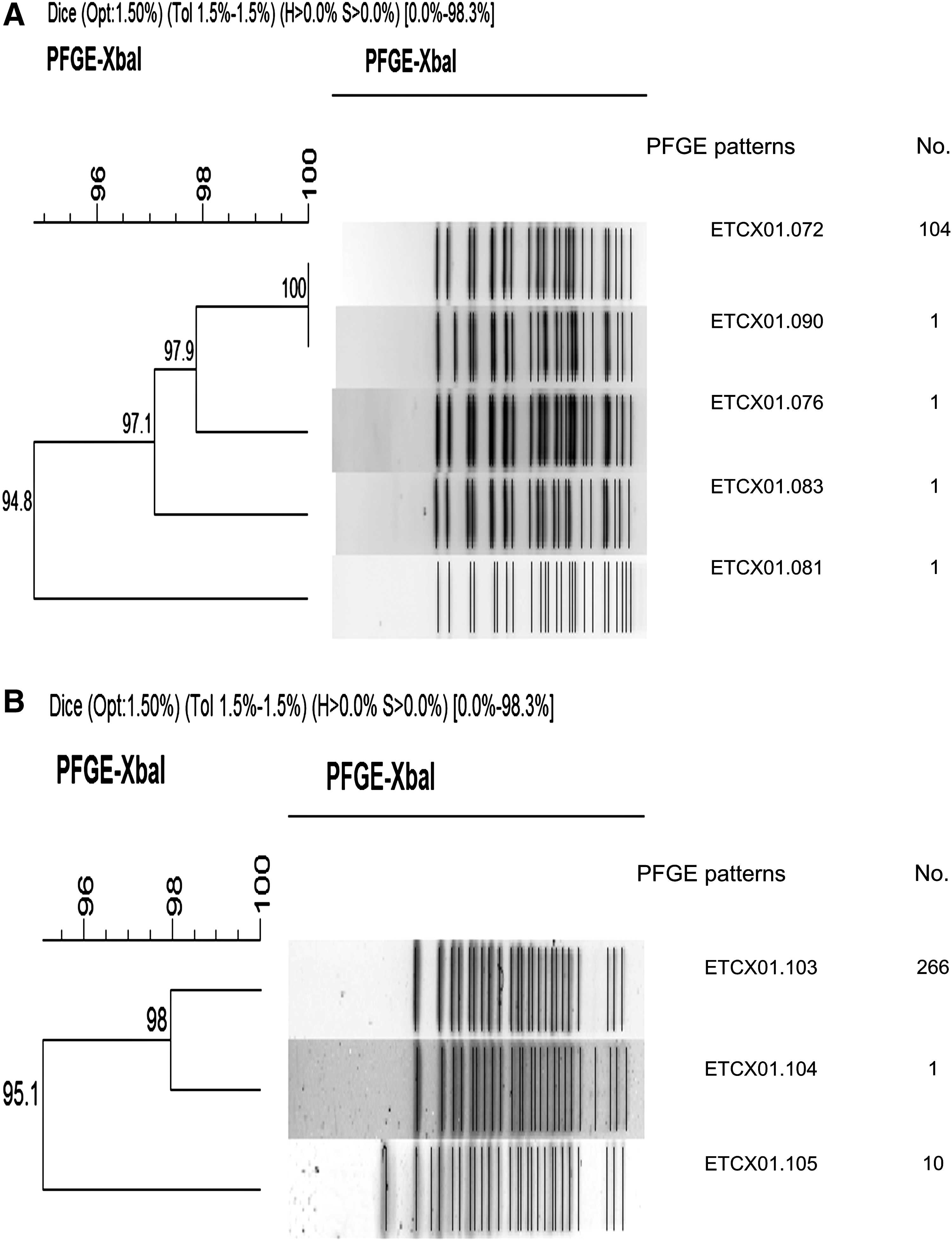
The XbaI-PFGE patterns from outbreak strains;
Discussion
Based on epidemiological and laboratory testing, the food vehicles suspected to cause the two large outbreaks of ETEC in the present study were two types of kimchi, cabbage kimchi and young radish kimchi; these had been served in school cafeterias. Our findings are based on a significant association between kimchi and illness and positive results from microbiological tests. ETEC O6 was isolated from stool samples from cases and samples of kimchi, and these isolates were indistinguishable from one another in each outbreak based on PFGE analysis.
In the traditional preparation process, kimchi is allowed to ferment for ∼1 week or can often be placed underground in jars for months. The pH of the traditionally complete fermented kimchi is about pH 4.5. What makes kimchi unique is its fermentation process, which involves the production of beneficial lactobacilli bacteria (Chang and Chang, 2010; Lee et al., 2011; Ji et al., 2013). In previous studies of kimchi, lactic acid bacillus (LAB, belonging to the genera Leuconostoc), Lactobacillus, and Weissella were presumed to be mainly responsible for fermentation, whereas members of the genera Lactococcus and Pediococcus were observed as minor populations (Jeong et al., 2013a, b; Jung et al., 2013); this is similar to other fermented vegetables such as sauerkraut and pickles (Breidt et al., 2013). After proper fermentation of kimchi, the growth of enteric pathogens is inhibited due to environmental conditions established by LAB communities. Recently, food for school cafeterias, especially kimchi, has been prepared by large food companies and consumed quickly, as shown in the Outbreak 2. In this food chain system, insufficiently fermented kimchi may be supplied and be a source of infection. According to the food handlers in Outbreak 1, insufficiently fermented kimchi was offered in the next day of preparation, although the kimchi was made in the school cafeteria. Humans are known to be the major reservoir of ETEC, and contaminated hands and water are the principal vehicles for its transmission (Olsvik et al., 1991). In the present study, we could not find any hygiene issues associated with food preparation or services. Even though the food handlers showed a similar rate of ETEC infection, all had consumed the same meal as the cases and had no symptoms before the outbreaks. In large outbreaks, water used during food preparation may be presumed to be the vehicle for transmission because food handlers have less potential to contaminate a large amount of food simultaneously. In drinking water at the Outbreak 1, total colony count was higher than 100 CFU/mL and total coliforms were detected, which may indicate that poor quality water was used for food preparation. Therefore, further studies relating to the exact criteria for the kimchi fermentation process and water preparation are needed with respect to kimchi-related outbreaks.
Bacterial survival in response to acid stress has been shown to be dependent on factors such as growth phase, growth medium, temperature, and acid tolerance systems (Lin et al., 1996; McQuestin et al., 2006). In one study, it was found that E. coli, Salmonella typhimurium, and Shigella flexneri could survive under extremely acidic conditions (pH 2–2.5) in complex medium due to acid survival systems expressed during log- and stationary phases. These include the acid tolerance response, acid resistance, and acid habituation (Lin et al., 1996). A survival study with the presence of probiotic starter strains showed that E. coli O157:H7, Salmonella enteritidis, and L. monocytogenes can survive for long periods in fermented green table olives in brine (pH 4.2 and high salt concentration [6%]) (Argyri et al., 2013). Moreover, it has been reported that these strains can be detected following long storage times in both commercial and laboratory prepared kimchi (Inatsu et al., 2004). However, one study suggested that the addition of starter fermentation to kimchi induced a faster die off of pathogens compared with natural fermentation. The results of this study showed that the use of a bacteriocin-producing starter culture (Leuconostoc citreum GJ7) for kimchi fermentation significantly reduced the number of E. coli O157:H7, Salmonella typhi, and S. aureus 48 h after inoculation (Chang and Chang, 2010).
In South Korea, ETEC O169 outbreaks were reported in seven schools in 2012. A contaminated kimchi product from a single food company, different from food company X, was identified as the source of infection (Cho et al., 2014). ETEC is a major cause of childhood death in developing countries (World Health Organization, 2006). The strains isolated from the two large outbreaks in the present study possessed the enterotoxin genes lt and st. For CFs, the CS21 gene was detected in the strains tested. These are the most common strains detected in Korea (Oh et al., 2014), although the proportion of enterotoxin and CF type varies between different geographical areas. Moreover, serotype O6 is the most common serotype of ETEC in Korea. The strains in the first outbreak in this study showed resistance to tetracycline and trimethoprim/sulfamethoxazole, consistent with other studies (Estrada-García et al., 2005; Cohen et al., 2010). However, in the second outbreak, the isolates showed multidrug resistance. Local hospitals were informed of the presence of multidrug-resistant strains to ensure proper patient care.
The large outbreaks of ETEC caused by kimchi contamination between 2012 and 2014 should highlight the need for sanitation and risk assessment studies in relation to ready-to-eat kimchi in general. The kimchi causing the two outbreaks described in this study may not have been fully fermented or may have been at an early stage of fermentation as they were distributed shortly after production. It has been reported that the secretion of LT toxin, a major virulence factor of ETEC, increases at neutral to alkaline pH conditions in comparison with acidic pH 5, where secretion is completely inhibited (Gonzales et al., 2013).
This investigation has several limitations. First, the self-reporting questionnaires used to collect data in both outbreaks may lead to underestimation of the number of actual cases. If students did not report minor symptoms to the health authorities, the number of cases and the interpretation of relative risks and ORs may have been affected. Second, we could only conduct a case–control study in the first five schools that reported illness in the second outbreak due to limited resources. Third, due to limited human resources, we could not investigate the food company X, supplying young radish kimchi in the second outbreak, which may have limited our results in relation to determining how ETEC was introduced into the kimchi.
Conclusion
In this report, we described consecutive outbreaks of ETEC O6 enteritis in multiple schools in South Korea with the aim of identifying the source of infections. Our investigation indicates that kimchi products are a possible source of ETEC O6 outbreaks. The kimchi produced by food companies, in comparison with homemade kimchi, is increasing in popularity in Korea and is a potential source for an ETEC outbreak. Continued monitoring and strengthened surveillance in relation to food safety, in particular to kimchi supply in school settings, are recommended.
Footnotes
Acknowledgment
This work was supported by the Korea National Institute of Health (NIH 4800-4851-304). The opinions expressed by authors contributing to this journal do not necessarily reflect the opinions of the Centers for Disease Control and Prevention or the institutions with which the authors are affiliated.
Disclosure Statement
No competing financial interests exist.