




Abstract
Italy is one of the main producers and exporters of cheese made from unpasteurized sheep milk. Since raw milk and its derived products are known sources of human infections, cheese produced from raw sheep milk could pose a microbiological threat to public health. Hence, the objectives of the study were: to characterize the potential risk of the presence of pathogens Escherichia coli O157, Listeria monocytogenes, and Salmonella in raw ovine milk destined for cheese production obtained from all the sheep farms (n = 24) in the Marches region (Central Italy) that directly transform raw milk into cheeses and to evaluate the equivalence between the analytical methods applied. A three-step molecular method (simultaneous culture enrichment, species-specific DNA magnetic isolation, and multiplex real-time polymerase chain reaction) was used for milk (n = 143) and cheese (n = 5) analysis over a 3-year period. L. monocytogenes was not detected on any of the farms, while E. coli O157 was found on three farms, although only using the molecular method. Four farms tested positive for Salmonella spp., and Salmonella enterica subsp. diarizonae serovar 61:k:1,5,7 was isolated in one of those cases. This information highlights the need to develop preventative measures to guarantee a high level of consumer safety for this specific product line, and the molecular method could be a time-saving and sensitive tool to be used in routine diagnosis.
Introduction
S
Considering the high level of consumption in Italy of locally produced raw ovine milk cheeses, our knowledge of the presence of Escherichia coli O157 in this product line appears to be inadequate. Goat milk and related dairy products have sometimes been associated with human cases of E. coli O157 infection (Caprioli and Tozzi, 1998; Allerberger et al., 2001; McIntyre et al., 2002; Ferens and Hovde, 2011). In the Lazio region, strains of E. coli O157 have been isolated from ovine milk with a prevalence of 0.6% (Rubini et al., 1999).
Further epidemiological data indicate that Listeria monocytogenes has been found in a high percentage of hard cheeses made from raw or low heat treated sheep milk (EFSA, 2015) in EU countries, including Italy (Ministry of Work, Health and Social Policies, 2009). Moreover, 36 notifications for Salmonella and L. monocytogenes in milk and milk products were also reported by the RASFF Portal (RASFF, 2015).
A more thorough investigation of pathogen presence in raw ovine milk and related products could therefore provide useful information. Hence, the first objective of this study was to expand the information available about the presence of E. coli O157, Salmonella spp., and L. monocytogenes on ovine milk farms in the Marches region.
The analytical system plays a main role in epidemiological investigations: recent studies on bovine raw milk highlighted the greater sensitivity of polymerase chain reaction (PCR)-based methods compared to conventional reference ones (Amagliani et al., 2012; Giacometti et al., 2013), with significant time reduction, particularly in case of multiple analysis platforms (Omiccioli et al., 2009; Sjöling et al., 2015).
However, the reliability of PCR detection methods in food depends, in part, on the purity of the target template and the presence of sufficient numbers of target molecules. In the present study, a Magnetic Capture Hybridization assay, which relies on selective isolation of target DNA by hybridization to oligonucleotide probes linked to magnetic nanoparticles, was proposed in a multiplex format (mMCH) for the simultaneous hybrid capture of target sequences from E. coli O157, Salmonella spp., and L. monocytogenes.
A complete three-step multiple platform, consisting of: (1) simultaneous culture enrichment in a specifically formulated medium, (2) species-specific mMCH, and (3) multiplex real-time PCR (m-rtPCR), was used in this work. The second aim of the study was to compare the molecular system with reference methods by first using raw ovine milk artificially contaminated with the three target species and then using milk and cheese field samples collected over a 3-year period.
Materials and Methods
Milk and cheese sampling and microbiological analyses
Samples of raw milk (n = 143), each in five 25 g-sample units (Italian Republic, 2007), were obtained from all 24 ovine dairy farms in the Marches (Central Italy) catchment area of the Istituto Zooprofilattico Sperimentale of Umbria and Marches that directly transform their own produced milk (Carloni et al., 2016). Samples were collected during milking periods over 3 years. In the case of positive results by either microbiological or real-time PCR assays, cheese samples (25 g) made with the same contaminated lot of milk were obtained from the farms and tested with both methods.
Microbiological analyses were carried out by the current recommended reference methods: validated ELFA (Enzyme Linked Fluorescent Assay; BioMérieux, Marcy l'Etoile, France) for Salmonella spp. (VIDAS Salmonella SLM; AFNOR BIO n. 12/16-09/05), L. monocytogenes (VIDAS L. monocytogenes II LMO2; AFNOR BIO n. 12/11-03/04), and E. coli O157 (VIDAS E. coli O157 ECO; AFNOR BIO n. 12/8-07/10). Confirmation of ELFA-positive samples was made according to the following methods: ISO 6579:2002 for Salmonella spp., UNI EN ISO 11290-1:1996 for L. monocytogenes, and ISO 16654:2001 for E. coli O157.
Equivalence evaluation between the analytical methods and statistical analysis
The entire molecular platform was tested for equivalence with standard methods using artificially contaminated samples of ovine milk, as detailed below.
Preparation of artificially contaminated milk samples
Reference strains of the three bacterial target organisms (Salmonella Enteritidis ATCC 13076, L. monocytogenes ATCC 7644, and E. coli O157 ATCC 35150) were separately grown in trypticase soy broth (TSB) to 108 CFU/mL, confirmed by standard plate counts. Milk aliquots of 25 g were artificially contaminated with 0-1-10-100 colony-forming unit (CFU) (each level in 30 replicates) of each species simultaneously and diluted 1:10 in Multipathogen Enrichment Medium (MEM; Diatheva, Fano, Italy). After incubation at 35°C for 18 ± 2 h, the bacterial growth was determined by plating on selective media (ALOA agar, CT-SMAC, and Salmonella Chromogenic Medium).
After enrichment, 10 mL-aliquots were processed for DNA isolation by MCH.
Magnetic capture hybridization
SiMAG-Amino-modified magnetic nanoparticles from Chemicell (Berlin, Germany) were covalently conjugated with NH2-oligonucleotides (capture probes LP, SP, or EP) (Omiccioli et al., 2009) specifically designed for the three target pathogens. Probe attachment and capture efficiency tests were conducted as previously described (Amagliani et al., 2006). Immobilization process yield and efficiency were indirectly estimated by subtraction of unbound probes (measured spectrophotometrically by A260 readings and quantified through standard curves) from the starting amount used in the functionalization protocol (5 μmol). Hybridization efficiency was also determined using fluorescently labeled probes with oligonucleotide sequences complementary to LP, SP, and EP (hybridization probes Lhyb, Shyb, and Ehyb). These probes were used in hybridization tests, then detached by denaturation and quantified spectrofluorimetrically.
A mixture of LP-, SP-, and EP-modified nanoparticles was prepared by combining equivalent volumes of each type, and 150 μg per sample was used for the simultaneous specific isolation of DNA of the three bacterial species in an mMCH assay. Briefly, 10 mL-aliquots of milk sample enrichments were centrifuged at 6000 g for 20 min at 4°C and bacterial pellets resuspended in 450 μL lysis buffer (0.05 M Tris-HCl pH 8, 0.05 M EDTA pH 8, and 0.5% v/v Triton X-100) with 9 μL RNase A 10 mg/mL and 80 μL Proteinase K 10 mg/mL, for enzymatic digestion at 37°C for 30 min. A subsequent centrifugation at 12,000 g for 10 min was required to eliminate the fat layer on the surface. After denaturation at 100°C for 10 min, mMCH was carried out as previously described (Amagliani et al., 2010).
m-rtPCR analysis
DNA-nanoparticle hybrids (5 μL) were then amplified with the Multipathogen FLUO Kit (Diatheva), an m-rtPCR assay for the simultaneous detection of the three target species, with internal amplification control (IAC). The amplification was carried out in a Rotor Gene 6000 (Corbett Research, Sydney, Australia) with the following thermal protocol: 10 min at 95°C, 40 cycles of 20 s at 95°C and 1 min at 63°C. Fluorescence acquisition was set on Green (495–520 nm), Red (647–667 nm), and Orange (590–610 nm) channels for the detection of Salmonella spp., L. monocytogenes, and E. coli O157 respective signals, with Yellow channel (538–554 nm) for the IAC.
Statistical analysis
A comparison of m-rtPCR results with the ELFA method was statistically analyzed. A 2 × 2 table was constructed with positive and negative results obtained through both methods and analyzed by the Cohen's K coefficient to estimate concordance (Mackinnon, 2000).
Molecular analysis of milk and cheese
Milk samples of 25 g were enriched in 225 mL MEM for 18 ± 2 h at 35°C, then 10 mL-aliquots were analyzed as described above for artificially contaminated milk.
When there were discrepancies between ELFA and m-rtPCR results, 1 mL-aliquots of selective enrichment broths (CT-MAC, SX2, Fraser Broth) of VIDAS procedures were used for mMCH and subsequent m-rtPCR.
Cheese samples (25 g) were collected from farms, which tested positive for target pathogens in milk, and analyzed as above.
Results
Magnetic capture hybridization
Capture probe sequences and structures have been previously described and their specificity has already been assessed (Omiccioli et al., 2009). In this study, they were used for nanoparticle functionalization through a well-established protocol (Amagliani et al., 2006). Results of seven immobilization batches indicated good reproducibility and similar values among the three sequences. LP ranged from 690.5 to 788.1 pmol/mg of nanoparticles, SP from 602.4 to 735.5 pmol/mg, and EP from 513.2 to 649.4 pmol/mg.
Hybrid capture proved to be reliable. The efficiency percentage was always considerably higher than 60%, with EP-conjugated nanoparticles being the most efficient, despite showing the smallest amount of immobilized probe (Table 1). Thanks to the similarity of efficiency values, the combination in equal amounts of the three nanoparticle types to be used in an mMCH was possible.
Immobilization process yield and hybrid capture efficiency. LP and Lhyb, Listeria monocytogenes captures probe and hybridization probe; SP and Shyb, Salmonella spp. captures probe and hybridization probe; EP and Ehyb, Escherichia coli O157 captures probe and hybridization probe.
Equivalence evaluation between the analytical methods and statistical analysis
Concentrations of bacterial cultures used for artificial contamination of milk samples were approximately as expected, with Salmonella Enteritidis ATCC 13076 being 0.99 × 10⁸ CFU/mL, L. monocytogenes ATCC 7644 1.34 × 10⁸ CFU/mL, and E. coli O157 ATCC 35150 0.62 × 10⁸ CFU/mL.
Sheep milk samples of 25 g were artificially contaminated with 0-1-10-100 CFU of each bacterial species simultaneously (each level in 30 replicates). To ensure evaluation of the method with unequivocally contaminated samples, after enrichment in MEM, aliquots were plated on selective agar to assess bacterial growth. Bacterial presence of all three species was detected in every replicate of levels 10 and 100 CFU, and in 40% of level 1 CFU. Therefore, only positive replicates of level 1 CFU, along with all replicates of levels 0-10-100 CFU, were used for bacterial DNA isolation by mMCH and subsequent m-rtPCR. Zero-level samples tested negative in m-rtPCR, while all contaminated replicates tested positive for each pathogen. The IAC was correctly amplified, confirming the effective application of mMCH to such a complex matrix as sheep milk.
A comparison of the performance of ELFA and the molecular assay proved their equivalence. Relative accuracy, sensitivity, and specificity were all 100%, demonstrating their complete agreement (Cohen's K coefficient = 1).
As shown in Figure 1, although the m-rtPCR was designed to be qualitative rather than a quantitative assay, a relationship between average Cts and contamination levels can be observed for each pathogen.
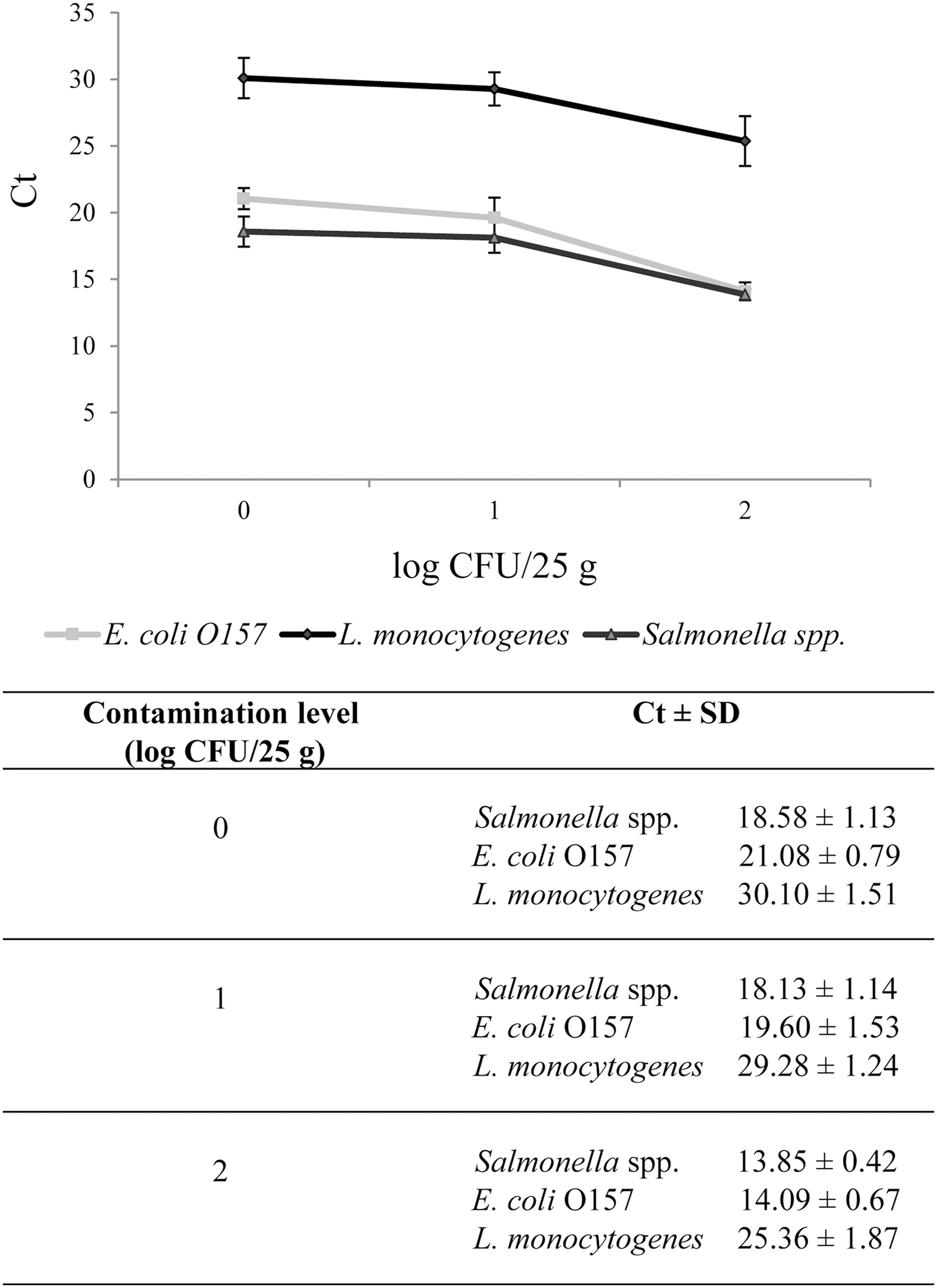
Molecular assay validation. Average ± SD of Ct obtained through m-rtPCR of artificially contaminated samples (n = 30 for 0-10-100 CFU and n = 12 for 1 CFU of each bacterial target species). Contamination levels are expressed as log CFU/25 g. CFU, colony-forming unit; m-rtPCR, multiplex real-time polymerase chain reaction.
Analysis of milk and cheese field samples
Throughout the 3-year study period, at least four samplings per farm were obtained, although in some cases sampling frequency was higher, thanks to farmer cooperation. A total of 715 25 g-sample units, corresponding to 143 samples in quintuplicate, were examined.
Microbiological analyses of milk
Negative results were always obtained through ELFA assays for E. coli O157 and L. monocytogenes. Salmonella spp. was found on two farms (farm 5, sample 23,600; farm 26, samples 6827, 7820, and 8960; 2.8%), although the microorganism was isolated using reference methods only from farm 26. Serotyping according to the White–Kauffmann–Le Minor scheme, recommended by the EU Reference Laboratory for Salmonella spp. and provided by ISO/TR 6579-3:2014, yielded a final identification of Salmonella enterica subsp. diarizonae serovar 61:k:1,5,7. These strains, also characterized for antimicrobial susceptibility according to CLSI (2008 and 2011), were susceptible for each of the tested antimicrobials.
Molecular analyses of milk
Samples were analyzed pooling the five sample units in a single sample. L. monocytogenes was never detected. Three samples tested positive for E. coli O157 DNA: 7011 (farm 11); 31,401 (farm 6); and 28,487 (farm 26) (2.1%). Salmonella spp. DNA was detected in various milk aliquots. Salmonella spp. positive samples were as follows: 23,155 (farm 24); 8962 (farm 22); 23,600, 24,800, and 31,242 (farm 5); and 6827, 7820, and 8960 (farm 26) (5.6%). In such cases, corrective actions were suggested to farmers (e.g., milking machine improved sanitation, substitution of milking machine filters, exclusion of diarrhetic cases from milking, and staff training) and shortly after the verification of their application, further samples were collected to check for the possible persistence of the contamination.
The molecular analysis of selective enrichments in CT-MAC or SX2, carried out when discrepancies were observed between ELFA and m-rtPCR (with Ct <34), always yielded positive results.
The discrepancy between ELFA and m-rtPCR may stem from the contamination level, which is reflected by Ct values. Indeed, samples with consistent results always showed Ct values <30, in the range between 20.92 and 29.56 (average 26.57), while discordant results showed Ct ranging from 27.69 to 32.40 (average 30.67) for Salmonella spp. and from 27.75 to 36.34 (average 32.80) for E. coli O157. It should also be noted that the only sample, from which a bacterial strain was isolated, yielded the lowest Ct (20.92). All results are shown in Table 2.
Only results of positive samples are reported.
Isolation of Salmonella enterica subsp. diarizonae 61:k:1,5,7.
(C), cheese; CT-MAC, MacConkey broth with Cefixime and Tellurite; ELFA, Enzyme Linked Fluorescent Assay; FB, Fraser Broth; m-rtPCR, multiplex real-time polymerase chain reaction; MEM, Multipathogen Enrichment Medium; n.d., not determined; SX2, Salmonella Xpress 2.
Cheese samples
All the farms investigated in the present study produce raw milk cheeses, which are sold to consumers at various ripening times. Cheese from farm 11, produced with E. coli O157 m-rtPCR positive milk, tested negative for the same pathogen using both ELFA and molecular methods.
Regarding Salmonella spp., cheeses from farms 5 and 24 tested negative with ELFA, but positive with m-rtPCR from SX2. The presence of Salmonella was confirmed in cheese from farm 26 both with ELFA and subsequent tests according to ISO 6579 and PCR-based assay (Table 2).
Discussion
E. coli O157 infections, salmonellosis, and listeriosis are common illnesses found worldwide and constitute a serious threat to food safety. The presence of even small amounts of pathogenic bacteria in milk destined for the production of raw milk cheeses constitutes a risk for consumers. In particular, the presence of viable E. coli O157 is of concern to all producers of raw milk cheeses since it can develop an adaptive tolerance response to acid environments, promoting resistance to gastric acid during the digestive process and the survival of an infective dose of bacteria (Vernozy-Rozand et al., 2005). The need for further investigation of E. coli O157 in ovine milk is also justified by a number of experimental studies that have shown the pathogen's ability to survive acidic pH in several fermented dairy products (Gulmez and Guven, 2003), in white brined cheese (Osaili et al., 2014) and in Cheddar cheese after 60 days of ripening (Schlesser et al., 2006). The growth of L. monocytogenes, Salmonella spp., and E. coli O157:H7 has recently been detected in cheese during extended storage at 25°C (Leong et al., 2014). It is therefore imperative to ensure that milk used in cheese production is of the highest bacteriological quality.
The aim of this investigation was to broaden our knowledge of the presence of E. coli O157, Salmonella spp., and L. monocytogenes in ovine milk in Central Italy and to evaluate the equivalence between the analytical methods.
The recovery of bacteria from foods, including milk, is often complicated by the very low level of bacterial contamination. The use of a proper enrichment medium can therefore improve the sensitivity and reproducibility of the test. The medium MEM ensured the concurrent growth of the mentioned species and was able to enrich a test sample with multiple pathogens.
The subsequent phase of the molecular protocol was the mMCH. The immobilization process is highly standardized and provided materials suitable for the intended downstream application with food matrix enrichments. Apart from our group's work, the application of MCH for bacterial DNA detection in food has never been reported. However, MCH proved highly effective when directly applied to milk samples (Amagliani et al., 2006) and in multiplex format for the specific and simultaneous isolation of E. coli O157, Salmonella spp., and L. monocytogenes DNA in artificially and naturally contaminated bovine milk (Omiccioli et al., 2009) and seafood (Amagliani, et al., 2010). In this study, it has been used for bacterial DNA isolation from raw ovine milk and cheese. Results proved the equivalence of ELFA validated systems and the multiplex molecular assay. Hence, the molecular assay appears to be suitable for routine use and to support ISO culture methods for preliminary screening in accordance with the EU Regulation 2073/2005 recommendations concerning alternative methods. The molecular assay is a platform that could also be applied to other food product lines.
In the present study, the analysis of field samples of raw sheep milk revealed the absence of pathogens or their presence at very low levels. Previous investigations of the same farms (Carloni et al., 2016) showed good hygienic conditions and the proper application of good farm management practices.
After a 3-year sampling period involving 715 sample units from 24 raw sheep milk farms, only one farm tested positive (ELFA and m-rtPCR with pathogen isolation) for S. enterica subsp. diarizonae 61:k:1,5,7 in milk and derived cheese. This result confirmed that sheep in Central Italy can be a potential reservoir for S. enterica subsp. diarizonae 61:k:1,5,7, in accordance with previous investigations (Davies et al., 2001; Alvseike et al., 2004; Zweifel et al., 2004). However, although foodborne infections in humans caused by this serovar from domestic animals such as sheep have occasionally been described (Davies et al., 2001), it is not included among the five serovars with public health significance (Commission Regulation [EC] No. 1003/2005), and there were no reports of its presence in food or animals in the last EFSA Report on zoonoses (EFSA, 2015).
Concerning E. coli O157, results of the molecular approach indicate occasional pathogen presence at very low levels. Hence, sheep milk and cheese producers must remain vigilant with this food matrix, paying particular attention to hygienic aspects of production. However, positive results obtained only by the molecular method should be considered with caution, since the results of biomolecular diagnoses should always be confirmed by pathogen isolation to prove its vitality (UNI EN ISO 20838:2006). m-rtPCR analysis of cheese samples produced with milk, which tested PCR positive and ELFA negative for E. coli O157, did not confirm the presence of the pathogen.
These results may be accounted for by the fact that the cheese was analyzed after 20 days of ripening, and pathogen growth might have been hampered by unfavorable conditions occurring in that matrix due to acidification and aging, especially if we consider the low starting concentration of the pathogen. Indeed, factors influencing pathogen survival and growth in cheese are numerous and include acidity, preservatives, temperature, competing flora, water activity, and salt concentration (FDA, 2015).
The implementation of food quality assurance systems along the ovine chain, as previously described for bovine milk (Cusato et al., 2013), would provide clear benefits in term of hygienic quality. The steps involved should include a diagnosis of the prerequisites, training of the food handlers, and implementation of good manufacturing practices (GMPs), sanitation standard operating procedures (SSOPs), and hazard analysis and critical control point (HACCP) principles (Costa Dias et al., 2012).
Conclusions
Results of this study suggest the presence of Salmonella spp. and E. coli O157 at very low levels and the absence of L. monocytogenes in sheep raw milk and cheese in Central Italy. Such data can inform the National Public Health Service of the need to implement an effective control strategy to ensure the safety of consumers, especially as regards the possible environmental contamination during and after milking.
Thanks to its intrinsic properties of high specificity and sensitivity, along with its rapidity, molecular diagnosis through validated methods could provide a very useful tool in early warning systems, thus offering improved and cost effective public health protection.
Footnotes
Acknowledgments
This study was supported by an RF-2009-1549175 Ministry of Health Project. The authors thank the farmers for their participation in this study.
Disclosure Statement
No competing financial interests exist.