




Abstract
Campylobacter jejuni, a foodborne pathogen, is the major cause of enteritis in humans worldwide, however, its increasing resistance to fluoroquinolones reported recently is of a major concern. In the present study, multiplex-mismatch amplification mutation assay-polymerase chain reaction (MMAMA-PCR) was developed for the first time with the aim to quickly identify C. jejuni and to detect the single nucleotide mutation (C-257 to T) frequently observed in gyrA gene, associated with the acquisition of resistance to fluoroquinolones. In this assay, mismatch amplification mutation primers for the detection of gyrA mutation in C. jejuni were coupled with primers for the hip gene encoding for hippuricase and 16S rRNA gene of C. jejuni, respectively, in the multiplex PCR assay. The specificity and accuracy of this method were analyzed by the use of 78 C. jejuni strains with previously confirmed resistance phenotypes and the mutation (C-257 to T) in gyrA gene, as well as 107 clinical isolates of various bacterial species, including 29 C. jejuni isolates. This study indicates that MMAMA-PCR is a promising assay for the rapid identification of C. jejuni with a specific mutation in gyrA gene, responsible for the resistance to fluoroquinolones.
Introduction
C
Due to the compatibility of MAMA-PCR and multiplex-PCR, in this study, we developed a single multiplex-mismatch amplification mutation assay-PCR (MMAMA-PCR) for the rapid simultaneous detection of the prevalent resistance to fluoroquinolone associated mutation in gyrA gene and identification of C. jejuni.
Materials and Methods
Bacterial strains and antibiotic susceptibility testing
Initially, eight C. jejuni, one C. coli, one Escherichia coli, and two Salmonella strains (Supplementary Table S1; Supplementary Data are available online at
DNA isolation and MMAMA-PCR assay
Genomic DNA was extracted using TIANamp Bacteria DNA Reagent Kit (Tiangen, Beijing, China), and different concentrations of purified genomic DNA templates (50, 10, 5, 1, 0.5, 0.1, 0.05, 0.01, 0.005, 0.001 ng) from two strains were used to assess the sensitivity of MMAMA-PCR method. The DNA templates of selected strains (Fig. 1) for establishment of the assay were prepared by TIANamp Bacteria DNA Reagent Kit (Tiangen, Beijing, China) method and boiling method (Dei-Tutuwa et al., 2014), respectively. The primers (Supplementary Table S3) with desired amplicon size were designed by PrimerPlex 2.61 (Premier Biosoft, Palo Alto, CA) based on the three highly conserved genes of Campylobacter published in NCBI database (Campylobacter 16S rRNA gene: Accession No. AL139074; hippuricase gene: Accession No. Z36940; and gyrA gene: Accession No. L04566). To ensure that fragments could be distinguished on a gel, the size of amplicon difference was 50–200 bp. Each detection group included two sets of PCR. The control set included 16S rRNA gene primers, hippuricase gene primers, and gyrA gene control primers (Supplementary Table S3), while the other detection set included 16S rRNA gene primers, the hippuricase gene primers, and gyrA mutation primers (Supplementary Table S3). Among these, 16S rRNA gene primers were used in PCR to generate an amplicon of 134 bp for C. jejuni and C. coli, and the hippuricase gene primers were used to generate a specific amplicon of 358 bp for C. jejuni. Forward conserved primer gyrA-F was used in conjunction with reverse mutation primer gyrA-MAMA-R to detect the ACT to ATT (Thr to Ile) mutation in the C. jejuni gyrA gene with a 180 bp amplicon and in parallel with primer gyrA-R to produce a positive control amplicon of 237 bp. The specificity of the primer sets was tested against seven C. jejuni, one C. coli, and two Salmonella strains. Primer mix (1.2 μL) (10 μM for each primer of three pairs) was used in a 25 μL reaction mixture. Each reaction mixture also contained 12.5 μL of Premix Ex Taq™ (TaKaRa, Dalian, China), 50 ng DNA template, and nuclease-free water was added up to 25 μL. The negative control contained the reaction mixture without DNA template. The MMAMA-PCR amplification program was as follows: initial denaturation step at 94°C for 3 min, followed by 32 cycles of 94°C for 30 s, 56°C for 30 s, and 72°C for 30 s, and final extension at 72°C for 8 min. With 130 V voltage, 7 μL MMAMA-PCR product was loaded and separated on 2.5% agarose gels for 30 min. Agarose gels were visualized with ethidium bromide under ultraviolet light.
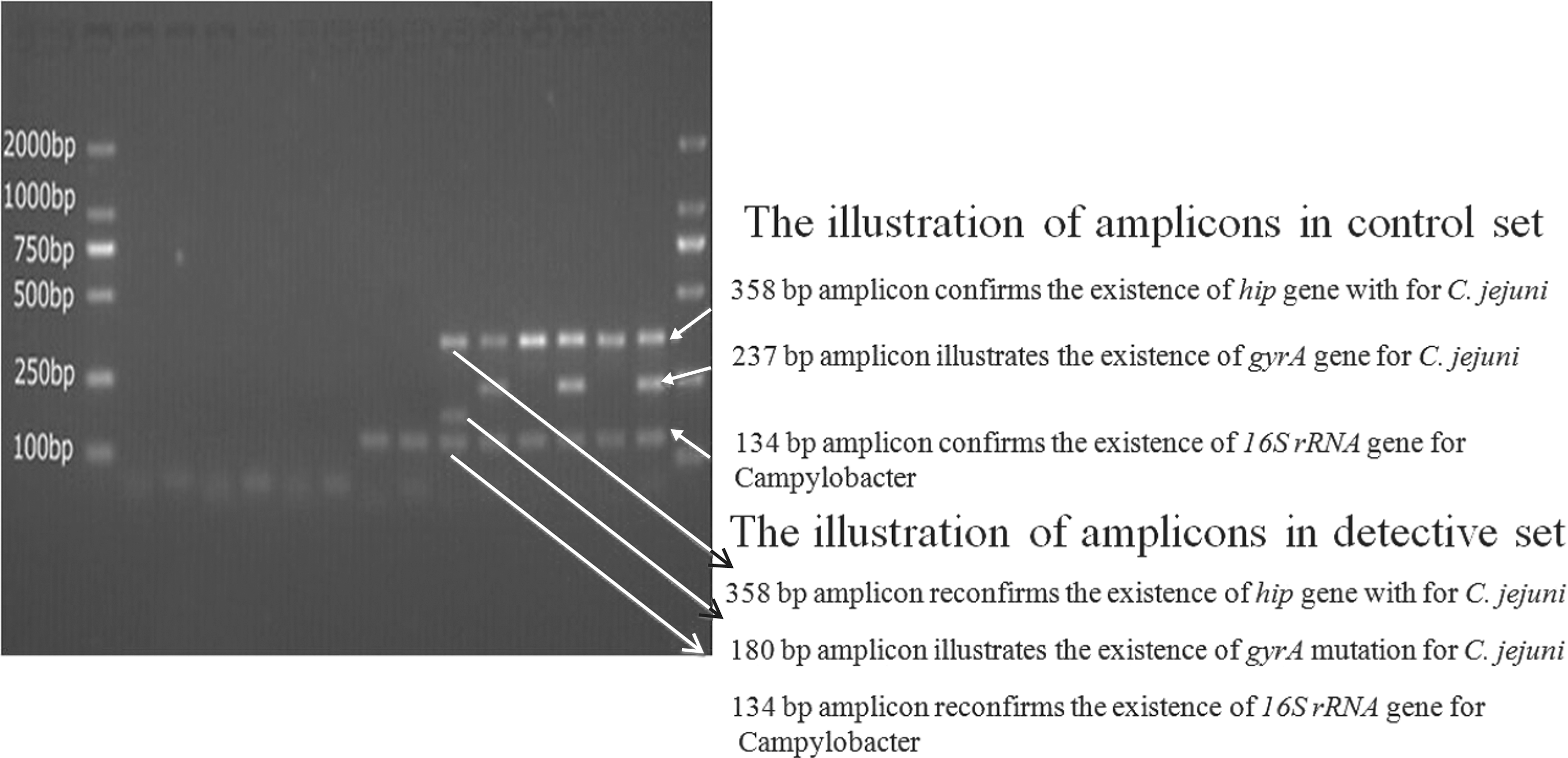
Application description of multiplex-mismatch amplification mutation-PCR assay.
Result and Discussion
A rapid MMAMA-PCR was developed for the identification of C. jejuni and its mutation (C-257 to T) in gyrA gene. The results of MMAMA-PCR of seven C. jejuni, one C. coli, and two Salmonella strains are shown in Supplementary Figure S1. The results revealed that in the detection sets, C. jejuni strains (ATCC 700819 and ATCC 33560) with the wild-type ACT (Thr, fluoroquinolone susceptible) were positive with 134 and 358 bp amplicons (Supplementary Fig. S1A). Whereas C. jejuni strains (DH69, TA60, TA154, TA155, TA156, and XT05) with the single nucleotide mutation in gyrA gene were positive with 134, 180, and 358 bp amplicons, which were corresponding to 16S rRNA, mutated gyrA, and hippuricase gene amplicon, respectively (Supplementary Fig. S1B). C. coli (ATCC 33559) strain was only positive for 16S rRNA genus specific primers, and no cross-reaction was observed for non-C. jejuni strains (LJ395, ATCC 13311, and ATCC25922) (Supplementary Fig. S1A). In addition, the specificity of MMAMA-PCR was determined using DNA template extracted by boiling method and reagent kit method, suggesting that boiling method extracting DNA template was suitable for the application of MMAMA-PCR (Supplementary Fig. S1B). The detection sensitivity limit of the MMAMA-PCR was estimated at 0.1 ng, which indicates the potential sensitivity of this method for practical applications (Supplementary Fig. S1C).
To test the accuracy of the MMAMA-PCR, 78 C. jejuni strains and 107 clinical isolates, previously stored by our laboratory, were used to conduct MMAMA-PCR. We observed that the detection results of 78 C. jejuni strains were consistent with the phenotypes and sequencing results, except for one C. jejuni strain with no detection of ACT to ATT (Thr to Ile) mutation in gyrA gene by MMAMA-PCR. Phenotypically, this strain was resistant to fluoroquinolone, while the result of MMAMA-PCR was inconsistent for this single strain (Supplementary Table S1). The possible reason might be that the fluoroquinolone resistance phenotype of C. jejuni strain is due to other fluoroquinolone-resistant mechanisms (Han et al., 2012). Nevertheless, MMAMA-PCR results were consistent with sequencing results, which is indicating high accuracy of MMAMA-PCR. In addition, MMAMA-PCR results for the other 107 clinical isolates showed that 28 isolates were identified as C. jejuni with the single nucleotide mutation (C-257 to T) in gyrA gene. Whereas gyrA mutation (C-257 to T) was not detected in one C. jejuni isolate resistant to fluoroquinolone (Supplementary Table S3). Furthermore, 11 out of 107 isolates were identified as Campylobacter genus and 67 of 107 isolates were identified as non-Campylobacter. Our MMAMA-PCR results suggest that it is a valid method for identification of C. jejuni simultaneously with the detection of resistance to fluoroquinolone antibiotic associated with the single nucleotide mutation (C-257 to T) in gyrA gene.
Several studies showed that the mutation in gyrA gene of Campylobacter species is primarily responsible for the resistance of most Campylobacter clinical isolates to fluoroquinolone (Zirnstein et al., 2000). In addition, the majority of cases ( = 90%) are attributed to infections with C. jejuni (Gillespie et al., 2002). Therefore, the identification of C. jejuni and the detection of mutation in gyrA gene (C-257 to T) are important tools in clinical diagnostics. The present study is a novel approach to combine multiplex PCR and MAMA-PCR for the simultaneous detection of the single nucleotide mutation (C-257 to T) in gyrA gene and identification of C. jejuni.
In conclusion, MMAMA-PCR was developed for the first time with aim to quickly identify C. jejuni and to detect the single nucleotide mutation (C-257 to T) frequently observed in gyrA gene, which is associated with the acquisition of resistance to fluoroquinolones. The study provides a valid detection method focused on C. jejuni with gyrA mutation C257T (Thr to Ile) in clinical diagnosis, and this is the screening method specifically useful and highly accurate in cases of positive results (detection of the species and mutation when present was 100% accurate). Although further research is still needed to develop this assay for the application in the clinical environment, this method can be used to quickly identify C. jejuni, with suspected quinolone antibiotic resistance, which might simplify the complex and laborious procedures regarding the species identification and susceptibility testing of the clinical isolates.
Footnotes
Acknowledgments
This work was supported by the Key Projects in the National Science & Technology Pillar Program during the 12th Five-year Plan Period (2012BAK01B02) and the Special Fund for Agro-scientific Research in the Public Interest (201203040).
Disclosure Statement
No competing financial interests exist.
References
Supplementary Material
Please find the following supplemental material available below.
For Open Access articles published under a Creative Commons License, all supplemental material carries the same license as the article it is associated with.
For non-Open Access articles published, all supplemental material carries a non-exclusive license, and permission requests for re-use of supplemental material or any part of supplemental material shall be sent directly to the copyright owner as specified in the copyright notice associated with the article.
