




Abstract
In the context of requested decrease of antimicrobial use in veterinary medicine, our objective was to assess the impact of two doses of marbofloxacin administered on young bulls (YBs) and veal calves (VCs) treated for bovine respiratory disease, on the total population of Enterobacteriaceae in gut flora and on the emergence of resistant Enterobacteriaceae. In two independent experiments, 48 YBs from 6 commercial farms and 33 VCs previously colostrum deprived and exposed to cefquinome were randomly assigned to one of the three groups LOW, HIGH, and Control. In LOW and HIGH groups, animals received a single injection of, respectively, 2 and 10 mg/kg marbofloxacin. Feces were sampled before treatment, and at several times after treatment. Total and resistant Enterobacteriaceae enumerating were performed by plating dilutions of fecal samples on MacConkey agar plates that were supplemented or not with quinolone. In YBs, marbofloxacin treatment was associated with a transient decrease in total Enterobacteriaceae count between day (D)1 and D3 after treatment. Total Enterobacteriaceae count returned to baseline between D5 and D7 in all groups. None of the 48 YBs harbored marbofloxacin-resistant Enterobacteriaceae before treatment. After treatment, 1 out of 20 YBs from the Control group and 1 out of 14 YBs from the HIGH group exhibited marbofloxacin-resistant Enterobacteriaceae. In VCs, the rate of fluoroquinolone-resistant Enterobacteriaceae significantly increased after low and high doses of marbofloxacin treatment. However, the effect was similar for the two doses, which was probably related to the high level of resistant Enterobacteriaceae exhibited before treatment. Our results suggest that a single treatment with 2 or 10 mg/kg marbofloxacin exerts a moderate selective pressure on commensal Enterobacteriaceae in YBs and in VCs. A fivefold decrease of marbofloxacin regimen did not affect the selection of resistances among commensal bacteria.
Introduction
S
A survey conducted in Europe reported that cattle were treated with a wide variety of antimicrobial classes such as penicillins, tetracyclines, macrolides, and quinolones (De Briyne et al., 2013). Marbofloxacin is a fluoroquinolone that is licensed in Europe for the treatment of bovine respiratory disease (BRD), digestive and udder infections. Marbofloxacin dosage regimen was recently reevaluated for treatment of Gram-negative infections by using updated pharmacokinetic-pharmacodynamic requirements, leading to a current labeled dose of 10 mg/kg given in a single injection, in addition to the first approval at the recommended dose of 2 mg/kg during 3 to 5 d (Valle et al., 2012). Moreover, experimental infection models in mice and calves indicated that when fluoroquinolones treatments are initiated in the early stage of disease when targeted bacterial inocula are still low, lower doses could be used to achieve microbiological and clinical cure, and they could potentially decrease their impact on commensal floras (Mizunaga et al., 2005; Ferran et al., 2011; Lhermie et al., 2015, 2016).
Several studies assessed the relationship between antibiotic dosage regimens and emergence of bacterial resistance in commensal flora, evidencing or not a dose–effect relationship, and, therefore, highlighting the complexity of this relationship (Wiuff et al., 2003; Nguyen et al., 2012; Vasseur et al., 2014).
Regarding the prevalence of resistant Enterobacteriaceae in the gut microbiota, several studies reported that the level of resistance varied between animal cohorts. As an example, the annual monitoring of resistance to antimicrobials in veterinary medicine conducted in France by the National Food Safety Agency highlights that for third-generation cephalosporins, the resistance level of Escherichia coli from digestive tract is fivefold higher in young compared with adult cattle (Anses, 2014).
The aim of our study was to assess the impact of two doses of marbofloxacin, administered on young bulls (YBs) and veal calves (VCs), on the total population of Enterobacteriaceae in gut flora and on the emergence of resistant Enterobacteriaceae.
Materials and Methods
Experiment 1 on YBs
Animals and antimicrobial treatments
In 6F commercial farms, 195 ruminant beef YBs aged between 7 and 10 months with an average body weight of 299 kg were recruited and clinically followed during 40 d on feed in winter 2014. YBs were administered eprinomectin before the experiment; the history of previous antibiotic treatments was unknown. In each farm, YBs were housed in pens of 8 to 10 animals. YBs presenting signs of BRD (abnormal respiratory efforts and sounds at auscultation, increased respiratory and cardiac rate) were allocated to one of the two treatment groups. YBs from the group LOW were administered a single intramuscular injection of 2 mg/kg marbofloxacin (Marbocyl®; Vétoquinol, Lure, France), and YBs from the group HIGH were administered a single intramuscular injection of 10 mg/kg marbofloxacin (Forcyl®; Vétoquinol). The day of treatment was expressed as day 0. The inclusion period lasted 7 d. YBs who did not show signs of BRD remained untreated. If needed, a relapse treatment was administered, and the YBs treated twice were excluded from our current study. The mean incidence of BRD was 0.45 (standard deviation = 0.05) (Fig. 1).
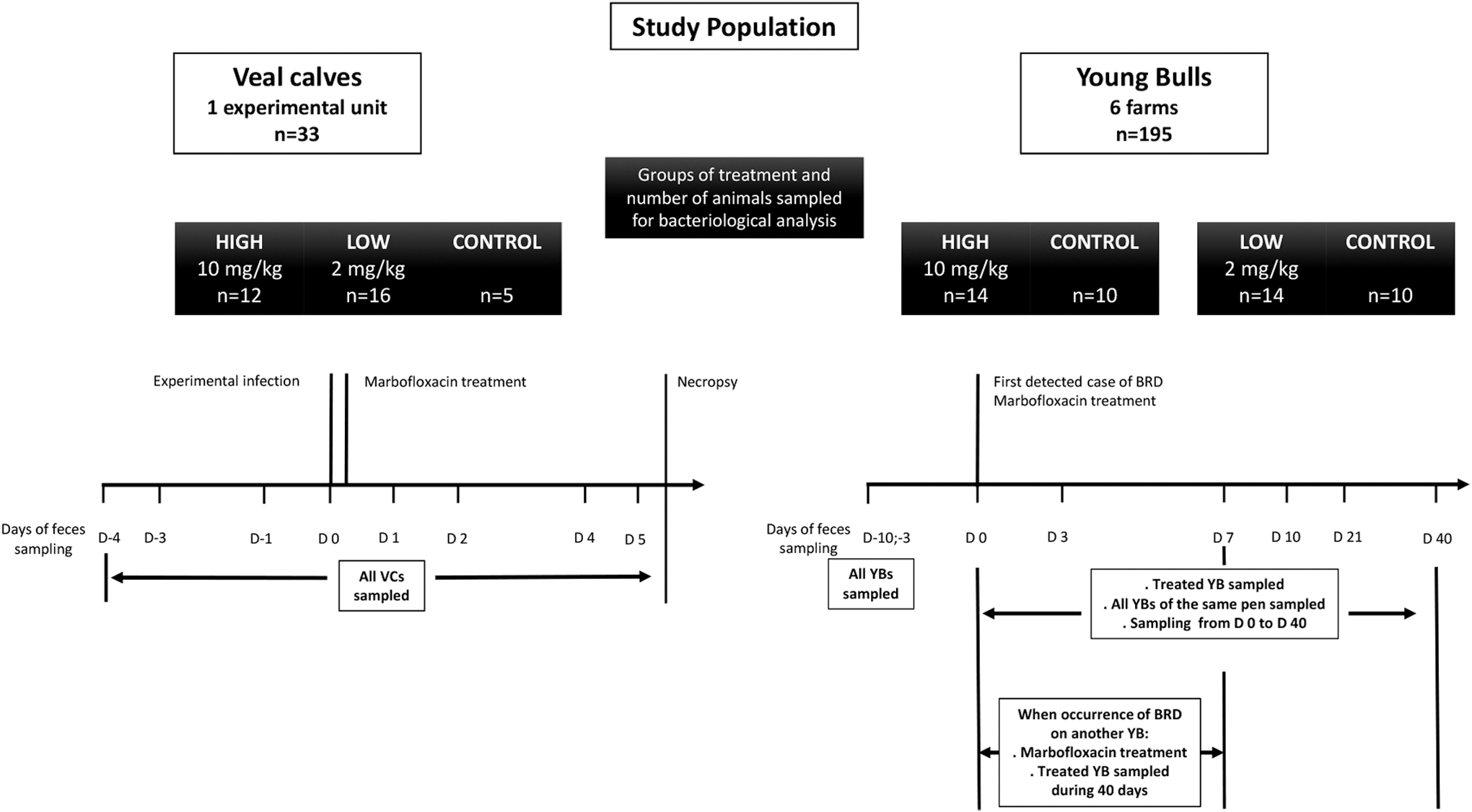
Chronologic description of the experimental procedures in VCs and YBs. For VCs, the study period lasted 5 d after experimental lung infection with Mannheimia haemolytica; feces from all the VCs were collected during the period. For YBs, the study period lasted 40 d after clinical diagnosis of BRD. Treated YBs were recruited during a period of 7 d. D0 represents the time of treatment of the YBs. After treatment of a YB, feces of all the YBs of the pen were sampled during 40 d. In a pen containing a YB already treated, a YB presenting signs of BRD was given marbofloxacin, and feces were sampled during 40 d after the day of treatment. If needed, a relapse treatment was administered, and the YBs treated twice were excluded of our current study. Control YBs were reared in the same pen as treated YBs, which did not present clinical signs of pneumonia during the study period. BRD, bovine respiratory disease; D, day; VCs, veal calves; YBs, young bulls.
Fecal sampling and bacteriology
Feces were collected by a veterinarian in all YBs by transrectal palpation, before treatment at days (−10; −3) and 0, and after treatment at days 3, 7, 10, 21, and 40 (Table 1). Samples were cooled on ice during transportation through the laboratory of Nantes Veterinary School. Bacteriological analyses were performed on feces of 48 YBs that were sampled by drawing of lots: 14 from HIGH group, 14 from LOW group. The Control group was constituted with YBs remaining untreated at the end of the study period: 10 YBs housed with YBs from HIGH group and 10 housed with YBs from LOW group. Two grams of feces from each sample and 18 mL of peptone water, with 30% glycerol, were placed in a BagFilter filter bag (Interscience, Saint-Nom-la-Breteche, France). The sample was blended, homogenized, and filtered by using a BagMixer paddle blender (Interscience). Three aliquots of 2 mL each were stored at −80°C between 1 and 2 months before analysis. For analysis, 100 μL of ½ dilution of the aliquot was spread in triplicate on MacConkey agar by using a spiral plater (Interscience), allowing a dilution range from 100 to 2.10−2. To select strains with decreased susceptibility (DS-Enterobacteriaceae) to marbofloxacin with an minimum inhibitory concentration (MIC) comprising between 0.12 and 4 μg/mL, or resistant (R-Enterobacteriaceae) with an MIC >4 μg/mL, fecal samples were also plated on MacConkey agar containing 0.12 or 4 μg/mL of marbofloxacin, respectively, based on the marbofloxacin MIC distribution already reported (Meunier et al., 2004; Kroemer et al., 2012). Colonies were counted after 24 h of incubation at 37°C. The lowest level of detection was 200 colony-forming units (CFUs) per gram feces.
YBs were raised in loose housing, and difficulties of restraint explains why samples could not be collected at several points and numbers are not constant over time. Each YB was sampled at least one time before the treatment of the first YB included in the pen.
D, day; YBs, young bulls.
Experiment 2 on VCs
Animals and antimicrobial treatments
Thirty-three dairy calves were selected at birth and reared until 2 to 3 weeks of age (weight range from 47 to 75 kg) in 1F experimental unit (INRA, Domaine-de-Borculo, Exmes, France). Calves were colostrum deprived after birth and fed with a milk replacer and a colostrum substitute (CER, Marloie, Belgium) during 7 d, as previously described (Riffault et al., 2010). Given the experimental features detailed later, calves were given a daily intramuscular dose of 1 mg/kg cefquinome (Cobactan, MSD, France) from birth to 7 d, to prevent them from acquiring bacterial infections. At 3 weeks of age, calves were transported and allocated to a specific experimental unit in collective pens with free access to hay and fresh water (experimental unit of Toulouse Veterinary School, France). They were fed ad libitum with starter food (Passio-Floc Junior, Sud Ouest Aliments, Anan, France) and once a day with a milk replacer (Laitine-Tech®; Bonilait-protéines, Chasseneuil-du-Poitou, France). They remained fully healthy during the 10 d period before the experiment. On day 0, challenge was performed in each calf by the intratracheal route. Two hundred milliliters of prewarmed solution containing 2.105 CFUs per milliliter of Mannheimia haemolytica was injected into an 18 G catheter that was inserted between two tracheal rings. In the next few hours, calves from the group LOW (n = 16) were administered a single intramuscular injection of 2 mg/kg marbofloxacin, and calves from the group HIGH (n = 12) were administered a single intramuscular injection of 10 mg/kg marbofloxacin. A non-treated group of 5 challenged calves, housed in the same pens, served as Control (Fig. 1).
Fecal sampling and bacteriology
Table 2 depicts the number of calves per group and the time of sampling. Feces were sampled on each calf before treatment at days (−4; −3), −1 and 0, and after treatment at days 1, 2, 4, and 5. Fecal samples were treated as described earlier before analysis in Toulouse Veterinary School laboratory. The count of total and resistant Enterobacteriaceae was determined by plating tenfold dilutions of fecal samples on MacConkey agar plates without antibiotics, supplemented with 32 μg/mL of nalidixic acid, or supplemented with 2 μg/mL of ciprofloxacin, based on the clinical breakpoints published by the CASFM (2013). The lowest level of detection was 200 CFUs per gram feces. Three control strains were used to check media reliability: a susceptible E. coli-ATCC-25922, a DS E. coli-K12 resistant to nalidixic acid but susceptible to ciprofloxacin and an E. coli-4S1F4 ciprofloxacin resistant.
Numbers are not constant over time in the different groups, because some animals were treated at various times and could not be collected, according to the apparition of signs of bovine respiratory disease, and one died in the Control group.
Statistical analysis
Analyses of counts of total and resistant Enterobacteriaceae were performed after log10 transformation by using the mixed procedure with repeated measures of SAS with group, time, time by group as fixed effects and subject, and herd as random effect. When a significant interaction between time and group was observed, a Kruskal–Wallis test was used to compare treatment groups on each sample day. Two-sided tests were performed at the 5% significance level. Statistical analyses were performed with the software SAS (SAS version 9.2 Inst. Inc., Cary, NC).
Results
Experiment 1 on YBs
Numbers of animals harboring resistant strains before and after treatment
Before treatment, no DS-Enterobacteriaceae were detected in the Control group and the HIGH group; 1 out of 14 YBs in the LOW group yield DS-Enterobacteriaceae.
After treatment, DS-Enterobacteriaceae were isolated in at least 2 successive samples in 2 out of 14 YB of each treated group. Bacteria resistant to marbofloxacin were isolated from day (D)7 to D40 in only 1 YB from the HIGH group, and none in the LOW group. In the Control group, DS-Enterobacteriaceae were isolated in only 2 YBs; R-Enterobacteriaceae were detected in 1 YB.
Bacterial counts
Average counts of total Enterobacteriaceae are depicted in Figure 2. Before treatment, total Enterobacteriaceae counts, between 5 and 6 log10 CFUs per gram, were similar in the three groups. At D3, a transient significant decrease in total Enterobacteriaceae count was observed between both treatment and Control group (p < 0.05). This decrease was higher in group HIGH (−2 log10) than in group LOW (−1 log10). Total Enterobacteriaceae count returned to baseline at D7 in both groups. In YBs harboring R-Enterobacteriaceae, the percentage of R-Enterobacteriaceae varied between 40% and 95% of total Enterobacteriaceae.
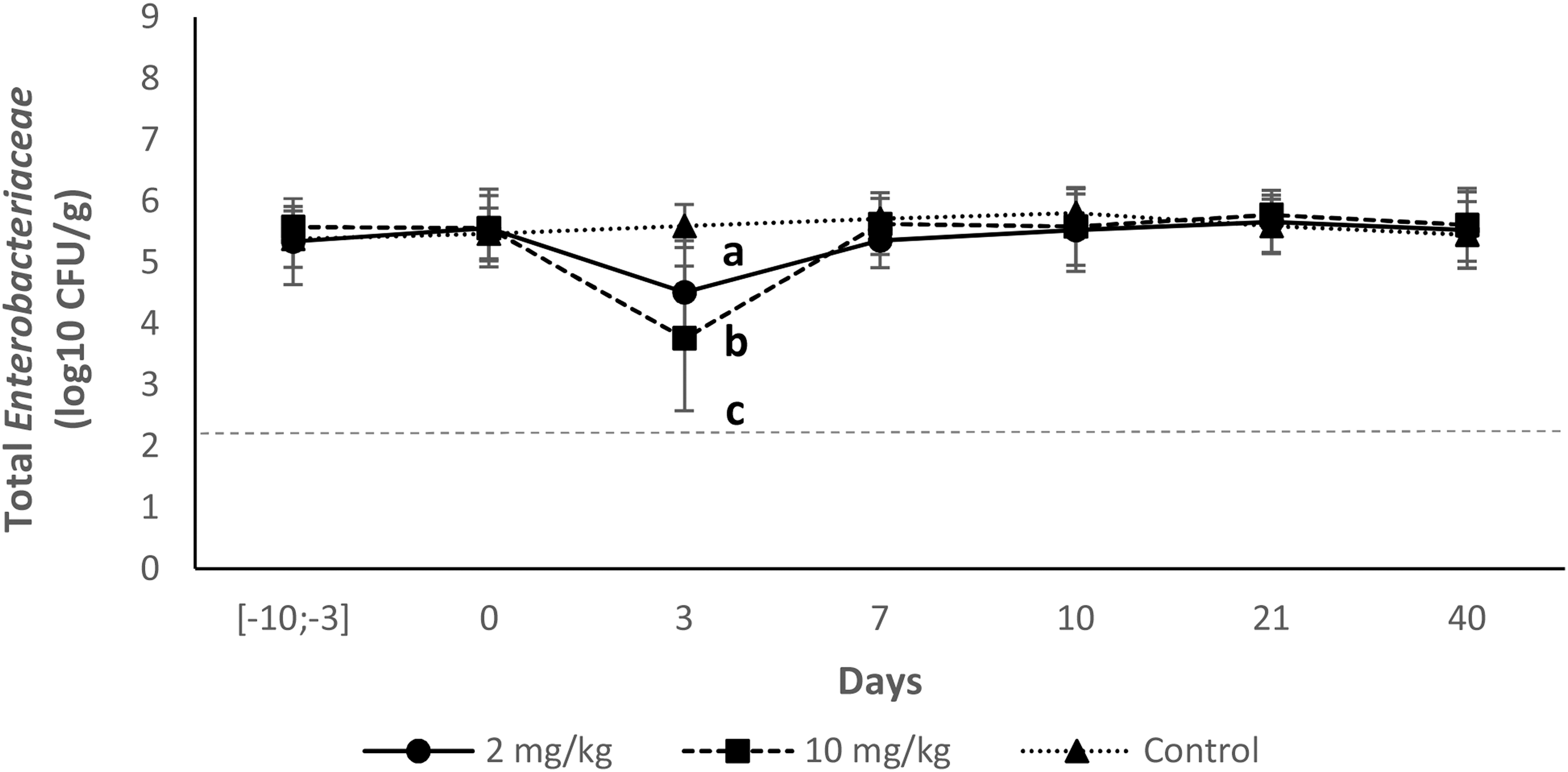
Log counts of total Enterobacteriaceae in fecal YBs samples treated with 0.2 or 10 mg/kg of IM marbofloxacin on day 0. Different letters besides curves indicate that values are statistically different. The dotted line indicates the lower limit of detection (2.3 log10 CFU/g) used for bacterial quantification. CFU, colony-forming units; IM, intramuscular.
Experiment 2 on VCs
Numbers of animals harboring resistant strains before and after treatment
Before treatment, and at D4 and D5 after treatment, nalidixic acid and ciprofloxacin-resistant Enterobacteriaceae were detected in all the calves from the three groups.
Bacterial counts and proportion of resistant bacteria
In the two treated groups, no significant difference in the total counts of Enterobacteriaceae was observed over time (Fig. 3a). In all groups, no significant differences were observed over time in the counts of nalidixic-resistant Enterobacteriaceae (p = 0.48) (Fig. 3b). The number of ciprofloxacin-resistant isolates was lower before treatment in each group (mean between 4.45 and 5.70 log10 CFU/g), compared with the number of susceptible isolates and nalidixic-resistant isolates (mean between 6.04 and 7.69 log10 CFU/g) (Fig. 3c). The number of ciprofloxacin-resistant isolates increased significantly from D0 to D5 in the two treated groups over time (p < 0.05). In the Control group, a significant increase of two log10 of the average number of ciprofloxacin-resistant isolates was also observed between D2 and D5 (p < 0.05). At D5, only 3 out of 5 calves were collected in the Control group: One calf died between D3 and D5, and one calf could not be sampled.
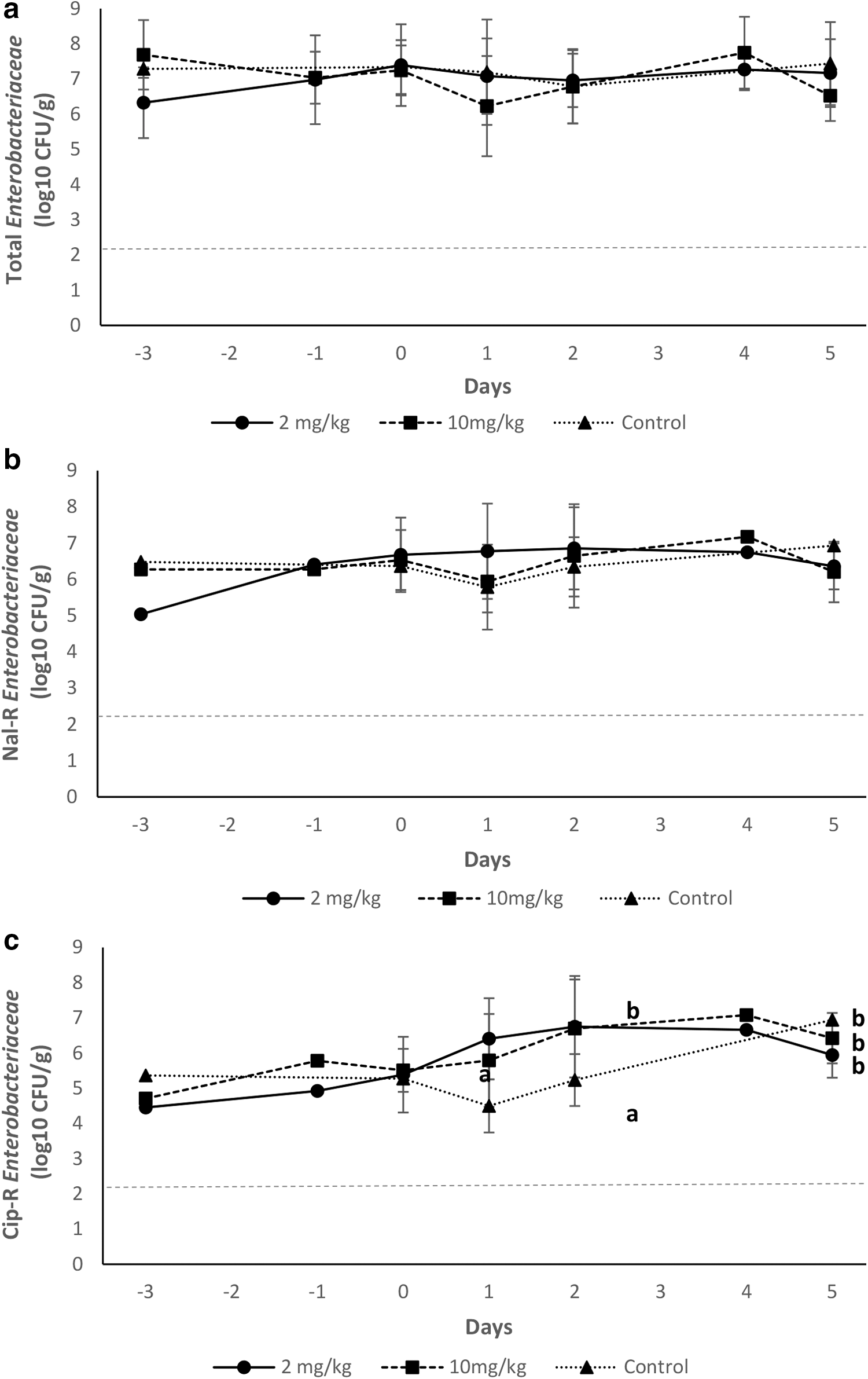
Log counts of total
Discussion
We aimed at assessing the impact of a decreased marbofloxacin regimen on selection of fluoroquinolone-resistant Enterobacteriaceae in young cattle. Animals from two study populations were considered in our experiment as a sub-sample of the target population. The choice was based on the frequent usage of fluoroquinolones in European YBs and VCs rearing systems, and lack of data regarding its potential impact on commensal flora. A fivefold decrease of marbofloxacin treatment did not affect the selection of resistances among commensal bacteria in young cattle. A moderate selective pressure was observed on commensal Enterobacteriaceae in YBs and VCs.
YBs were reared in loose housing, and restraint difficulties explain why some samples were not collected. All the YBs included in our study have been sampled at least one time before marbofloxacin treatment. History of antimicrobial treatments was unknown, and previous treatments might have interfered with the selection of bacterial resistance. However, under French field conditions, it was not feasible to document history of treatments in YBs transferred via an auction market. The low prevalence of R-Enterobacteriaceae observed in YBs was consistent with the results reported in a study conducted in Canadian feedlots, reporting a low prevalence in resistant E. coli at the arrival of YBs in fattening units (Checkley et al., 2010). This observation suggests that potential previous treatments did not affect our results.
In contrast, before treatment, all the pre-ruminant calves were found to carry resistant Enterobacteriaceae in their feces, whereas DS-Enterobacteriaceae were detected in only 1 YB. Such results should be interpreted while taking into account the putative effect of specific experimental procedures. The calves recruited were also enrolled in a study assessing the impact of marbofloxacin dosage in an experimental lung infection model (Lhermie et al., 2016). For ethical issues, we restricted at the minimum the number of calves in the Control group. To avoid transfer of immunoglobulin, VCs were colostrum deprived. After experimental challenge and apparition of clinical signs, some calves of treated groups could not be collected, due to experimental features or absence of feces.
We cannot exclude that cefquinome treatment administered in our experimental challenge context might have favored the selection of resistant Enterobacteriaceae. In the field, such practices should be banned. Several studies have already reported that pre-weaned calves harbored multiple resistant E. coli in gut flora (Hoyle et al., 2004; Berge et al., 2006; Thames et al., 2012). Specifically for fluoroquinolones and E. coli, resistance levels between 10% and 25% were reported in Europe (EFSA, 2010; Hordijk et al., 2012). Several factors, such as housing, weaning, and use of discarded milk containing antimicrobial residues for calves' feeding, influence the presence of resistant gut flora bacteria (Langford et al., 2003; Berge et al., 2005; Pereira et al., 2014). Indeed, previous studies reported the coselection of plasmid-mediated quinolone resistance genes with β-Lactams use, leading to a decrease in susceptibility of E. coli, but not clinical resistance to fluoroquinolones (Nordmann and Poirel, 2005; Vien et al., 2012).
Khachatryan et al. (2004) showed an inverse relationship between the age of animals and the prevalence of fecal resistant E. coli. In a field study conducted in adult dairy cows, Mann et al. (2011) reported a low prevalence of E. coli strains that were resistant to different antimicrobial classes. Several studies, aggregated in a review, reported low percentages of fluoroquinolone-resistant E. coli in feces of dairy cows (Oliver et al., 2011). Taken together, all these results are consistent with those we observed, showing differences between calves and YBs in the initial level of bacterial resistance.
Regarding the moderate selection pressure on Enterobacteriaceae in VCs, the limited effect of a single dose of marbofloxacin, whatever the regimen, could probably be associated with the high level of resistant Enterobacteriaceae present before treatment. Total count of Ciprofloxacin-resistant Enterobacteriaceae slightly increased by one log10 between D0 and D5 in both treatment groups.
One study reported that a threefold increase in fluoroquinolone dose did not lead to measurable differences in the probability of selection of resistant bacteria in the human gut flora (Fantin et al., 2009). A study investigating the effect of dose escalation of a 3-d enrofloxacin treatment on resistance of coliforms in pigs stressed a selective pressure effect within 1 d, regardless of the regimen (Wiuff et al., 2003). However, a positive correlation between antimicrobial dosage and the proportion of resistant bacteria has been reported in other species. In an experiment conducted in piglets, Nguyen et al. (2012) observed that the higher the ciprofloxacin dose administered (1.5 or 15 mg/kg), the higher the proportion of resistant Enterobacteriaceae. Similar results were observed on Enterobacteriaceae in an experimental model using rats treated with different doses of cefquinome (Vasseur et al., 2014). In both studies (Nguyen et al., 2012; Vasseur et al., 2014), resistant strains were present at very low levels (counts about 103 CFU/g, representing 0.1–0.001% of the total Enterobacteriaceae), which is probably the most favorable feature enabling antibiotic selective pressure to produce selection and subsequent amplification of resistant strains. In the present experiment, the initial composition of gut microbiota of VCs was probably not favorable for such effect.
Regarding the effects of marbofloxacin in YBs, administration of 2 or 10 mg/kg decreased the total number of Enterobacteriaceae in the 3 d after treatment. A similar decrease after a single administration of 10 mg/kg of marbofloxacin was reported in sheep (El Garch et al., 2015). In our study, R-Enterobacteriaceae did not colonize the gut when present, and susceptible Enterobacteriaceae flora was restored in 7 d. Marbofloxacin treatment exerted a very low selective pressure on R-Enterobacteriaceae. In the groups LOW and HIGH, 2 out of 14 YBs harbored DS-Enterobacteriaceae. Only one YB from the HIGH group harbored R-Enterobacteriaceae, which persisted until the last sampling (D40). The greater part of YBs did not exhibit resistant bacteria over time. In the absence of strains that are resistant to quinolones in basal condition, marbofloxacin treatment did not allow to select for resistant strains or de novo mutants with DS.
In one YB of each group, we observed that isolation of DS-Enterobacteriaceae strains after D0 was not systematically repeated. R-Enterobacteriaceae were isolated at low level after D0 in one untreated YB, in which R-Enterobacteriaceae were not present in feces before D0. We cannot exclude that our methods of sampling and analysis led to an underestimation of the presence of resistant strains. However, our method was pretty similar to that used in studies assessing the impact of antimicrobials on commensal floras in cattle (Lowrance et al., 2007; Mann et al., 2011).
Even if Enterobacteriaceae represent a low percentage of the total digestive flora in ruminants, they constitute a potential reservoir of resistance genes potentially transferred from animals to humans (Aarestrup and Wegener, 1999; Bywater, 2004; Wooldridge, 2012). Enterobacteriaceae represent a frequent carcass contaminant at slaughter (Ramos et al., 2013). Therefore, Enterobacteriaceae were chosen as the indicator commensal organism in this study. The concentrations of 32 μg/mL of nalidixic acid or 0.12 μg/mL of marbofloxacin, and 2 μg/mL of ciprofloxacin or 4 μg/mL of marbofloxacin were retained to isolate Enterobacteriaceae with DS or resistant to fluoroquinolones, respectively. These concentrations are commonly used to perform such experiments (Meunier et al., 2004; Kroemer et al., 2012; CASFM, 2013).
Conclusions
A fivefold decrease of marbofloxacin regimen did not affect selection of resistances among commensal bacteria. Basal level of resistance to fluoroquinolone differed strongly between the two animal study populations. Our results suggest that a single treatment with 2 or 10 mg/kg marbofloxacin exerts a moderate selective pressure on commensal Enterobacteriaceae in young cattle. The possible impact of fluoroquinolones on environmental bacteria, after their shedding in the environment, encourages their prudent use.
Footnotes
Acknowledgments
The authors thank Nathalie Arpaillange, Julie Blanc, Emmanuelle Blandin, and Françoise Leray. This work was performed in a PhD program supported by INRA and Vetoquinol-Drug-Development.
Disclosure Statement
No competing financial interests exist.