




Abstract
There are growing concerns about the coselection of resistance against antibiotics and disinfectants in bacterial pathogens. The aim of this study was to characterize the antimicrobial susceptibility profiles, the prevalence of extended-spectrum β-lactamases (ESBLs), plasmid-mediated quinolone resistance genes (PMQRs), and quaternary ammonium compound resistance genes (QACs) in Escherichia coli isolated from ready-to-eat (RTE) meat products obtained in Guangzhou, China, and to determine whether these genes were colocalized in the isolates. A total of 64 E. coli isolates were obtained from 720 RTE meat samples. Multidrug resistance was observed in 70.3% of the isolates. A 100% of the isolates were resistant to benzalkonium chloride. Four types of β-lactamase genes were identified in the 16 ESBL-producing E. coli isolates: bla SHV (9.4%), bla TEM (7.8%), bla CTX-M-15 (1.6%), and bla CTX-M-9 (1.6%). PMQRs were present in nine isolates (14.1%), with aac(6′)-Ib-cr and qnrD detected in eight (12.5%) and one isolate (1.6%), respectively. The QACs ydgE/ydgF were most commonly present (60.9%), while qacF, mdfA, sugE(p), emrE, qacG, sugE(c), and qacE were less prevalent (1.6%–18.8%). Coexistence of ESBLs and/or PMQRs with QACs was found in 21 isolates (32.8%). The aac(6′)-Ib-cr and bla CTX-M-15 genes were found to be cotransferred with qacF in one isolate. The data obtained in this study indicate that ESBLs and/or PMQRs with QACs can not only be colocalized but can also be cotransferred in E. coli isolates from RTE meat products. The E. coli isolates with multiple antimicrobial resistance genes may transmit to humans through food chain and thus require further investigation and increased awareness.
Introduction
T
Disinfectants based on quaternary ammonium compounds such as benzalkonium chloride (BC) are commonly used for disinfecting food processing and production environments to ensure microbiologically safe food products (Buffet-Bataillon et al., 2012a; Lavilla Lerma et al., 2013). It has been suggested that the widespread use of disinfectants in the food processing environments may generate a selective pressure for the emergence of disinfectant-resistant bacteria (Buffet-Bataillon et al., 2013; Tezel and Pavlostathis, 2015). Also, limited scientific evidence available indicated that the disinfectants may induce or select for bacterial adaptations, which result in decreased susceptibility to one or more antibiotics (Buffet-Bataillon et al., 2012b; Gerba, 2015; Lavilla Lerma et al., 2015). Many of the disinfectant resistance pathways and mechanisms have been found similar to those involved in antibiotic resistance, such as cellular mechanisms, acquisition of resistance/tolerance genes by plasmids or integrons, and overexpression of efflux pump systems (Katharios-Lanwermeyer et al., 2012; Moen et al., 2012; Tezel and Pavlostathis, 2015).
Increasing antimicrobial resistance, especially toward 3rd- and 4th-generation cephalosporins and (fluoro) quinolones, has been reported in the last decade, and this poses serious therapeutic problems (Bush, 2010; Karlowsky et al., 2016). As Escherichia coli strains are regarded as indicators of antimicrobial load on their hosts and reservoir for intra- and interspecific exchange, numerous studies have investigated the occurrence of extended-spectrum β-lactamases (ESBLs) and plasmid-mediated quinolone resistance genes (PMQRs) in foodborne E. coli isolates. These resistance traits have been found to commonly coexist in various plasmids and are often conjugative to other bacteria (Han et al., 2010; Briales et al., 2012; Jiang et al., 2014). However, limited data are available on the presence and association of quaternary ammonium compound resistance genes (QACs) with ESBLs and PMQRs in foodborne E. coli isolates.
Ready-to-eat (RTE) meat products are susceptible to bacterial contamination during processing and storage. Such food products are very popular in China and are often consumed without reheating. Antimicrobial-resistant isolates in these kind of food products can be transferred to humans through the food chain and this presents a public health risk (Alexander et al., 2010; Ryu et al., 2012).Therefore, the objectives of this study were to investigate the antimicrobial susceptibility profiles and further the colocalization and cotransfer of PMQRs and/or ESBLs with QACs among E. coli from RTE meat products. The results in this study will improve our understanding of the coselection potential between disinfectants and antibiotics.
Materials and Methods
Sample collection and E. coli isolation
A total of 720 samples of cooked meat products, including sauced meat (n = 240), toasted meat (n = 240), and meatballs (n = 240), were purchased from 30 supermarkets and 30 farmer's markets from September to November 2013 in Guangzhou, China. The samples were collected three times and four samples were collected per sampling site on each visit. Samples collected from supermarkets were covered with poly ethylene fresh-keeping film, while samples from the farmer's markets were exposed to air. Samples were collected aseptically and transported to the laboratory in an icebox within 2 h of collection.
E. coli isolation and identification were performed as described previously (Badri et al., 2009). For each sample, a minimum of two presumptive E. coli colonies were subjected to Gram staining and conventional biochemical tests using Microbial Biochem Identification Tube System (HKM, Inc.). Only one isolate from each positive sample was selected for further analysis.
Antimicrobial susceptibility testing and ESBL detection
The antimicrobial susceptibility of the isolates was determined using the agar dilution method in Mueller–Hinton (Guangdong Huankai Microbial Sci & Tech) agar plates. The following 16 antibiotics with different concentration ranges were used: gentamicin (1–32 μg/mL), imipenem (1–32 μg/mL), meropenem (1–32 μg/mL), cefotaxime (1–16 μg/mL), ceftazidime (1–32 μg/mL), cefepime (1–64 μg/mL), cefoxitin (1–64 μg/mL), ciprofloxacin (0.5–16 μg/mL), trimethoprim/sulfamethoxazole (12.5–160 μg/mL), tigecycline (1–32 μg/mL), aztreonam (1–32 μg/mL), ampicillin (1–64 μg/mL), ampicillin/sulbactam (6–96 μg/mL), chloramphenicol (1–64 μg/mL), fosfomycin (16–512 μg/mL), and tetracycline (1–512 μg/mL) (Sigma-Aldrich).
Screening for ESBL production was performed by the double disk diffusion method according to CLSI guidelines, using ceftazidime (30 μg), ceftazidime/clavulanic acid (30 μg/10 μg), cefotaxime (30 μg), and cefotaxime/clavulanic acid (30 μg/10 μg).
The classes of the resistance levels were defined as described by the Clinical and Laboratory Standards Institute (2012). Multidrug resistance (MDR) was determined according to Magiorakos et al. (2012). E. coli ATCC 25922 was used as control strain.
The minimum inhibitory concentrations (MICs) of BC were determined by the broth microdilution method with concentrations ranging from 0.125 to 1024 μg/mL in Mueller–Hinton broth as described previously (Morrissey et al., 2014). E. coli ATCC25922 was used as a quality control strain.
Detection of β-lactamases, PMQRs, and QACs
Polymerase chain reaction (PCR) detection assays were used for broad-scale screening of the presence of three types of β-lactamase genes (bla
CTX-M, bla
TEM, and bla
SHV) in ESBL-positive isolates, seven PMQRs (qnrA, qnrB, qnrC, qnrD, qnrS, aac(6′)-Ib-cr, and qepA)), and ten QACs (sugE(c), emrE, ydgE, ydgF, mdfA, qacE, qacEΔ1, qacF, qacG, and sugE(p)). Subgroups of CTX-M-1 and CTX-M-9 were further amplified as previously described (Pagani et al., 2003; Eckert et al., 2004). The quinolone resistance determining region (QRDR) of the gyrase (gyrA and gyrB) and topoisomerase (parC and parE) genes was also amplified. PCR amplicons were confirmed by sequencing. Primers and annealing temperatures are described in Supplementary Table S1 (Supplementary Data are available online at
Conjugation experiments and plasmid analysis
The cotransfer of ESBLs and PMQRs with QACs in two isolates was studied by performing conjugation experiments with E. coli J53Azr (a sodium azide-resistant strain) as the recipient, as described previously (Jiang et al., 2014). Transconjugants were selected on trypticase soy agar (TSA; Huankai) plates containing sodium azide (150 μg/mL; Sigma-Aldrich) and one of the following antimicrobials: cefotaxime (2–4 μg/mL) or ciprofloxacin (2–4 μg/mL) and BC (32–64 μg/mL). PCR was used to confirm that the transconjugants carried the same genes as their donors. Plasmids from E. coli isolates and transconjugants were detected using S1-PFGE as previously described (Barton et al., 1995). PCR-based replicon typing was performed as described by Coque et al. (2008) using DNA from the donor and transconjugants as the template.
Pulsed-field gel electrophoresis
Pulsed-field gel electrophoresis (PFGE) of 21 isolates carrying ESBLs and/or PMQRs with QACs after digestion with XbaI was performed according to the CDC PulseNet standardized protocol for subtyping of E. coli (Ribot et al., 2006) by using the CHEF MAPPER apparatus (Bio-Rad Laboratories). The images of PFGE patterns were captured with a Gel Doc system (Bio-Rad) using the Quantity One software program (version 4.6.2; Bio-Rad). PFGE patterns were compared using the BioNumerics software package (Sint-Martens-Latem; version 5.10). Cluster analysis of the PFGE patterns was performed through the unweighted-pair group method using arithmetic mean (UPGMA) and the band-based Dice correlation coefficient with a position tolerance of 1.0%.
Results
E. coli recovery from cooked meat products
In total, 64 E. coli isolates were obtained, including 28 from meatballs (11.7% isolation rates), 20 from sauced meats (8.3% isolation rates), and 16 from roasted meats (6.7% isolation rates).
Antimicrobial resistance profiles of E. coli isolates
Among the 64 E. coli isolates, 55 isolates (85.9%) were resistant to at least one antibiotic tested. All 64 strains were susceptible to cefepime, tigecycline, aztreonam, fosfomycin, imipenem, and meropenem (Table 1). A total of 84.4% isolates were resistant to trimethoprim/sulfamethoxazole, 81.3% to tetracycline, 57.8% to chloramphenicol, 56.3% to ampicillin, 21.9% to ciprofloxacin, 21.9% to gentamicin, 9.4% to cefotaxime, 9.4% to ceftazidime, 6.3% to ampicillin/sulbactam, and 4.7% to cefoxitin (Table 1). MDR (resistance to ≥3 groups of drugs) was observed in 70.3% of the isolates. Sixteen isolates were positive for ESBL production, as tested using the double disk method. All of these 16 isolates were multidrug resistant.
MIC tests showed that 100% of strains were resistant to BC with MIC value range of 64–256 μg/mL.
Presence of antimicrobial resistance genes and genotypic diversity
Of the 64 isolates, 57 isolates (89.1%) contained one or more of antimicrobial resistance genes. QACs were detected in 84.4% of the isolates (Table 2). Among QACs, the ydgE/ydgF genes were the most widespread, being found in 61.0% of the isolates, followed by qacF (18.8%; n = 12), mdfA (15.6%; n = 10), sugE(p) (14.1%; n = 9), emrE (12.5%; n = 8), qacG (4.8%; n = 3), qacE (1.6%; n = 1), and sugE(c) (1.6%; n = 1). The qacEΔ1 gene was not detected in any of the isolates. 26.6% of the isolates were found to contain two QACs. Multiple QACs were found in 36.0% of the isolates.
ESBL, extended-spectrum β-lactamase; PMQR, plasmid-mediated quinolone resistance gene; QAC, quaternary ammonium compound resistance gene; RTE, ready-to-eat.
The ESBLs detected by PCR and sequencing in the 16 ESBL-positive E. coli isolates were as follows: bla SHV (nine isolates), bla TEM (five isolates), bla CTX-M-9 (one isolate), and bla CTX-M-15 (one isolate) (Table 2).
Nine (14.1%) of the 64 E. coli isolates were positive for PMQRs (Table 2). Among them, eight isolates (12.5%) harbored the aac(6′)-Ib-cr gene and one isolate (4.0%) harbored the qnrD gene. However, other PMQRs were not detected in these isolates. In addition, mutations in the parC gene (Ser83Ile) in the QRDR were identified in one isolate among the nine PMQR-positive isolates, whereas no mutations in the QRDR of the gyrB or parE genes were found (Table 2). Nine mutations in the QRDR of the gyrA (Ser83Leu) were found among PMQR-negative isolates, including five mutations in combination with mutations in Asp87Asn (data not shown). There was no mutation in the QRDR genes in either the recipient or the transconjugant.
Coexistence of ESBLs and/or PMQRs with QACs was found in 21 isolates (32.8%). Two isolates coharbored ESBLs, PMQRs, and QACs. Strain E28 carried bla SHV, bla CTX-M-15, aac(6′)-Ib-cr, qacF, and ydgE/ydgF. Strains E51 harbored bla TEM, aac(6′)-Ib-cr, emrE, sugE(p), and qacF (Table 2).
Examination of the PFGE patterns of the 21 isolates carrying ESBLs and/or PMQRs with QACs revealed 21 different PFGE fragment patterns (Fig. 1), indicating no clear-cut association of these isolates.
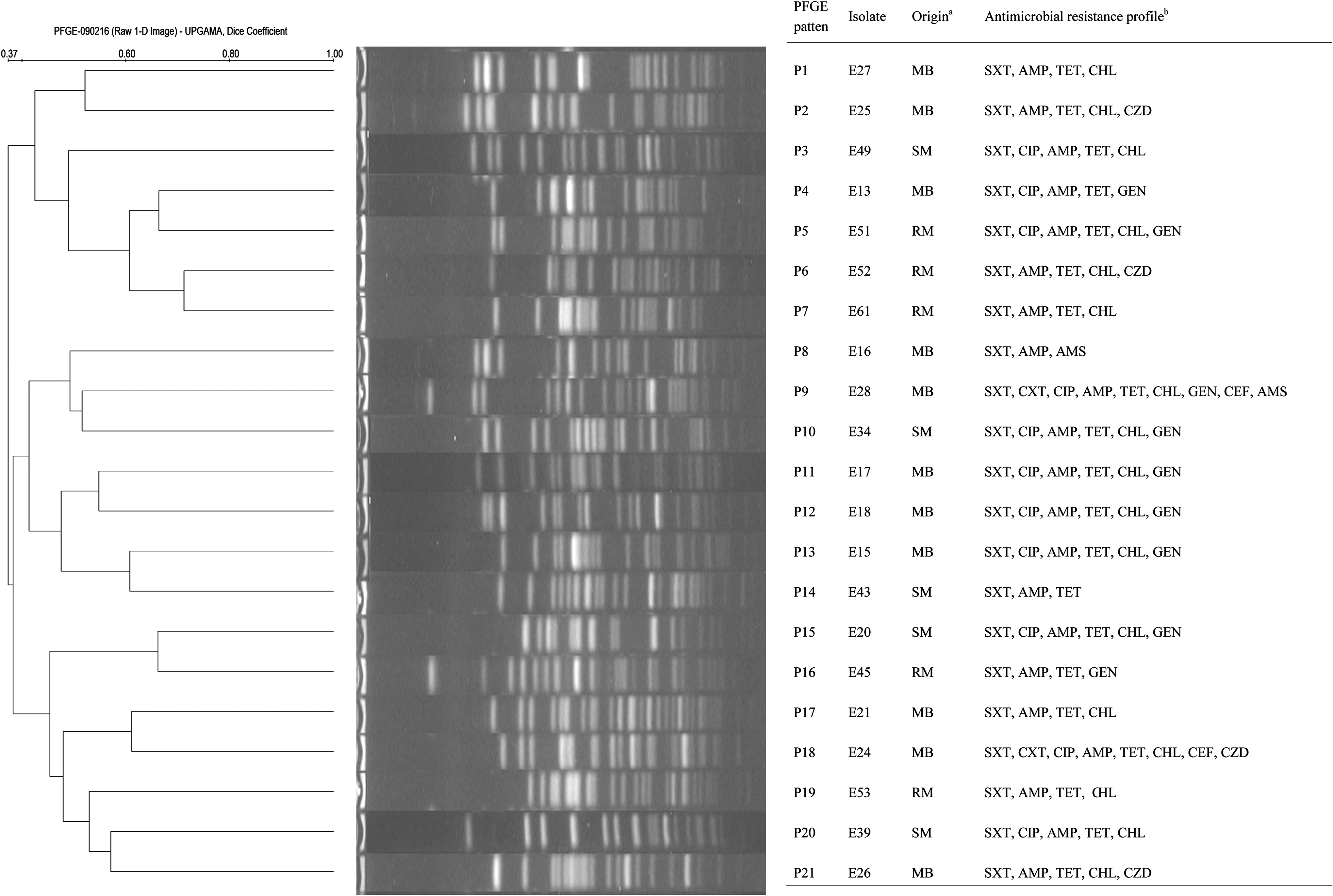
Dendrogram of pulsed-field gel electrophoresis patterns based on XbaI digestion of 21 E.coli isolates from RTE meat products. aMB, meatballs; SM, sauced meat; RM, roasted meat products. bGEN, gentamicin; CEF, cefotaxime; CZD, ceftazidime; CXT, cefoxitin; CIP, ciprofloxacin; SXT, trimethoprim/sulfamethoxazole; AMP, ampicillin; AMS, ampicillin/sulbactam; CHL, chloramphenicol; TET, tetracycline.
Conjugation experiments and plasmid analysis
Of the two E. coli isolates carrying ESBLs, PMQRs, and QACs, only one isolate E28 was capable of transferring qacF, bla CTX-M-15, and aac(6′)-Ib-cr by conjugation with a frequency of 10–7 per donor cell. PCR experiments confirmed that the transconjugants harbored the same resistance genes as their donors. Results of S1-PFGE showed two plasmids with the sizes of 62.5 and 151.9 kb, respectively (Supplementary Fig. S1). The donor and the transconjugants were found to harbor both FIA and FIB.
Discussion
Despite the widespread use of disinfectants in the food processing environment (Buffet-Bataillon et al., 2012), the results of this study showed that E. coli with ESBLs, PMQRs, and various QACs is present in retail RTE meat products and may be transferred directly to the human population through the food chain. Considering that most organisms should be killed by the high temperature commonly applied during RTE meat product processing, it is probable that the E. coli contamination of these samples may have occurred by cross-contamination from food handling processes or environment sources following the heating process. Despite the low occurrence, the survival of bacteria after cleaning and disinfection in the RTE food production requires special attention due to the health risk constituted by these bacteria.
Resistance to trimethoprim/sulfamethoxazole, tetracycline, chloramphenicol, and ampicillin was observed frequently among E. coli isolated from RTE meat products in this study, which is similar to other reports on the antibiotic resistance of E. coli isolates from retail meats in China, Turkey, and Italy (Li et al., 2014; Ghodousi et al., 2015; Pehlivanlar Önen et al., 2015; Zhang et al., 2016). High rates of resistance toward streptomycin, cefalotin, oxytetracycline, doxycycline, amoxicillin, amikacin, ceftriaxone, lomefloxacin, ofloxacin, enrofloxacin, gentamicin and florfenicol in E. coli isolates from retail meat products have also been reported in China (Li et al., 2014; Yu et al., 2015). The reasons for the wide resistance spectrum in China could be related to the unrestricted usage of antibiotics in food animals and on farms (Zhu et al., 2013).
ESBL-producing Escherichia spp. have been widely found in retail meat products, livestock animals, and on farms (Abdallah et al., 2015; Dahms et al., 2015). However, data on the presence of ESBL-producing E. coli in RTE meat products were limited. The proportion (23.4%) of ESBL-producing E. coli isolated from RTE meat products in the present study was higher than the reports from cooked meat products (6.7%) in China and retail meats (16.7%) in Germany (Jiang et al., 2014; Yu et al., 2015; Day et al., 2016).
Due to the widespread use of disinfectants in the food industry and related environments, bacterial adaptation to quaternary ammonium compounds (mainly BC) has been reported among bacteria isolated from food products and food production environments (Xu et al., 2014; Lavilla Lerma et al., 2015). Zhang et al. (2016) reported that 89.2% of E. coli isolates from retail meat products were resistant to BC. A large survey from the National Antimicrobial Resistance Monitoring System (NARMS) retail meat program in the United States reported that the E. coli isolates from retail meat products showed reduced susceptibility to four QAC disinfectant families (Zhao et al., 2012). In the present study, all E. coli isolates were resistant to BC. The BC-resistant E. coli isolates were correlated to the high occurrence of QACs observed in this study, as the expression of many of these genes in E. coli has been confirmed to confer host resistance to benzalkonium (Edgar and Edgar, 1997; Nishino and Yamaguchi, 2001; Chung and Saier, 2002).
Several studies have shown the prevalence of ESBLs and PMQRs in E. coli isolates from meat products, the environment, and humans (Yu et al., 2015; Day et al., 2016). QACs were commonly present in E. coli isolated from retail meat products (Zou et al., 2014). However, the co-occurrence of QACs with ESBLs and/or PMQRs in foodborne isolates of E. coli was not common in the present study due to the low incidence of PMQRs. Analyses of PFGE banding patterns indicated that there has been a high rate of genetic diversity in isolates positive for ESBLs and/or PMQRs and QACs. The occurrence of diverse E. coli isolates in RTE meat products in this study revealed that these types of food products are easily contaminated by various bacterial contamination sources, which need to be further investigated.
It has been reported that the aac(6′)-Ib-cr gene can coexist with ESBL-encoding genes and can be cotransferred to the recipient, which may have contributed to the rapid increase in the prevalence of MDR among bacteria (Yang et al., 2008; Han et al., 2010; Tausova et al., 2012). Also, several QACs have been reported to have the potential to be transferred with antibiotic resistance genes via plasmids. For example, the sugE(p) gene has been reported to be frequently present on an IncA/C MDR plasmid and was able to be transferred among Gram-negative bacteria. The IncA/C plasmid was often linked with various resistance genes, such as bla CMY-2, aadA, aacC, sul1, sul2, tet, and floR (Welch et al., 2007; Call et al., 2010). In this study, the qacF, bla CTX-M-15, and aac(6′)-Ib-cr genes in one multidrug-resistant isolate were able to be cotransferred to E. coli J53 via IncF conjugative plasmids. As the QACs are commonly present in E. coli isolates, the cotransfer through various conjugative plasmids raises concerns about food safety that require further investigation and increased awareness.
Conclusions
Our results showed that ESBLs and/or PMQRs can not only coexist but can also be cotransferred with QACs in E. coli isolates from RTE meat products. Furthermore, to better understand the strategy of development and spread of potential resistant bacteria to both disinfectants and antibiotics via the food production chain to human, both the identification of all resistant bacteria at species level and characterization in depth of resistance mechanisms are needed.
Footnotes
Acknowledgments
This work was supported by the National Natural Science Foundation of China (31571934) and the National Key Research and Development Program of China (2016YFD0500600).
Disclosure statement
No competing financial interests exist.
References
Supplementary Material
Please find the following supplemental material available below.
For Open Access articles published under a Creative Commons License, all supplemental material carries the same license as the article it is associated with.
For non-Open Access articles published, all supplemental material carries a non-exclusive license, and permission requests for re-use of supplemental material or any part of supplemental material shall be sent directly to the copyright owner as specified in the copyright notice associated with the article.
