




Abstract
Ingestion of undercooked meat has been proposed as an important source of human Toxoplasma gondii infection. To ascertain the contribution of meat consumption to the risk of human infection, estimates of the prevalence of infection in meat-producing animals are required. A cross-sectional study was conducted to assess T. gondii infection in pigs raised in England, to identify risk factors for infection, and to compare performance of two serological tests: modified agglutination test (MAT) and enzyme-linked immunosorbent assay (ELISA). Blood samples from 2071 slaughter pigs originating from 131 farms were collected and 75 (3.6%) were found to be positive by MAT. Positive pigs originated from 24 farms. A subset of samples (n = 492) were tested using ELISA, and a significant disagreement (p < 0.001) was found between the two tests. An empirical Bayes approach was used to estimate the farm-level prevalence and the probability of each individual farm having at least one positive animal, considering the uncertainty arising from the sampling strategy and the imperfect test performance. The adjusted farm-level prevalence was 11.5% (95% credible interval of positive farms 8.4–16.0%). Two different criteria were used for classifying farms as infected: (1) ≥50% probability of having at least one infected pig (n = 5, 6.8%) and (2) ≥10% probability (n = 15, 20.5%). Data on putative risk factors were obtained for 73 farms. Using a 10% cutoff, the relative risk (RR) of infection was higher in farms where cats have direct access to pigs' food (RR = 2.6; p = 0.04), pigs have outdoor access (RR = 3.0; p = 0.04), and farms keeping ≤200 pigs (RR = 3.9; p = 0.02), with strong collinearity between the three variables. The findings suggest a low level of T. gondii infection in the farms studied, most of which are likely to send to slaughter batches comprising 100% uninfected pigs. These results provide key inputs to quantitatively assess the T. gondii risk posed by pork to consumers.
Introduction
T
Humans can become infected through three main routes: (1) congenital, (2) ingestion of sporulated oocysts present in cats' litter trays or contaminated soil, water, and vegetables, and (3) consumption of raw or undercooked meat containing T. gondii bradyzoites clustered in tissue cysts (infective cysts) (Tenter et al., 2000; Andreoletti et al., 2007). The latter has been considered the most important route of infection in developed countries by the World Health Organization (WHO, 2015). It is estimated that up to a third of the world's population is currently infected with T. gondii with important differences between and within countries (Tenter et al., 2000; Pappas et al., 2009). In recent years, Toxoplasmosis has been ranked as posing the highest disease burden among foodborne pathogens in Europe (Havelaar et al., 2012; WHO, 2015), and consumption of pork has been ranked second among the top 10 pathogen–food combinations in the United States (Batz et al., 2011). Estimates of the overall incidence of human toxoplasmosis in England are lacking as records of the number of confirmed cases (on average, 330 cases per year) represent a small proportion of the total number of cases in the population given the asymptomatic nature of the infection in healthy individuals (PHE, 2015, 2016). On the contrary, immunocompromised people can become seriously ill, while infection during pregnancy could result in lifelong complications for the offspring (Andreoletti et al., 2007).
Pigs rarely show clinical signs when infected with T. gondii, and detection of T. gondii cysts during meat inspection is not feasible given their microscopic size. Numerous techniques are available for antibody detection and a fairly good correlation has been reported in pigs between seropositivity and the presence of cysts (Dubey et al., 2002; Gamble et al., 2005; Hill et al., 2006). Therefore, the presence of antibodies can be used as an indicator for the potential presence of infective cysts in pork. Among the serological tests available, the modified agglutination test (MAT) has the highest sensitivity and specificity (based on isolation of viable T. gondii from tissues of experimentally infected pigs as gold standard) having the advantage of not being affected by cross-reactivity with other parasites (Dubey et al., 1996, 1997; Dubey, 1997). In field conditions, however, the limited number of studies have reported inconsistent results. A study conducted in naturally infected sows found higher sensitivity and specificity in MAT compared with enzyme-linked immunosorbent assays (ELISA) (Dubey et al., 1995); while the contrary was found in a study conducted in finishing pigs (Gamble et al., 2005).
The prevalence of toxoplasmosis in pigs varies between countries and is mainly associated with the presence of cats and contamination of pigs' food with cat feces with differences in risk found depending on the type of housing and production system (Assadi-Rad et al., 1995; Weigel et al., 1995; Kijlstra et al., 2004; Klun et al., 2006; van der Giessen et al., 2007; Garcia-Bocanegra et al., 2010a, 2010b; Tao et al., 2011; Ortega-Pacheco et al., 2013; Guo et al., 2016). It has been hypothesized that recent trends in consumer habits in developed countries, with a shift toward the consumption of free range and organic pork, where animals have a higher risk of exposure to T. gondii from the environment, may result in a higher risk of consumer exposure to T. gondii (van der Giessen et al., 2007; Kijlstra et al., 2009).
Policies to mitigate the risk of foodborne exposure to T. gondii should be based on scientific risk assessment and best available data. Lack of information regarding the prevalence and risk factors for T. gondii infection of pigs reared in the United Kingdom have been highlighted as important data gaps for the assessment of the risk of pork to human infection (AMCSF, 2012). A recent UK survey on slaughtered pigs (Powell et al., 2016) found that 7.7% of pigs were seropositive by Sabin-Feldman dye test (a test that can detect T. gondii IgG antibodies); potential risk factors for T. gondii infection were not assessed. Ideally, prevalence estimation should take into account the imperfect performance of the test and the sampling strategy used.
The objectives of this study were (1) to assess, by means of an empirical Bayes estimation, the probability of T. gondii infection in selected commercial farms in England, (2) to identify factors associated with a higher risk of T. gondii infection at the farm level, and (3) to compare the performance of the reference serological test for T. gondii in pigs (MAT), with a commercially available ELISA.
Materials and Methods
Study design
A cross-sectional study was conducted in England between January and July 2015 with the pig batch as the unit of interest. A batch was defined as a group of pigs received in the abattoir from the same herd and on a given day. A note explaining the aim of the study was published in the British Pig Executive (BPEX) newsletter in December 2014 and five commercial slaughterhouses volunteered to take part in the study; they varied in size and throughput from 40 to >10,000 pigs processed per week. Farmers regularly sending pigs to these slaughterhouses were contacted and invited to participate.
The target sample size was calculated as 129 batches to be able to estimate prevalence at the level of the batch (expected to be 25%) with 7.5% precision and 95% confidence. In the absence of farm-level prevalence estimates in England, values reported in other European countries were used as reference (van der Giessen et al., 2007; Steinparzer et al., 2015). Within each batch, the number of pigs needed to be sampled to classify, with 90% confidence, the study batches in three groups based on within-batch prevalence (<7.5%; 7.5–25%; >25%) was estimated as 25 pigs.
The study received ethical approval from the Royal Veterinary College Ethics and Welfare Committee under the reference URN 2015-1328.
Samples and data collection
Each slaughterhouse was visited up to five times. On the day of the visit, batches of pigs from farmers who agreed to participate were included (in later visits, farms already sampled were excluded). From each batch, blood samples were collected from individual pigs during routine slaughter at the point of bleeding (sticking). Nine milliliters of blood was collected from each pig using prelabeled vacutainer tubes. For large batches, every third animal was sampled until the required sample of 25 pigs was achieved, while for small batches (less than 25 pigs), all pigs in the batch were sampled. Date of sampling and the sex were recorded.
Information on farm characteristics, management practices, and biosecurity was gathered using a standardized questionnaire designed based on putative risk factors identified in a literature review (Opsteegh et al., 2016). The questionnaire was either sent by post (with a prepaid envelope to be posted back) or handed directly to farmers at the slaughterhouse. Copies of the questionnaire are available from the corresponding author upon request.
Serology
Blood samples were centrifuged to separate serum samples from blood cells and serum samples were stored at −20°C until testing using MAT for the detection of T. gondii-specific immunoglobulin (IgG). Testing was performed at the French Agency for Food, Environmental and Occupational Health and Safety in Reims, France, as previously described (Dubey and Desmonts, 1987). A sample was considered positive if the titer was ≥1:25 (Dubey, 1997). Titers between 1:1 and 1:10 were classified as suspicious.
All MAT-positive and suspicious samples from which serum samples were available (n = 152), plus a subset of 340 samples randomly selected among all the negative samples (n = 1916) with maximum three negative samples per farm, were tested in duplicate by a commercially available ELISA (ID Screen® toxoplasmosis indirect multispecies) according to the manufacturer's instructions. The optical density readings for the sample were used to calculate percentage seropositivity (SP) as described by the manufacturer. A sample with an SP value of ≥50% was considered positive, ≤40% was considered a negative result, and between 40% and 50% was considered doubtful. Testing was repeated (also in duplicate) for those samples which had contradictory results during the first ELISA test (i.e., one well classified as positive and one negative or doubtful). If the repeated test results were also contradictory, the sample was considered inconclusive.
McNemar's chi-squared test for paired data was used to assess whether there was a significant difference in the proportion positive between MAT and ELISA excluding inconclusive results. Repeatability between ELISA results was measured using the coefficient of variation (CV). Low values indicate high precision, while the opposite is true for high values. A CV up to 0.20 can be expected due to random variation (Reed et al., 2002) and considered acceptable. The CV of each sample was calculated for all the replicate values and then averaged across all 492 samples.
Data analysis
Descriptive statistics were obtained at the animal level for all pigs sampled (n = 2071) and at the farm level for farms that completed the questionnaire (n = 73).
The extent to which sex was associated with infection was determined using a logistic regression model, including farm as a random effect. Animals with serum sample titers ≥1:25 were considered positive and suspicious results were considered negative.
Intrafarm correlation (ICC) for positive status of individual pigs was estimated using the farm variance (σ) from the mixed effect model considering the farm as a random effect (Wu et al., 2012):
An empirical Bayes model was used to estimate the farm-level prevalence (Beauvais et al., 2016). Briefly, the probability of each farm having at least one true positive pig was estimated after taking into account the number of pigs tested, how many of them were found to be positive, the imperfect sensitivity and specificity of the test, the uncertainty arising from sampling only a proportion of animals on each farm, and prior information about the within-farm prevalence probability distribution. The within-farm prevalence probability distribution was generated empirically from this study and does not therefore rely on prior knowledge about the distribution of the disease. For each iteration of the model, based on the probabilities of each farm being positive, we simulated the overall farm-level prevalence. The results for each iteration were combined to create an uncertainty distribution for the true farm-level prevalence. The median value of this uncertainty distribution was taken as the adjusted farm-level prevalence. Serum sample titers ≥1:25 were considered positive. MAT sensitivity and specificity of 86% and 95%, respectively, were used as inputs (Gamble et al., 2005). Model results were used to classify farms as positive or negative using two cutoffs: positive farms for which the probability of having at least one true positive pig was ≥0.50 (cutoff 1) or those for which the probability was ≥0.10 (cutoff 2).
In addition, to explore whether there was a difference in the number of farms deemed positive depending on the serological test used, the probability of a farm having at least one true positive pig was estimated using results from the subset of samples tested in duplicate by MAT and ELISA. ELISA sensitivity and specificity of 89% and 98%, respectively, were used (Gamble et al., 2005).
Putative predictors of exposure to T. gondii within a farm were categorized on the basis of answers given in the questionnaire and risk factors previously identified in the literature. The recategorization of variables is described in Table 1.
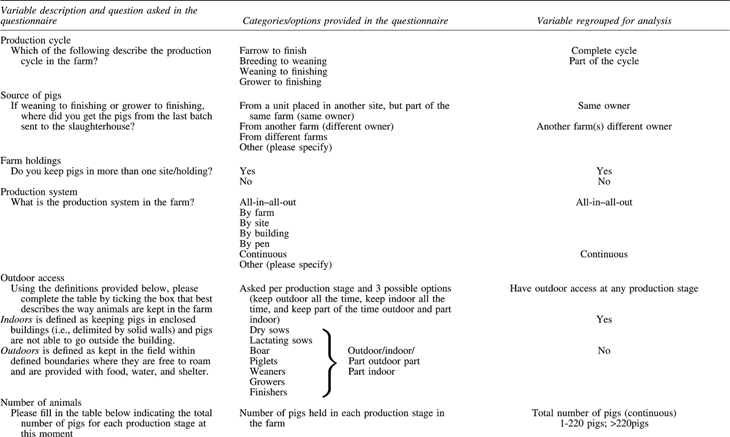
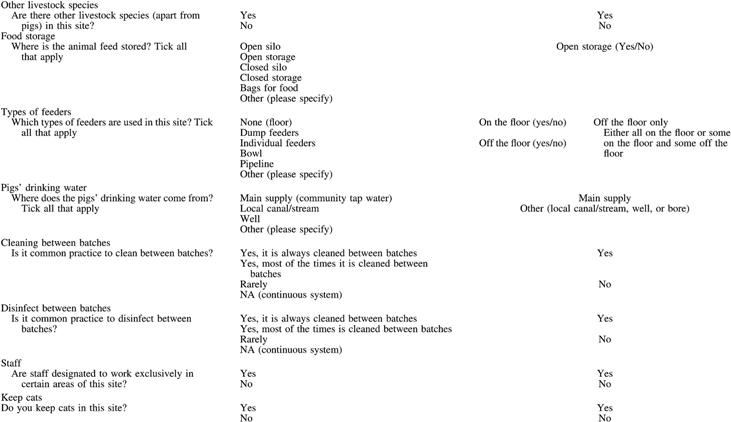
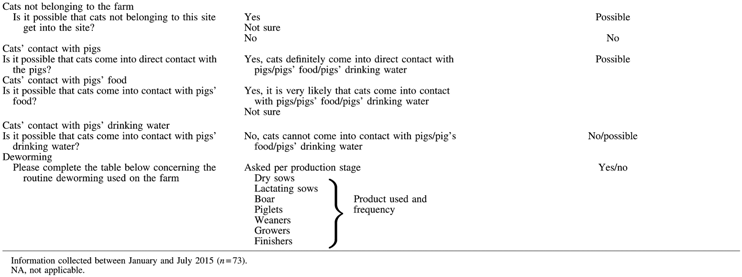
Crude associations between predictor variables (Table 1) and farm status were tested by Fisher's exact or Pearson's chi-squared test as appropriate; relative risk (RR) was calculated as a measure of strength of association. Collinearity was assessed between all predictor variables for which p ≤ 0.05 in the univariate analysis and, when present (p < 0.1), only one of the variables was kept in the model for further multivariable analysis. Logistic regression was used to assess the relationship between the individual predictor variables and the outcome, accounting for the potential confounding effect of other variables. Odds ratios (ORs) obtained from the logistic regression were converted to RR = OR/(1 - p 0 + [p 0 * OR]), where p 0 was the baseline risk (i.e., the risk of being positive in the control group) (Grant, 2014). Note that risk factors were collected retrospectively and therefore exposure to a given risk factor might have happened after infection. In that case, the RR would have been overestimated.
Statistical analyses were performed in R 3.0 (R Development Core Team, 2015) using packages epicalc (Chongsuvivatwong, 2010) and lme4 (Bates et al., 2013).
Results
A total of 2071 pigs from 131 farms were sampled; including 1101 females (53.6%) and 953 (46.3%) males (sex was not recorded for 17 pigs). Antibodies against T. gondii by MAT were found in 155 pigs (7.5%), but only 75 pigs (3.6%) had titers ≥1:25 (Fig. 1). Sex was not significantly associated with T. gondii serostatus (p = 0.14).
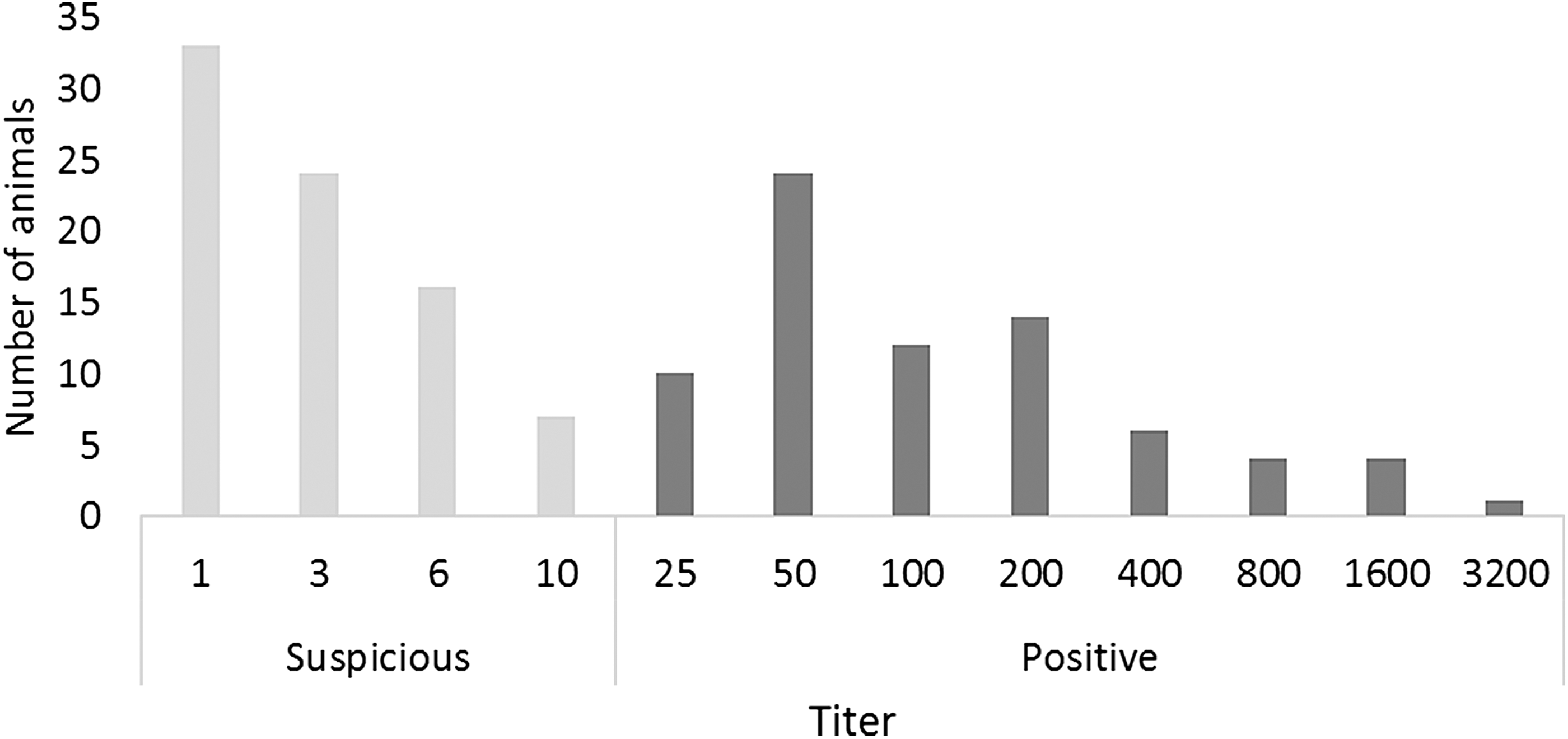
Number of suspicious (titer between 1:1 and 1:10) and positive (titer ≥1:25) pigs in England to Toxoplasma gondii by MAT in each titer band. Samples collected between January and July 2015. Results in this figure are not adjusted for sensitivity and specificity of the test. MAT, modified agglutination test.
A higher number of samples were classified as positive using MAT (73 samples were positive by MAT and 37 by ELISA) and the difference was statistically significant (p = < 0.001) (Table 2 and Supplementary Fig. S1; Supplementary Data are available online at
Samples collected between January and July 2015 from commercial pigs in England. Results in this table are not adjusted for sensitivity and specificity of the test.
There was no serum left for three serum samples to be tested by ELISA—one sample with titer 1:10; one sample with titer 1:100, and one sample with titer 1:3200.
ELISA, enzyme-linked immunosorbent assay; MAT, modified agglutination test.
The proportion of farms deemed positive (i.e., farm-level prevalence) was 1.5% higher using results given by ELISA when considering a ≥50% cutoff. However, the opposite happened when considering a 10% cutoff, with more farms deemed positive using results given by MAT (Supplementary Tables S1 and S2).
Twenty-four farms of 131 sampled had at least one animal positive (apparent prevalence 18.3%) (Table 3). The adjusted farm-level prevalence was 11.5% (95% credible interval 8.4–16.0%) after adjusting for the number of pigs tested per farm and the imperfect sensitivity and specificity of the test; the credible interval refers to the sample estimate rather than a population estimate. The farm variance was 36.35, giving an ICC of 0.92.
Serum samples tested by MAT. Samples collected between January and July 2015 (n = 131).
Results in this table are not adjusted for the number of pigs tested per batch/farm and MAT sensitivity and specificity. The number of animals included in a batch ranged from 1 to 235 pigs.
Sixty-four of the 118 farms with ≤10% apparent within-herd prevalence returned a completed questionnaire. In 30 of 64 farms (46.9%), pigs had outdoor access, and in 22 farms (34.4%), cats had access to pigs' food.
Nine of the 13 farms with >10% apparent within-herd prevalence returned a completed questionnaire. In 5 of 13 farms (55.6%), pigs had outdoor access, and in 5 farms (55.6%), cats had access to pigs' food.
MAT, modified agglutination test.
Seventy-three farms (55.7%) returned a completed questionnaire. The median number of pigs in the farm at the time of sampling was 220 (first and third quartiles 31 and 2217 pigs). In almost half of the farms (48%), pigs had outdoor access for some stage of the production cycle. Twenty-seven farms (37%) had cats on the site and 62% considered it was possible for cats not belonging to the site to have access to the farm (Table 4).
Significance in bold p < 0.05.
RR, relative risk.
Of those farms that returned a completed questionnaire (n = 73), only two were deemed positive using a cutoff of ≥90% probability of having at least one infected animal; four farms were deemed positive using ≥80% cutoff; and five farms using a cutoff of ≥50% (Fig. 2). There were no statistically significant associations (p ≤ 0.05) between farm status and any of the putative risk or protective factors explored (Table 4). This could be due to the lack of statistical power given the small number of positive farms (16% and 28% power of identifying a risk factor with OR ≥2.5 and ≥3.5, respectively, with five positive farms). Fifteen farms were deemed positive considering a lower cutoff: ≥10% probability of having at least one true positive, increasing the power to 30% (for OR ≥2.5) and 50% (for OR ≥3.5). Three farm characteristics were statistically significant from the univariate analysis; having outdoor access (RR = 3.0; p = 0.04), holding up to 200 pigs (RR = 3.9; p = 0.02), and cats having direct access to food (RR = 2.6; p = 0.04). These three variables exhibited strong collinearity (p < 0.1) and therefore the three univariate models were kept. Overall, 17 (23.3%) of the farms had the three characteristics (small herds, outdoor access, and allowed cats to have access to pigs' food), of which 7 farms (41.2%) were positive (≥10% probability).
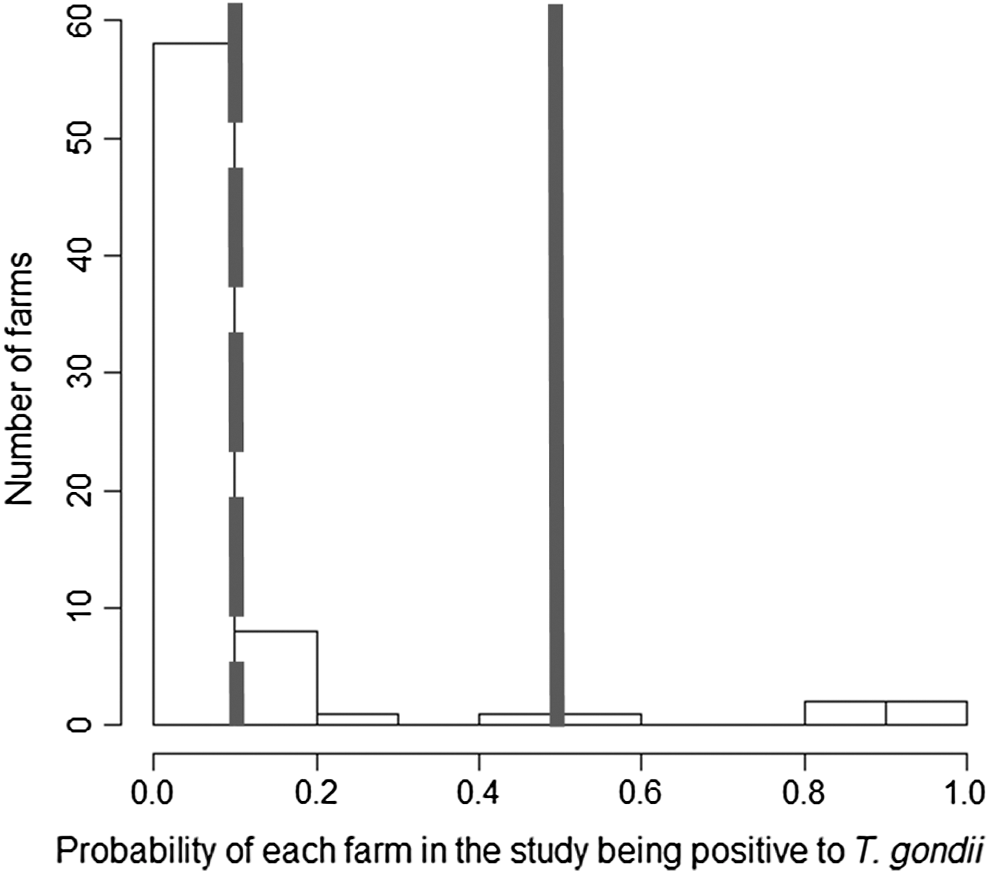
Frequency distribution of the probability of each English pig farm in the study being positive to Toxoplasma gondii after adjusting for test sensitivity and specificity and proportion of animals sampled in each batch. Cutoffs used to consider farms positive or negative are illustrated with a dashed line (≥10%) and a solid line (≥50%).
Discussion
A low proportion of pigs tested positive in the current study (3.6%) with the majority of these having a low MAT titer. Some of the animals tested could have been sows or boars, which may have increased the number of animals that tested positive. This suggests a low level of T. gondii infection in the farms studied, most of which are likely to send to slaughter batches comprising 100% uninfected pigs. Crucially, positive pigs came from a small number of farms (24 farms of 131) and a very high ICC was found, suggesting that the risk of T. gondii infection in pigs is largely driven by farm-level factors. In a previous study in the United Kingdom, 7.4% of pigs tested positive for T. gondii antibodies (Powell et al., 2016). Although important geographical overlap exists between studies, our study only included farms in England where 82% of the UK pig production is located (PHWC, 2015). The results are not directly comparable given the differences of study design and the test used.
Although the five collaborating slaughterhouses reflect the diversity of abattoirs in the country in terms of throughput, specialization, and types of farms (PHWC, 2015), voluntary participation of slaughterhouses and farms is a limitation of this study. However, one of the collaborating abattoirs is among the few in the country that slaughters finishing pigs only and has one of the highest throughputs. The remaining four slaughterhouses handle other species and two of them also slaughter boars and sows. Similarly, the farms in the study reflect the variability of pig production in England (PHWC, 2015).
Studies comparing the sensitivity and specificity of MAT and ELISA in naturally infected pigs are scarce and results are contradictory (Dubey et al., 1995; Gamble et al., 2005). Variation of test results could be due to the T. gondii strain and time elapsed between infection and sampling (Dubey et al., 1997). Antibodies are detected by MAT 3 weeks postinfection, peaking at week 6, and then decreasing, but maintained permanently. Titers ≥1:320 are indicative of recent infection (Dubey et al., 1996). In this study, a higher number of samples were classified as positive using MAT (p < 0.001), which is aligned with results elsewhere (Steinparzer et al., 2015). MAT has been shown to have better precision and accuracy under experimental conditions, but it is time-consuming, expensive, and not commercially available. Conversely, ELISA is cheap, easy to conduct, and commercially available, yet its accuracy is low. For surveillance purposes, ELISA could be used as a routine screening test, while MAT should be the test of preference if regional or national farm-level prevalence estimates are required.
Once adjusted for the number of animals tested per batch and the sensitivity and specificity of MAT, the farm-level prevalence was 11.5% (95% credible interval 8.4–16.0%). Although extrapolations and comparisons should be made with caution given the nonprobabilistic selection of farms and different survey methodologies applied in different countries, the level of T. gondii infection appears to be lower than that reported by studies in Germany (69.1%) (Damriyasa et al., 2004), Italy (42.3%) (Villari et al., 2009), Spain (85.0%), Greece (26.2%) (Papatsiros et al., 2016), and Austria (23.3%) (Steinparzer et al., 2015). It is important to note that prevalence estimates reported in these studies were not adjusted for test sensitivity and specificity and the criteria for classification of positive farms varied.
Regional differences within some European countries have been reported. Farms located in regions with high temperatures and moderate rainfall in Spain had higher risk of infection than those located in regions below or above the average rainfall, and a similar pattern was reported outside Europe (Alvarado-Esquivel et al., 2014, 2015). Comparisons between areas on the basis of climatic conditions should be made with caution as there are likely to be other potential confounding effects, such as farm characteristics or management practices. However, it has been hypothesized that survival of oocysts might increase with humidity, while sporulation time might be shortened with higher temperatures (Dubey, 2010; Opsteegh et al., 2016). Although further studies are needed to explore the role of climatic conditions on the survival of T. gondii oocysts, English climatic conditions could potentially limit oocyst survival and therefore reduce the level of exposure and infection in pigs compared with other climates.
Smaller herds (≤200 pigs) had a higher risk of infection (RR = 3.0; p = 0.02), which is in accordance with studies elsewhere (Zimmerman et al., 1990; Villari et al., 2009). Herd size is often related to other management practices and should not be considered as an isolated factor. In this study, farms with smaller herds were more likely to keep other livestock species, have a continuous cycle, allow outdoor access to pigs, and have open food storage.
Having outdoor access, the presence of cats in the farm and feed stored with the possibility for contamination with cats' feces have been previously reported as risk factors for T. gondii infection (Assadi-Rad et al., 1995; Weigel et al., 1995; Kijlstra et al., 2004; Klun et al., 2006; Gebreyes et al., 2008; Garcia-Bocanegra et al., 2010a, 2010b; Tao et al., 2011; Ortega-Pacheco et al., 2013; Guo et al., 2016). In our study, the RR of infection was higher in those farms where pigs had outdoor access at any production stage (RR = 3.0; p = 0.04). Keeping cats in the farm or cats from outside being able to access the farm was not significantly associated with T. gondii infection. However, cats having direct access to pigs' food increased the risk of infection 2.6-fold and was significant (p = 0.04) when a 10% cutoff was considered. Recommendations to farmers should emphasize the importance of ensuring that cats do not have access to pigs' food. Such recommendations should reduce the level of exposure to sporulated oocysts and therefore the level of infection regardless of the herd size and level of confinement. At EU level, requirements for controlled housing (Anonymous, 2015) could be amended to include mandatory feed storage in closed silos or containers impenetrable to cats to distinguish between low and high biosecurity herds for T. gondii.
The true incidence of human toxoplasmosis in England is unknown as a result of underreporting; an enhanced surveillance program in England and Wales introduced in 2008 (Halsby et al., 2014) identified 1824 confirmed cases during its first 5 years, with over a third of them coming from the London area. A previous study had reported a seroprevalence of 17% among pregnant women in London, with African, Afro-Caribbean, Middle Eastern, and mixed race ethnic origins and consumption of undercooked meat as the main risk factors (Flatt and Shetty, 2013). Lower seroprevalence (9.9%) was reported in studies conducted in northern England (Zadik et al., 1995) and southern England (7.7%) (Allain et al., 1998) 15 years previously. Both studies tested women during the antenatal screening, but risk factors were not reported.
The foodborne route has been considered as the most important route for human T. gondii infection in a recent WHO expert elicitation (WHO, 2015). Furthermore, consumption of undercooked meat (pork, beef, and lamb) has repeatedly been found as a risk factor for T. gondii infection (Kapperud et al., 1996; Baril et al., 1999; Cook et al., 2000; Bobic et al., 2007; Jones et al., 2009; Flatt and Shetty, 2013); however, the type of meat reported varies across countries. Ascertainment of the relative contribution of pork and other animal products to the risk of human T. gondii infection and of the effect of farm-level measures warrants a formal risk assessment in which risk mitigation measures along different stages of meat production chain are assessed by probabilistic risk modeling.
Conclusions
This study provides an approximation to the level of T. gondii infection in pigs raised in commercial farms in England using a novel method for prevalence estimation. It also investigates farm characteristics and management practices that may increase the risk of pigs becoming infected. Most of the batches included in this study were likely to contain 100% of uninfected pigs, with a small number of batches accounting for a large proportion of positive pigs, which indicates that the risk of T. gondii infection is largely driven by farm-level factors. At the preharvest level, mitigation of the risk of exposure to toxoplasmosis through consumption of pork should target farms with outdoor access and/or open feed storage. The study fills some of the data gaps previously identified by the UK Food Standard Agency (AMCSF, 2012) and provides inputs that could be used to populate probabilistic assessments of human foodborne exposure.
Footnotes
Acknowledgments
The study was part of project FS517004 funded by the Food Standard Agency United Kingdom. This research was conducted by a consortium within the framework of project no. GA/EFSA/BIOHAZ/2013/01 entitled “Relationship between seroprevalence in the main livestock species and presence of Toxoplasma gondii in meat,” grant agreement funded by the European Food Safety Authority (budget). This article/publication is based on the results obtained in the framework of this mentioned project and it is published under the sole responsibility of the authors and shall not be considered as an EFSA output. The authors are grateful to Mandy Nevel for helpful discussions, to Damer Blake, Veronica Brewster, Adriana Diaz, Adebowale Oluwawemimo, and Elaine Pegg for their assistance in the laboratory, to Bhagyalakshmi Chengat Prakashbabu for her help during sampling, and to Hannah R. Holt for helpful comments on an early draft of the manuscript. The authors particularly thank farmers and staff from the slaughterhouses for their invaluable support. This article has been assigned the reference PPH_01340 by the Royal Veterinary College.
Disclosure Statement
No competing financial interests exist.
References
Supplementary Material
Please find the following supplemental material available below.
For Open Access articles published under a Creative Commons License, all supplemental material carries the same license as the article it is associated with.
For non-Open Access articles published, all supplemental material carries a non-exclusive license, and permission requests for re-use of supplemental material or any part of supplemental material shall be sent directly to the copyright owner as specified in the copyright notice associated with the article.
