




Abstract
We assessed the susceptibility of 182 Campylobacter jejuni isolates from patients with diarrhea to eight antibiotics and analyzed the molecular mechanisms of ciprofloxacin resistance as well as the genetic characteristics based on multilocus sequence typing (MLST). The C257T mutation was found on the quinolone resistance-determining region (QRDR) of the gyrA gene in all ciprofloxacin-resistant strains. Mutations on the QRDR of the gyrB gene were silent. A total of 74 strains had 7 inverted repeat (IR) (a 16-bp IR on the intergenic region between cmeR and cmeABC) mutation polymorphisms. Compared with strains without the IR mutations, strains with the IR mutations had higher resistance rates to ciprofloxacin (94.6% vs. 83.3%), nalidixic acid (94.6% vs. 83.3%), tetracycline (98.6% vs. 85.2%), doxycycline (91.9% vs. 71.3%), florfenicol (59.5% vs. 17.6%), chloramphenicol (25.7% vs. 4.6%), gentamicin (16.2% vs. 3.7%), and multidrug resistance than those without IR mutations (all p < 0.05). With C257T mutation alone, 89.9% strains with minimum inhibitory concentration (MIC) values focused on 16, 32, and 64 μg/mL, whereas strains with C257T mutation in combination with the IR mutations had a higher ciprofloxacin resistance level with 88.6% MIC values focused on 64, 128, and 512 μg/mL (p < 0.0001). The strains in this study showed a high genetic variability based on MLST with 117 sequence types (STs), 37 of which were novel. CC-21 was the most common clonal complex (CC) followed by CC-353 and CC-45. No association was found between STs and ciprofloxacin resistance. In conclusion, the C257T mutation on gyrA was the major mechanism for ciprofloxacin resistance, and the C257T mutation in combination with the IR mutations might result in more severe ciprofloxacin resistance to C. jejuni.
Introduction
C
C257T mutation resulting in an amino acid substitution (Thr-86-to-Ile) on the quinolone resistance-determining region (QRDR) of the gyrA gene is the major mechanism of resistance to quinolones in C. jejuni (Wang et al., 1993; Bachoual et al., 2001; Griggs et al., 2005; Sonnevend et al., 2006). cmeR suppresses the transcription of the efflux pump cmeABC operon by specifically binding to an inverted repeat (IR) on the cmeR-cmeA intergenic region of C. jejuni. Furthermore, mutations on the IR can increase the expression of efflux pump CmeABC (Lin et al., 2005). Few studies in China have investigated the genetic characteristics of C. jejuni isolated from humans (Zhang et al., 2010, 2015). Multilocus sequence typing (MLST) is a useful tool for C. jejuni genotyping. Thus, the current study analyzed the molecular mechanisms of ciprofloxacin resistance and described the genetic characteristics of C. jejuni isolated from humans with diarrhea based on MLST findings.
Materials and Methods
Bacterial strains
A total of 203 non-duplicate C. jejuni strains were isolated from the stool samples of patients with diarrhea at the Department of Infectious Diseases and the Center for Liver Diseases, Peking University First Hospital, Beijing, China, from 1994 to 2010 (Zhou et al., 2016). Due to failure of recovery, 21 strains were excluded from this study; thus, a total of 182 strains were analyzed. The 182 strains were collected throughout the year, with most (95.1%) isolated between May and October. All of the patients were from Beijing, 57.7% were women, and the mean age was 36.6 ± 15.8 years (median, 33 years; range, 14–87 years).
The resistance rates to ciprofloxacin, nalidixic acid, erythromycin, doxycycline, tetracycline, gentamicin, chloramphenicol, and florfenicol in C. jejuni isolates could be found in our previous publication (Zhou et al., 2016). High-level resistance to ciprofloxacin was defined as ≥512 μg/mL in this study. Of the 182 C. jejuni strains, 160 (87.9%) were resistant to ciprofloxacin. Thirteen strains showed high-level resistance to ciprofloxacin, and all of these strains were isolated after 2000.
Amplification of gyrA, gyrB, and the IR between cmeR and cmeABC
Genomic DNA for PCR assays was extracted by using QIAamp DNA Mini Kits (QIAGEN, Hilden, Germany) according to the manufacturer's instructions. Mutations on the QRDR of the gyrA and gyrB genes as well as the IR between the cmeR and cmeABC genes were analyzed for all of the C. jejuni strains to evaluate the mechanisms of ciprofloxacin resistance. The PCR products were purified and then haplotype sequenced by Biomed Corporation (China, Beijing). The DNA sequences were analyzed with Chromas and ContigExpress to identify mutations (Payot et al., 2002; Piddock et al., 2003; Pérez-Boto et al., 2010).
Multilocus sequence typing
To perform MLST, seven housekeeping genes (aspA, glnA, gltA, glyA, pgm, tkt, and uncA) were amplified by using PCR, purified, and bi-directionally sequenced as described by Dingle et al. (2001). Allele numbers, sequence types (STs), and clonal complexes (CCs) were assigned by submitting the DNA sequences to the Campylobacter PubMLST database at
Statistical analysis
Chi-square and Fisher's exact two-tailed tests were used to perform the statistical analysis via SPSS 20.0. The significance level was set at p < 0.05.
Results
Amplification of gyrA, gyrB, and the IR
A 270-bp fragment of the QRDR of the gyrA gene was amplified from the strains. All of the 160 ciprofloxacin-resistant strains exhibited C257T substitution on the gyrA gene. In addition, four silent mutations, His-81 (CAC-CAT), Gly-110 (GGC-GGT), Ser-119 (AGT-AGC), and Ala-120 (GCC-GCT), were also found.
The QRDR of the gyrB gene from all 182 strains was sequenced; however, the five mutations, Arg-432 (AGA-AGG), Phe-436 (TTC-TTT), Leu-454 (CTA-TTA), Gly-471 (GGC-GGT), and Leu-483 (CTT-CTC), were silent.
The IR is a 16-bp sequence in the intergenic region between cmeA and cmeR located either from −46 to −31 (consensus sequence: TGTAATAAAAATTACA) or from −50 to −35 (consensus sequence: TGTAATAAATATTACA) upstream of the cmeA gene (Lin et al., 2005; Pérez-Boto et al., 2010). Overall, 182 strains presented eight types of the IR polymorphisms, and Type 0 was the consensus sequence. Compared with Type 0, strains in Type 1 to Type 6 had a higher ciprofloxacin resistance level (all p < 0.05, see Table 1). The minimum inhibitory concentration (MIC) values of strains in Type 0 focused on 16, 32, and 64 μg/mL, whereas strains in Type 1 to Type 6 focused on 64–512 μg/mL; detailed data are presented in Table 1.
The p-values came from a comparison between Type 0 and Type 1 to Type 7.
The mutation points are in bold.
Nucleotide A deletion on the IR.
IR, inverted repeat.
Association between MICs and the mutations on the gyrA gene and the IR
One hundred sixty ciprofloxacin strains were divided into Group 1 (n = 90) and Group 2 (n = 70) according to the mutation type. Group 1 had C257T mutation alone, whereas Group 2 had C257T mutation and the IR mutations. Strains in Group 2 had a higher ciprofloxacin resistance level than Group 1 (p < 0.0001). Overall, 89.9% MIC values of Group 1 were concentrated in 16, 32, and 64 μg/mL; nevertheless, 86.6% MIC values of Group 2 were concentrated in 64, 128, and 512 μg/mL. Detailed data are shown in Table 2.
The p-value came from a comparison between Group 1 and Group 2.
In addition, strains with the IR mutations were more likely to be resistant to ciprofloxacin (94.6% vs. 83.3%, p = 0.0223), nalidixic acid (94.6% vs. 83.3%, p = 0.0223), tetracycline (98.6% vs. 85.2%, p = 0.0015), doxycycline (91.9% vs. 71.3%, p = 0.0007), florfenicol (59.5% vs. 17.6%, p < 0.0001), chloramphenicol (25.7% vs. 4.6%, p < 0.0001), gentamicin (16.2% vs. 3.7%, p = 0.0060), and multiple drugs compared with strains without the IR mutations. Detailed data are shown in Table 3.
The resistance rate of erythromycin was not analyzed, because there were only 6 erythromycin-resistant strains.
CHL, chloramphenicol; CIP, ciprofloxacin; FFC, florfenicol; DOX, doxycycline; GEN, gentamicin; NAL, nalidixic acid; TET, tetracycline.
Multilocus sequence typing
Of the 182 C. jejuni strains, 117 STs were obtained; 119 strains were assigned to 61 STs that belonged to 19 CCs, whereas 63 strains were assigned to 56 STs that did not belong to any CC. Thirty-seven of the 117 STs were newly identified STs that came from 38 strains, among which 13 STs were from 15 novel alleles (Table 4). The most commonly identified CC was CC-21, which accounted for 14.3% (26/182) of all strains, followed by CC-353 (7.1%, 13/182) and CC-45 (6.6%, 12/182). In addition, CC-21 was the major genotype during the 17-year period except 2000–2002 (when CC-21 was not isolated). The distribution of the CCs during each period is shown in Figure 1.
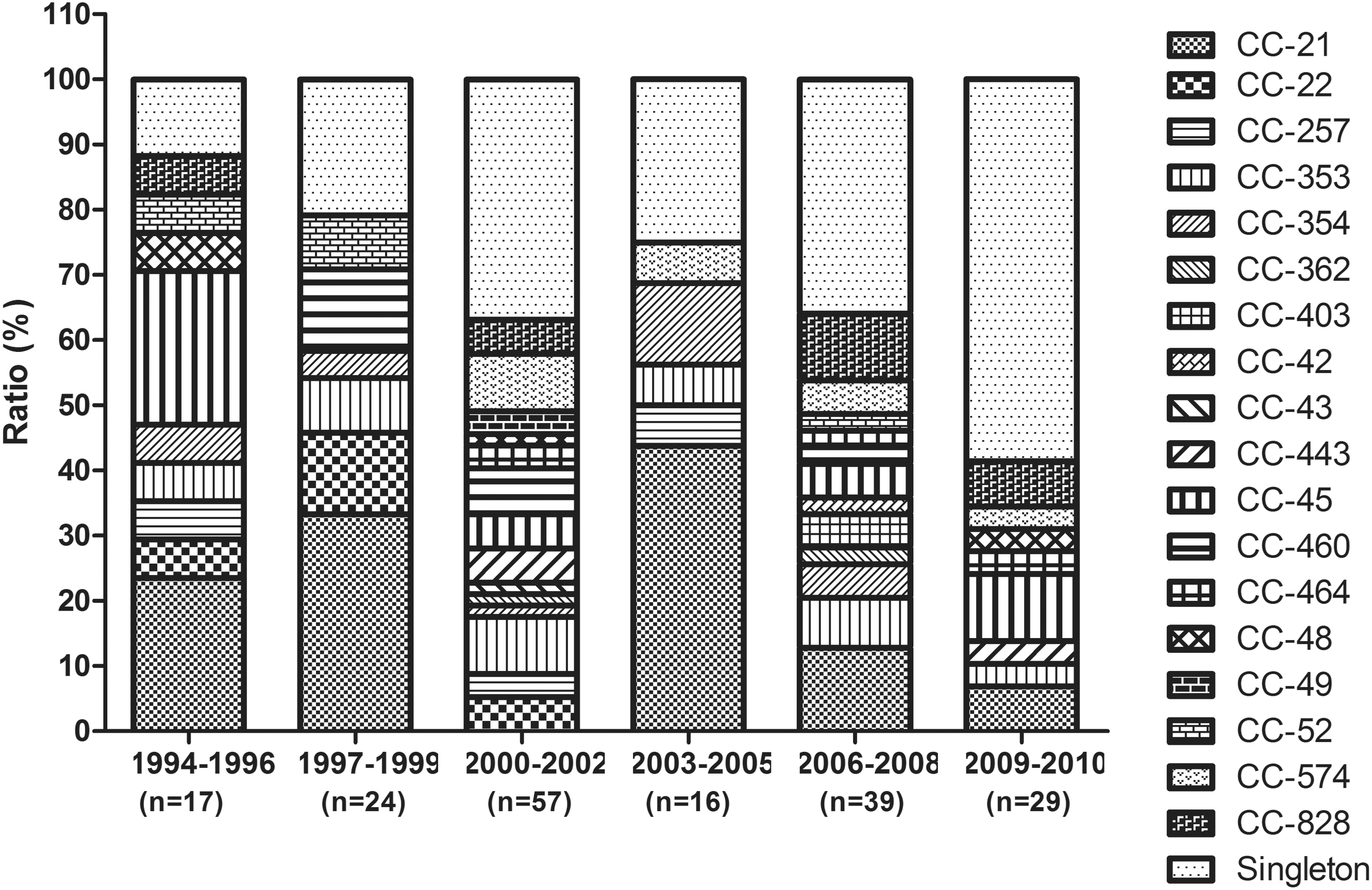
The distribution of CCs for all isolates examined in each 2-year period examined based on a multilocus sequence typing analysis. CC, clonal complex.
A total of 117 STs were identified in the 182 strains, among which 80 STs have been previously reported, whereas 37 STs presented in this table were newly identified from 38 strains.
New allele numbers are in bold and marked with *.
ND, not defined; ST, sequence type; CC, clonal complex.
Discussion
In China, the high resistance rate of C. jejuni to ciprofloxacin is a common and severe problem regardless of the origins of the C. jejuni isolate (Chen et al., 2010; Zhang et al., 2010; Wang et al., 2016). Similar results have been reported in other countries, such as India, Italy, Peru, and Canada (Pollett et al., 2012; Mukherjee et al., 2013; Giacomelli et al., 2014; Riley et al., 2015). However, the ciprofloxacin resistance rate (13.5%) to C. jejuni is lower in the United States (Thakur et al., 2010). The empirical use and overuse of ciprofloxacin in both clinical and veterinary practice are considered to be the main underlying causes of the increased ciprofloxacin resistance (Luangtongkum et al., 2009). The rising prevalence of a resistance-enhancing variant (named RE-CmeABC) of the predominant efflux pump CmeABC may be another reason for the high ciprofloxacin resistance (Yao et al., 2016).
Regarding the molecular mechanisms of ciprofloxacin resistance, the current study showed that 100.0% of the ciprofloxacin-resistant strains had the C257T mutation on the gyrA gene, which is the major mechanism of ciprofloxacin resistance in C. jejuni. This is in agreement with previous researchers (Wang et al., 1993; Bachoual et al., 2001; Griggs et al., 2005). Mutations on the gyrB gene were silent, which is also consistent with previous publications (Payot et al., 2002; Kinana et al., 2007). The gyrB gene is likely not involved in the mechanisms of ciprofloxacin resistance in C. jejuni.
The overexpression of the efflux pump CmeABC promotes the emergence of resistance to several antimicrobials in C. jejuni (Yan et al., 2006; Grinnage-Pulley and Zhang, 2015). cmeR suppresses the expression of CmeABC by specifically binding to the IR upstream of the cmeA gene in C. jejuni (Lin et al., 2005). As previously studied, a single-nucleotide deletion and base substitution on the IR could obstruct this combination, which results in overexpression of the CmeABC and an increased antimicrobial resistance rate (Lin et al., 2005; Cagliero et al., 2007). However, most of the results were observed in laboratory-generated mutants. In the current study, we found that strains with the IR mutations had higher antibiotic resistance rate and multidrug resistance rate than strains without the IR mutations (Table 3), supporting the enhancive effect of the IR mutations on antimicrobial resistance rate epidemiologically. In addition, to our knowledge, the current study is the first to report the A to G transition at base 4 of the 16-bp IR (Type 3 in Table 1).
Several studies have also reported that the overexpression of CmeABC is correlated with an increased ciprofloxacin resistance level (Lin et al., 2005; Yan et al., 2006; Shen et al., 2011); however, other researchers found that strains with overexpressed CmeABC exhibit a high resistance rate to ciprofloxacin but not an increase in resistance level (Grinnage-Pulley and Zhang, 2015). In contrast, a different idea has been reported that the inactivation of CmeABC decreases the ciprofloxacin resistance level (Ge et al., 2005; Yan et al., 2006; Mavri and Mozina, 2012) and without the C257T mutation on gyrA, overexpression of CmeABC generates no ciprofloxacin resistance to C. jejuni (Yan et al., 2006; Yao et al., 2016). In this study, we found that strains with the C257T mutation on gyrA in combination with the IR mutations had a higher ciprofloxacin resistance level than those with the C257T mutation alone (Table 2). In addition, all 13 strains with a ciprofloxacin resistance level at ≥512 μg/mL had the C257T mutation in combination with the IR mutations. Given that IR mutations are associated with the overexpression of CmeABC (Lin et al., 2005; Cagliero et al., 2007), our results also suggest that IR mutations are involved in the increased ciprofloxacin resistance level and the high-level ciprofloxacin resistance via the overexpression of CmeABC.
There were eight types of the IR polymorphisms, including a consensus one (Type 0). Strains in Type 1 to Type 6 had a higher ciprofloxacin resistance level than Type 0, whereas strains in Type 7 did not (Table 1). However, there were few strains in Type 4, Type 6, and Type 7, and more strains were needed to verify these results. In addition, the role of each mutation on the IR region and its influence on increasing ciprofloxacin resistance will require further molecular studies.
MLST analysis of C. jejuni revealed a high diversity among the genotypes in other studies (Lévesque et al., 2008; Klein-Jobstl et al., 2016). Our results were consistent with these findings: 117 STs and 19 CCs were identified from 182 isolates based on the current MLST analysis. Of the 117 STs, 37 (31.6%) were novel. Few studies in China have focused on the genetic characteristics of C. jejuni of human origin before our study (Zhang et al., 2010, 2015). This lack of investigation might explain the high proportion of novel STs in the current study.
In this study, CC-21, CC-353, and CC-45 predominated all C. jejuni strains, and CC-21 was the most common genotype found from 1994 to 2010; however, CC-21 was not isolated from 2000 to 2002. The reason for this phenomenon is not yet clear. CC-21 was common in C. jejuni isolates from various origins in other countries, such as the United Kingdom, Switzerland, Canada, and Australia, which suggests that CC-21 is distributed worldwide (Manning et al., 2003; Lévesque et al., 2008; Korczak et al., 2009; Klein-Jöbstl et al., 2016). One study analyzed a part of the submitted data in the Campylobacter PubMLST database, which revealed that CC-21 was the most prevalent clonal complex; furthermore, the database contained a majority of CC-21 obtained from humans and chicken (Colles and Maiden, 2012). CC-21 is also the major genotype in C. jejuni of human origin and chicken origin in China (Zeng et al., 2016; Zhang et al., 2015). Thus, CC-21 might play a major role in transmitting C. jejuni to humans via the food chain. No association was found between ciprofloxacin resistance and STs because the strains sharing the same STs had variable MIC values.
Conclusions
In conclusion, the C257T mutation on the gyrA gene is the major mechanism of ciprofloxacin resistance in C. jejuni. Mutations on the IR region in combination with the C257T mutation on the gyrA gene might result in an increased ciprofloxacin resistance level in C. jejuni. The strains in this study showed a high genetic variability based on MLST analysis. CC-21 was the dominant genotype, followed by CC-353 and CC-45. No association was found between genotype and ciprofloxacin resistance.
Footnotes
Acknowledgments
The National Science and Technology Major Projects supported this study (No. 2013ZX10004605001004). The authors sincerely thank their collaborators at the Chinese Centers for Disease Control and Prevention for offering their assistance with the antibiotics susceptibility test.
Disclosure Statement
No competing financial interests exist.