




Abstract
Nontyphoidal Salmonella are one of the leading causes of foodborne diseases in the world. As poultry products are recognized as main sources of human salmonellosis, nontyphoidal Salmonella control has become a global issue for the poultry industry. The increasing antimicrobial resistance in poultry-related nontyphoidal Salmonella serovars is a global matter of concern. By monitoring the evolution of antimicrobial resistance, alternative treatments can be identified and possible restrictions in the treatment of systemic human salmonellosis foreseen. A meta-analysis was conducted to assess the profile and temporal evolution of the antimicrobial resistance of nontyphoidal Salmonella of poultry and human origin in Brazil, isolated in the period from 1995 to 2014. Four databases were researched; twenty-nine articles met the eligibility criteria and were included in the meta-analysis. In the nontyphoidal isolates of poultry origin, the highest levels of antimicrobial resistance were verified for sulfonamides (44.3%), nalidixic acid (42.5%), and tetracycline (35.5%). In the human-origin isolates, the resistance occurred mainly for sulfonamides (46.4%), tetracycline (36.9%), and ampicillin (23.6%). Twenty-two articles described results of antimicrobial resistance specifically for Salmonella Enteritidis, also enabling the individual meta-analysis of this serovar. For most antimicrobials, the resistance levels of Salmonella Enteritidis were lower than those found when considering all the nontyphoidal serovars. In the poultry-origin isolates, a quadratic temporal distribution was observed, with reduced resistance to streptomycin in Salmonella Enteritidis and in all nontyphoidal serovars, and a linear increase of resistance to nalidixic acid in Salmonella Enteritidis. In the human-origin isolates, a linear increase was identified in the resistance to nalidixic acid in Salmonella Enteritidis and in all the nontyphoidal isolates, and to gentamicin in Salmonella Enteritidis. Continuous monitoring of the development and spread of antimicrobial resistance could support the measurement of the consequences on poultry and human health.
Introduction
S
Antimicrobials have been key in controlling bacterial infections; however, over the course of time, use of these drugs has promoted the selection of resistant bacteria. The choice of unsuitable antimicrobials, dosage, and treatment times has fomented the emergence of resistant strains. The spread of resistant microorganisms has been supported by inefficient infection control measures, improper sanitary conditions, and inappropriate manipulation of foodstuffs (WHO, 2015). Contaminated poultry products are considered important sources of human Salmonella infection. As a rule, poultry colonized by nontyphoidal Salmonella do not develop clinical signs of illness and do not require antimicrobial treatment, but they do offer fertile conditions for the bacteria to disseminate in the flock (EFSA, 2015a). In this condition, the bacteria remain under the selective pressure of any other antimicrobial that is administered.
Brazil is the world's leading exporter of chicken meat, and a portion of its table eggs production is sold to foreign markets (ABPA, 2015), this is why the impact of antimicrobial resistance could have international reach. Therefore, epidemiological surveillance of microorganisms resistant to antimicrobials is essential to gather information about the magnitude and trends of such resistance, allowing for alternative treatments to be planned and identified and the possible limitations in the treatment of severe cases of salmonellosis to be foreseen. Several studies about antimicrobial resistance in Salmonella have been independently accomplished in Brazil, representing different geographic areas and periods of time (Wilson, 2004; Oliveira et al., 2005, 2012; Vaz et al., 2010; Campioni et al., 2012, 2014; Voss-Rech et al., 2015). Consequently, the results obtained in each study are variable and hinder an all-encompassing interpretation. In such cases, meta-analysis represents an important tool to support retrospective studies into antimicrobial resistance. Integrated analysis of data from previous studies can allow one to adopt a more realistic perspective of the antimicrobial resistance of Salmonella spp. and its temporal evolution in Brazil. This information is important for establishing strategies to prevent the emergence and spreading of resistant strains in the country. We, therefore, carried out a systematic review and meta-analysis study with the aim of evaluating the profile and temporal evolution of the antimicrobial resistance of nontyphoidal Salmonella from humans and poultry over the past 20 years in Brazil.
Materials and Methods
Search strategy
To obtain the data to be included in the research, an extensive systematic review of the literature was performed to identify the studies that have assessed the antimicrobial resistance of Salmonella spp., published between January 1995 and May 2015. This review was conducted in four stages: identification, screening, eligibility, and inclusion, as recommended in the Preferred Reporting Items for Systematic Reviews and Meta-Analyses—PRISMA (Moher et al., 2009). The following online databases were consulted: Web of Science, PubMed, SciELO, and Science Direct. The keywords searched for in the articles included (“antimicrobial resistance” or “microbial resistance” or “bacterial resistance” or “resistance pattern” or resistance or susceptibility) and Salmonella and Brazil or Brasil.
Study selection
The initial selection prioritized the identification of articles related to the study scope, based on the title and abstract. All selected articles were read in full for a second selection stage, in accordance with the following eligibility criteria: (1) isolated in Brazil, (2) isolated from poultry and/or human origin, (3) isolated between 1995 and 2014, (4) number of isolates and year of isolation identified, (5) results separated by origin, (6) not directed at multiresistance, and (7) employed the disk diffusion susceptibility test. Furthermore, the references cited in the selected articles were also analyzed and included in the study, when pertinent. The information extracted from the articles was systematized in a spreadsheet (Microsoft Excel, 2010). Studies that present data from different years separately were included in the database as different observations. For articles in which the results of multiple years were presented together, the average year of the period was considered.
Quality assessment
The studies included in the database were categorized by quality, in accordance with the following set of criteria: informed the criterion for interpreting zones of inhibition, used a standard strain for quality control of the tests, employed the international methodology approved by the Clinical and Laboratory Standards Institute (CLSI) or European Committee on Antimicrobial Susceptibility Testing (EUCAST), and evaluated >20 nontyphoidal Salmonella isolates. The articles received a score from 0 to 4 according to the number of criteria met.
Statistical analysis
The data were analyzed using the statistical software SAS, version 9.4. The antimicrobial resistance of the nontyphoidal Salmonella isolates was assessed in function of the percentage of resistance by serovar and the origin. Resistance against the most commonly used antimicrobials was compared, for both humans and poultry. The comparisons were made by means of the Kruskal–Wallis test and, when any differences were found between antimicrobials, the Bonferroni test was applied to compare the mean averages.
Regression analysis was conducted to assess the temporal evolution of the antimicrobials, in which the choice of the models was based on the significance of the linear, quadratic, and cubic coefficients, using the Student's t-test at 5% probability. This analysis only considered those antimicrobials that were assessed for at least five different years. For regression analysis, square root transformation was applied to the antimicrobials that failed to present normality. The temporal distributions graphs of the antimicrobial resistance were generated by plotting the level of resistance of each observation.
To classify the levels of antimicrobial resistance, the following parameters were used: rare, <0.1%; very low, 0.1% to 1%; low, >1% to 10%; moderate, >10% to 20%; high, >20% to 50%; very high, >50% to 70%; extremely high, >70% (EFSA, 2015b).
Results
Systematic review
The systematic review of the literature process is presented in Figure 1. Initially, 473 articles were identified, of which 29 met all the eligibility criteria and were included in the meta-analysis. Of those, 17 articles assessed nontyphoidal Salmonella isolated from poultry, 8 from humans, and 4 from both humans and poultry (Table 1).

Flow diagram of articles selection.
NI, not informed.
Quality assessment
Of those articles included in the meta-analysis, 22 articles (75.8%) met two or more pre-established criteria and were considered of higher quality. Only 4 articles clearly mentioned the criteria for interpreting zones of inhibition, 14 articles described the use of strains for quality control of the antimicrobial susceptibility tests, 24 articles used and/or informed the international methodology (CLSI or EUCAST), and 23 articles tested >20 isolates. All the categorized articles were analyzed, irrespective of the score achieved.
Antimicrobial resistance
In the 29 articles included in the study, a total of 2119 nontyphoidal Salmonella isolates were assessed, 1272 of which were recovered from poultry (drag swab, cloacal swab, viscera, stools, meconium, carcasses, chicken portions, feed, broiler litter, and table eggs) and 847 recovered from humans (stools, blood, and other fluids). Of these, 22 articles showed positive results for Salmonella Enteritidis, enabling individual analysis of this serovar.
Forty-five different antimicrobials were tested for at least one of the studies included in the database. The most frequently tested antimicrobials were selected for meta-analysis: ampicillin, cefalotin, chloramphenicol, ciprofloxacin, enrofloxacin, gentamicin, nalidixic acid, norfloxacin, streptomycin, sulfonamides, trimethoprim/sulfamethoxazole, and tetracycline. Furthermore, cefotaxime and ceftriaxone were also included, because of their clinical importance. Analysis of these 14 antimicrobials comprised 556 observations. Observations corresponded to the frequency (%) of antimicrobial resistance found in each given article according to the source (poultry or human).
Antimicrobial resistance in human isolates
In the nontyphoidal Salmonella isolates from human, the highest resistance levels were found against sulfonamides (46.4%), tetracycline (28%), and ampicillin (24.5%). For Salmonella Enteritidis, the highest resistance levels were against nalidixic acid (21.1%), ampicillin (13%), and tetracycline (9.4%) (Table 2).
All, nontyphoidal serovars, including Salmonella Enteritidis; NA, not analyzed (less than four articles have tested these antimicrobials).
It was found that the nontyphoidal serovars of human origin displayed a growing linear temporal evolution of the antimicrobial resistance against nalidixic acid (p = 0.0004, R 2 = 80.5%) (Fig. 2A). For Salmonella Enteritidis, resistance against nalidixic acid (p = 0.0005, R 2 = 88.5%) and gentamicin (p = 0.0005, R 2 = 88.5%) also increased over the course of the years (Fig. 2B, C). No temporal effect was identified for any of the other antimicrobials.

Temporal evolution of the antimicrobial resistance of Salmonella of human origin.
Antimicrobial resistance in poultry isolates
In the nontyphoidal Salmonella isolated from poultry, the highest levels of resistance were found for sulfonamides (44.3%), nalidixic acid (42.5%), and tetracycline (35.6%). For Salmonella Enteritidis, the antimicrobial resistance was more prominent against nalidixic acid (48.2%), sulfonamides (43.8%), and tetracycline (32%) (Table 2).
The antimicrobial resistance of the poultry nontyphoidal Salmonella serovars and Salmonella Enteritidis against streptomycin showed a quadratic temporal distribution (p = 0.029, R 2 = 33.9%) (Fig. 3A) and (p = 0.029, R 2 = 33.9%) (Fig. 3B), respectively. Furthermore, Salmonella Enteritidis displayed a growing linear temporal evolution against nalidixic acid (p = 0.015, R 2 = 35.3%) (Fig. 3C). No temporal effect was identified for any of the other antimicrobials. In general, Salmonella Enteritidis in isolation showed lower levels of antimicrobial resistance than all the nontyphoidal serovars (p = 0.036).
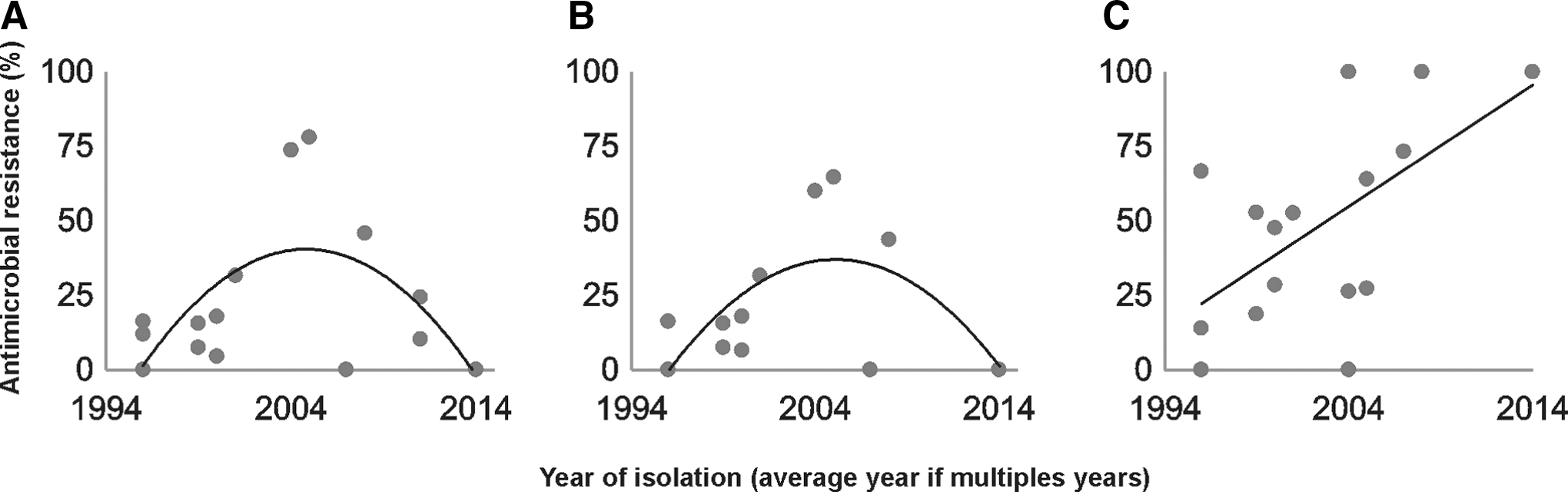
Temporal evolution of the antimicrobial resistance of Salmonella of poultry origin.
Discussion
In the isolates recovered from poultry, the highest levels of antimicrobial resistance were against sulfonamides, nalidixic acid, and tetracycline, respectively. For the human isolates, sulfonamides, tetracycline, and ampicillin showed the highest levels of resistance (Table 2). Similar results have also been found in other countries (Jasson and Butaye, 2012; Van et al., 2012; CDC, 2015; EFSA, 2015a). These antimicrobial agents are among the oldest groups used in the treatment of bacterial infections, both in human and in veterinary medicine. The tetracyclines and sulfonamides were used as additives in animal feeds in Brazil until 1998, when their use was restricted to therapeutic purposes. However, these drugs still exert selection pressure on the microorganisms. Despite the high levels of resistance found, these antimicrobials are not among those considered critical for the treatment of human salmonellosis (WHO, 2011).
The resistance to nalidixic acid of the poultry isolates and the Salmonella Enteritidis isolates from humans was high (>20% to 50%) (Table 2) in the analyzed period; the resistance levels increased significantly over the course of time, for nontyphoidal Salmonella isolated both from humans and from poultry (Figs. 2A, B and 3C). The increased resistance to quinolones has also been found in nontyphoidal Salmonella of human origin in the United States since 1996 (Stevenson et al., 2007; WHO, 2015) and in China between 2009 and 2012 (Lai et al., 2014). Isolates from poultry displayed an increase in resistance to nalidixic acid in Austria, Czech Republic, Germany, Poland, and Slovakia (EFSA, 2015a). For some antimicrobials, differences in the occurrence of resistance are observed between countries. However, this increase has been attributed to the broad use of these antimicrobials in both human and veterinary medicine (Angulo et al., 2004; Stevenson et al., 2007).
Despite nalidixic acid not being one of the critical antimicrobials in human treatment, the resistance of this drug in Enterobacteriaceae is generally correlated to reduced susceptibility to ciprofloxacin (Lai et al., 2014). Ciprofloxacin, a second-generation quinolone (fluoroquinolone), is the medication of choice for treating serious cases of human salmonellosis. Treatments with fluoroquinolones have failed in patients infected with Salmonella spp. resistant to nalidixic acid (Dimitrov et al., 2007; Stevenson et al., 2007). This resistance is primarily attributed to point mutations in the gene regions where resistance to quinolones is determined, including the gyrase and topoisomerase IV genes (Cavaco et al., 2009; EFSA, 2015a), as well as by active efflux mechanisms (Hur et al., 2012). In this study, we found low resistance levels to ciprofloxacin, <1.5%, regardless of the origin of the isolates (Table 2). Low resistance levels to quinolones have been found in nontyphoidal Salmonella of human origin in the United States (3.5%) (CDC, 2015) and the European Union (EU) (3.8%) (EFSA, 2015a). However, in the EU, highest levels of microbiological resistance were found in isolates from chickens (53.8%), although lower levels (<10.0%) were recorded in Denmark, France, Ireland, and the United Kingdom.
The second most important group for treating human salmonellosis is the third-generation cephalosporins, especially for serious infections in children, in whom the use of fluoroquinolones can cause side effects (EFSA, 2015a). In the antimicrobials assessed in this work, this group is represented by ceftriaxone and cefotaxime. Resistance to these antimicrobials results from the presence of genes, usually found on plasmids, encoding extended-spectrum β-lactamase enzymes or AmpC enzymes, which can degrade the chemical structure of the antimicrobial (Miriagou et al., 2004). Our results demonstrated that resistance to cefotaxime and to ceftriaxone was moderate (>10% to 20%) in the nontyphoidal isolates and rare (<0.1%) in Salmonella Enteritidis, regardless of the origin (Table 2). Lower levels of antimicrobial resistance in the nontyphoidal Salmonella have been described in the United States and the EU. In the United States, 2.5% of resistance was related to ceftriaxone in human isolates (CDC, 2015), and in the EU, this level was 1.4% and 3.2% to cefotaxime in human and poultry, respectively (EFSA, 2015a).
A temporal evolution of the antimicrobial resistance was also observed for streptomycin and gentamicin, belonging to the class of aminoglycosides. Resistance to members of this class is associated with enzymes production, changes in uptake and efflux, action of membrane proteases, and target modification (Becker and Cooper, 2013). The Salmonella Enteritidis isolates of human origin displayed increased resistance to gentamicin until 2003, the last year of assessment in the articles (Fig. 2C). This antimicrobial is widely used in human treatment, which may have promoted the selection of resistant isolates. For streptomycin, the isolates of nontyphoidal Salmonella and Salmonella Enteritidis of poultry origin presented a quadratic distribution effect of antimicrobial resistance. We observed an increase in resistance until 2005, followed by a sharp decline until the end of the studied period (Fig. 3A, B). Streptomycin is commonly used in treating infectious diseases in animals, it is a low-cost drug, discovered more than 70 years ago, which may have contributed toward the increased resistance in the first decade of assessment. The decline observed in recent years has also been demonstrated in other countries (CDC, 2015) and could have resulted from reduced use of streptomycin in poultry.
In Brazil, Salmonella Enteriditis was the most frequently reported serovar in the poultry industry for more than two decades. Indeed, the majority of the studies reviewed in this study presented specific data about Salmonella Enteriditis (Table 1). A national program for vaccination and control was implemented in breeders (Brazil, 2003), as well as the establishment of continuous monitoring of broiler chicken and turkey flocks at farm level (Brazil, 2009), and, recently, a decline has been reported in this serovar in broiler chickens (Pandini et al., 2014; Voss-Rech et al., 2015). However, Salmonella Enteritidis is among the serovars most commonly involved in human infections in Brazil (Baú et al., 2001; Delicato et al., 2004; Capalonga et al., 2014) and also in other countries (CDC, 2014; EFSA, 2015b). Therefore, monitoring the antimicrobial resistance of Salmonella Enteritidis is indispensable. In this study, Salmonella Enteritidis, when individually analyzed, was more susceptible to the majority of the antimicrobials than all the nontyphoidal serovars (Table 2). In contrast to its prevalence in human infections, Salmonella Enteritidis is reported as a more susceptible serovar to antimicrobials (Hur et al., 2012; Van et al., 2012; EFSA, 2015a).
Study limitation
Several studies were excluded from the meta-analysis because of inconsistencies in the presentation of the results, conflicting information in different sections of the article, or because they failed to separate the results by origin, and others (Fig. 1). Despite this critical evaluation, some limitation could not be overcome in this study: (1) it was not possible to standardize interpretation of the results, because of modifications to the diameter ranges of the zones of inhibition used over the years or because of an absence of information of the interpretation criteria adopted; (2) the number of isolates from each geographic region varied over the years, tending to the greater representation of some regions at certain periods of time; and (3) in the articles that presented the results of multiple years together, the average year of the period was considered in the temporal evaluation.
Similar difficulties were observed by Moodley et al. (2014), and we can corroborate their recommendation that, for new meta-analysis studies, it would be important for the resistance interpretation criteria to be harmonized, as well as the presentation of standardized results.
Conclusions
The results demonstrated that the highest resistance levels were found for the oldest antimicrobials. The resistance to the majority of the antimicrobials was not changed over the course of time, except for streptomycin, nalidixic acid, and gentamicin, the observed effect of which varied in accordance with the origin or serovar of the isolates. In addition, Salmonella Enteritidis displayed lower levels of antimicrobial resistance than all the nontyphoidal serovars. These results reinforce the importance of epidemiological surveillance and the need to limit the continued evolution of antimicrobial resistance to preserve the action of available drugs.
Footnotes
Disclosure Statement
No competing financial interests exist.