




Abstract
The objective of this work was to determine the growth potential of Salmonella spp. and Escherichia coli O157:H7 on fresh-cut honeydew melon, cantaloupe, watermelon, pitaya, mango, papaya, and pineapple stored at 5°C, 13°C, and 25°C. The results showed that both pathogens were able to grow on fresh-cut fruits except fresh-cut pineapple at 13°C and 25°C. Salmonella spp. grew more rapidly on fresh-cut honeydew melon, cantaloupe, watermelon, and mango than did E. coli O157:H7 at 13°C. The growth of both species was inhibited on fresh-cut pineapple, with that of Salmonella spp. being particularly pronounced. Naturally occurring microbiota populations on fresh-cut fruits increased significantly at 13°C and 25°C, but no significant changes in growth were observed for Salmonella spp., E. coli O157:H7, or natural microbiota species at 5°C. The study therefore emphasizes the importance of strict temperature control from processing to consumption, including transportation, distribution, storage, and handling in supermarkets and by consumers.
Introduction
G
Bacteria on the surface of damaged parts may then reach high population densities following the release of nourishing exudates from the site of damage (Patel and Sharma, 2010; Teplitski et al., 2012). Various foodborne pathogens have been linked to the consumption of fresh-cut fruits, some of which may cause illness or even death among consumers. Especially Escherichia coli O157:H7 and Salmonella spp. were the most common pathogens, causing 42.9% and 34.3% of the outbreaks, respectively (Nuesch-Inderbinen and Stephan, 2016). For example, Salmonella enterica (Gorski et al., 2011) and the pathogenic E. coli O157:H7 (Centers for Disease Control and Prevention, 2013) can grow on various different types of fruits (Strawn and Danyluk, 2010; Abadias et al., 2012; Penteado et al., 2004; Huang et al., 2015) and contamination by these organisms may occur in the farm or during handling or processing at any point of the production and distribution chain (Alegre et al., 2010).
Salmonella spp. may be present in the intestinal tract of humans and animals (Adley et al., 2011). An outbreak of Salmonella Litchfield occurred in Australia and was linked to the consumption of fresh cut papaya (Gibbs et al., 2009). Salmonella Hvittingfoss was linked to rock melons that caused 97 cases (Withewoth, 2016). E. coli O157:H7 is a life-threatening bacterium that produces large quantities of potent toxins that cause severe damage to the lining of the intestine. Westrell et al. (2009) reported a total of 2905 cases of E. coli O157:H7 poisoning in 27 EU Member States (EU Scientific Committee on Food, 2002) and the four European Free Trade Association (EFTA) countries. In 2016, a national-level outbreak of a rare strain of E. coli O157 associated with mixed salad leaves outbreak had a total of 161 cases (England 154, Wales six, and Scotland one) with 60 hospitalizations and two deaths (Public Health England, 2016).
The growth potential (δ) is defined as the difference between the initial and end of shelf life populations of a microorganism on a specific food type (Sant'Ana et al., 2012). This parameter is useful for determining the critical control points and storage conditions needed to prevent the growth of pathogenic strains on fresh-cut fruits. Fresh-cut produce should be stored at low temperature to keep the quality. However, the refrigerator at the market could not keep the ideal refrigeration condition (4°C) most of the time due to temperature fluctuations caused by opening and closing the refrigerator. Less is known about the fate of foodborne pathogens on produce held at elevated temperatures that are above recommended refrigeration, but below normal room, temperatures. Moreover, fresh-cut fruits are often stored at ambient temperature and exposed to air during distribution after purchase in the household.
The objective of this study was to identify the growth potential (δ) of Salmonella spp. and E. coli O157:H7 in seven types of fresh-cut fruits stored at different temperatures. Populations of naturally occurring bacterial species among the microbiota were also investigated since they may influence the survival and growth of pathogenic strains. The growth potential of pathogens was determined on fresh-cut fruits at 5°C, 13°C, and 25°C. It might assist in the assessment of the exposure of consumers to potentially pathogenic microorganisms.
Materials and Methods
Bacteria strains
Four strains of Salmonella spp. and two strains of E. coli O157:H7 were used in this study. Salmonella spp. CMCC(B) 50071, ATCC 14028, CMCC(B) 50041, and CMCC(B) 50075 were obtained from the National Center for Medical Culture Collections (CMCC, Beijing, China). E. coli O157:H7 NCTC 12900 and CICC 10372 were obtained from the China Center of Industrial Culture Collections (CICC, Beijing, China). Salmonella spp. and E. coli O157:H7 were stored separately in Trypticase Soy Broth (TSB; QingDao Hope Bio-technology CO., China) and Luria Bertani (LB) broth (QingDao Hope Bio-technology CO., China), respectively, containing 80% glycerol at −20°C. Before use, Salmonella spp. or E. coli O157:H7 were recovered in TSB or LB media at 37°C for 24 h.
Fresh-cut fruits
Honeydew melon, cantaloupe, watermelon, pitaya, mango, papaya, and pineapple were purchased from Newmart supermarket (Dalian, China). Fruits with visible physical injuries were discarded and the rest were washed in sterile distilled water. Each fruit was scrubbed using sterile cotton before cutting and cut into cubed pieces using a sterile knife.
Physical and chemical analyses
Samples were homogenized and the pH was determined using a calibrated pH meter (Mettler Toledo FE20, Zurich, Switzerland). Brix was measured using a pocket PAL-1 refractometer (ATAGO CO., LTD., Tokyo, Japan). Water activity (Aw) was analyzed with an Aqualab Pawkit (Decagon Devices, Inc., Pullman). All analyses were performed in triplicate and average values calculated.
Preparation of cell suspensions
Four strains of Salmonella spp. were cultured overnight on TSA plates at 37°C. A single colony was then transferred to TSB and cultured for 24 h at 37°C. Cocktails of Salmonella spp. were mixed and combined in equal volumes (10 mL per strain), and the cell density in the TSA media was determined. E. coli O157:H7 was cultured in LB media as described above. Pathogen samples used for inoculation were diluted to ∼3 − 4 log CFU/mL. Cell suspensions were washed twice with 0.1% peptone water.
Inoculation and storage
The surface of fruit samples (10 g) was spot inoculated with a 0.5 mL cocktail of Salmonella spp or E. coli O157:H7 (Sim et al., 2013). Noninoculated samples served as controls. Samples (treated and untreated) were air-dried in a biosafety cabinet (Haier, Qingdao, China) for 1 h. After air-drying, samples were placed in individual polystyrene trays and packaged with polyvinyl chloride (PVC) film (O2 is 14,200% ± 40% [cm3/(m2/.24 h.atm)]; CO2 is 65,000% ± 20% [cm3/(m2/.24 h.atm)]) that was bought at a local supermarket. Samples were incubated at 5°C, 13°C, and 25°C to investigate the growth potential of Salmonella spp. and E. coli O157:H7 at different temperatures.
Detection and quantification of pathogenic bacteria
Salmonella spp. and E. coli O157:H7 populations on fresh-cut fruits were quantified at different time points. Inoculated fruit samples (10 g) were immersed in a blender bag containing 90 mL of 0.1% sterile peptone water and pummelled for 1 min in a stomacher (Interscience, Saint Nom la Breteche, France). Serial dilutions of each sample were prepared in 0.1% peptone water and plated (0.1 mL) in triplicate onto Salmonella spp. chromogenic media (Hopebio) or O157:H7 chromogenic media (Hopebio). E. coli O157:H7 and Salmonella spp. colonies were counted using a colony counter (Acolyte, United Kingdom) after incubation for 24 h at 37°C. Control samples were plated onto Plate Count Agar to determine the natural microbiota on fresh-cut fruits. Bacterial densities are expressed as log CFU/g.
Statistical analysis
All experiments were performed in triplicate and average values calculated and reported. Experimental factors were compared simultaneously for each pathogen. Mean log CFU/g values were compared for different fruit types, storage temperatures, and storage times. Populations of Salmonella spp., E. coli O157:H7, and naturally occurring microbiota species were quantified at different time points. Duncan's multiple range test in SPSS software (SPSS, Inc., Chicago) was used to determine the statistical significance at p ≤ 0.05.
Results
The pH, soluble solid content, and water activity of fresh-cut fruits are shown in Table 1. The soluble solid content results showed that all seven different types of fruit pulp could support the growth of Salmonella spp. and E. coli O157:H7. The average pH of fresh-cut pitaya, mango, papaya, honeydew and cantaloupe melons, and watermelon was not inhibitory, especially for honeydew, cantaloupe, watermelon, and pitaya, all of which had a pH >6. By contrast, mango and pineapple pulp were more acidic and had a pH <4.2 that is typical of a low acid fruit (Feng et al., 2015).
Mean values ± standard deviation.
Effect of temperature on bacterial growth on fresh-cut fruits
No significant Salmonella spp. growth was observed on fresh-cut fruits stored at 5°C (Fig. 1A). Specifically, bacterial populations increased by ∼0.5 − 1 log CFU/g on fresh-cut honeydew melon, cantaloupe, watermelon, pitaya, mango, and papaya after 6 days, and Salmonella spp. even declined slightly on fresh-cut pineapple (Fig. 1A). Meanwhile, E. coli O157:H7 growth was inhibited under these conditions (Fig. 2A), although the bacterium survived on all samples, and the population on fresh-cut pineapple also declined slightly for this species after 5 days, but remained unchanged on other fruits after 1 day.
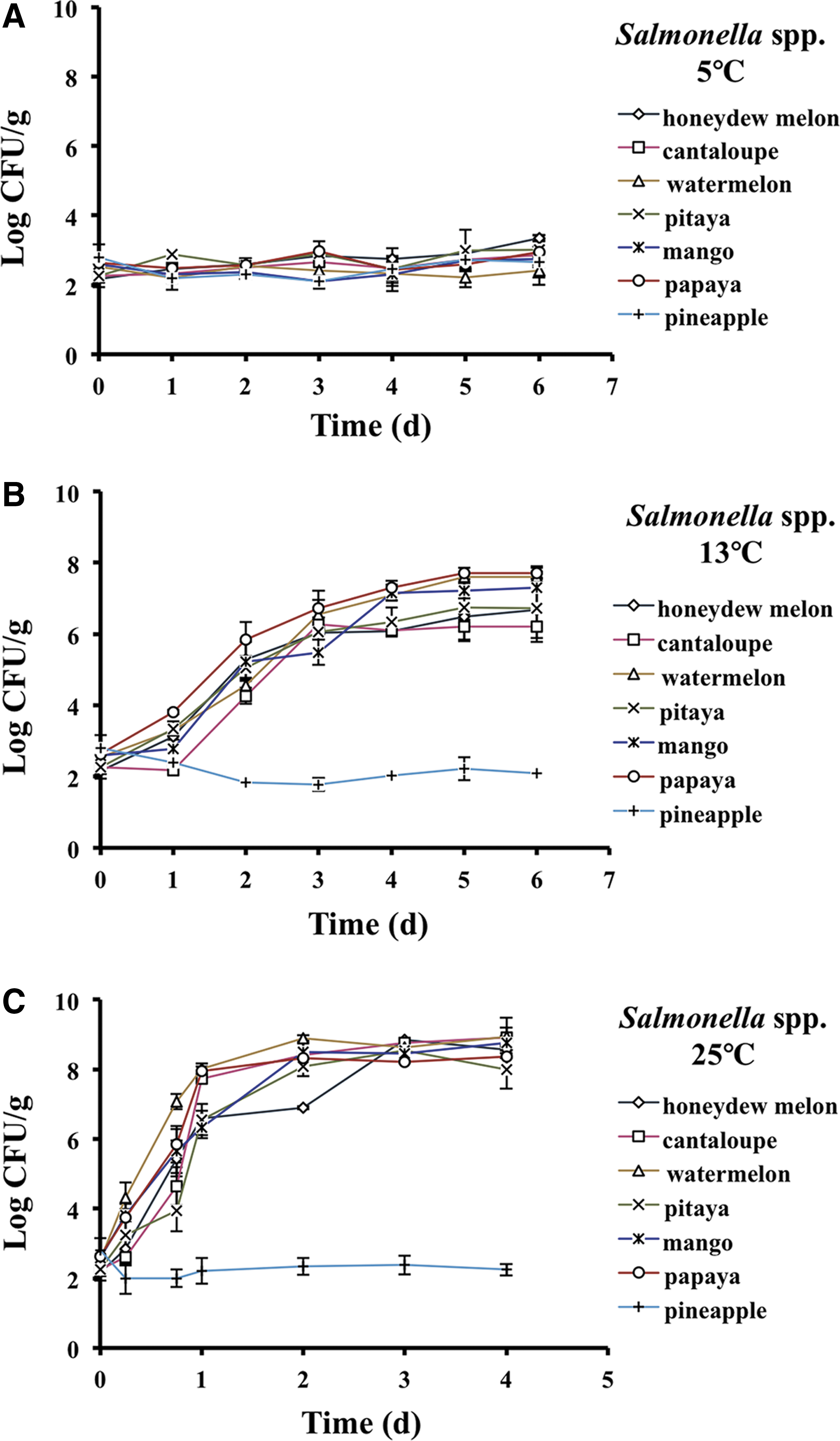
Growth of Salmonella spp. inoculated onto seven types of fresh-cut fruits
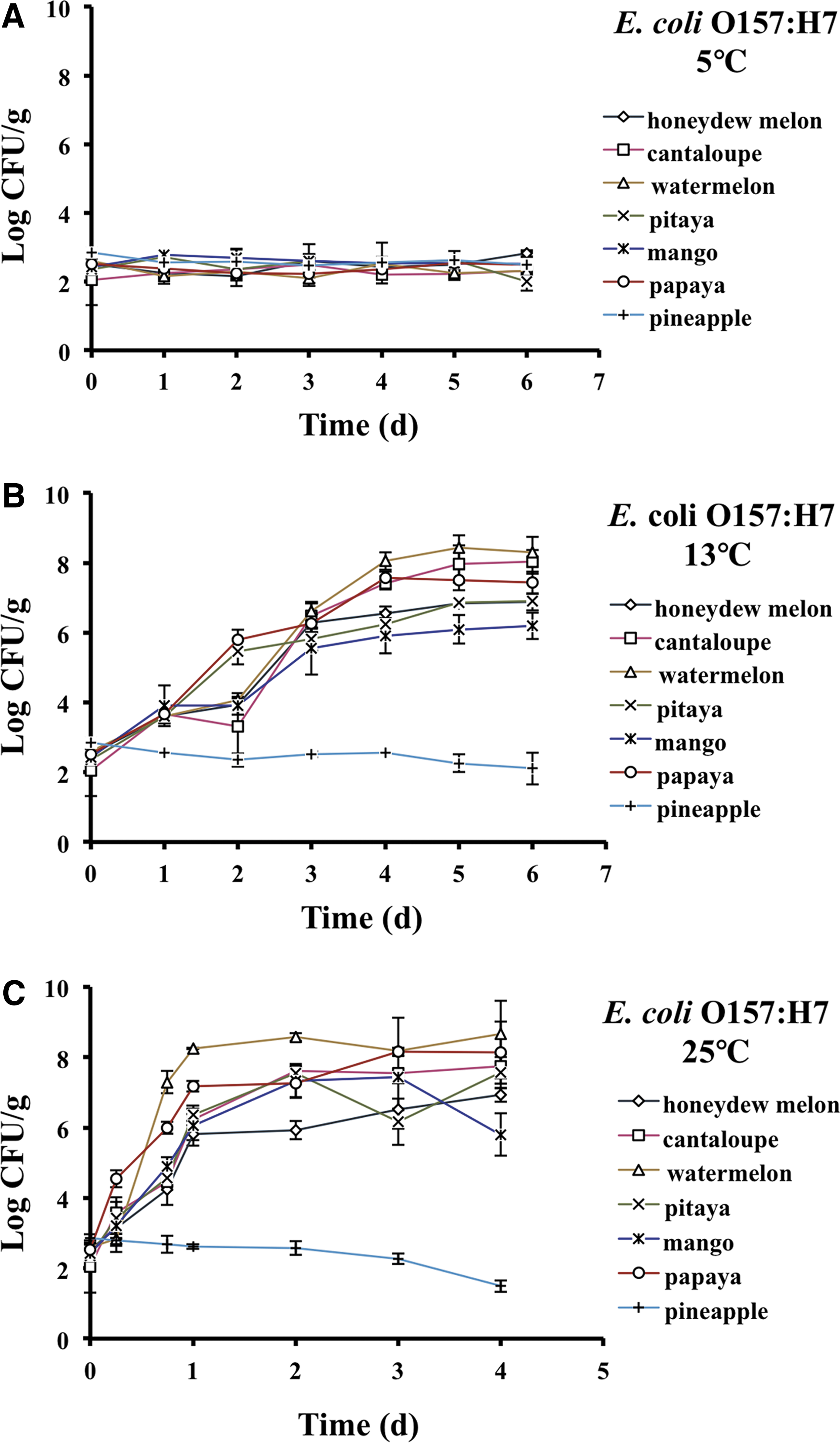
Growth of Escherichia coli O157:H7 inoculated onto seven types of fresh-cut fruits
The growth potential of Salmonella spp. and E. coli O157:H7 was investigated at 13°C over 6 days (Figs. 1B and 2B). Salmonella spp. populations increased significantly (p ≤ 0.05) from 2.1 to 6.6 log CFU/g on fresh-cut honeydew melon, 2.2 to 6.2 log CFU/g on cantaloupe, 2.5 to 7.6 log CFU/g on watermelon, 2.2 to 6.7 log CFU/g on pitaya, 2.5 to 7.3 log CFU/g on mango, and 2.6 to 7.7 log CFU/g on papaya on day 6 at 13°C (Fig. 1B). The population of this pathogen reached >7.0 log CFU/g and increased with increasing storage time on all fresh-cut fruits studied except for pineapple, on which its growth was inhibited and declined from 2.7 log CFU/g to 2.0 log CFU/g after 6 days.
For E. coli O157:H7, populations on fresh-cut fruits increased significantly at a temperature of 13°C after 6 days (Fig. 2B), and growth was most rapid on pitaya and papaya after 1 day. E. coli O157:H7 reached a population density of ∼8.0 log CFU/g on watermelon and cantaloupe, and growth increased with increasing storage time, but again, growth was inhibited on fresh-cut pineapple, on which the density was only 2.1 log CFU/g at 13°C.
At 25°C, the Salmonella spp. population density reached ∼8.0 log CFU/g on fresh-cut honeydew melon, cantaloupe, watermelon, pitaya, mango, and papaya, and growth was highest on cantaloupe, watermelon, and papaya after 1 day (Fig. 1C). However, the growth of Salmonella spp. appeared to decline on fresh-cut pineapple stored at 25°C. The highest growth potential values for E. coli O157:H7 were observed at 25°C on fresh-cut watermelon (δ = 6.1 log CFU/g), followed by papaya (δ = 5.6 log CFU/g), cantaloupe (δ = 5.7 log CFU/g), honeydew melon (δ = 4.4 log CFU/g), pitaya (δ = 5.2 log CFU/g), mango (δ = 3.4 log CFU/g), and pineapple (δ = −1.4 log CFU/g).
Effect of temperature on the growth of naturally occurring microbiota
The growth of naturally occurring microbiota on fresh-cut fruits was investigated in samples stored at 5°C, 13°C, and 25°C (Fig. 3) (Feng et al., 2015). Populations of naturally occurring microbiota species remained stable during storage at 5°C on fresh-cut honeydew melon, cantaloupe, watermelon, and pineapple, but decreased slightly on pitaya and papaya, and increased significantly on mango (p ≤ 0.05) after 4 days to reach a maximum population density of ∼5 log CFU/g. At 13°C, naturally occurring microbiota species population increased over time on fresh-cut pineapple, honeydew melon, watermelon, and mango. However, on fresh-cut cantaloupe, pitaya, and papaya, populations initially declined slightly, but then increased, and reached a stable state after 6 days. The growth potential of population reached 3.1 log CFU/g on fresh-cut honeydew melon, 2.6 log CFU/g on cantaloupe, 4.7 log CFU/g on watermelon, 2.8 log CFU/g on pitaya, 5.3 log CFU/g on mango, 2.5 log CFU/g on papaya, and 2.7 log CFU/g on pineapple after 4 days at 25°C.

Growth of naturally occurring microbiota species inoculated onto seven types of fresh-cut fruits
Discussion
The survival of a pathogenic microorganism on produce is dependent on its metabolic capabilities, which can be greatly influenced by intrinsic and extrinsic environmental factors (Beuchat, 2002). Intrinsic factors affecting fresh-cut fruits may affect the growth of pathogens such as Salmonella spp. and E. coli O157:H7. In the present study, the soluble solid content and Aw value showed that all seven types of fruits studied could provide adequate nutrition to support the growth of both pathogens (Table 1). The average pH of fresh-cut pitaya, mango, papaya, honeydew melon, cantaloupe, and watermelon was >4, which is too high to inhibit their growth. By contrast, the pH of fresh-cut pineapple was <4, which is more acidic and typical of a low acid fruit, and both pathogens grew less rapidly on this fruit as a consequence. The report found that Salmonella enteritidis required a minimum pH of 4.37, a water activity of 0.98%, and a temperature >17.5°C (Lanciotti et al., 2001) to support growth, whereas E. coli O157:H7 required a minimum pH of 3.8 and a temperature of 37°C (Haberbeck et al., 2015). In the present study, when the pH was above the minimal required to support growth of the pathogen, a correlation between the pH and growth potential (δ) was not observed for mango, papaya, pitaya, watermelon, honeydew melon, or cantaloupe. The results also showed that the high acidity and nutritional composition of fresh-cut pineapple act as a barrier against pathogen growth (Figs. 1 and 2).
Storage temperature is an extrinsic factor that can play a significant role on the growth of microorganisms on fresh-cut fruits (Capozzi et al., 2009). A lower temperature (5°C) suppressed the growth of both pathogens, consistent with ≤5°C as the lower limit required to support the growth of these organisms reported previously by the U.S. Food and Drug Administration in 1999.
Storage of fresh-cut fruits at inappropriate temperatures occurs often at food stalls and in shops, and this can accelerate the growth of foodborne pathogens such as Salmonella spp. and E. coli O157:H7. Exposure of fresh-cut fruits to temperatures of 13°C and 25°C significantly stimulated the growth of Salmonella spp. and E. coli O157:H7 in the present study. These results are consistent with a previous study in which Salmonella spp. on fresh-cut watermelon and papaya reached a population density of ∼8 log CFU/g after 2 days at 20°C and 20 h at 30°C, respectively (Penteado and Leitão, 2004). Similarly, Salmonella spp. and E. coli O157:H7 on fresh-cut papaya maintained at 23°C reached a carrying capacity (maximum log CFU/g load on fruit sample) of 7.2 log CFU/g for all inoculum levels within 72 h (Strawn and Danyluk, 2010). Salmonella is known to be capable of significant growth on fresh-cut cantaloupe at various temperatures (Huang et al., 2015). Our results further demonstrate that the growth of pathogens may be accelerated by higher incubation temperature and growth more pronounced after a longer incubation period.
Intrinsic differences in the properties of fruits such as pH and shelf life may be important in this regard, and the growth potential of a given pathogen may be highly dependent on the type of fruit when incubated at higher temperatures of 13°C and 25°C. More acidic fruits such as papaya and pineapple appear to possess antibacterial properties, and inhibitory compounds found in pineapple are particularly effective against pathogens (Conner and Kotrola, 1995). Consistent with this, in the present study, the growth of Salmonella spp. and E. coli O157:H7 inoculated on fresh-cut pineapple was inhibited significantly at 13°C and 25°C compared with other fruits (Figs. 1 and 2). The antimicrobial activity of fresh-cut pineapple has been associated with citric acid, which inhibits pathogen growth (Abadias et al., 2012).
The effects of naturally occurring microbiota species on the growth of Salmonella spp. and E. coli O157:H7 on fresh-cut fruits were also investigated at different storage temperatures (Fig. 3). It indicated that the longer the time stored at room temperature, the higher the population density of naturally occurring microbiota at the end of the shelf life. At 25°C, the increment of population remained below 3.0 log CFU/g on fresh-cut cantaloupe, honeydew melon, pitaya, papaya, and pineapple. However, on fresh-cut mango, the natural microbiota increased from 2.6 to 7.9 log CFU/g with increasing incubation time. These changes are in agreement with previous reports showing an increase in the microbial population from 2 log CFU/g to 8 log CFU/g, depending on the type of fruit as well as other factors (Abadias et al., 2008; Caponigro et al., 2010). At 13°C, naturally occurring microbiota species increased slightly on fresh-cut mango, honeydew melon, and pineapple during their shelf life. Growth curves for cantaloupe, pitaya, papaya, and watermelon initially declined, then increased at this temperature. These changes in the natural microbiota are dependent on the type of fruit. In the present study, storage temperature had a significant influence on naturally occurring microbiota species populations on fresh-cut fruits, and the growth of pathogens and the natural microbiota were consistent at different storage temperatures. It demonstrated that the growth of pathogens on fresh-cut fruits was not only associated with the natural microbiota but also the type of fruit and storage temperature were even more important in determining pathogen growth (Oliveira et al., 2012).
Conclusions
Our results confirmed that these pathogens were able to grow and reach high population densities in several fresh-cut fruits. Honeydew melon, cantaloupe, watermelon, pitaya, mango, and papaya all served as good substrates for the growth of both pathogens. By contrast, fresh-cut pineapple did not support the growth of Salmonella spp. or E. coli O157:H7. Our results suggest that fresh-cut fruits should be stored below 5°C to ensure they are safe for human consumption. Hence, the growth of Salmonella spp. and E. coli O157:H7 should instead be controlled by ensuring that products are stored below 5°C to minimize pathogen contamination.
Footnotes
Acknowledgments
This study was supported by the Thirteenth Five-Year Plan for National Key Research and Development Program (Grant No. 2016YFD0400903), National Natural Science Foundation (Grant No. 31471923), and the Twelfth Five-Year Plan for National Science and Technology Support Program (Grant No. 2012BAD38B05).
Disclosure Statement
No competing financial interests exist.