




Abstract
In April–May 2014, an outbreak of campylobacteriosis occurred after a preschool visit to a dairy farm in the South Western part of Sweden. During the visit, a meal, including unpasteurized milk, was served. A retrospective cohort study using a web-based questionnaire was performed among the participants (n = 30) of the farm visit. A total of 24 of the 30 (80%) cohort members completed the questionnaire. Eleven cases were identified, and Campylobacter jejuni was isolated from eight of them. Seven of the cases were 2- to 7-year-old children. We found the highest attack rates among those who usually drink milk (45%) and those who consumed unpasteurized milk during the farm visit (42%). No cases were unexposed (risk ratio incalculable). As result of the farm investigation, Campylobacter was isolated from cattle on the farm. Genotyping with pulsed-field gel electrophoresis and whole genome sequencing confirmed that human and cattle isolates of C. jejuni belonged to one cluster. Thus, cattle on the farm are considered the source of infection, and the most likely vehicle of transmission was contaminated unpasteurized milk. We recommend consumption of heat-treated milk only and increased awareness of the risk of consuming unpasteurized milk.
Introduction
C
In Sweden, Campylobacter is the main causative agent for bacterial gastroenteritis with a yearly incidence of 82–93 reported cases/100,000 population (SVA, 2016). Of the notified cases, 40–50% are domestically acquired, and most cases are reported during the summer months (SVA, 2016).
Fecal shedding of Campylobacter is common among cattle, with dairy herd prevalences of more than 50% (Wesley et al., 2000; Besser et al., 2005; Guevremont et al., 2014; Rapp et al., 2014). Unpasteurized milk is a well-known vehicle for the transmission of pathogens, Campylobacter included (Oliver et al., 2009).
On May 5, 2014, a hospital in Västra Götaland and County informed the County Medical Officer (CMO) about a case of frequent bloody diarrhea in a preschool teacher with a symptom onset on May 1. Through the primary healthcare clinic, the CMO found out about another case with bloody diarrhea, a family member of a child attending the preschool. Both cases turned out to be positive for Campylobacter. Interviews with the cases revealed that the preschool group, together with some family members of the children, had been on a field trip to a dairy farm on April 28, 2014. The farm had ∼70 milking cows, 100 young cattle, and five horses. The only common link between the cases was the farm visit. Interviews with the preschool staff revealed further cases linked to the preschool-farm-visit. To assess the extent of the outbreak, identify the source to prevent further cases, and investigate the usefulness of whole genome sequencing (WGS) as a typing method, a joint outbreak investigation team was formed on May 13 with the CMO, the Public Health Agency of Sweden, the National Veterinary Institute (SVA), the National Food Agency, and the Swedish Board of Agriculture.
Materials and Methods
Epidemiological investigation
First, interviews were carried out with preschool staff and farm owners to map the events during the farm visit and identify persons with gastrointestinal symptoms and ask them to provide stool samples.
Second, we defined all participants of the farm visit on April 28, 2014 as a cohort. The cohort was identified by interviewing the preschool staff and farm owners. The cohort consisted of preschool staff, preschool children, relatives of preschool children, and farm employees (n = 30).
Suspected case
A cohort member with diarrhea (loose stool ≥three times per day) and/or bloody diarrhea, or at least two of the following: loose stool, abdominal pain, nausea, vomiting, or fever ≥1 day between 29 April and 8 May, 2014.
Confirmed case
A cohort member with a laboratory verified Campylobacter infection between 29 April and 8 May, 2014.
Noncase
A cohort member that did not meet the criteria for suspected or confirmed case or a suspect case, tested for Campylobacter but with a negative result.
We asked the cohort members to complete a web-based questionnaire. Parents were asked to answer on behalf of their children.
The questionnaire included questions about travel history, clinical symptoms, date of symptom onset, food and beverages consumed during the farm visit (unpasteurized milk served from plastic cups, hot dogs, and sweet buns), contact with the animals, and hand washing. As we suspected that parents not accompanying their children to the farm visit may lack information on several of the exposures, we also asked about habits regarding milk and hot dog consumption to use these as a proxy for actual consumption during the farm visit. To those who indicated symptoms, we additionally asked if they had visited a healthcare provider, provided a fecal sample, and if household members had presented similar symptoms.
We identified confirmed cases in the cohort using laboratory diagnosis reported in the Swedish electronic surveillance system of notifiable human diseases (SmiNet). Due to data protection issues, the personal identification number was not collected in the questionnaire; thus birth year and the four last digits in the personal identification number were used for linkage.
Data analysis
We described the cohort in terms of risk exposures at the farm and demographic characteristics by case status. We calculated the attack rates (AR) among exposed and unexposed cohort members and compared them by calculating the relative risk (RR) with 95% confidence intervals.
Farm investigation
The District Veterinary Officer conducted an investigation at the farm on 22 May, 2014 and collected samples from cattle feces through boot sock samples (n = 4) and fecal pat samples (n = 3). Boot sock samples were put into a plastic bag with 30 mL of Cary Blair transport medium (Difco Becton Dickinson and Merck) (Hansson et al., 2007; Widgren et al., 2013). Samples from milk tank filters (n = 2) were collected after milking by the farmer at two points in time, on 22 May and on 9 June, 2014, 3 and 6 weeks after the preschool visit. The milk filters were placed in a plastic bag together with Cary Blair transport medium and sent together with the animal samples to the SVA (Uppsala, Sweden) for analysis. The well water was sampled by the farmer using a filter with a throughput of 60 L of water. In addition, an ordinary 500 mL water sample was taken. The water samples were sent to the National Food Agency (Uppsala, Sweden) for analysis.
Microbiological investigations
Samples from humans
Stool samples were analyzed at the clinical microbiological laboratory in Borås using standard microbiological methods for the presence of Campylobacter, Salmonella, Shigella, VTEC, and Yersinia. For Campylobacter, fecal samples were plated onto a modified charcoal-cefoperazone-deoxycholate agar (mCCDA; Oxoid), incubated at 40–42°C for 44 ± 4 h in a microaerophilic atmosphere created using the Anoxomat system (Anoxomat™; Mart Microbiology). Suspected colonies were confirmed phenotypically as Campylobacter spp. by testing for oxidase production and detecting a typical appearance under the microscope. Confirmed isolates were sent to the SVA for further typing.
Farm samples
At the SVA, sock samples, fecal pat samples, and milk filters were analyzed using enrichment. Briefly, 1 g of the fecal sample was added into 9 mL of Bolton broth (Oxoid) and further incubated in a microaerobic atmosphere using the Anoxomat system at 37°C for 4–6 h, then at 41.5°C for 24 and 44 ± 4 h with a subsequent culture on Preston agar (Oxoid) and mCCDA plates (Oxoid). Sock samples and milk filter samples were analyzed as above, but by adding 90 mL of the enrichment broth. The plates were incubated at 41.5°C in a microaerobic atmosphere according to ISO 10272: part 1 (2006). In addition, fecal pat samples were analyzed by direct culture on mCCDA and Preston agars and incubated at 41.5°C in a microaerobic atmosphere as described above.
Subtyping
Pulsed-field gel electrophoresis (PFGE) and WGS were used to examine and compare the genetic profiles of the C. jejuni isolates from human cases, sock samples, and fecal pat samples. WGS was performed on C. jejuni isolates from outbreak cases, as well as from an unrelated case and cattle isolates closely related in the PFGE.
Pulsed-field gel electrophoresis
PFGE was performed in accordance with a standardized protocol, Campynet 1 . Genomic DNA was digested with SmaI, and fragments were separated by PFGE in a CHEF-DRII apparatus (Bio-Rad Laboratories). Computer-assisted identification with BioNumerics 7.6.1 (Applied Maths) was used to analyze PFGE banding patterns.
Whole genome sequencing
Sequencing libraries were prepared using the Nextera XT Kit (Illumina), and 75 bp paired-end sequencing was performed on a MiSeq sequencer (Illumina). A coverage of 90 × was used for the assembly, and the reads were assembled using the SPAdes v. 3.1.1 assembler with the “—careful” option (Bankevich et al., 2012). The phylogenetic relationships between the genomes were determined using the SeqSphere+ v2.3 software (Ridom GmbH), which is a whole genome multilocus sequence typing (MLST) or core genome MLST (cgMLST) analysis software. To define the target gene set for cgMLST, the MLST+ target definer function of SeqSphere+ was used with default parameters. As reference for the MLST+ target definer, the C. jejuni RM1221 genome (NCBI accession NC_003912) was used. Multiple copy genes and other genes not suitable for MLST were filtered away by the software using default settings. This scheme created consisted of 1271 genes used for the query of the sequenced isolates. Truncated and missing genes from each isolate were discarded in the final comparison of all isolates. The allelic differences are therefore based on the shared core genome of the current set of isolates. A minimum spanning tree was created in SeqSphere+ based on the determined allelic differences between the genomes.
Results
Epidemiological investigation
Out of 30 individuals asked to complete the cohort study questionnaire, 24 replied (80%). Among these, nine met the criteria for suspected case (AR = 38%) of which six provided a stool sample and were laboratory confirmed (confirmed cases). Two additional confirmed cases were identified in SmiNet, but they did not respond to the cohort study questionnaire and could not be included in the analysis. Seven of the nine suspected cases were children between ages 2 and 7 years (median: 6, range: 2–60 years). Five were female. The cases started showing symptoms between 30 April and 7 May (Fig. 1).Of the nine suspected and confirmed cases, eight had diarrhea (three with bloody stools), seven had fever, six had abdominal pain, and three had been vomiting. None of the farm employees developed illness.
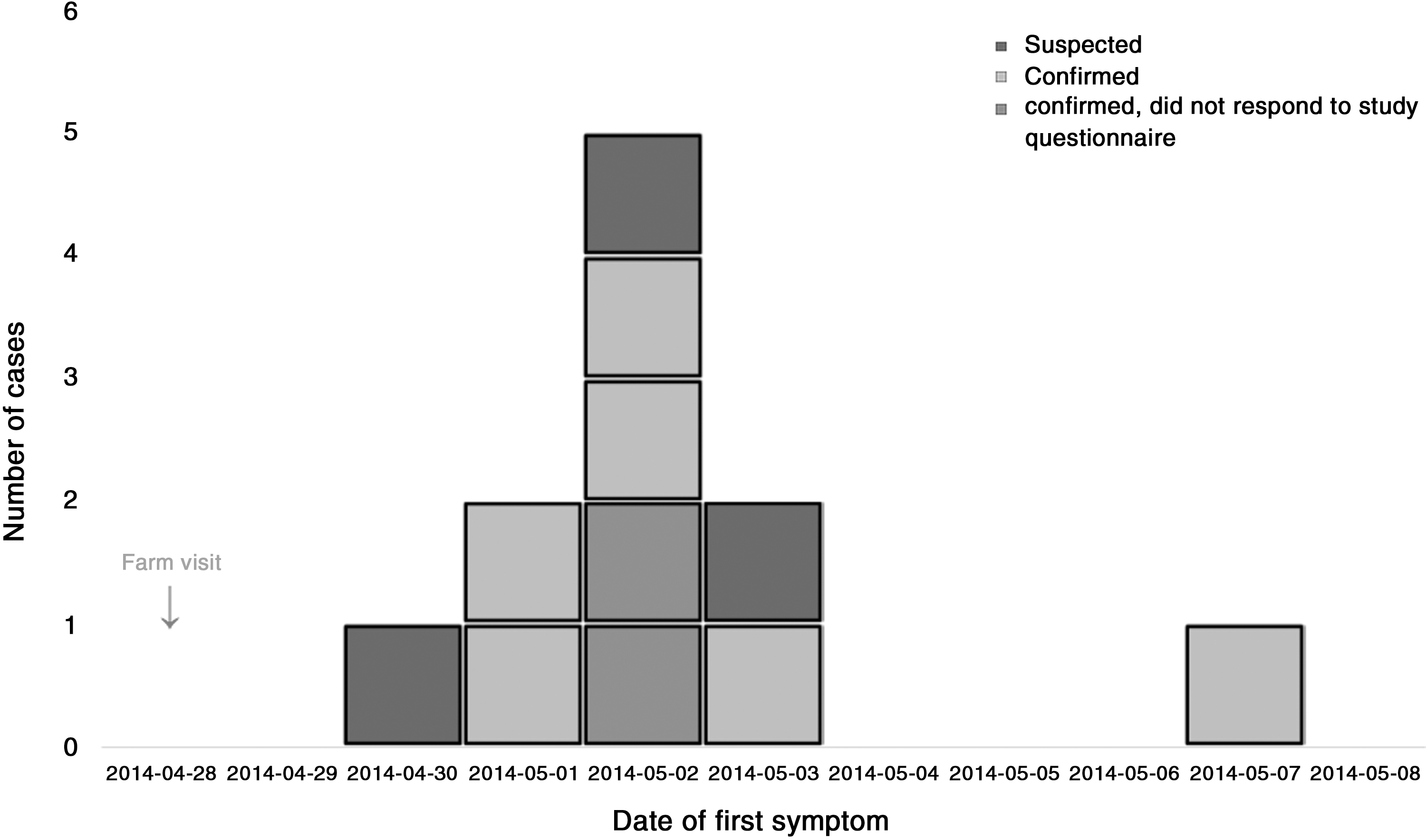
Date of symptom onset of suspected and confirmed cases of campylobacteriosis among persons participating in the farm visit (n = 11), Västra Götaland, April–May 2014.
We found the highest AR among those who usually drink milk (AR 45%) and those who consumed unpasteurized milk during the farm visit (42%) (Table 1). All cases for whom information was available were exposed to unpasteurized milk and reported to usually drink milk (RR incalculable). Approximately 2.5 L of unpasteurized milk was consumed during the farm visit. We found no statistically significant associations between risk exposures during the farm visit and being a suspected or confirmed case of campylobacteriosis.
AR, attack rates; RR, risk ratio; CI, confidence intervals.
Farm investigation
C. jejuni was detected from four of seven animal samples: from one sock sample and all three fecal pat samples. These isolates were detected using enrichment and subsequent culture on mCCDA (isolate 39909), or using direct culture on Preston agar (isolate 39914), or both with enrichment and direct culture on mCCDA and Preston (39915-1, 39915-2, 39915-3, 39915-4, 39916-1, 39916-2, 39916-3, 39916-4). In addition, C. hyointestinalis was detected from two sock samples and one pat sample. Campylobacter could not be isolated from the milk filter samples. The water specimen contained enterococci (2/100 mL), but no Campylobacter, coliform bacteria, or Escherichia coli were identified.
Microbiological investigation
Eight cases tested positive for Campylobacter. None of the cases were positive for Salmonella, Shigella, VTEC, or Yersinia. Six isolates from the outbreak cases and ten cattle isolates of C. jejuni were available for confirmation and typing. The six human isolates and three cattle isolates (39915-2, 39915-3, 39916-2) had indistinguishable PFGE profiles (Fig. 2). Isolates with indistinguishable profiles or profiles of one band difference (39915-1, 39915-2, 39916-1) were sequenced, as well as an earlier unrelated isolate of a human case (34). All the outbreak case isolates and two of the cattle isolates (39915-2, 39915-3) from one fecal pat sample were of MLST type ST 21 and belonged to the same WGS cluster with no or one allelic difference (Fig. 3). Two cattle isolates (39915-1, 39916-1) were of ST 53 (ST-CC 21) and the unrelated case isolate (34) was of MLST type ST 61.
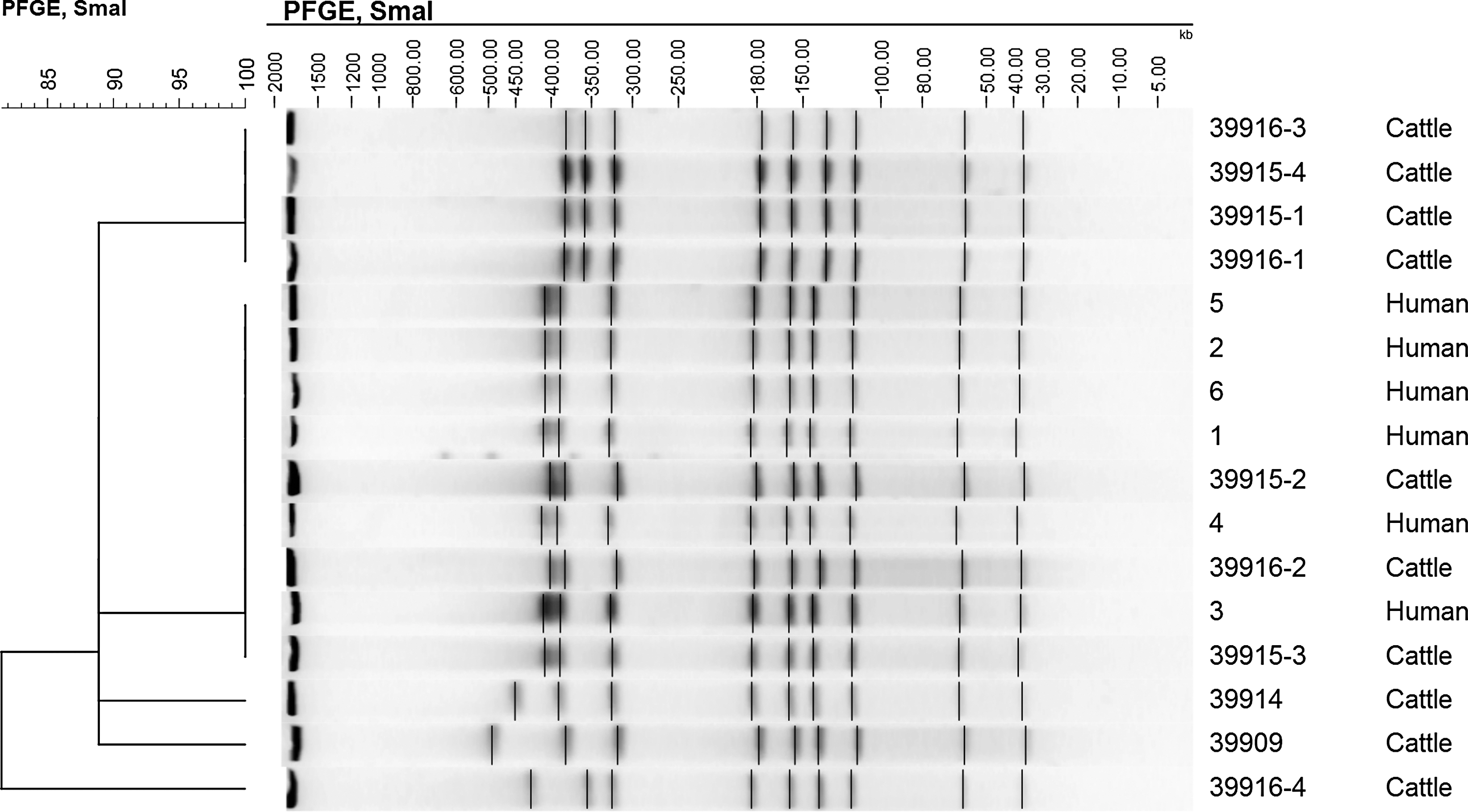
Pulsed-field gel electrophoresis (PFGE) profiles of Campylobacter jejuni isolates from humans (2, 3, 4, 5, 6, 7) and cattle (39909, 39914, 39915-1, 39915-2, 39915-3, 39915-4, 39916-1, 39916-2, 39916-3, 39916-4).
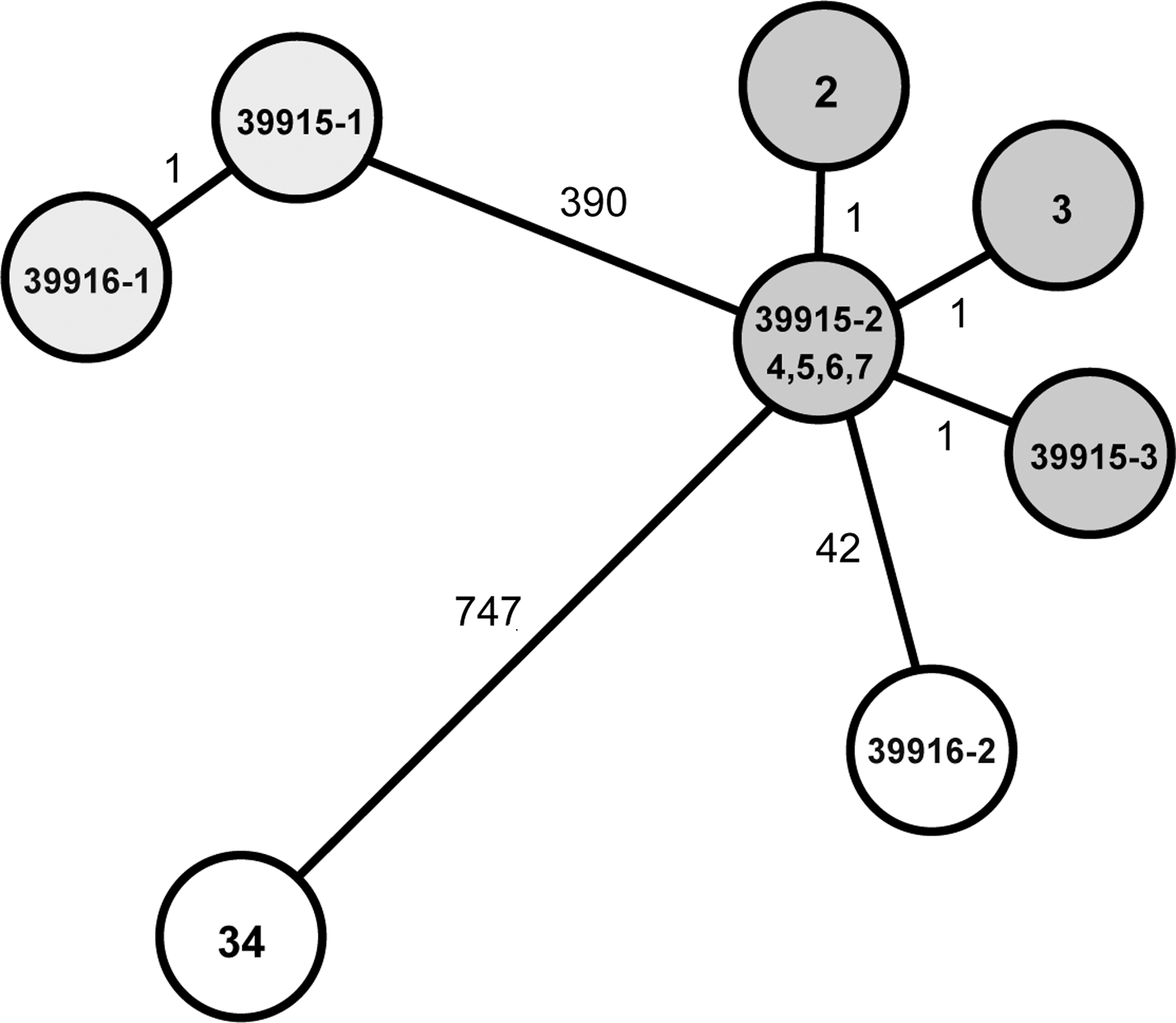
Minimum spanning tree showing the whole-genome core multilocus sequence typing analysis of Campylobacter jejuni isolates from outbreak cases (2, 3, 4, 5, 6, 7) and an unrelated case (34), as well as cattle (39915-1, 39915-2, 39915-3, 39916-1, 39916-2). The numbers between isolates represent the allelic differences between the isolates. The lengths of the lines are not proportional to the numbers.
Discussion
The investigation strongly suggests that the cases were infected by a common source and that cattle on the farm were the source of infection. Although Campylobacter was not detected in the milk tank filter, several factors suggest that the vehicle of infection was contaminated unpasteurized milk. First, among the exposures examined in this investigation, consumption of unpasteurized milk was the only one explaining all symptomatic cases and none of the unexposed cohort members became ill. Second, having petted cattle was rare among symptomatic cases according to adult cases and parents reporting for their children. In addition, an overall attack rate of almost 40% and the identical results from WGS and PFGE among cases suggest that this was a point source outbreak. Third, unpasteurized milk is a biologically plausible vehicle, having been identified as a vehicle for Campylobacter in previous outbreaks (Fahey et al., 1995; Heuvelink et al., 2009; Castrodale et al., 2013; CDC, 2013).
This investigation had several challenges. As most cases were small children without an accompanying relative, it was difficult to collect information about exposures. Most parents were able to provide information about what had been consumed and activities at the farm, probably by asking the child itself or one of the preschool teachers. However, the validity of behavioral exposures (e.g., petting animals) may be questionable since accompanying adults are unlikely to register or remember who did what.
Unpasteurized milk consumption was a common exposure among both sick and healthy cohort members. Only four cohort members did not drink milk during the farm visit and none of them were ill. Asymptomatic Campylobacter infections are not common, but do occur (Ang et al., 2011) and might be linked to the number of bacteria ingested or an uneven distribution of the pathogen in the food consumed. We made an attempt to investigate the quantities of consumed milk, but we found no dose–response relationship (data not shown). Overall, the small size of the outbreak and high proportion of exposed healthy cohort members resulted in weak statistical evidence of association.
Isolates from the cases, as well as two cattle isolates from the farm, belonged to the same cluster which strengthens the evidence of association. These isolates were similar or with a one-locus difference. A value of 20 locus differences has been suggested as a cutoff value for investigations of potential clusters (Cody et al., 2013). Single PFGE subtypes are typically reported in point-source outbreaks of Campylobacter (Longenberger et al., 2013), as was the case in the current outbreak.
Despite the fact that the environmental investigation took place 3 weeks after the outbreak occurred, it was possible to identify a microbiological link using a combination of culture methods and genotyping. A combination of culture methods was used to increase the sensitivity of detection, as well as the sensitivity to obtain different genotypes. PFGE typing has been commonly used in investigations of Campylobacter outbreaks, but WGS has so far seldom been applied (Revez et al., 2014). The results of WGS confirmed the PFGE results and provided a valuable tool for supporting the evidence in this outbreak.
Raw milk can be contaminated with Campylobacter in different ways. Campylobacter is ubiquitous in the farm environment (Humphrey and Beckett, 1987). Contamination can occur with fecal material during milking process or with poorly cleaned milking equipment or with wild bird droppings (Schildt et al., 2006). In some previously reported investigations of Campylobacter outbreaks where epidemiological evidence suggested consumption of unpasteurized milk as the source, the bacterium could not be detected from milk tanks or milk tank filters either (Fahey et al., 1995; Heuvelink et al., 2009). Thus, it was not unexpected that Campylobacter could not be isolated from the milk filter samples taken in this investigation. However, in a Swedish study on pathogens in unpasteurized milk, Campylobacter was detected in 10% of 74 milk filters investigated (personal communication SVA). In studies from other countries, Campylobacter has been detected from 2% (Jayarao et al., 2006), 9% (Jayarao and Henning, 2001), and 12% (Bianchini et al., 2014) of the bulk tank milk samples tested.
An increasing number of outbreaks associated with unpasteurized milk has been reported in other countries (Mungai et al., 2015) most likely as a result of the increased demand for raw milk. Consumption of raw milk is linked not only to infection with Campylobacter but also other foodborne pathogens (Oliver et al., 2009). However, although the risks with consumption of raw milk are well documented, interviews with the farmer and preschool staff revealed that they were unaware of the risk linked to consumption of unpasteurized milk, suggesting that there is still a need for targeted information campaigns. To ensure the safety of individuals drinking milk, milk needs to be heat treated. Furthermore, inclusion of hygiene theory in the preschool teacher education program, as well as information campaigns targeting lay people and particularly dairy producers about the risk of unpasteurized milk consumption, should be implemented.
Conclusions
This report describes an outbreak of campylobacteriosis after a preschool visit to a dairy farm. The epidemiological and microbiological evidence in the outbreak investigation showed that cattle on the farm were the source of the outbreak and unpasteurized milk the most likely vehicle. Genotyping proved to be a suitable tool for verification. To prevent human illness, consumption of heat-treated milk and increased awareness of the risk of consuming unpasteurized milk are needed.
Footnotes
Acknowledgments
The authors thank the outbreak investigation team and the farmer for their excellent cooperation. Our special gratitude goes to Borås Clinical Microbiological Laboratory for analyzing the human samples, to Rickard Dryselius at the National Food Agency for analyzing the water samples, and to Boel Harbom at the National Veterinary Institute for confirming and typing the isolates.
Disclosure Statement
No competing financial interests exist.